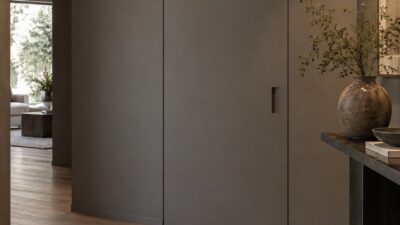
There’s a version of LVT flooring that looks cheap. You’ve definitely seen it — the grain repeats too neatly, the colour lands in that awkward in-between where it’s neither warm nor cool, and somehow the whole floor feels slightly off. A little too perfect. A little too flat. Once you notice the repeating pattern every metre or so, you can’t stop seeing it.
- Why LVT Has Become the Serious Designer’s Practical Choice
- Format and Scale: The Decisions That Change the Room
- Colour and Tone: Reading a Dubai Interior Before You Choose
- The Wear Layer: Why Specification Matters More Than Price
- Installation: The Decisions That Affect the Final Look
- Where LVT Fits in the Dubai Home Room by Room
- FAQ: LVT Flooring in Dubai
- Is LVT flooring suitable for Dubai's climate?
- What is the difference between LVT and regular vinyl flooring?
- Can LVT flooring be installed over existing tiles in Dubai?
- What LVT formats work best in open-plan Dubai apartments?
- How do I match LVT tone with Dubai interior design palettes?
- Is LVT flooring comfortable to walk on in a Dubai home?
- How long does LVT flooring last in a Dubai home?
That version did real damage to LVT’s reputation.
Then there’s the other kind.
I’ve stood in apartments in Dubai Marina convinced I was looking at engineered oak. Wide planks, natural warmth, enough variation that it didn’t read fake for even a second. One place in particular had this soft European oak look that felt expensive without trying too hard. I asked what flooring they used.
LVT.
Honestly, that surprised me.
The difference between those two outcomes usually comes down to product choice and installation. Cheap LVT tends to expose itself quickly. The grain looks copied and pasted. The finish catches light in an odd way. Sometimes the boards are too short, which somehow makes the whole room feel smaller. Good LVT gets those details right, and suddenly nobody’s questioning what they’re standing on.
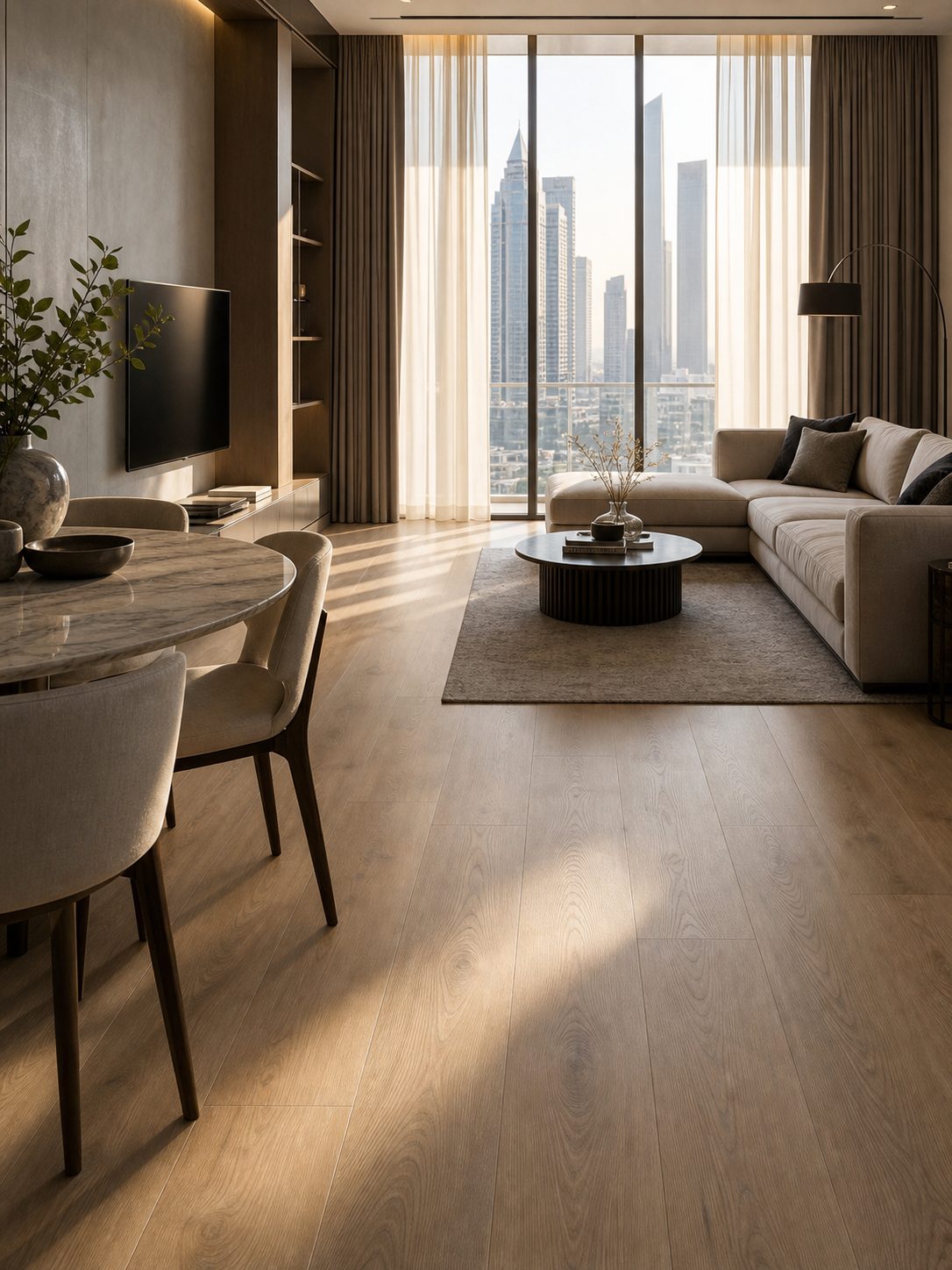
And for Dubai homes, there’s a reason people keep coming back to it. Real timber looks beautiful, but heat, humidity, constant air conditioning — it can be fussy. LVT is easier to live with. Less drama, fewer maintenance worries.
This guide is about choosing the version that actually works. The kind that feels considered, not like a compromise. Where LVT performs best in a Dubai home, what details separate good products from forgettable ones, and how to make the floor feel like it belongs in the space rather than something chosen at the last minute.
Why LVT Has Become the Serious Designer’s Practical Choice
Ten years ago LVT was mostly a commercial product — hotels, healthcare, retail. The print quality wasn’t convincing enough at close range for residential use and the wear layer thickness made it feel thin underfoot. That has changed substantially. Current residential LVT uses high-resolution digital printing that captures the grain variation, knots, colour shifts, and surface texture of natural timber or stone with significantly more fidelity than earlier generations.
For Dubai specifically, LVT solves a set of problems that natural materials don’t handle as well. Solid hardwood is hygroscopic — it absorbs and releases moisture, expanding and contracting with the humidity swings between interior air conditioning and outdoor air. In Dubai’s climate that cycling is significant, and solid timber floors in apartments without careful humidity management show gapping and movement over time. Engineered timber handles this better, but still requires more controlled conditions than LVT, which is dimensionally stable across the temperature and humidity range typical of a Dubai interior.
The design case is different from the practical case, though. LVT flooring in Dubai projects that work well do so because the designer or homeowner made deliberate choices about format, tone, and installation pattern — the same decisions they’d make with any other floor finish. The material’s practical advantages are the reason to consider it. The design decisions are the reason it ends up looking right.
Format and Scale: The Decisions That Change the Room
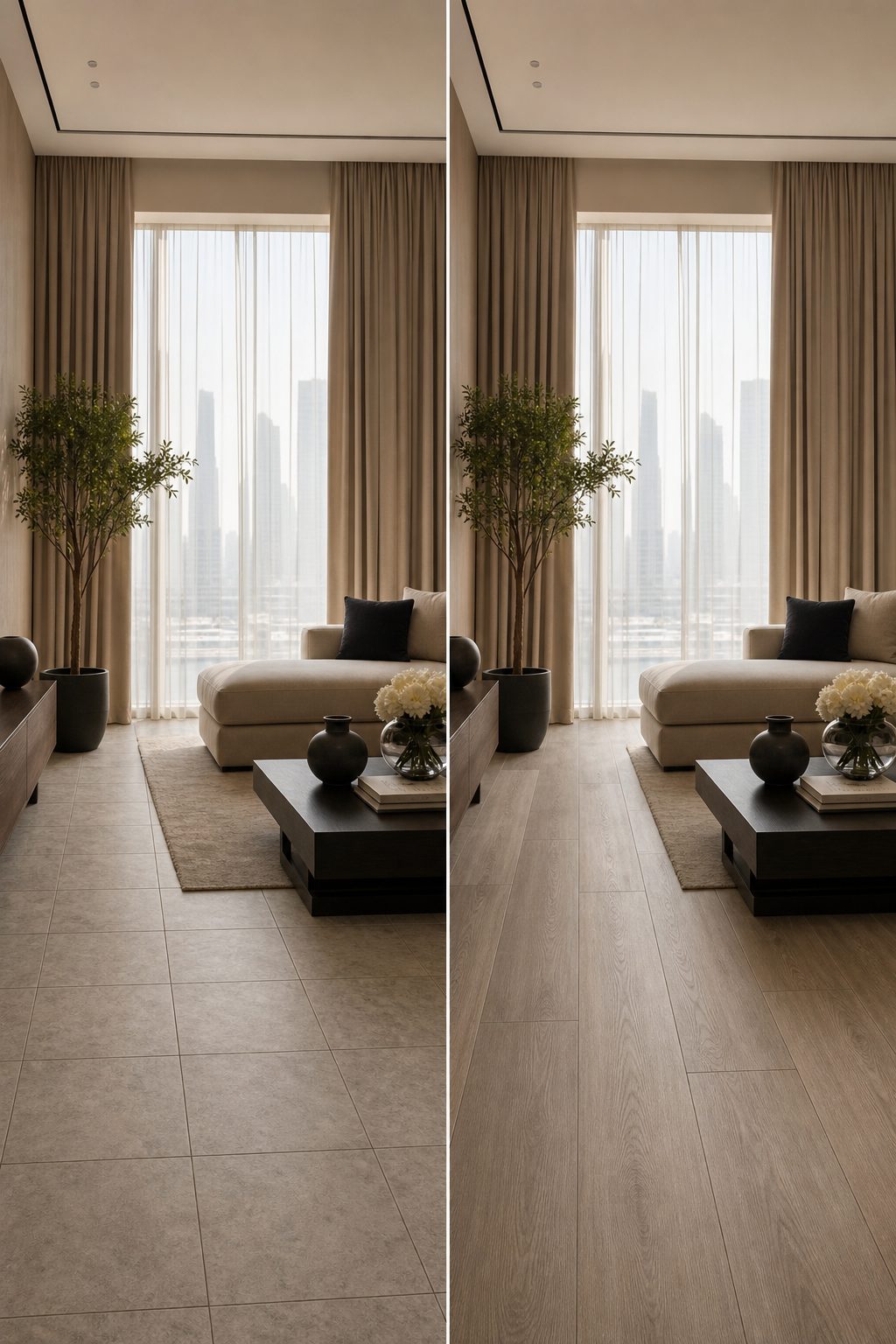
Format is the most impactful design decision in LVT selection and the one most often defaulted to without thought. The plank width, length, and whether you choose a wood-look or stone-look format determines how the floor reads across the room more than the colour does.
Plank length and width
In Dubai’s apartments and villas, which tend toward generous proportions and open-plan layouts, large-format planks work consistently better than shorter ones. A 220cm or longer plank running in the longest dimension of the space creates a calmer, more continuous surface with fewer end joints interrupting the eye. Shorter planks — anything under 120cm — start to read as busy in a large open-plan room.
Width follows the same logic. Narrow planks in the 10–14cm range suit smaller spaces and more traditional aesthetics. Wide planks from 22cm upward suit the scale of contemporary Dubai interiors and also tend to show more realistic grain variation because each board has more surface area for the print to work across.
Stone-look versus wood-look
Dubai’s residential design language is heavily influenced by natural stone — travertine, marble, and limestone are common in higher-end developments. Large-format LVT in a stone-look finish, particularly in cream, warm grey, or sandy beige, integrates with that aesthetic more seamlessly than timber in some rooms. For bathrooms and kitchen areas where stone reads naturally, a stone-format LVT tile with realistic surface texture and colour variation is often more convincing than timber.
For living rooms, bedrooms, and hallways, timber-look LVT tends to add warmth that stone-look formats don’t. The choice depends on whether the room needs to feel warmer or cooler, and whether the surrounding palette leans toward the organic warmth of timber or the mineral cool of stone.
Herringbone and parquet patterns
LVT’s click-lock installation system has made herringbone and other parquet patterns accessible without the cost or complexity of real parquet. A herringbone LVT floor in a hallway or bedroom adds significant design quality for a modest additional cost over straight-lay. The installation takes more time and generates more material waste, but the visual result is genuinely different from a standard straight-lay floor.
In Dubai interiors, herringbone LVT in a warm mid-tone blonde or sandy oak reads particularly well against the white or off-white walls that dominate residential design there. It adds the kind of considered detail that lifts a room from functional to designed.
Colour and Tone: Reading a Dubai Interior Before You Choose
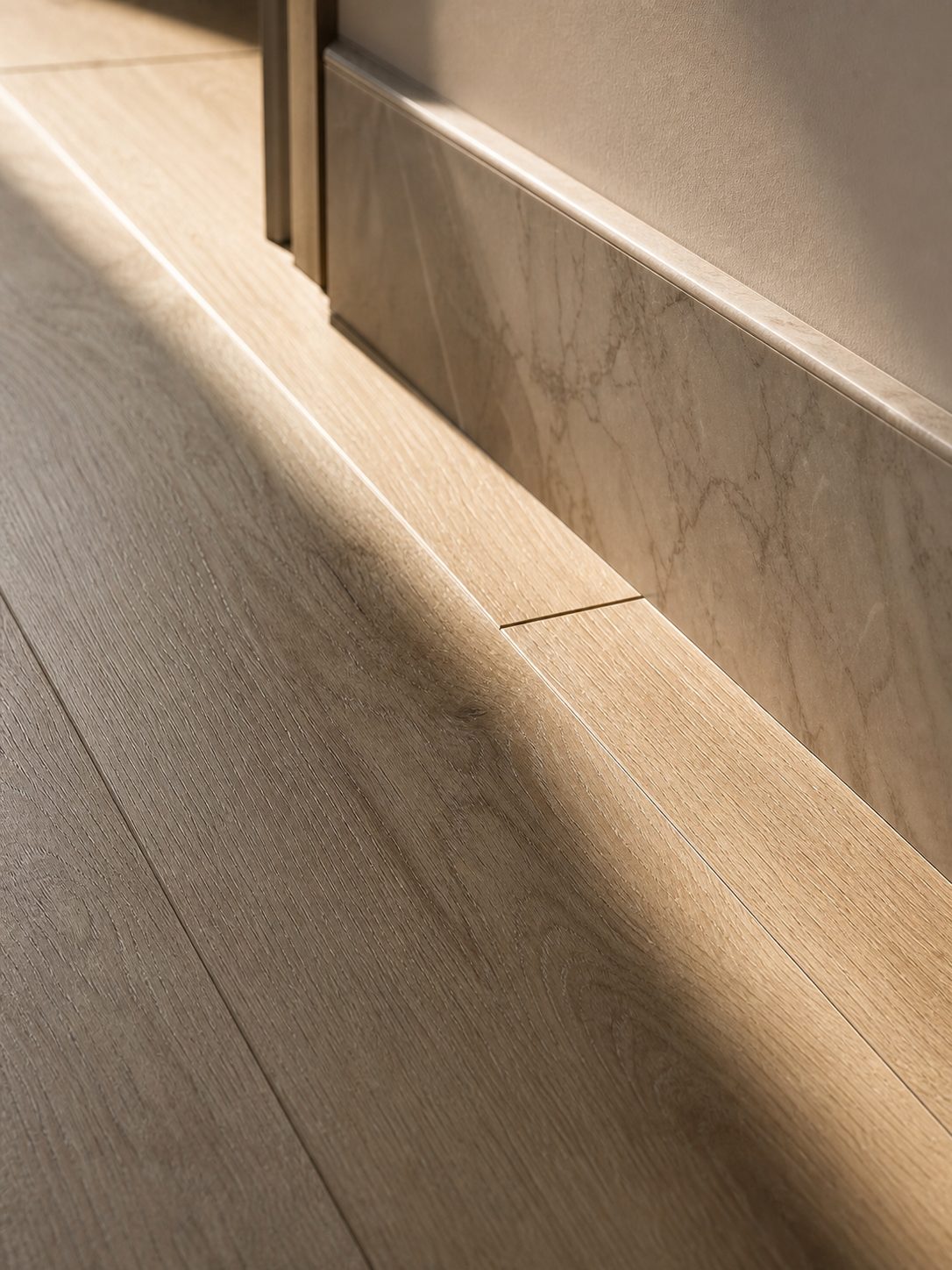
The dominant residential interior palette in Dubai runs warm and neutral: cream and off-white walls, beige and greige upholstery, natural stone in travertine or cream marble, warm timber accents in furniture and joinery. A floor needs to work within that palette rather than compete with it.
Warm mid-tone LVT — sandy oak, blonde ash, greige wood — integrates most naturally into the standard Dubai interior palette. These tones complement the cream stone, warm white walls, and the warm ambient light that characterises many Dubai interiors in the evening. They read as neutral enough to not impose on the room while still adding warmth that a cool grey or near-black floor wouldn’t.
For more contemporary schemes with a cooler palette — grey upholstery, darker joinery, white and black accents — a cool ash or light grey-toned plank creates better visual contrast. The floor becomes part of the colour composition rather than a warm neutral backdrop.
Dark floors are worth approaching carefully in Dubai. In rooms with strong natural light they look rich and intentional. In rooms that rely on artificial light — interior bedrooms, bathrooms, internal corridors — a dark floor compresses the space visually and makes the room feel smaller than it is. In those situations a mid-tone or lighter plank is almost always the better choice.
The Wear Layer: Why Specification Matters More Than Price
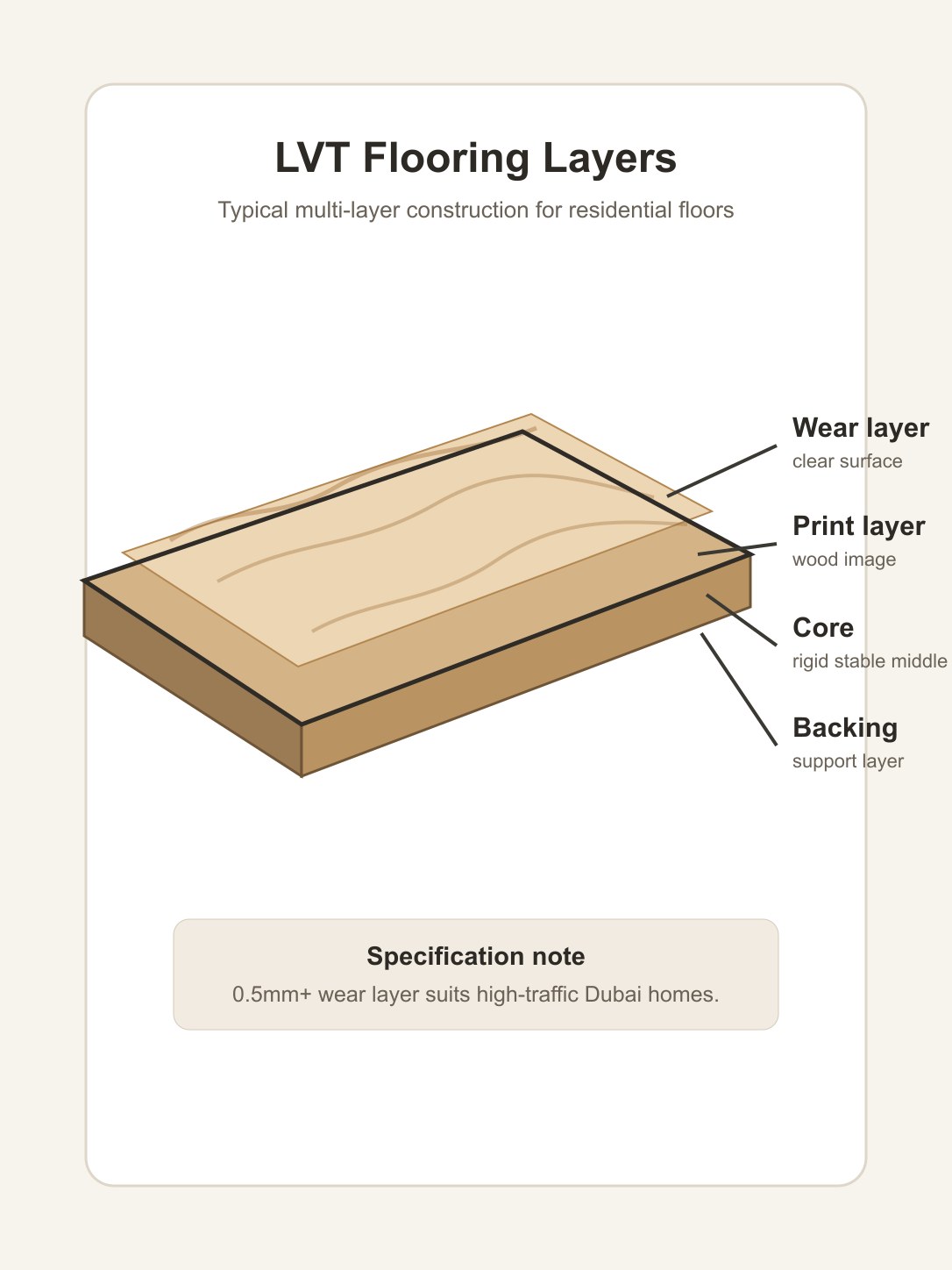
LVT is a multi-layer construction: a backing layer for stability, a rigid or semi-rigid core, a high-resolution photographic print layer, and a protective wear layer on top. The wear layer is the part that contacts foot traffic and determines how long the floor stays looking new.
Wear layer thickness is measured in millimetres. For residential Dubai use, the practical minimums are:
- 0.3mm: Minimum for bedrooms and low-traffic areas. Will show scratches over time in any space with regular foot traffic.
- 0.5mm: Standard for living rooms, hallways, and kitchens. Handles normal residential use well for 15+ years.
- 0.7mm and above: Appropriate for families with pets, high foot traffic, or when maximum longevity is the priority.
A common specification error is choosing LVT on price without checking the wear layer. Two products can look identical and be priced differently because one has a 0.3mm wear layer and one has a 0.55mm wear layer. After two years of use in a family home, those floors will look completely different.
UV inhibitors in the wear layer also matter in Dubai’s context. Direct sunlight through south or west-facing windows accelerates surface degradation on floors without UV protection. Quality LVT products include UV stabilisers as standard; budget products often don’t. This is worth asking about specifically when specifying for rooms with significant direct sun exposure.
Installation: The Decisions That Affect the Final Look
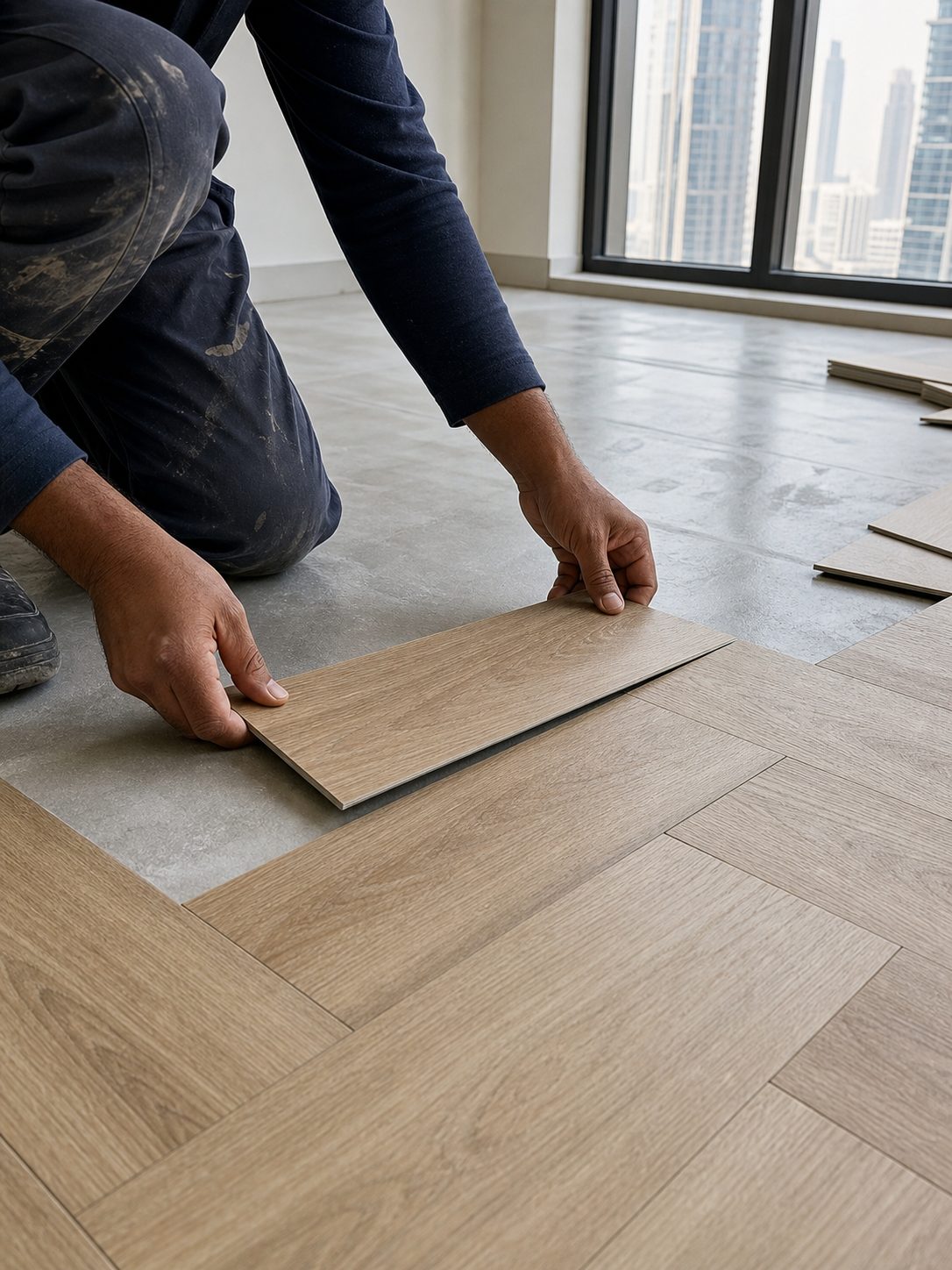
The same LVT product installed two different ways produces two different-looking floors. Installation decisions that affect the design outcome:
Direction of lay
Running planks in the longest dimension of the room elongates the space visually. Running them across the room widens it. In open-plan Dubai apartments where the depth of the space is the dominant dimension — running from the entry through to the living and dining area — laying planks along that axis creates a sense of continuity and draws the eye through the space. Running planks toward the main window or view also works well because it directs the eye toward the room’s focal point.
Subfloor condition
Click-lock LVT will telegraph any unevenness in the subfloor through to the surface. The tolerance is typically 3mm variation over 1.8 metres. In Dubai apartments with existing ceramic tile in good condition, LVT can often be laid directly over the tile if it’s flat and well-bonded, which significantly reduces installation disruption. Where tiles are cracked, lifting, or uneven, grinding or self-levelling compound is needed before installation.
Expansion gaps and transitions
LVT expands and contracts slightly with temperature change even though it’s dimensionally stable compared to timber. An expansion gap of 8–10mm at all walls and fixed elements is standard. In Dubai’s context where air conditioning creates significant temperature differentials between occupied and unoccupied rooms, this gap matters more than in temperate climates. Skipping or compressing expansion gaps leads to planks lifting at the edges — a common installation failure in budget projects.
Where LVT Fits in the Dubai Home Room by Room
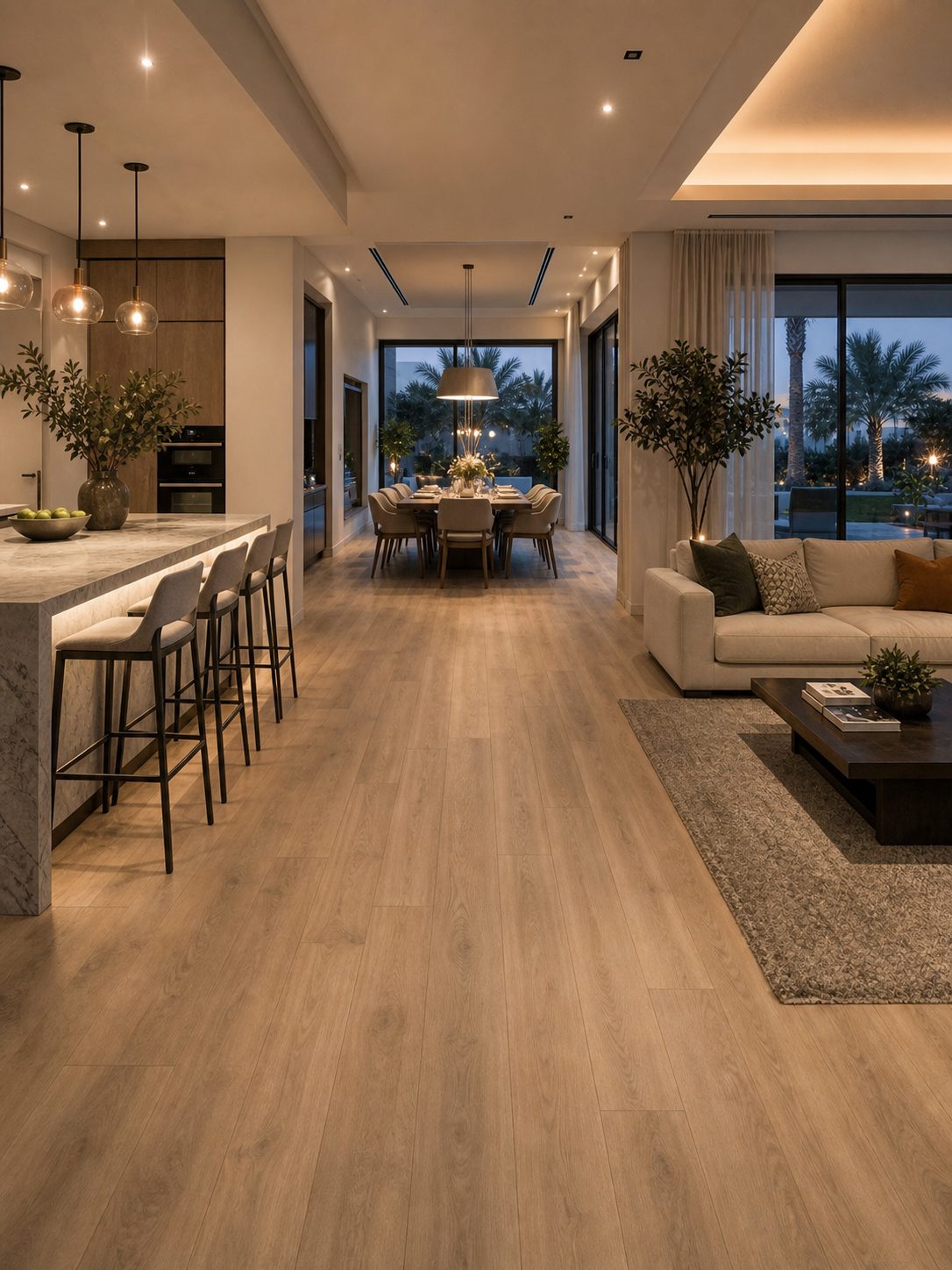
LVT’s waterproof core and dimensional stability give it a wider application range than almost any other single flooring material.
Living and dining areas: Wide-plank timber-look LVT in a warm mid-tone runs through open-plan spaces continuously, creating the sense of a unified floor plane that connects zones without visual interruption. The absence of expansion joints between zones — possible with LVT where it would be required with timber — is a significant aesthetic advantage in open-plan layouts.
Bedrooms: Slightly narrower plank widths and softer tones — pale blonde, dusty grey-beige — suit bedroom aesthetics. The softness underfoot compared to tile or stone also matters in a room used barefoot most of the time. An acoustic underlay beneath the LVT reduces impact sound transmission to lower floors, relevant in Dubai apartment living.
Kitchens and utility areas: Waterproof core makes LVT the practical choice over timber in any area with water exposure. A stone-look format in a kitchen connects to the benchtop material logic and reads naturally in a space where stone would make sense. Grout-line LVT tile formats with realistic texture are a particularly convincing option here.
Across all applications, flooring Dubai designers increasingly specify LVT as the continuous floor material rather than switching between materials between rooms — using one well-chosen LVT throughout the whole ground floor of a villa, for instance, or through all rooms of an apartment. The continuity makes the home feel larger and more considered.
LVT is often strongest when it sits inside a full rental house interior design plan, not as an isolated flooring choice. Match it with paint, lighting, hardware, and staging so the whole property reads as intentional.
FAQ: LVT Flooring in Dubai
Is LVT flooring suitable for Dubai’s climate?
Yes. LVT is dimensionally stable in heat and humidity, making it better suited to Dubai conditions than natural hardwood. Solid timber expands and contracts with humidity fluctuations, leading to gapping or cupping. LVT maintains its form across the temperature range typical of Dubai interiors, including the thermal cycling between air-conditioned rooms and outdoor heat.
What is the difference between LVT and regular vinyl flooring?
Regular vinyl is a thin, single-layer product with a printed surface. LVT is a multi-layer construction: a rigid or semi-rigid core, a high-resolution print layer, and a protective wear layer measured in millimetres. Wear layer thickness determines scratch resistance and longevity. For residential Dubai use, a minimum 0.3mm wear layer for bedrooms, 0.5mm or above for living areas and hallways.
Can LVT flooring be installed over existing tiles in Dubai?
In many cases yes. Click-lock LVT can float over an existing flat, clean, structurally sound tile surface without adhesive, reducing installation time and disruption. The substrate must be level to within 3mm over 1.8 metres. Where existing tiles are uneven or damaged, grinding or self-levelling compound is needed first.
What LVT formats work best in open-plan Dubai apartments?
Large-format planks in 220cm or longer lengths reduce visible end joints and create a calmer surface in open-plan spaces. Running planks in the longest dimension of the room emphasises depth. Wide-plank formats from 22cm upward suit the generous proportions common in Dubai apartments and villas.
How do I match LVT tone with Dubai interior design palettes?
Dubai’s dominant palette runs warm neutral: cream walls, beige and greige furniture, natural stone surfaces. Warm mid-tone LVT in sandy oak, blonde ash, or greige wood tones complements this without competing. For cooler contemporary schemes with grey tones or dark furniture, a cool ash or grey-toned plank creates better contrast.
Is LVT flooring comfortable to walk on in a Dubai home?
LVT is softer underfoot than ceramic tile or marble and warmer in thermal feel. Rigid core LVT with an acoustic underlay reduces impact sound transmission to lower floors, useful in apartments. Some products include a pre-attached underlay for convenience.
How long does LVT flooring last in a Dubai home?
Quality LVT with a 0.5mm or thicker wear layer typically lasts 15 to 25 years in residential use with standard maintenance. In Dubai conditions, UV exposure from direct sunlight can affect the surface over time; quality products include UV inhibitors in the wear layer. Avoid prolonged direct sun exposure without window protection.
The floor is the largest single surface in any room. It deserves the same design attention as the furniture, the lighting, and the walls — not a default decision made on price alone.
Related design note: LVT makes sense when durability, budget, or subfloor conditions point away from timber. When an older home already has solid boards worth saving, use this wood floor sanding guide before deciding to cover the floor with a new material.
For homeowners comparing resilient floors with real wood, this light oak flooring ideas guide is a helpful reference for color, warmth, and room styling.
- 1.7Kshares
- Facebook0
- Pinterest1.7K
- Twitter0
- Reddit0