The first thing most people notice when they walk into a well-designed entryway is the light, the flooring, maybe the console table. The second thing — and this took me a while to fully register when I started paying attention to it — is the door hardware. Handles, hinges, and the lock. They set a tone. They communicate whether someone actually thought about this space or just filled it.
- The Entryway Problem Smart Locks Actually Solve
- 7 Smart Lock Features Interior-Minded Homeowners Actually Use
- 1. Finish consistency — the detail that ties hardware together
- 2. Integrated camera — one unit instead of two
- 3. Arrive-home automations — where lighting design meets smart home
- 4. Temporary access codes — the hosting upgrade
- 5. Slim exterior profile — the flush install standard
- 6. Do-Not-Disturb mode and scheduled locking
- 7. Voice control for hands-free entry
- Choosing a Finish That Works With Your Interior
- How Smart Locks Fit Into a Whole-Home Automation Scheme
- Installation: What Matters for a Clean Result
- FAQ: Smart Locks and Interior Design
- Q: Do smart locks come in finishes that match interior door hardware?
- Q: Can a smart lock replace a separate video doorbell?
- Q: Will a smart lock look out of place on a traditional or period-style door?
- Q: Can I set lighting scenes to trigger when I unlock the front door?
- Q: How do I handle smart lock aesthetics in a rental where I cannot change the exterior?
- Q: What is the most design-forward smart lock available in 2026?
- Q: Does smart lock placement affect the entryway design?
A smart lock is visible door hardware now. It sits on the door face, it is one of the first details you touch when you arrive home, and in many entryways it lands right in the main sightline. That means the design question matters just as much as the security question.
This article is about what interior-minded homeowners should look for in a smart lock: finish, scale, profile, camera placement, access control, and the automations that change how the entryway works day to day.
Smart locks and interior design: the quick design answer
A smart lock works with interior design when it looks intentional from both sides of the door. Match the finish to nearby hardware, keep the exterior profile slim, check that the keypad or camera does not crowd the handle set, and connect the lock to lighting scenes that make the entry feel calmer when someone arrives.
| Design check | What to choose | What to avoid |
|---|---|---|
| Finish | Matte black, satin nickel, bronze, or brass that repeats elsewhere nearby | A one-off metal that fights the handle, hinges, or entry light |
| Profile | Slim exterior plate, clean interior battery cover, tidy screw alignment | Bulky hardware that sits proud of a traditional or narrow stile door |
| Function | Fingerprint, keypad, guest codes, camera, or automations you will actually use | Feature stacking that makes the door look busy without solving a daily problem |
| Entry mood | Warm entry lighting and auto-lock routines tied to arrival and bedtime | A smart lock that works alone while the rest of the home stays disconnected |
The Entryway Problem Smart Locks Actually Solve
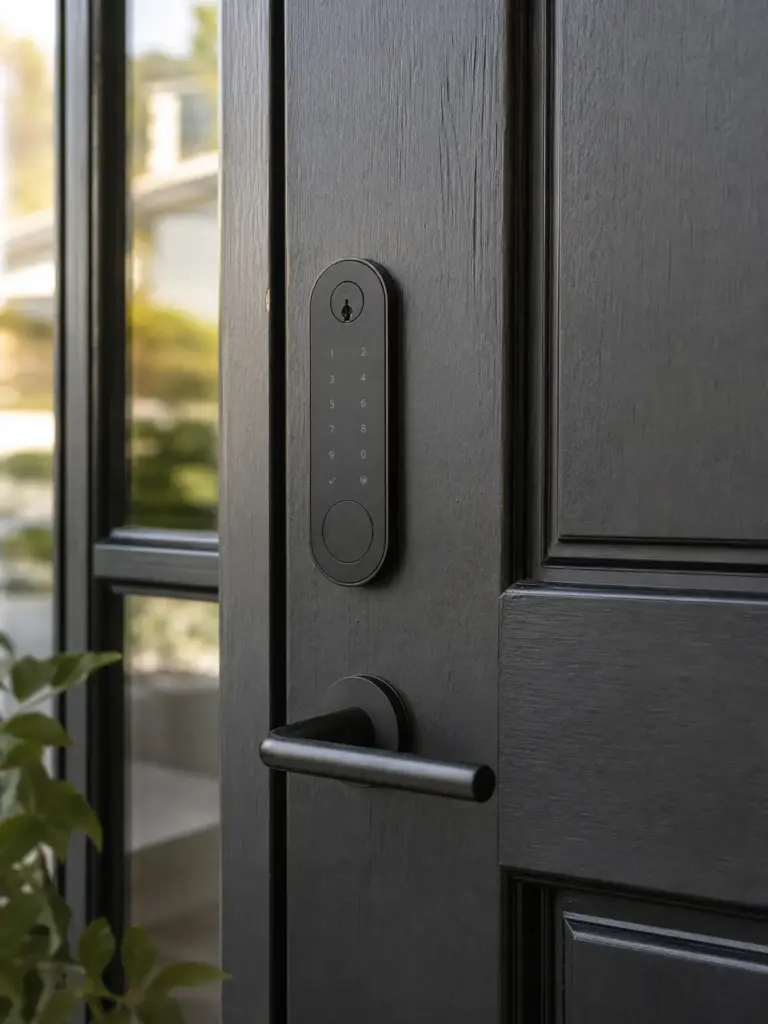
The entryway is the one room in a home that everyone passes through but almost nobody designs deliberately. It gets a bench, a hook rail, maybe a mirror — and then the actual door hardware gets chosen out of a hardware store catalogue in five minutes while someone is trying to fix a broken lock.
Smart locks change the conversation because they bring the door hardware back into consideration. You’re replacing the deadbolt anyway. You’re choosing a finish, a profile, a form factor. That’s a design decision whether you treat it as one or not.
The best reason to approach it deliberately: the entryway is also a functional room. It handles arrivals, departures, deliveries, guests, and the daily friction of getting in and out of the house. A smart lock can reduce that friction significantly — but only if it’s chosen with how the household actually uses the space in mind.
7 Smart Lock Features Interior-Minded Homeowners Actually Use
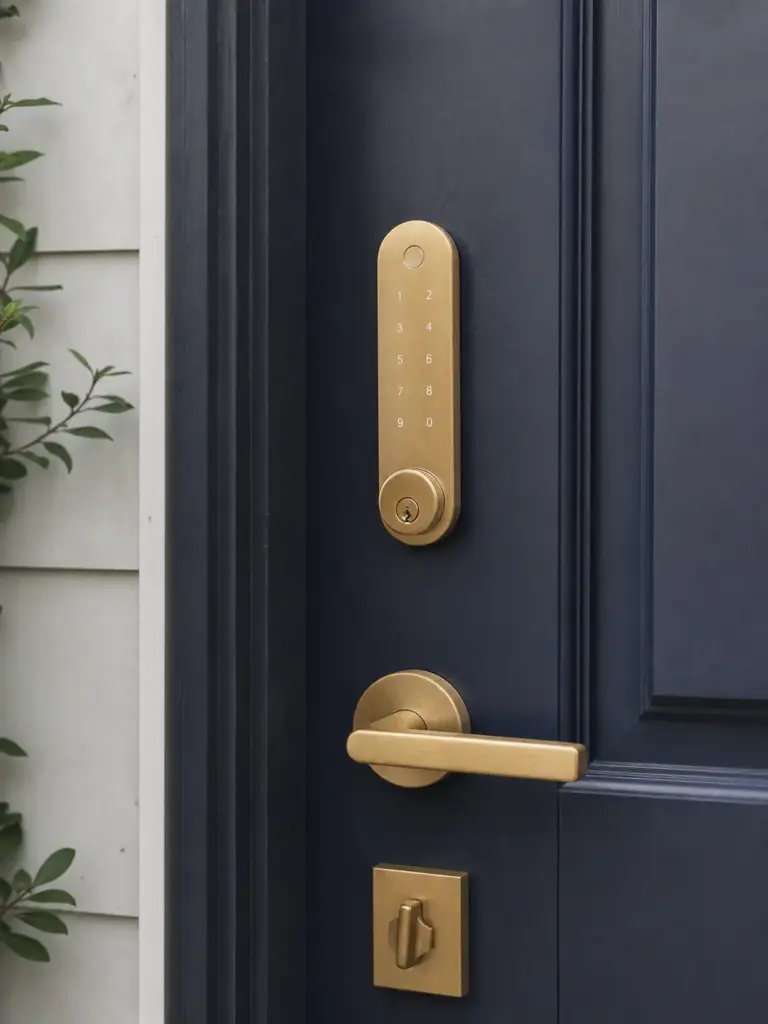
1. Finish consistency — the detail that ties hardware together
Matte black is dominating contemporary interiors right now, and for good reason: it reads well against both light and dark doors, doesn’t show fingerprints as aggressively as polished finishes, and matches the shift toward dark fixture choices in kitchens and bathrooms. Satin nickel works better in Scandinavian and transitional schemes.
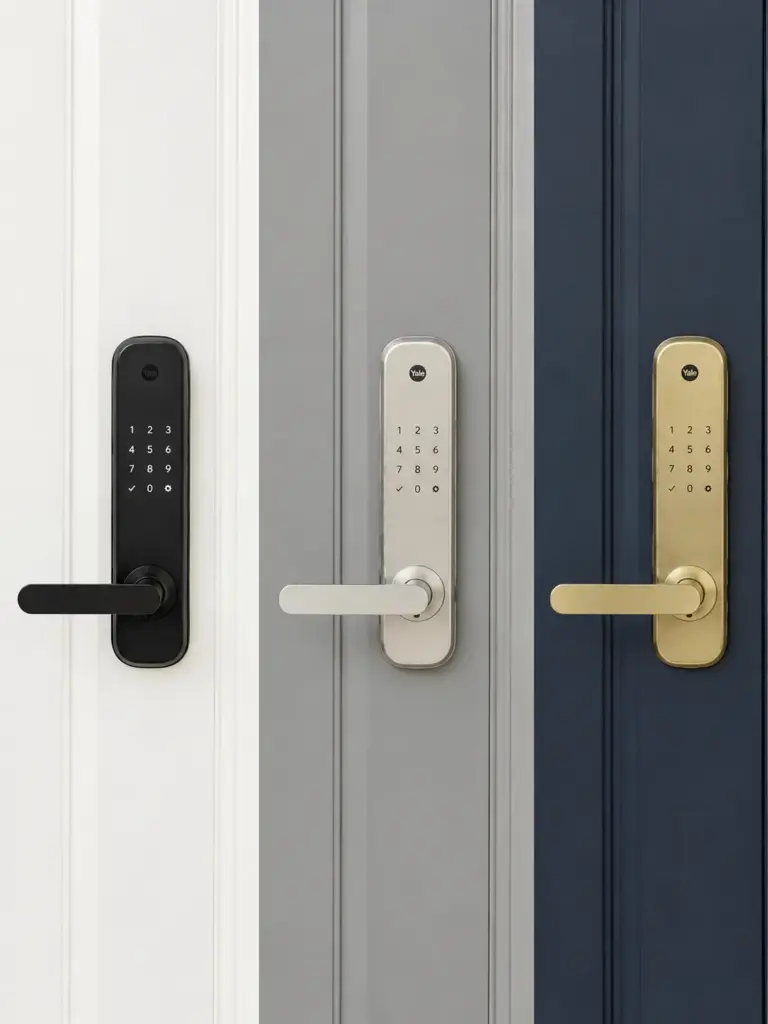
Brushed gold has become common in warmer, maximalist interiors. The principle is the same regardless: match the smart lock finish to your door handle, hinges, and any exterior light fixtures. Mismatched metal finishes in an entryway are the hardware equivalent of a rug that doesn’t quite fit.
2. Integrated camera — one unit instead of two
A separate video doorbell next to a smart lock means two devices, two mounting holes, two apps, and twice the visual clutter on the door face. Locks that integrate the camera into the lock body itself — like the eufy Video Smart Lock S330 with its 2K camera and 10,000 mAh built-in battery — consolidate that into a single flush-mounted unit. From a design standpoint, the door face stays cleaner. From a practical standpoint, you answer the door and manage entry from the same interface. For entryways where the door is the visual centrepiece, less hardware is almost always better.
3. Arrive-home automations — where lighting design meets smart home
If the home already runs on routines and notifications, a lock works best as a true connected endpoint. Status checks, activity history, and remote responses matter more than a long list of modes. A video smart lock like eufy Video Smart Lock S330 fits that style of home. It handles everyday entry, and it also captures context at the door. When a delivery arrives or a guest turns up early, live video and more meaningful alerts make it easier to decide whether to unlock without walking to the door.
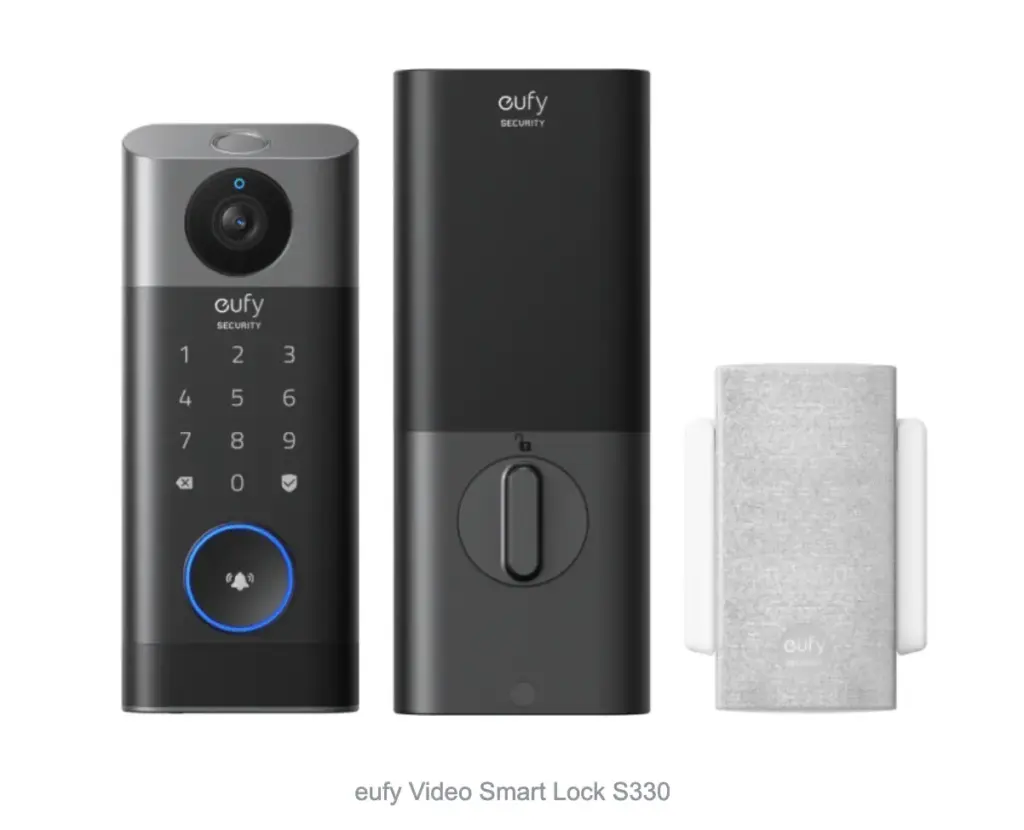
Many households also want fast fingerprint access for arrivals, app control for remote management, and voice assistant support when hands are full. With a high-capacity 10,000 mAh battery and a 2K camera in one unit, it can also replace both an older lock and a separate doorbell.
4. Temporary access codes — the hosting upgrade
Interior designers and architects often think about a home in terms of flow and use. One flow that traditional key systems handle poorly is the guest-or-contractor visit: a key gets cut, passed on, maybe returned, maybe not. Temporary access codes solve this cleanly. Set a code that works between 2pm and 6pm on a Tuesday for a furniture delivery, then it expires. Give houseguests a code for their stay, then revoke it. The access log shows exactly when it was used. For households that host regularly, or for anyone who has ever worried about who still has a spare key, this is genuinely useful.
5. Slim exterior profile — the flush install standard
A smart lock that protrudes significantly from the door surface reads as an afterthought, regardless of how good the finish is. The exterior profile — how much the lock body extends outward from the door face — is one of the first things to check in specifications. Slim-profile models sit tighter against the door, which helps them read as integrated rather than added-on. This matters more on period or traditional doors where a large modern keypad looks incongruous, but it matters on contemporary doors too. A flush install on a slim profile is the hardware equivalent of a well-tailored detail.
6. Do-Not-Disturb mode and scheduled locking
For homeowners who work from home, have young children on a routine, or simply value the idea that the house manages itself after a certain hour — scheduled auto-lock and Do-Not-Disturb modes are quietly useful features. Auto-lock after 10pm means one less thing to remember. DND mode mutes notifications during sleep hours without disabling the lock’s function. Neither of these is glamorous. Both of them reduce daily friction in ways that make a home feel more considered. The best interior design does exactly that: removes friction without drawing attention to itself.
7. Voice control for hands-free entry
“Unlock the front door” said while carrying groceries, a pushchair, or a delivery box is useful in a way that goes beyond convenience. It’s the kind of friction reduction that changes how a space feels to live in. Smart locks that work with Alexa, Google Assistant, or Siri allow this natively. The setup takes a few minutes. The payoff is that the entry experience stops requiring a free hand. For households with children, older residents, or anyone who has stood outside juggling bags while trying to find their phone, this is one of those features that sounds like a gimmick until you use it daily.
Choosing a Finish That Works With Your Interior
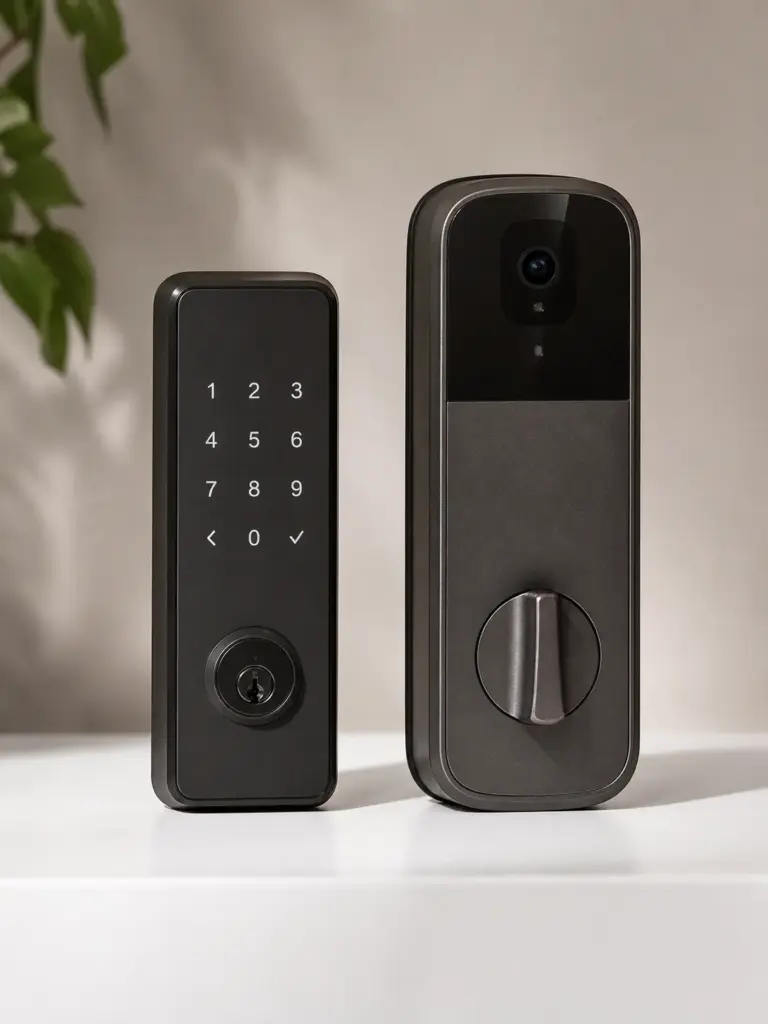
Finish choice is a detail that gets decided in about ninety seconds at the point of purchase and then lives on the door for years. Worth taking a few more minutes.
Matte black
Works with: contemporary, industrial, and Japandi interiors. Pairs well with black window frames, dark grout lines, and aged brass or unlacquered brass accents (the contrast is intentional). Avoid pairing with polished chrome door handles — the contrast reads as error rather than style.
Satin nickel
The most neutral finish and the safest choice when uncertain. Works across Scandinavian, transitional, and traditional interiors. Pairs naturally with white, warm grey, and greige colour schemes. More visible fingerprint marks than matte black but easier to wipe clean than polished chrome.
Brushed gold / champagne bronze
Works with: warmer interiors, maximalist schemes, Mediterranean-influenced design, and spaces with terracotta, cream, or forest green as dominant colours. Pairs well with rattan, natural timber, and linen textures. Tends to read as dated in cool-toned minimal schemes.
Oil-rubbed bronze
Traditional and craftsman interiors. Pairs naturally with darker wood tones, iron fixtures, and aged-look hardware throughout the home. The least common choice in new builds but the most cohesive option in period properties with existing bronze or antique brass hardware.
How Smart Locks Fit Into a Whole-Home Automation Scheme
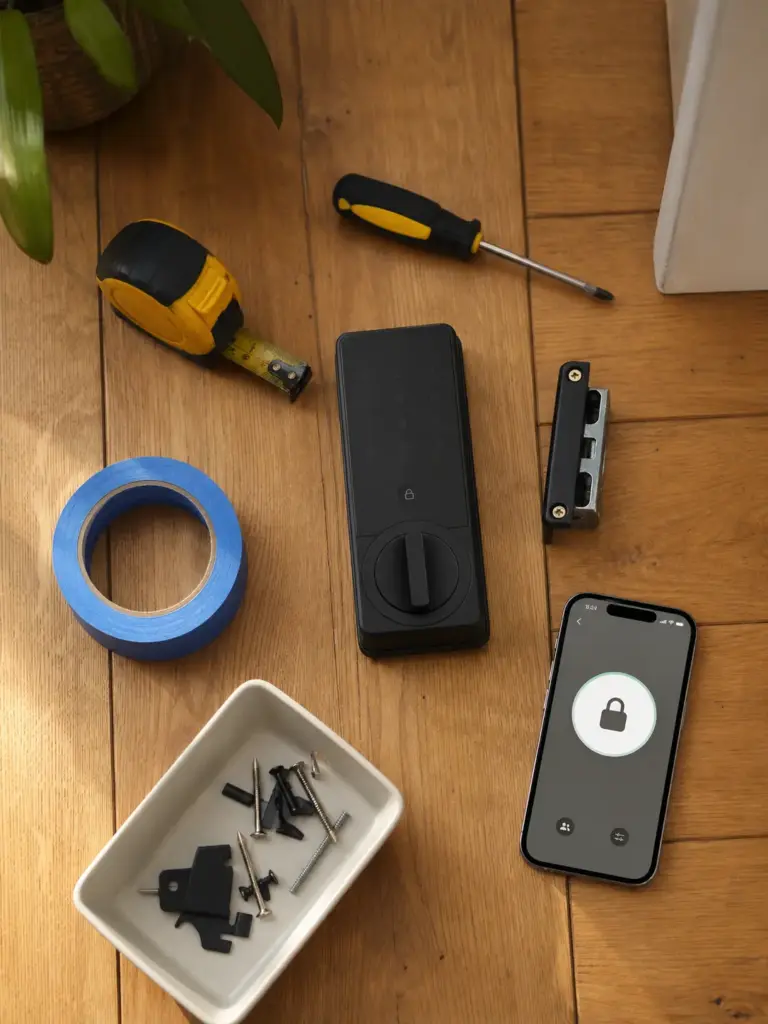
A smart lock that operates in isolation — just unlocking a door — is the least interesting version of what it can do. The more interesting version is when the lock becomes a trigger point in a larger home automation scheme.
A few setups worth considering:
- Arrive home: Door unlocks → entry lights turn on at 70% warm white → thermostat moves to occupied temperature → music starts in the kitchen.
- Leave home: Last person out → lock engages → all interior lights off → blinds close → thermostat to away mode.
- Bedtime: Scheduled auto-lock at 10:30pm → exterior lights turn off → bedroom lamp dims to 20%.
- Guest arrives: Temporary code entered → notification sent to host phone → guest bedroom lamp turns on.
The common thread is that the lock becomes a presence detector — it knows when people are arriving and leaving, and the home responds accordingly. This is the interior design argument for smart locks that doesn’t get made often enough: it’s not just about security, it’s about making the home feel responsive to the people living in it.
A quick specification checklist before you buy
Before buying, measure the existing bore, backset, door thickness, stile width, and the clearance between the lock and handle. Then photograph the entryway in daylight and at night. The lock has to work with both views: the exterior facade and the interior arrival moment.
- Match the finish to at least two nearby details, such as the handle, hinges, entry light, switch plate, or stair rail.
- Check whether the interior battery pack looks clean from the hallway, not only from the outside product render.
- Confirm that the app, keypad, fingerprint reader, camera, and voice controls solve real household routines.
- Choose professional installation if the door is old, slightly warped, unusually thick, or already has an imperfect deadbolt alignment.
Installation: What Matters for a Clean Result
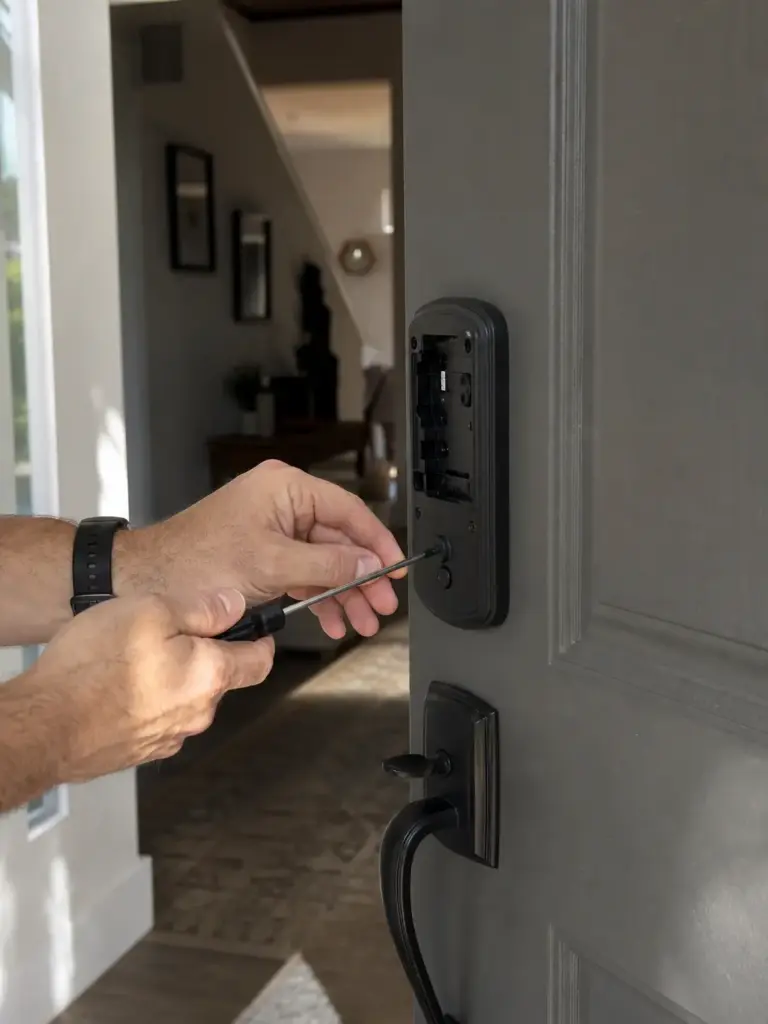
The most design-conscious lock choice can be undermined by a poor install. A few things that determine whether the result looks considered or afterthought:
Flush plate seating. The exterior and interior plates should sit flat against the door surface with no visible gap or rock. If the door has a slight bevel near the edge, address the fit before final tightening. A plate that doesn’t sit flush catches light badly and reads as amateurish regardless of the finish quality.
Screw head visibility. Most smart locks have visible screws on the interior plate. These are usually covered by a trim ring or battery cover, but on models where screws remain visible, misaligned or over-driven screw heads are a detail that bothers people in retrospect. Drive slowly and stop when the head is flush.
Cable routing. Locks with exterior cameras or display screens have a cable connecting the exterior and interior units through the door bore. This cable should be routed neatly and not visible at the door edge. A pinched or twisted cable that shows at the seam between door and jamb is both a functional risk and a visible flaw.
Bolt alignment. The bolt should extend and retract smoothly with the door both open and closed. If it binds only when the door is closed, the strike plate needs adjustment. Run the lock through several cycles before calling the install done. A smooth bolt is the functional foundation everything else sits on.
Smart locks work best when they support the whole entry experience. For rental and resale projects, this property investor design ROI guide shows how security, lighting, finishes, and staging can work together.
FAQ: Smart Locks and Interior Design
Q: Do smart locks come in finishes that match interior door hardware?
Yes. Most quality smart locks ship in satin nickel, matte black, brushed gold, and oil-rubbed bronze. For a cohesive look, match the smart lock finish to your door handles, hinges, and light switch plates in the entryway. Matte black is currently the most popular finish for contemporary interiors.
Q: Can a smart lock replace a separate video doorbell?
Some models do combine both functions. The eufy Video Smart Lock S330 includes a 2K camera and two-way audio in the lock unit itself, eliminating the need for a separate doorbell. This reduces hardware clutter on the door face, which matters in minimal or design-forward entryways.
Q: Will a smart lock look out of place on a traditional or period-style door?
It depends on the profile and finish. Slimmer-profile models in bronze or satin nickel read more neutrally on traditional doors than large-format keypads in matte black. Some homeowners opt for smart locks that retrofit behind an existing exterior deadbolt, keeping the exterior appearance completely unchanged.
Q: Can I set lighting scenes to trigger when I unlock the front door?
Yes, if your smart lock supports integrations with your lighting system. Locks compatible with Google Home, Amazon Alexa, or Apple HomeKit can trigger automations on unlock events — entry lights on, thermostat adjusted, music started. This requires both the lock and the lighting system to share a compatible smart home platform.
Q: How do I handle smart lock aesthetics in a rental where I cannot change the exterior?
Choose an interior-only retrofit model. These install on the inside of the existing deadbolt and leave the exterior keyway and hardware unchanged. From outside the door, nothing looks different. From inside, you still get app control and easier daily access. Most rental-friendly models remove cleanly when you move out.
Q: What is the most design-forward smart lock available in 2026?
The most design-conscious options tend to be slim-profile models with flush exterior plates and minimal keypad surface area. Level Lock remains popular for its completely hidden interior mechanism. For households that want camera integration without visual clutter, the eufy Video Smart Lock S330 consolidates lock and doorbell into a single clean unit.
Q: Does smart lock placement affect the entryway design?
Yes, more than most people expect. A lock that sits proud of the door surface or has a large exterior plate draws attention in the wrong way. A flush, well-aligned install on a slim-profile model tends to disappear into the door and let the door itself remain the visual focus. Finish consistency with surrounding hardware amplifies this effect.
Related home design guides
For a whole-home version of the same design problem, this smart locks for 55+ homes explains how entries, bathrooms, lighting, kitchens, flooring, laundry, and outdoor rooms can work together in a 55+ home.
If you are planning the whole entry rather than only the lock, continue with smart home infrastructure planning, modern door design ideas, and facade modernization. Those choices decide whether the smart lock feels integrated or simply bolted on.
If the property will sit empty between visits, use the lock choice as part of a broader lock-and-leave smart home checklist that also covers temporary codes, local fallback access, cameras, and power backup.
- 0shares
- Facebook0
- Pinterest0
- Twitter0
- Reddit0