A client brought a set of glass tumblers to my studio with a brief that should have been simple: a small two-colour logo repeated on each one, one hundred units, needed in a week. Three methods immediately came off the table. Vinyl would not follow the curve cleanly at that scale. Sublimation was out because the tumblers were not polyester-coated. Direct-to-object UV printing was possible but required fixturing each tumbler individually, and I had neither the time nor the setup for it at that volume.
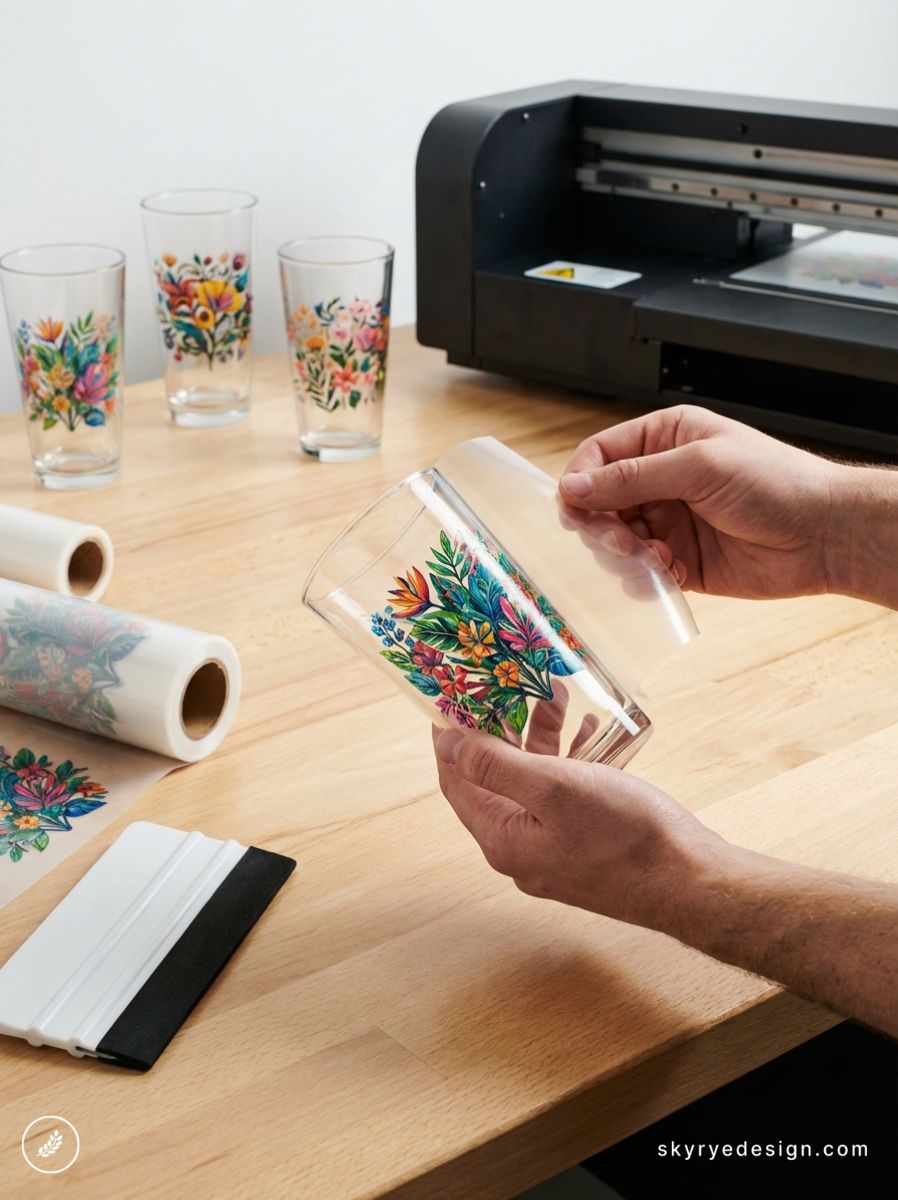
What got the job done was a UV DTF printer that had arrived in the shop three months earlier and which I had mostly been using for phone cases and acrylic signage. I printed the transfers onto film, laminated them, trimmed to shape, and applied them to the tumblers by hand — one hundred units in about four hours, no press, no heat, no fixturing.
The transfers sat flush on the curve without lifting. The colour was accurate. The client was happy. That was the moment I understood that UV DTF was not a niche tool for a specific substrate category — it was a workflow solution for the entire category of things that have always been awkward to decorate.
This guide covers what UV DTF printing is, why the UV-curable ink chemistry expands what is possible, how it compares with the established decoration methods most shops already run, the step-by-step workflow and the specific handling mistakes that hurt results, and when to reach for a different method. Whether you are evaluating UV DTF as a new capability or trying to understand where it fits in a shop that already runs sublimation and heat transfer, the comparison below should give you a clear picture.
The Shift Toward Custom and Small-Batch Decoration
Demand for personalised and short-run product decoration has been rising steadily for the past five years, driven by two converging forces: the growth of e-commerce brands wanting differentiated merchandise at low minimum order quantities, and the normalisation of custom gifting and event merchandise that would previously have required screen printing minimums of 50-100 units per colour.
The economics of custom decoration have shifted — clients now expect full-colour, detailed work on runs of 10-50 units at prices that make sense for small businesses and individual buyers.
For print shops, this shift has put pressure on traditional methods that were designed for efficiency at scale rather than flexibility at low volume. Vinyl cutting and weeding is practical for bold lettering and simple shapes but labour-intensive for intricate artwork. Screen printing achieves excellent results but carries setup costs that make it economically irrational below a certain quantity. The gap between what clients want and what established methods can deliver cost-effectively is exactly where UV DTF printing has found its market position.
A UV DTF printer addresses this gap by eliminating the setup costs associated with most other methods. There is no screen to prepare, no vinyl to weed, no dye bath to mix. The artwork goes from file to film in a single print step, and the same printer produces a one-unit order and a hundred-unit order with equivalent per-unit effort. For shops that have been turning away short-run custom work because the economics did not work, UV DTF changes the calculus.
✏ Shop note: UV DTF transfers can be stored flat in a cool, dry environment for weeks after printing before application. This makes it practical to print a batch of transfers in advance and apply them to order as individual items sell — a workflow model that suits on-demand merchandise operations and reduces inventory risk compared to pre-decorated stock.
Why UV-Curable Inks Expand Application Possibilities
The capability difference between UV DTF and standard transfer methods starts at the ink chemistry level. UV-curable inks are reactive polymer systems that remain liquid until exposed to UV light, at which point they cross-link and harden almost instantaneously.
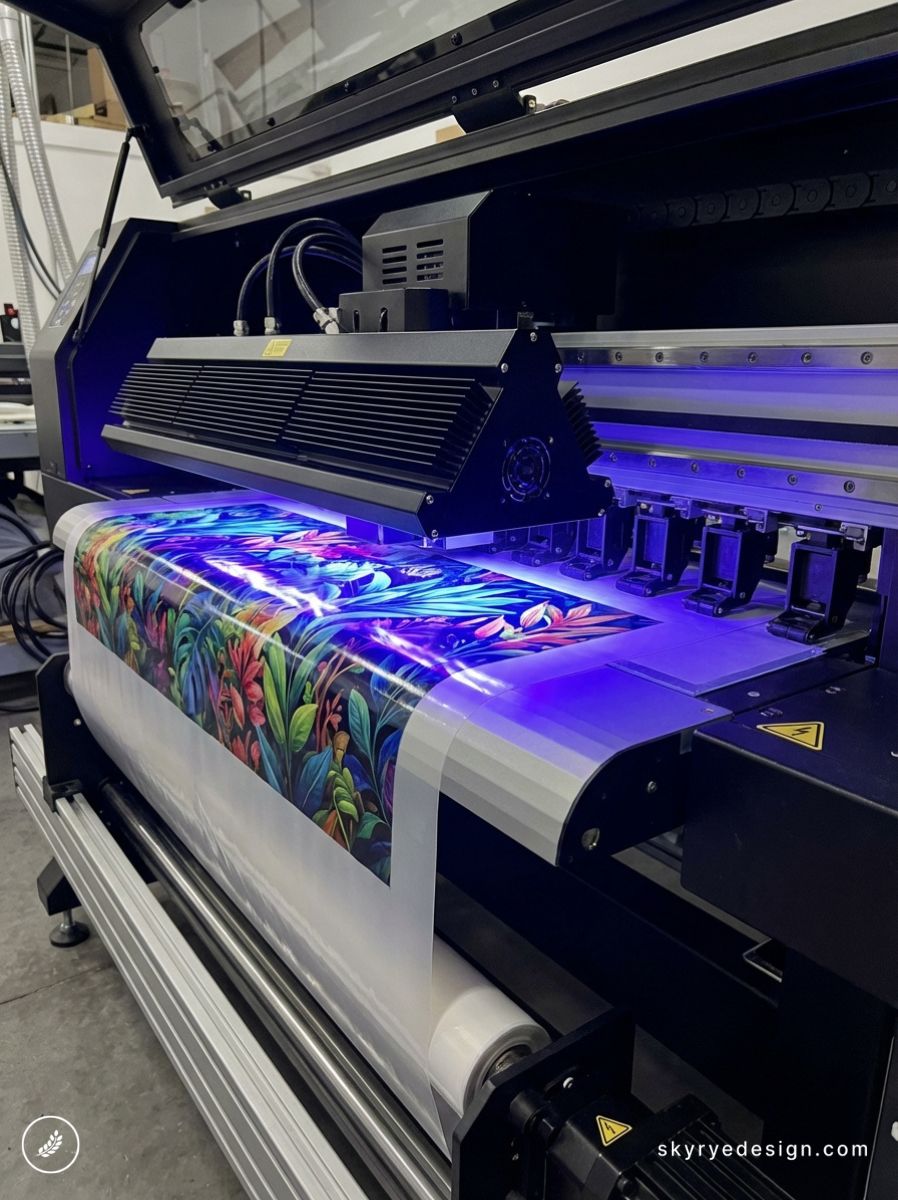
The result is a cured ink layer with significantly higher hardness and chemical resistance than water-based or solvent-based inks, which is why UV DTF transfers adhere to surfaces that other methods cannot handle and hold up to handling that other transfers cannot sustain.
What Instant Cure Means for Production
In conventional inkjet printing, water-based inks require drying time — the solvent must evaporate before the ink is stable. In UV printing, the cure is triggered by the lamp that follows the printhead, meaning the ink is fully stable the moment it exits the print zone. For UV DTF specifically, this means the transfer is ready for the lamination step almost immediately after printing — no waiting for drying, no risk of smearing during handling. In a busy shop, this difference in workflow speed is practically significant.
Surface Compatibility: Why Film Beats Direct
Direct-to-object UV printing — applying ink directly to the substrate rather than via a film — is technically capable of decorating a wide range of surfaces, but it has a fundamental limitation: the object must be presented flat and level within the printhead’s working height tolerance, which is typically 3-5mm. Bottles, curved cases, and objects with ridges or raised features either cannot be printed directly at all, or produce distortion and misalignment at the edges of the print area.
Film-based UV DTF sidesteps this entirely. The design is printed onto a flat film surface under controlled conditions, producing a geometrically accurate transfer. That transfer can then be applied to any surface — curved, slightly irregular, or with mild texture — because the film is flexible enough to conform to the substrate during application. The separation of printing and application is the core practical advantage of the film-based approach over direct printing for irregular surfaces.
Common Substrates for UV DTF
- Drinkware: glass tumblers, stainless steel water bottles and flasks, ceramic mugs. The most common UV DTF application category in most shops.
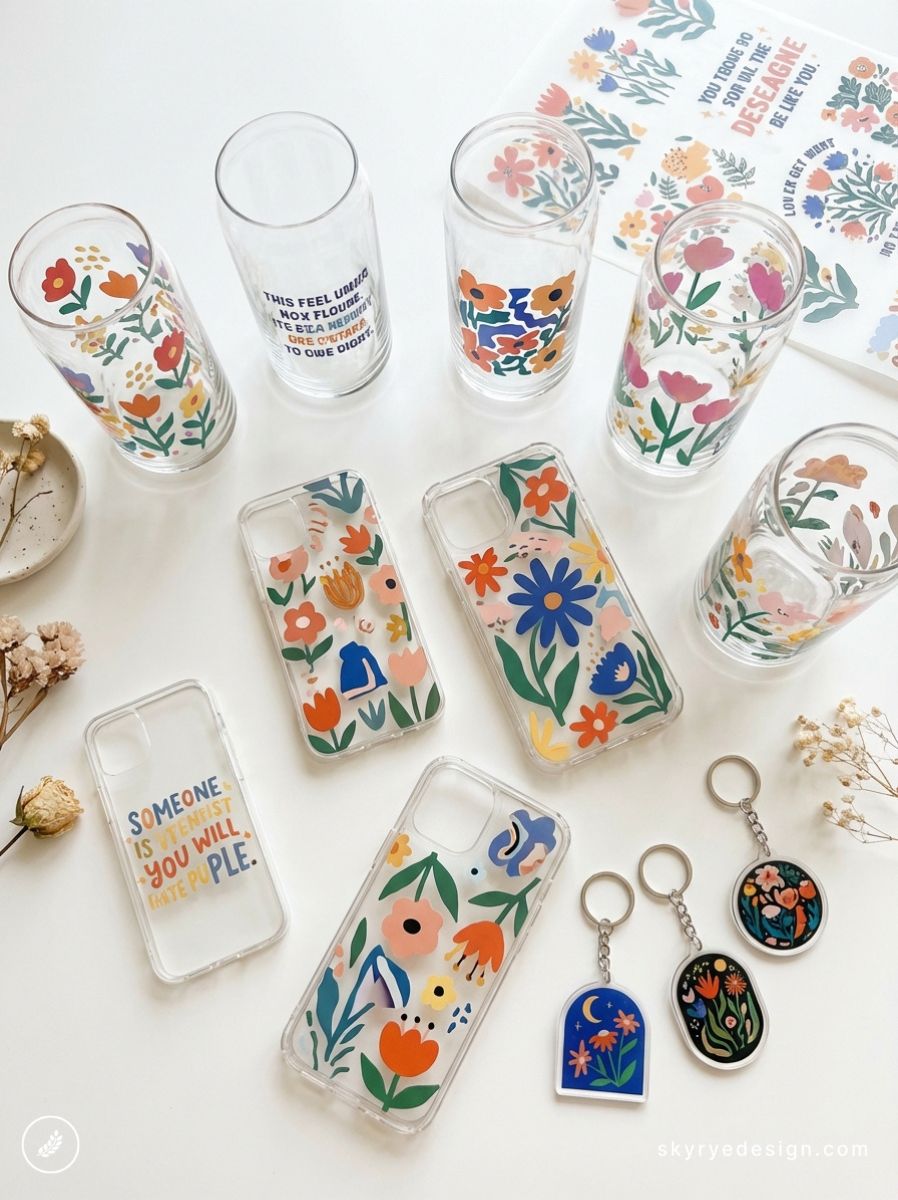
- Phone cases: polycarbonate, TPU, and hard plastic cases. Flat or with mild texture. One of the earliest and largest markets for UV DTF.
- Acrylic and signage blanks: keychains, tags, plaques, signs. UV ink adheres to acrylic with strong bonding.
- Candles and jars: glass and wax surfaces with smooth sides.
- Wooden items: smooth-finished wood surfaces including frames, boxes, and gifts. Raw or heavily textured wood is less suitable.
- Rigid packaging and promotional goods: boxes, hard cases, and a wide range of promotional hard goods.
✏ Shop note: Surface preparation is the single biggest variable in UV DTF adhesion quality. Clean the substrate with isopropyl alcohol immediately before application to remove skin oils, dust, and manufacturing residues. Even substrates that look clean carry contamination that will cause early transfer edge lifting. This step takes 10 seconds and prevents the most common adhesion failures.
UV DTF Compared with Other Transfer Methods
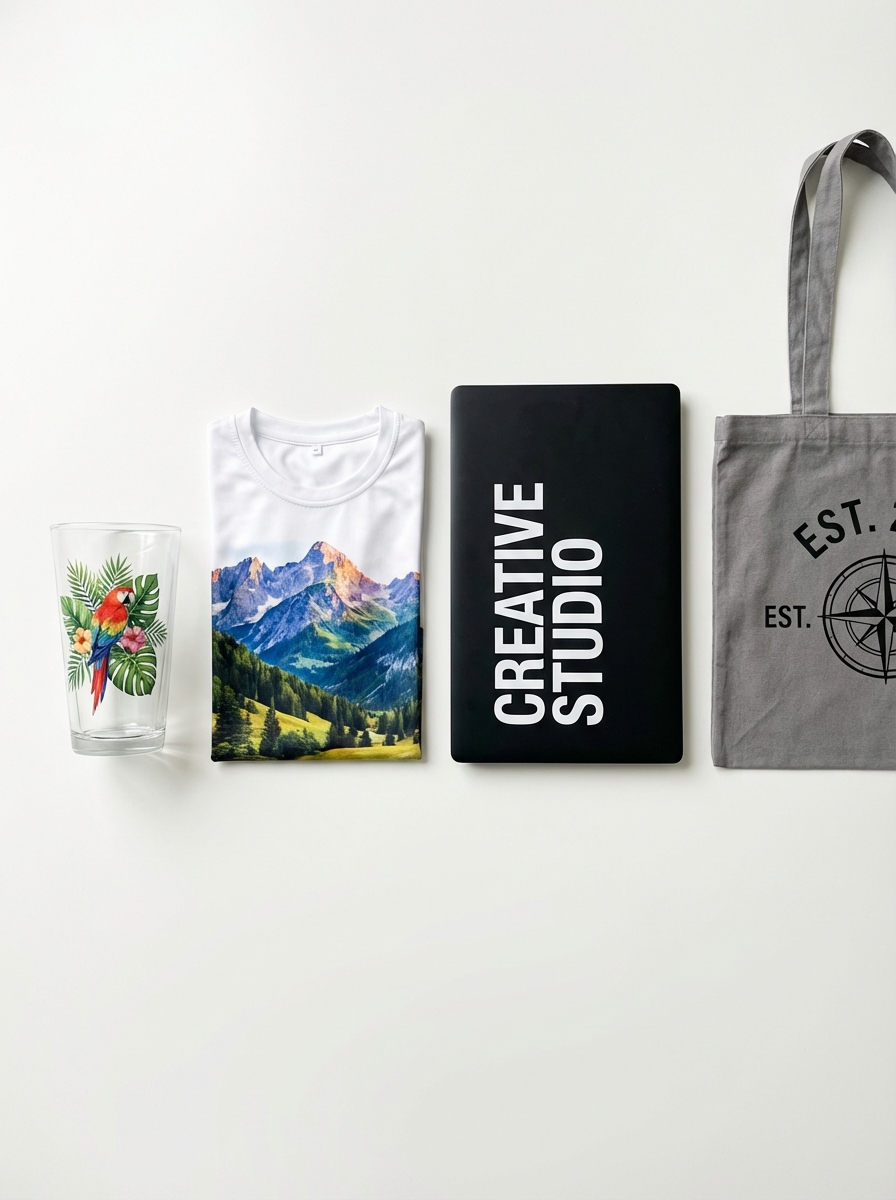
No single decoration method is correct for every substrate and every application. The value of UV DTF is clearest when it is understood in relation to the methods it complements and the ones it cannot replace.
UV DTF
Best for: Hard surfaces — glass, metal, acrylic, ceramic, wood, rigid plastic. Curved or irregular forms. Short runs with full-colour artwork
Colour quality: Excellent — full CMYK + white, accurate colour reproduction, fine detail capable
Durability: Strong on hard surfaces with proper preparation. Not dishwasher-safe on most substrates. 2-5 years typical for indoor/hand-wash use
Key limitation: Not suitable for fabric. Not flexible — will crack on substrates that flex significantly. Not dishwasher-resistant without additional protective coating
Vinyl (Cut and Apply)
Best for: Bold lettering, simple graphics, signage, vehicle graphics, flat or gently curved rigid surfaces
Colour quality: Limited to solid colours — no gradients, no photographic detail, no true full-colour artwork
Durability: Very good for outdoor applications. UV and weather-resistant vinyl options available. Long outdoor lifespan
Key limitation: Cannot reproduce photographic or gradient artwork. Requires cutting and weeding — labour-intensive for complex shapes. Not suitable for very fine detail
Sublimation
Best for: Polyester-coated hard goods, polyester garments. Works on white or light-coloured polyester substrates only
Colour quality: Excellent — dye becomes part of the substrate, producing vivid and photographic colour quality
Durability: Very high — the dye is embedded in the coating rather than sitting on the surface, so it does not peel, crack, or fade with normal washing
Key limitation: Only works on polyester or poly-coated substrates. Cannot print on non-coated glass, metal, wood, or dark fabrics. White or light base required
Heat Transfer (HTV and Sheets)
Best for: Garments and textiles, some hard goods with appropriate transfer sheets
Colour quality: Good for standard designs — photographic quality available with DTF transfer sheets
Durability: Good on garments with proper pressing. Will crack over time with heavy washing on stiff transfers
Key limitation: Requires heat press with specific temperature and pressure. Heat-sensitive materials cannot be pressed. Less suitable for very curved surfaces
Workflow and Practical Tips for Consistent Results
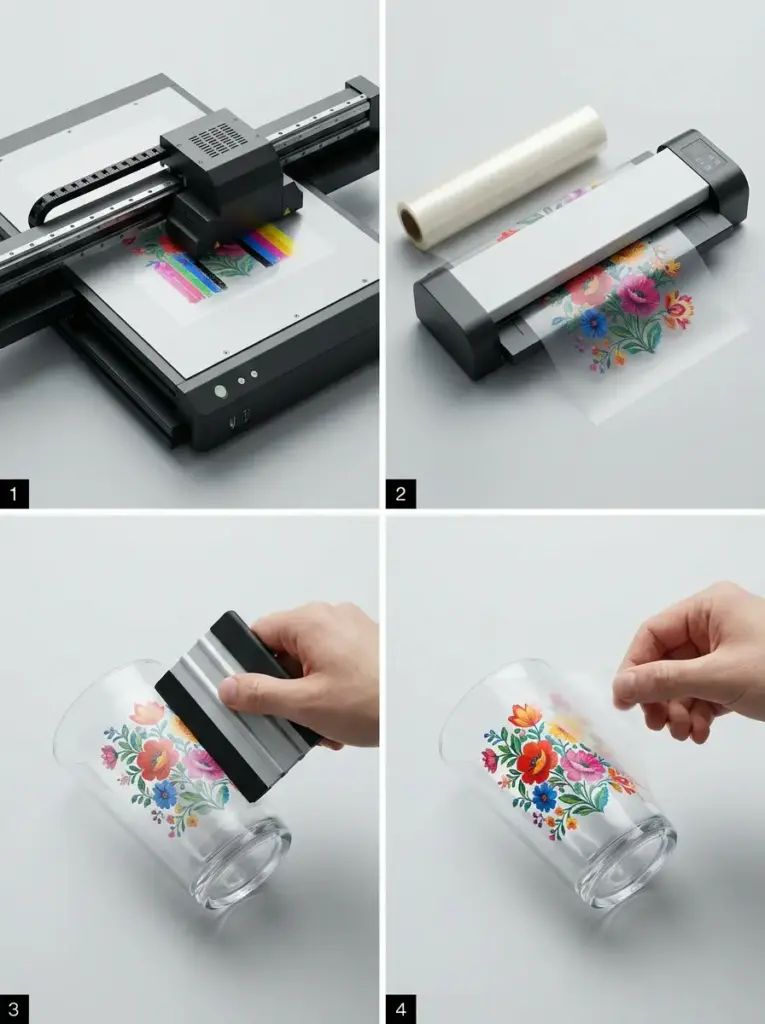
The UV DTF workflow has fewer steps than most other decoration methods, but each step carries a specific failure mode that consistent results depend on avoiding. Understanding where things go wrong — and why — is more useful than a generic checklist.
The Five Steps
- Print: artwork is printed onto the PET film using UV-curable CMYK and white inks, cured instantly by the UV lamp. White is typically printed as the base layer to ensure colour opacity on dark or coloured substrates.
- Laminate: the adhesive film is applied over the printed surface using a cold laminator. Even lamination pressure prevents air bubbles and ensures uniform adhesion across the entire transfer.
- Trim: the transfer is trimmed to shape using scissors, a craft knife, or a cutter. Leave a 1-2mm clear border around the design edge rather than cutting flush — this prevents the design edge from being a weak point during application.
- Apply: place the transfer adhesive-side-down on the clean substrate, apply firm even pressure across the entire surface for 30-60 seconds. A soft squeegee helps on flat surfaces; firm finger pressure works on curves.
- Peel: remove the carrier film at a low angle (15-30 degrees rather than straight up) once the transfer has bonded. Cold peeling gives more control; slightly warming the film with a heat gun for 3-5 seconds before peeling can help on textured surfaces.
Colour Accuracy and Printhead Maintenance
UV DTF colour accuracy depends more on printhead condition than on any software calibration setting. Blocked nozzles are the primary cause of colour banding and inaccurate output — a printhead with 5% nozzle dropout will produce visibly inconsistent results that no ICC profile can compensate for. Run a nozzle check before any production run. Clean the printhead if any nozzle rows show gaps. This takes 2-3 minutes and prevents the most common quality failures.
Colour profiling is worth doing once properly for each substrate type, then leaving alone. UV inks respond differently on film than on direct substrates, and a profile built for a different output method will not translate accurately. If colour matching is critical for a client job, print a proof and compare under the correct viewing light before running the full order.
Film Storage and Handling
- Store flat: rolled or curled film causes application problems — the transfer will not lie flat against the substrate and will trap air under the edges.
- Avoid humidity: moisture affects the adhesive layer. Store film in a sealed bag or cabinet in a climate-controlled environment.
- Handle by edges: fingerprints on the adhesive side contaminate the bonding surface. Always handle laminated transfers by the edges or use clean gloves.
- Avoid static buildup: static attracts dust to the adhesive layer before application. Anti-static measures (ioniser bars, anti-static wrist straps) help in dry environments where static is persistent.
✏ Shop note: One of the most underrated quality checks in UV DTF production: examine the peeled carrier film after application. If the design is partially remaining on the carrier film rather than fully transferring to the substrate, the bonding has been insufficient — most commonly due to a contaminated surface, insufficient application pressure, or premature peeling. Catching this early allows re-application before the adhesive fully sets.
UV DTF as a Practical Expansion, Not a Replacement
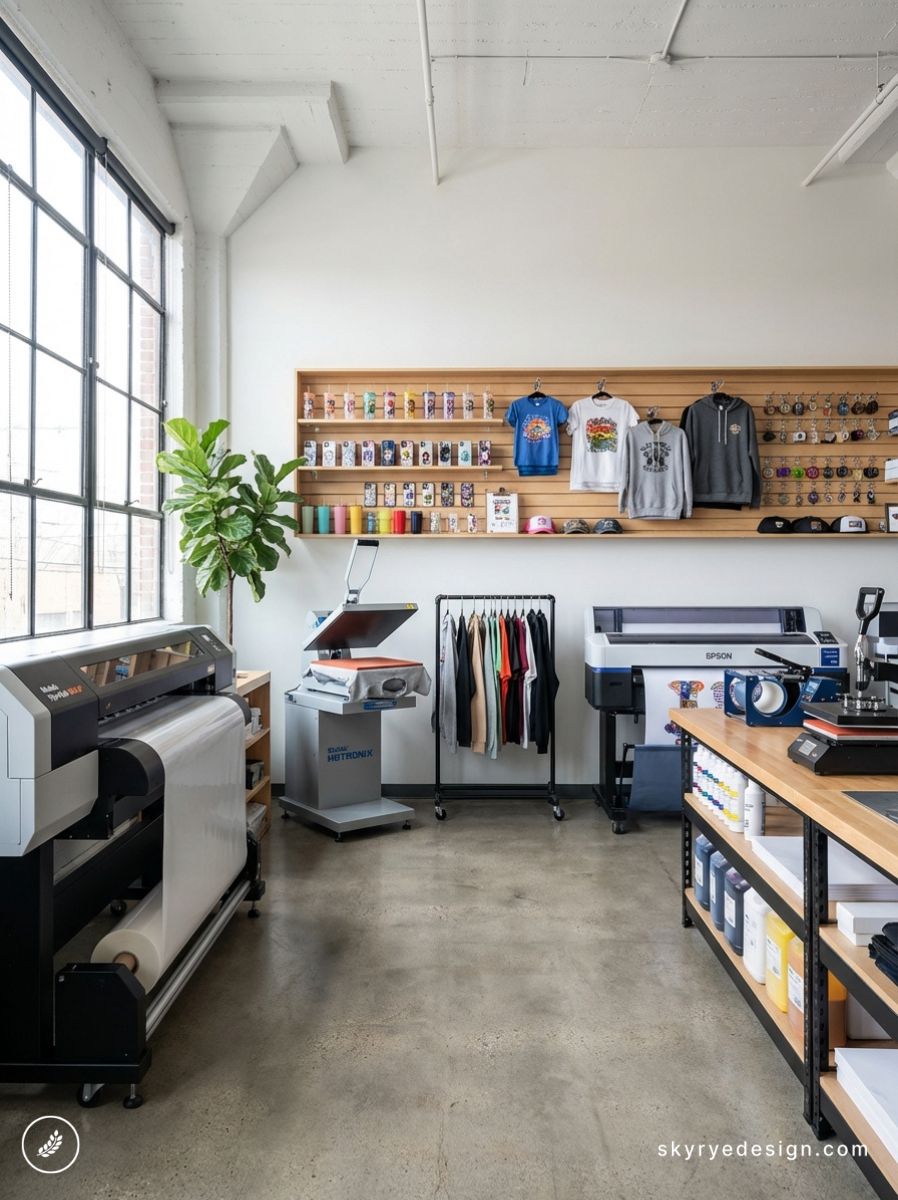
The clearest way to understand where UV DTF fits in a print shop’s capability set is to return to the question it answers: what do you do when a client brings a substrate that your current methods cannot handle cleanly?
Sublimation handles polyester-coated goods at excellent quality but nothing else. Vinyl handles bold graphics on flat surfaces but not fine detail or curves. Heat transfer handles garments and some hard goods but requires specific temperature ranges that not all materials can tolerate. UV DTF fills the space between these methods — hard goods that are not sublimation-ready, surfaces too curved for vinyl, materials too heat-sensitive for a press. It does not replace any of those methods; it handles what they cannot.
For the shops most likely to benefit from adding UV DTF capability: those already running drinkware, promotional goods, or phone case orders that have been relying on sublimation or vinyl and encountering substrate limitations; those running short-run custom orders where the economics of screen printing do not work; and those wanting to expand into custom gift and merchandise categories without investing in direct-to-object UV printing equipment. The equipment cost, the workflow simplicity, and the substrate range all point to UV DTF as a practical first step into hard goods decoration rather than a specialised niche tool.
FAQ: UV DTF Printing
Q: What is UV DTF printing?
UV DTF printing uses UV-curable inks printed onto PET film, instantly cured by UV light, then laminated with an adhesive layer. The transfer applies to almost any smooth hard surface by hand pressure — no heat press required. Distinct from standard DTF (which uses water-based inks on fabric with heat activation).
Q: What surfaces can UV DTF transfers stick to?
Glass, metal, acrylic, ceramic, wood (smooth-finished), rigid plastic, and hard promotional goods. The surface must be clean, dry, and grease-free for best bonding. Very porous, heavily textured, or significantly flexible substrates are less suitable — the rigid cured ink layer can crack under repeated bending.
Q: How long do UV DTF transfers last?
2-5 years on indoor hard surfaces with hand washing. Not dishwasher-safe — dishwasher exposure significantly accelerates edge lifting. Outdoor applications fade faster with UV and weather exposure. Surface preparation quality at application is the single biggest factor in longevity — contaminated surfaces fail much sooner.
Q: What is the difference between UV DTF and standard DTF?
Standard DTF uses water-based inks, requires hot-melt powder adhesive, and applies to fabric via heat press. UV DTF uses UV-curable inks, requires no powder, and applies to hard surfaces by hand pressure. Same name structure, entirely different inks, substrates, and application processes. Standard DTF is for garments; UV DTF is for hard goods.
Q: Do I need a heat press for UV DTF printing?
No. UV DTF transfers apply by hand pressure — place transfer adhesive-side-down on clean substrate, apply firm even pressure for 30-60 seconds, peel carrier film at a low angle. This is a practical advantage over heat transfer and sublimation for heat-sensitive materials and curved surfaces.
- 567shares
- Facebook0
- Pinterest567
- Twitter0
- Reddit0