The first time I tried drawing a Rolls-Royce Phantom from imagination, it came out looking like a stretched Honda Civic with a fancy hood ornament. The proportions were completely off — the Pantheon grille too narrow, the roofline too rounded, the rear doors nowhere near long enough. It was a perfectly anonymous luxury sedan, which is about the worst thing you can say about a car that starts at $480,000.
For the foundation behind the grille, roofline, and wheel placement, use this beginner car drawing tutorial before refining the Rolls-Royce details.
The problem is that Rolls-Royce’s design language lives in details that feel subtle until you study them closely: the absolutely vertical Pantheon grille, the suicide rear doors that open backwards from a central pillar, the Spirit of Ecstasy mascot balanced on the hood with precisely engineered poise. Each of these is a drawing challenge in itself.
- The Right Drawing Tools for Rolls-Royce Sketches
- How to Draw a Rolls-Royce Phantom: Step by Step
- How to Draw the Rolls-Royce Pantheon Grille and Spirit of Ecstasy
- Top 10 Rolls-Royce Models to Draw in 2026
- #1. Rolls-Royce Phantom VIII (2025 Series II)
- #2. Rolls-Royce Ghost Series II (2025)
- #3. Rolls-Royce Spectre (Electric Coupe)
- #4. Rolls-Royce Cullinan Series II (2025)
- #5. Rolls-Royce Wraith
- #6. Rolls-Royce Dawn
- #7. Rolls-Royce Phantom Extended Wheelbase
- #8. Rolls-Royce Silver Shadow (Classic)
- #9. Rolls-Royce Boat Tail (Coachbuild)
- #10. Rolls-Royce Droptail (Coachbuild)
- Common Rolls-Royce Drawing Mistakes — and How to Avoid Them
- Frequently Asked Questions
- Q: What is the easiest Rolls-Royce model to draw for beginners?
- Q: How do you draw the Spirit of Ecstasy mascot?
- Q: What makes Rolls-Royce cars harder to draw than other luxury cars?
- Q: How long does it take to draw a detailed Rolls-Royce Phantom sketch?
- Q: What paper and pencils work best for Rolls-Royce car sketches?
- Q: What is the Rolls-Royce Pantheon grille and why is it significant?
- Q: Which Rolls-Royce model is the most dramatic to draw?
This guide gives you a complete pencil sketching method for the Rolls-Royce Phantom — the brand’s flagship and the best starting reference for learning the Rolls design vocabulary. Then it breaks down the top 10 Rolls-Royce models worth adding to your sketchbook, with honest notes on what makes each one visually distinct and where beginners typically go wrong.
After the calmer luxury proportions here, switch to how to draw a Lamborghini to practice lower stance, sharper angles, and more dramatic side intakes.
The Right Drawing Tools for Rolls-Royce Sketches
Rolls-Royce cars present a specific technical challenge: they combine extremely formal, nearly architectural straight lines (the vertical grille, the long flat hood, the formal roofline) with very subtle curves (the coach door arches, the rear quarter panels, the fender lines). Your pencil kit needs to handle both.
Pencils: The Full Range Matters
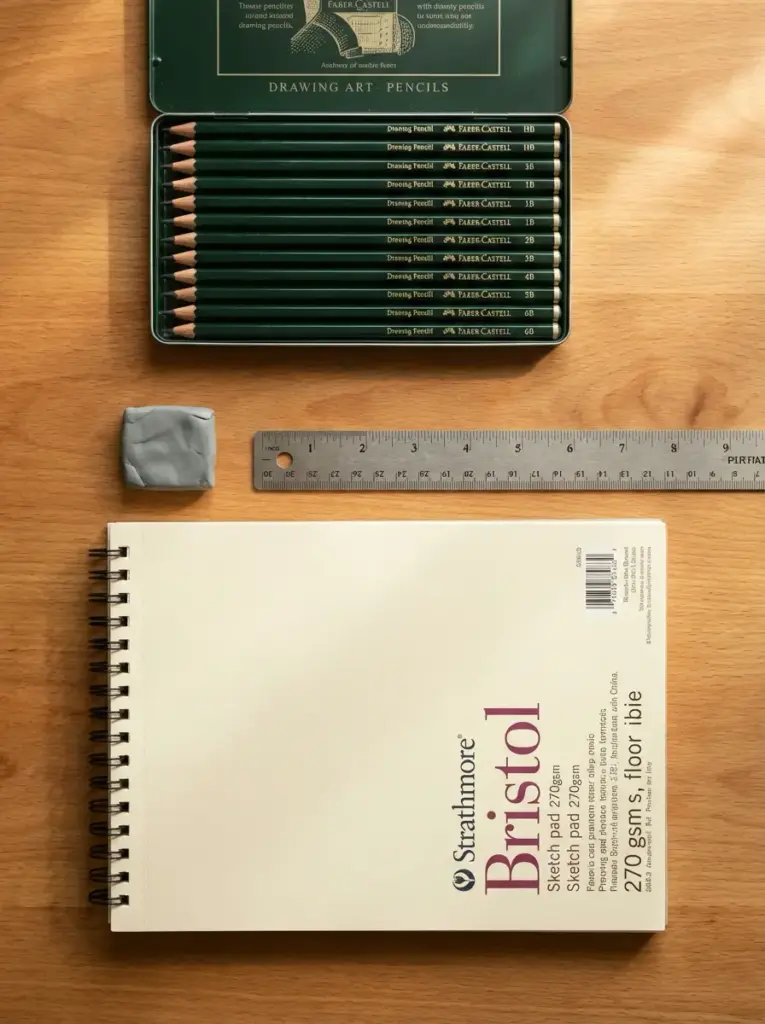
The foundation kit I’d recommend: HB for construction geometry and initial light blocking, 2B for bodywork shading and medium tones, 4B for deep shadows in wheel arches and under the body, and a 6B for the darkest areas like open doorways and tire sidewalls. Faber-Castell 9000 pencils ($14 for a set of eight) are the benchmark here — consistent graphite density and clean layering. The Staedtler Mars Lumograph set is equally good and slightly harder, which some artists prefer for automotive work where control matters.
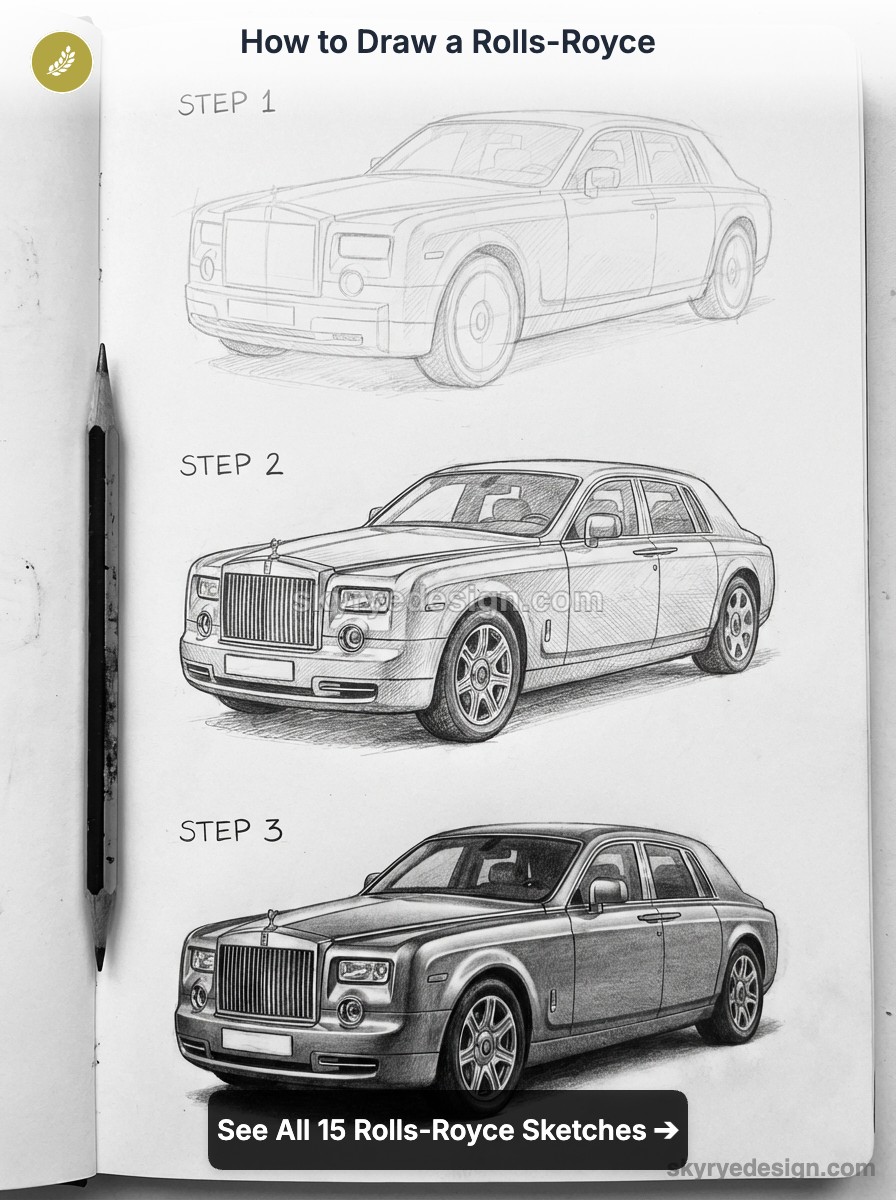
One underrated tool for Rolls-Royce sketches: a sharp H or 2H pencil for the initial geometry. The Pantheon grille requires very precisely spaced vertical bars, and getting those right in light construction lines before committing with a 2B saves enormous time.
Paper: Smooth Surface Is Non-Negotiable
Strathmore Bristol 270gsm smooth surface is the right choice for Rolls-Royce drawings. The car’s long, flat hood and formal door panels need to shade as clean, gradual gradients — rough paper texture fights that. A 9×12 pad runs about $18 and is the most useful format for side and 3/4 views. Canson Bristol 250gsm is the budget alternative at around $12; it performs well for practice work.
I keep a strip of the same Bristol paper taped beside my drawing to test pencil pressure before touching the main sketch. On a car as formal as a Phantom, a single over-pressed line on the hood can ruin twenty minutes of careful work.
| Pro Tip: Before sketching any Rolls-Royce, spend five minutes just observing the reference photo. Identify the three or four lines that make the car unmistakably a Rolls. For the Phantom, those are: the vertical grille face, the flat hood plane, the long rear door, and the Spirit of Ecstasy silhouette. Draw those confidently first. Everything else supports them. |
How to Draw a Rolls-Royce Phantom: Step by Step
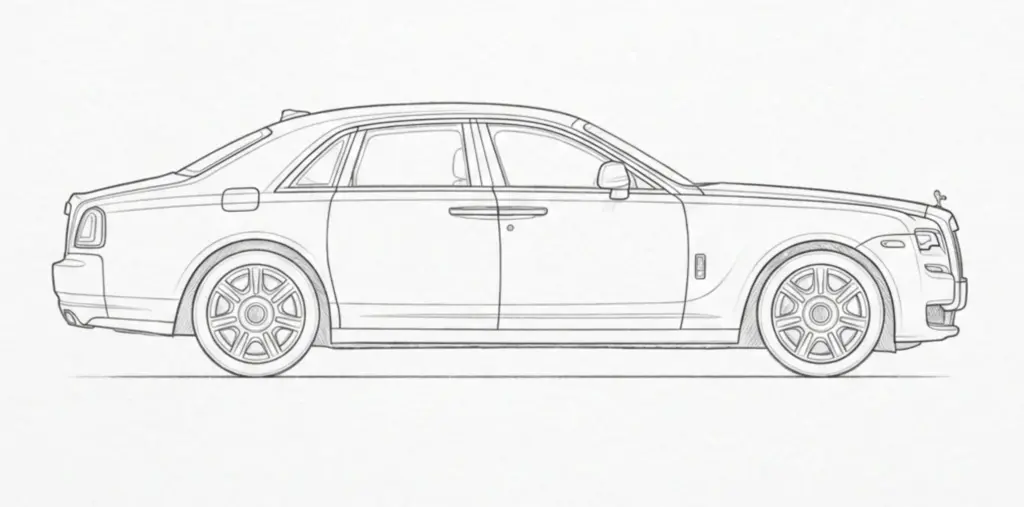
The Phantom is the ideal Rolls-Royce to learn first. Its lines are cleaner and more architectural than the Ghost or Spectre, which means fewer subtle curves to get wrong. The 2025 Phantom Series II is the reference model here — it received updated LED headlamps with intricate detailing and redesigned 23-inch wheels, making the front end sharper than earlier generations.
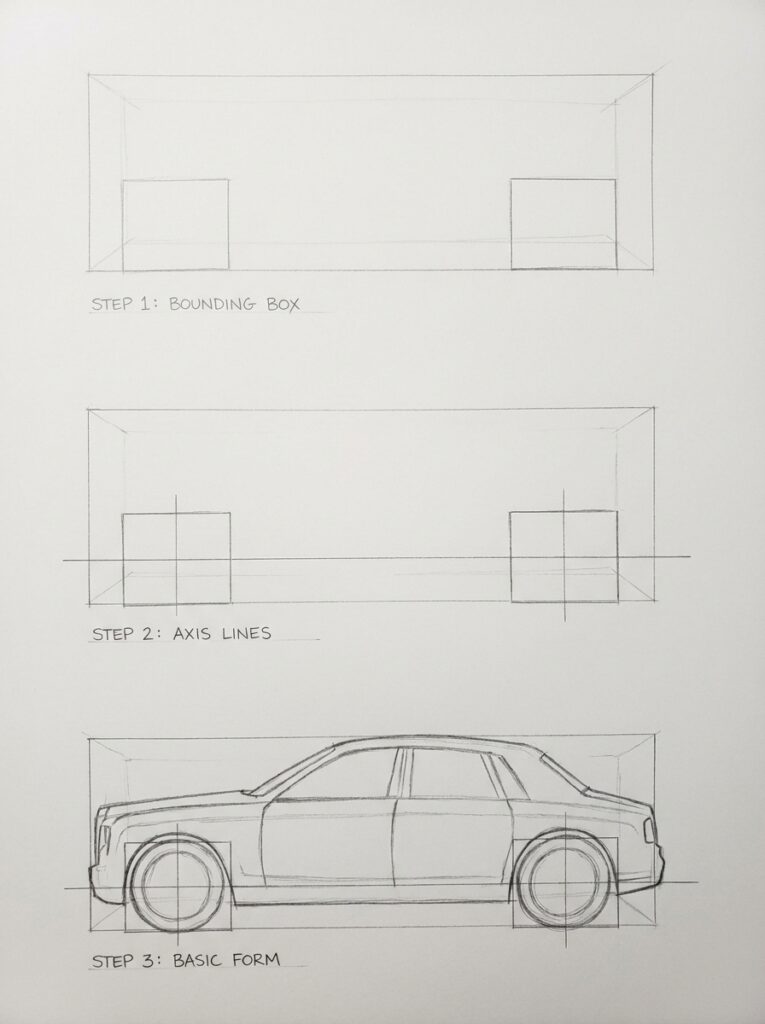
| Step 1: Establish the Bounding Box. Draw a rectangle roughly 3.5:1 width to height. The Phantom is a massive car — 5.77 metres long in standard form and 5.98 metres in Extended wheelbase — and its sketch should feel imposing on the page. Mark a horizontal centre axis for the wheel centres. Unlike most modern cars, where the body sits well above this axis, the Phantom’s body comes close to the wheel centre line, reflecting its low-slung, formal posture. |
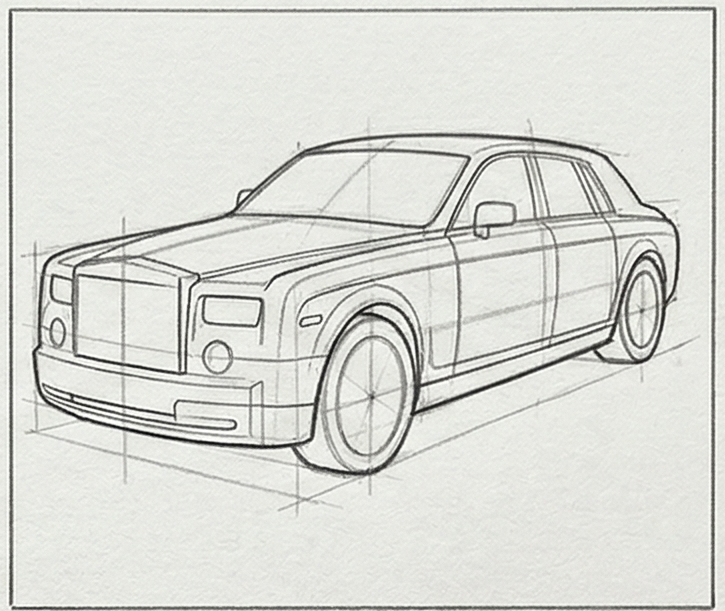
| Step 2: Place the Wheels and Wheelbase. Mark the front and rear wheel positions along your centre axis. The Phantom’s wheelbase is long — the rear wheel is set significantly back from the visual midpoint of the car, leaving a very long front overhang ahead of the front wheel. This front overhang is one of the car’s signature proportions. Get it too short and it reads as a generic luxury sedan. The 23-inch wheels are large; their diameter should equal roughly 30% of the car’s total height. |
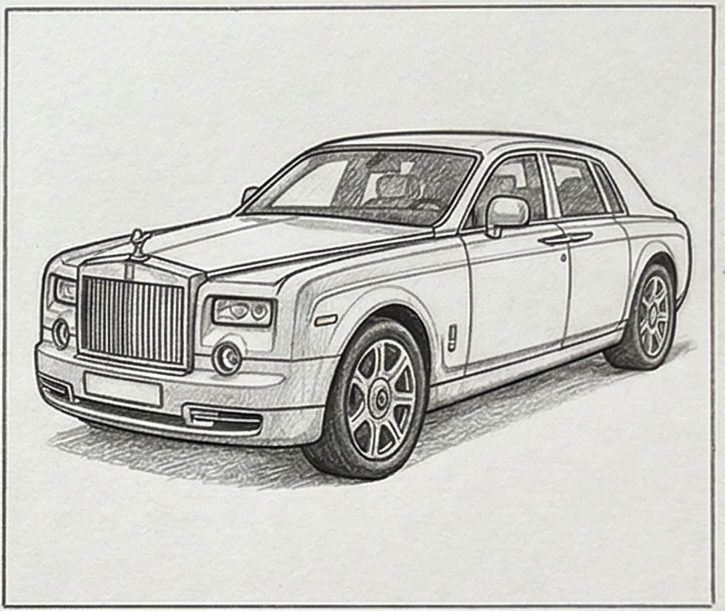
| Step 3: Block the SilhouetteWith light HB lines, sketch the overall body shape. The Phantom has a very upright C-pillar (rear roof support) — much more vertical than contemporary cars. The roofline is essentially flat from windscreen to rear. The front end rises steeply from the bumper to the hood level. The hood itself is nearly horizontal, with minimal slope. These geometric, almost architectural proportions are what separates the Phantom from every other luxury car. |
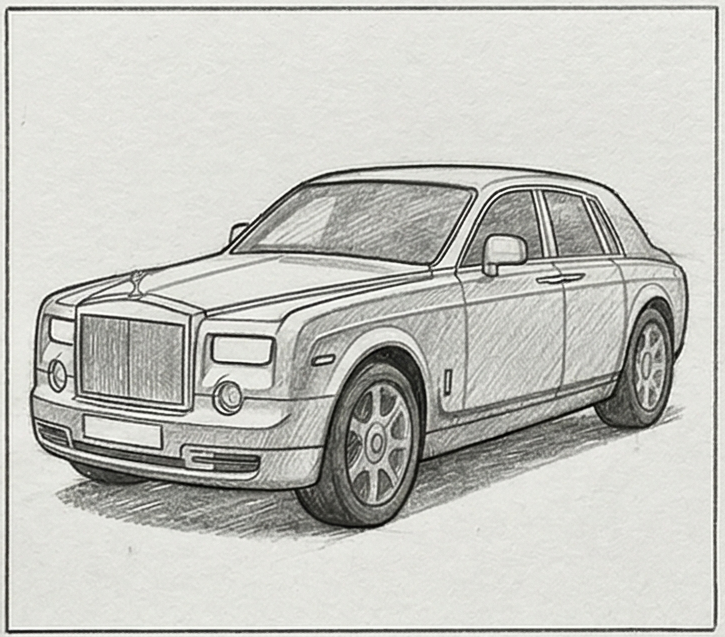
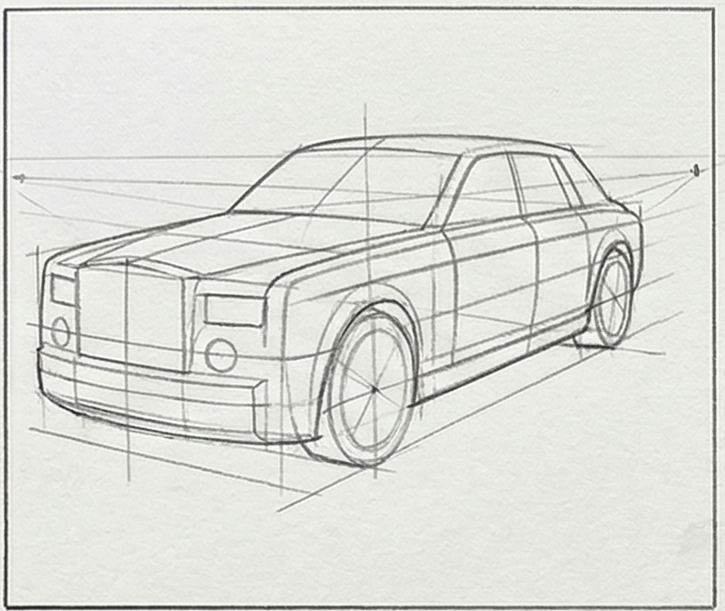
| Step 4: Draw the Pantheon GrilleThis is the defining detail. The Pantheon grille is tall, rectangular, and perfectly vertical — it does not slant back into the car the way most modern grilles do. It should occupy approximately the full height of the front end from bumper to hood. Inside the frame, draw evenly spaced vertical bars — the 2025 Series II Phantom features an illuminated grille with refined brightwork around each bar. Use an H pencil and a ruler to get the spacing consistent before switching to 2B to darken the bars. The Spirit of Ecstasy mascot sits at the top of the grille surround: a small, forward-leaning figure with outstretched arms. Even at sketch size, getting this silhouette right makes the drawing unmistakably Rolls. |
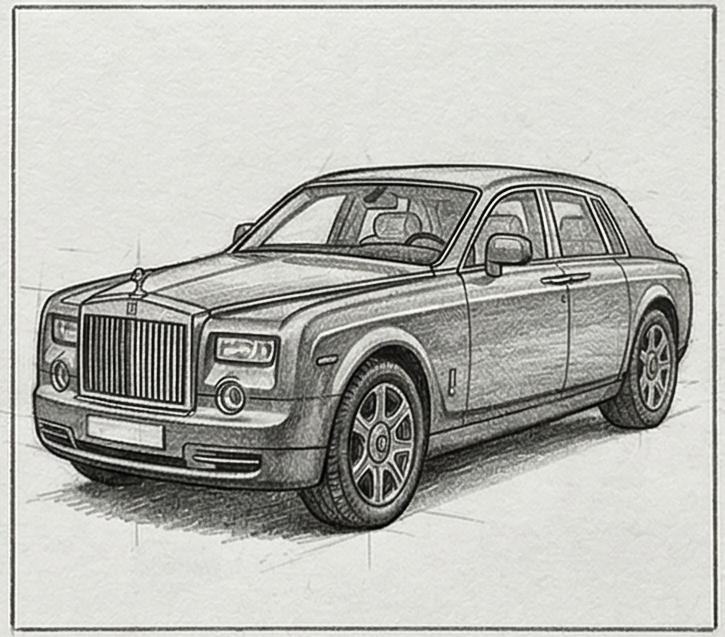
| Step 5: Add Headlamps, Doors, and GreenhouseThe 2025 Phantom’s LED headlamps are slim and horizontal, with intricate internal detailing — draw them as narrow rectangular shapes flanking the grille. The greenhouse (glass area) has a formal, almost rectangular profile with upright pillars. The rear doors are coach-opening (suicide doors): they’re hinged at the rear and open backwards from a central B-pillar. In a side-profile sketch, mark where this central pillar falls — it’s further forward than on a conventional car. The rear door is noticeably longer than the front door. |
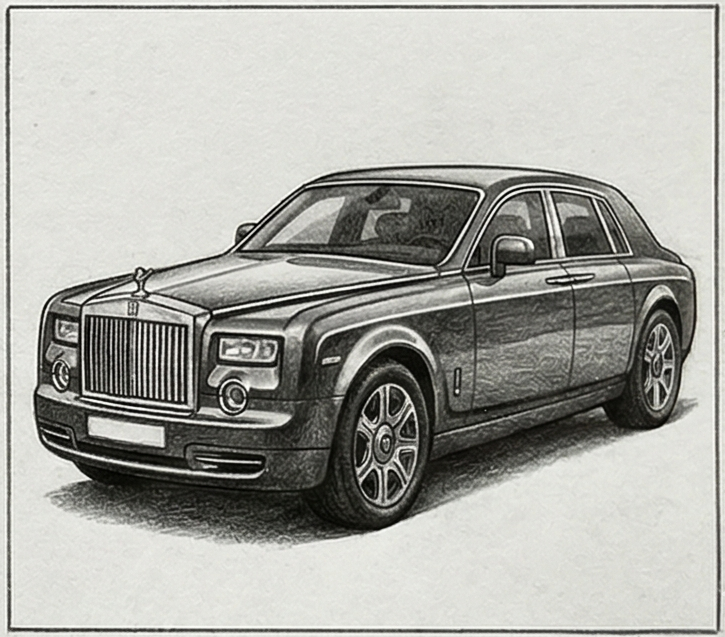
| Step 6: Shade and FinishSwitch to your 2B and 4B pencils. The Phantom’s hood is a large, flat surface — shade it with very long, even strokes to suggest the mirror-like paint. The wheel arches get 4B for the inner shadow. The grille interior is darker than the chrome surround — use 4B there. Leave the upper surface of the hood and the upper door panels largely white, representing the car’s characteristic light reflections. The Spirit of Ecstasy mascot can be shaded with small directional strokes following the flow of the robes. |
| Pro Tip: The Rolls-Royce coach door (rear-hinged door) is the single detail that most beginners draw incorrectly. In a side view, the rear door’s rear edge aligns with the D-pillar at the back of the car. The B-pillar sits roughly above the rear wheel arch. Study this carefully before committing — getting the door hinge point wrong changes everything. |
How to Draw the Rolls-Royce Pantheon Grille and Spirit of Ecstasy
These two elements are the identity of every Rolls-Royce drawing. Get them right and the sketch reads as unmistakably correct. Get them wrong and no amount of careful bodywork shading will save it.
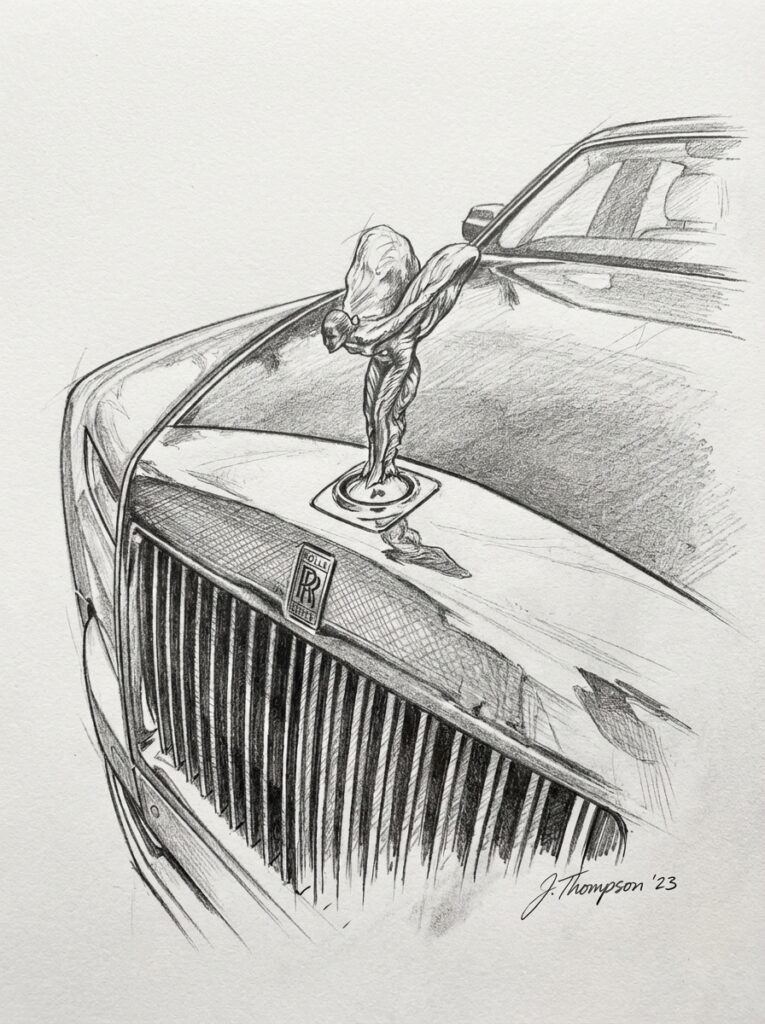
The Pantheon Grille: Precision Over Flair
Unlike the Bentley matrix grille (which is all about hatching texture), the Pantheon grille is about architectural precision. Here’s the sequence:
- Use a ruler and H pencil to draw the outer rectangular frame first — keep it perfectly vertical
- Divide the interior into evenly spaced vertical columns (count the reference photo carefully — the 2025 Phantom has a specific bar count)
- Each bar is slightly rounded on the face and narrower toward the bottom — subtle, but visible at close range
- The chrome surround catches strong light: leave the outer edges of the frame as white paper, then shade inward with a 2H pencil for the mid-tones
- The interior between the bars is darker — use 2B for the shadows between bars, leaving the bar faces lighter
The Spirit of Ecstasy: The World’s Most Recognised Car Mascot
The Spirit of Ecstasy has graced every Rolls-Royce since 1911. She’s a standing female figure with outstretched arms and flowing robes, leaning slightly forward as if into the wind. Drawing her well at sketch scale (typically 1-2cm tall in a full car drawing) requires understanding her key shapes: a triangular torso, wide swept arms, and robes that sweep back into a triangular tail.
At small scale, simplify: draw the head and arms as a wide T-shape, add the forward lean, then add the robe sweep as a backward-flowing triangular form. Don’t attempt realistic detail at sketch scale — the silhouette reads correctly if the proportions are right. Use a sharp 2B for the final lines.
Top 10 Rolls-Royce Models to Draw in 2026
Rolls-Royce’s current and recent lineup spans everything from a 3-tonne flagship limousine to a fully electric fastback coupe and ultra-rare coachbuilt one-offs. Each model is a distinct drawing challenge. Here’s the definitive ranked list for your sketchbook.
#1. Rolls-Royce Phantom VIII (2025 Series II)
The flagship. The Phantom Series II arrived for 2025 with an updated illuminated Pantheon grille, new LED headlights with intricate internal detailing, and redesigned 23-inch wheels. Starting price around $480,000. It’s the definitive Rolls-Royce drawing subject: the most architectural proportions, the most formal roofline, the clearest lines.
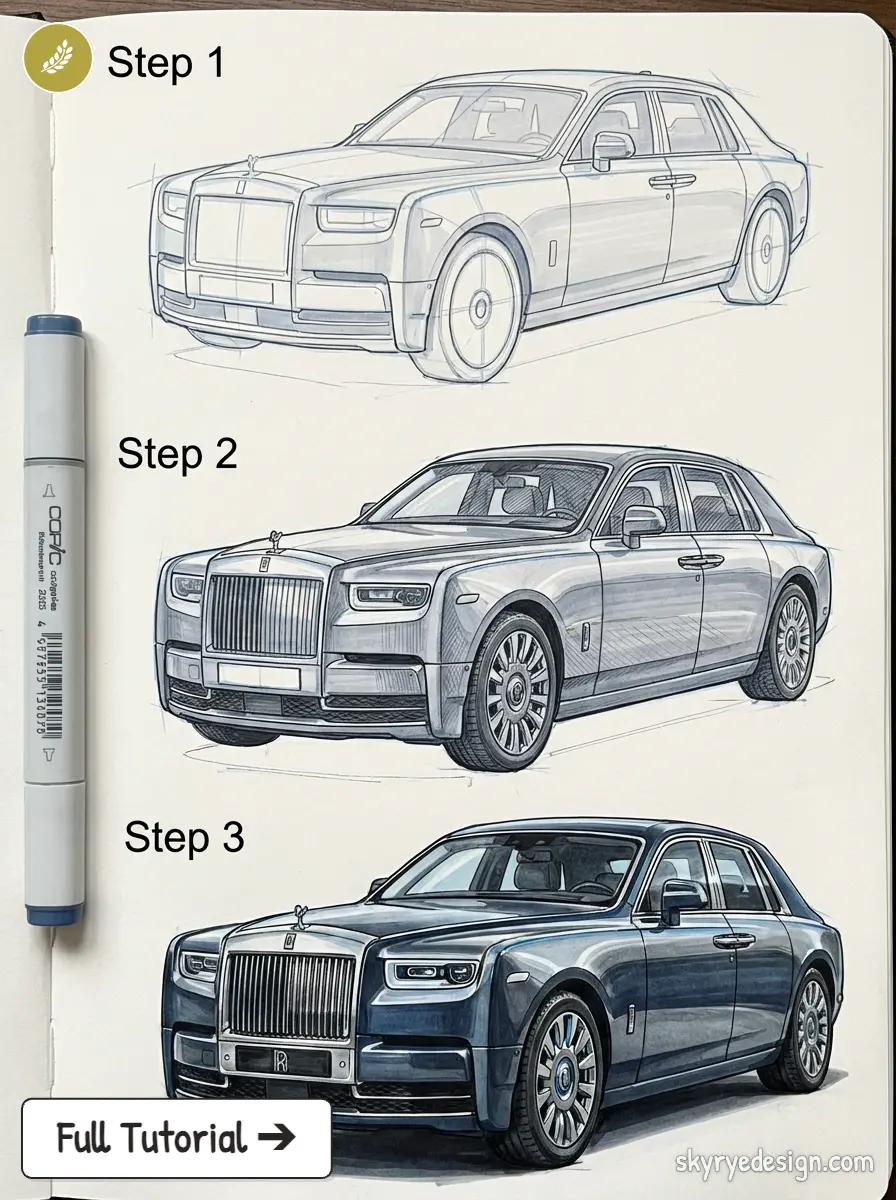
Drawing challenge: the hood is an almost perfectly flat, horizontal surface of enormous area. Shading it realistically requires extremely even, controlled pencil strokes. Any variation in pressure reads as a dent in the panel.
#2. Rolls-Royce Ghost Series II (2025)
The Ghost received a meaningful exterior refresh for 2025: a wider front grille, tapered headlights inspired by the Spectre, new Spectre-style tail lights, and new 22-inch wheel designs.
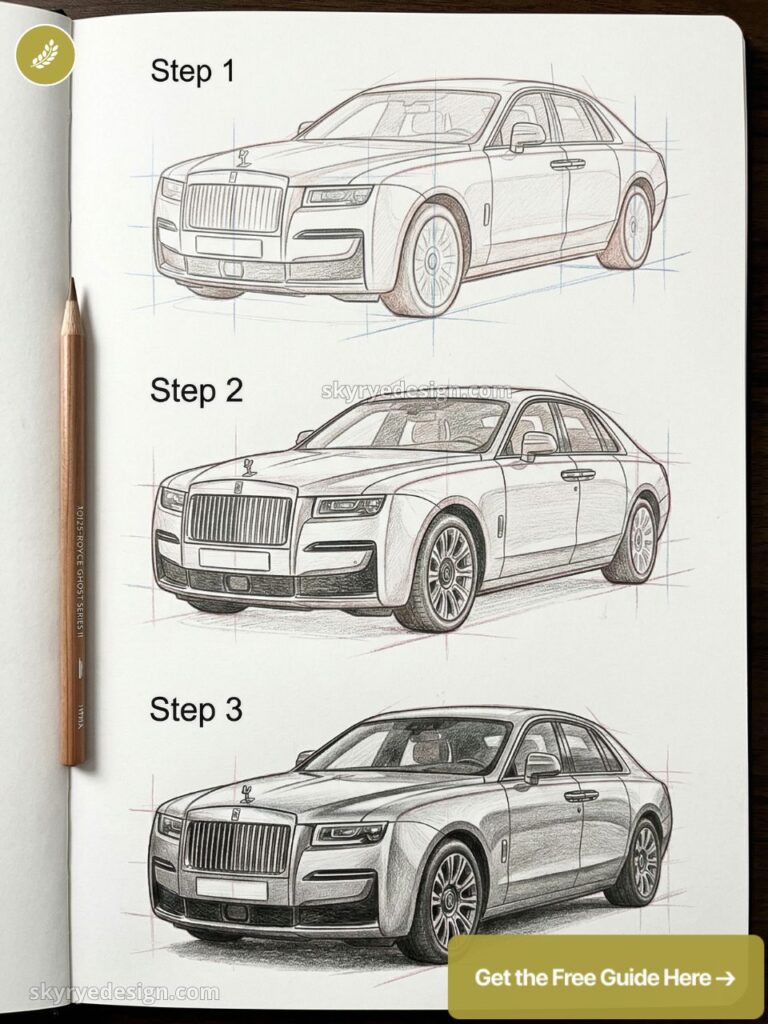
The 6.75-litre twin-turbo V12 engine produces 571 PS in standard form. The Black Badge version pushes over 600 PS with carbon fibre detailing throughout.
Drawing tip: the Ghost is fractionally lower and wider-looking than the Phantom. The front end is less vertically upright, making it feel slightly more dynamic. The wider 2025 grille is a key detail — proportionally broader than earlier Ghost generations.
#3. Rolls-Royce Spectre (Electric Coupe)
The Spectre is Rolls-Royce’s first fully electric car and a completely different visual proposition from the Phantom and Ghost.
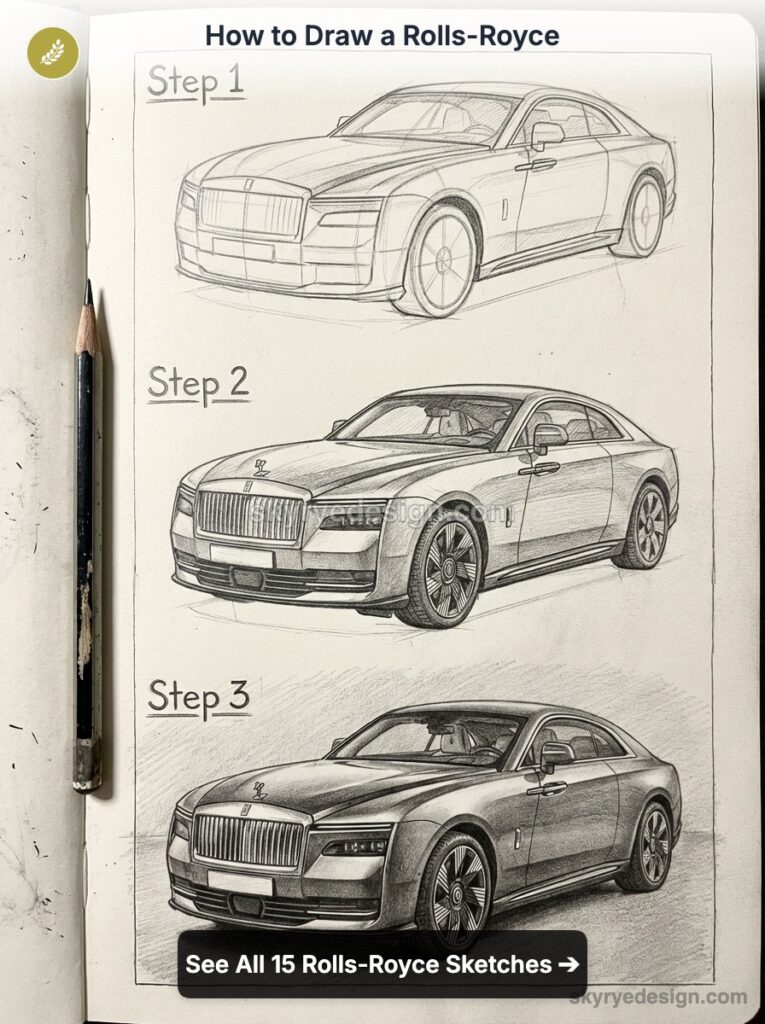
It’s a two-door fastback coupe — long, low, dramatically proportioned — with an illuminated Pantheon grille that glows at night. Starting around $423,000. The Spectre weighs more than the Phantom (the battery pack is heavy), which you can actually feel in the drawings: it sits very close to the ground.
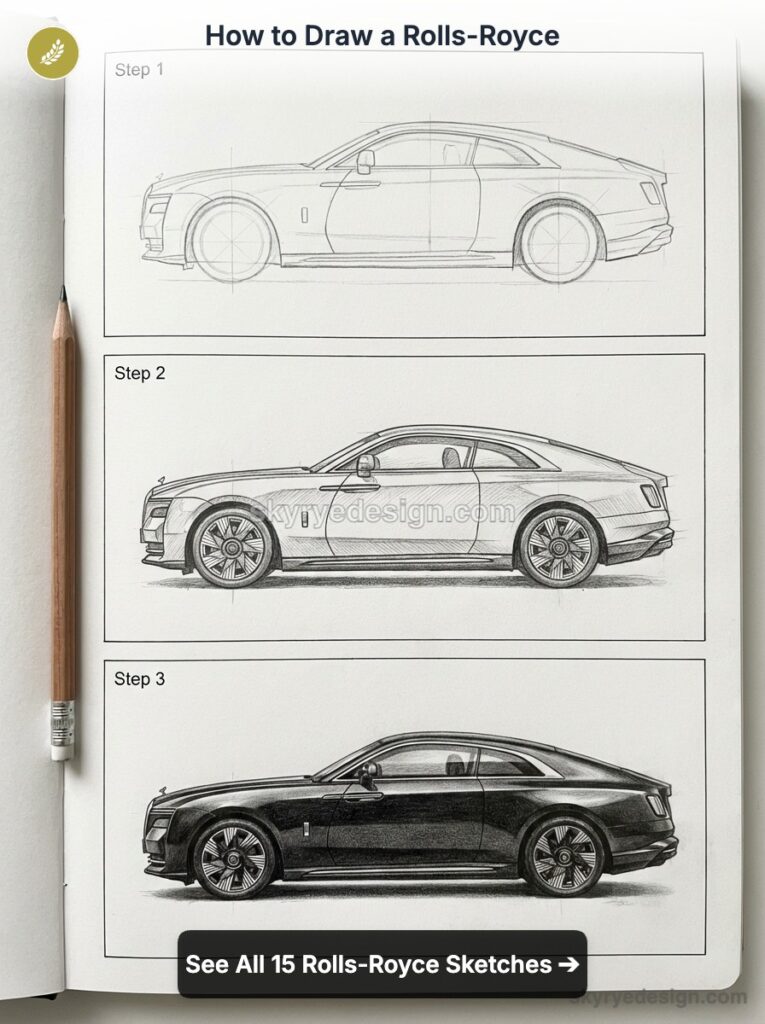
Drawing challenge: the fastback roofline sweeps dramatically from the A-pillar all the way to the tail. Getting this single unbroken curve right is what makes a Spectre sketch look correct. Draw it as one confident stroke — any interruption reads as a design break that shouldn’t be there.
#4. Rolls-Royce Cullinan Series II (2025)
Rolls-Royce’s ultra-luxury SUV received a significant mid-cycle refresh for 2025: redesigned headlights with new LED daytime running lights, a backlit illuminated grille, and 23-inch wheels as standard.
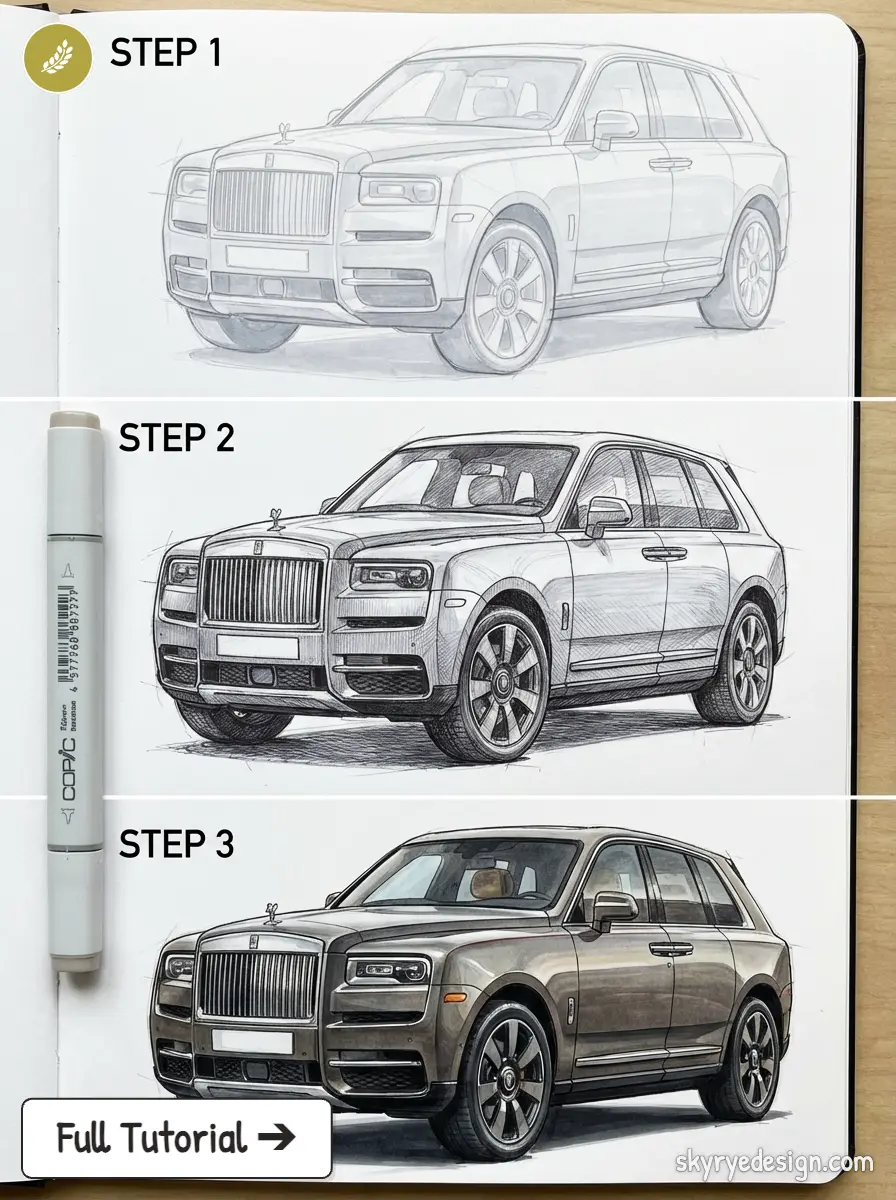
The Black Badge version adds gloss black trim and specific wheel designs.
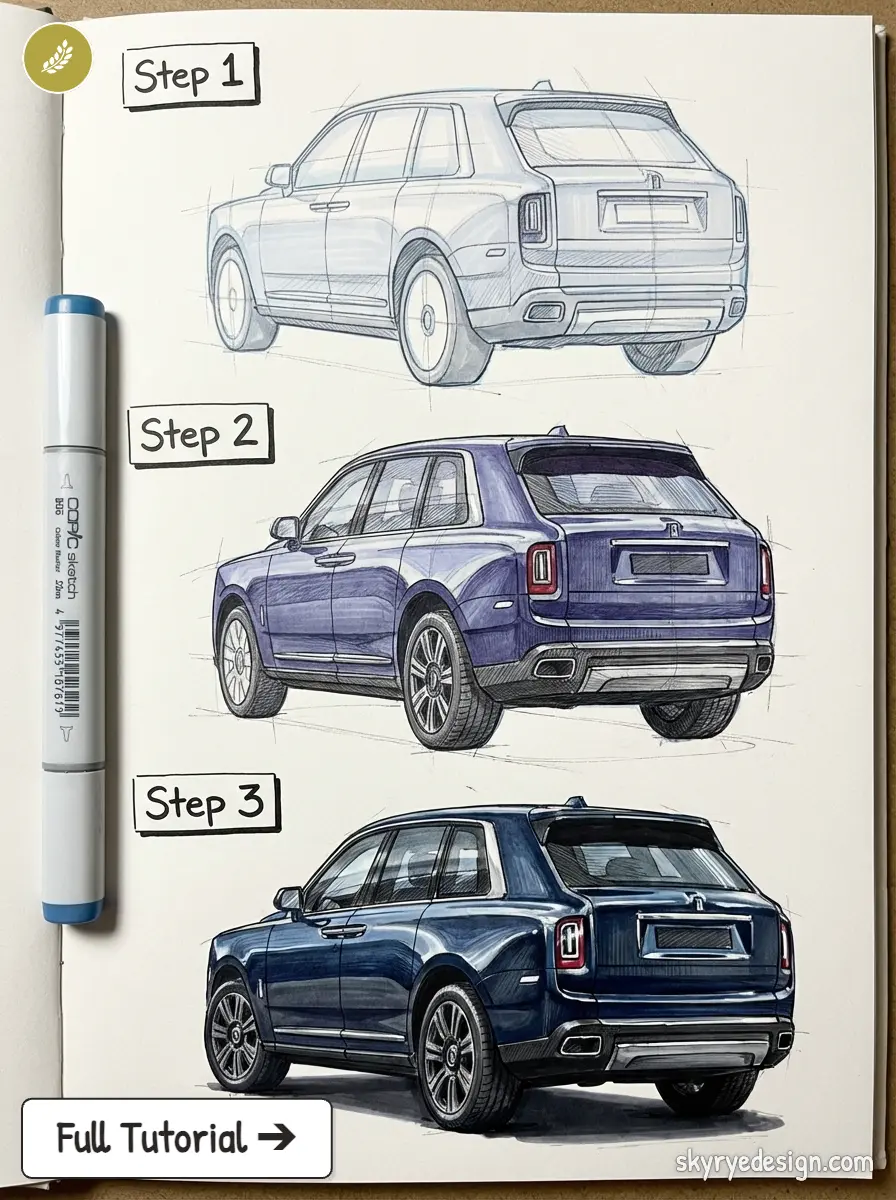
Drawing tip: the Cullinan is the most upright Rolls-Royce to sketch — very square proportions, near-vertical windscreen, and a high roofline. Unlike most modern SUVs which use raked, aerodynamic fronts, the Cullinan has a nearly vertical front face. This formality is the key to capturing it on paper.
#5. Rolls-Royce Wraith
The Wraith was discontinued after 2023, making it an increasingly collectible drawing subject. It was Rolls-Royce’s grand touring coupe — a fastback two-door with a swooping roofline and enormous coach doors.
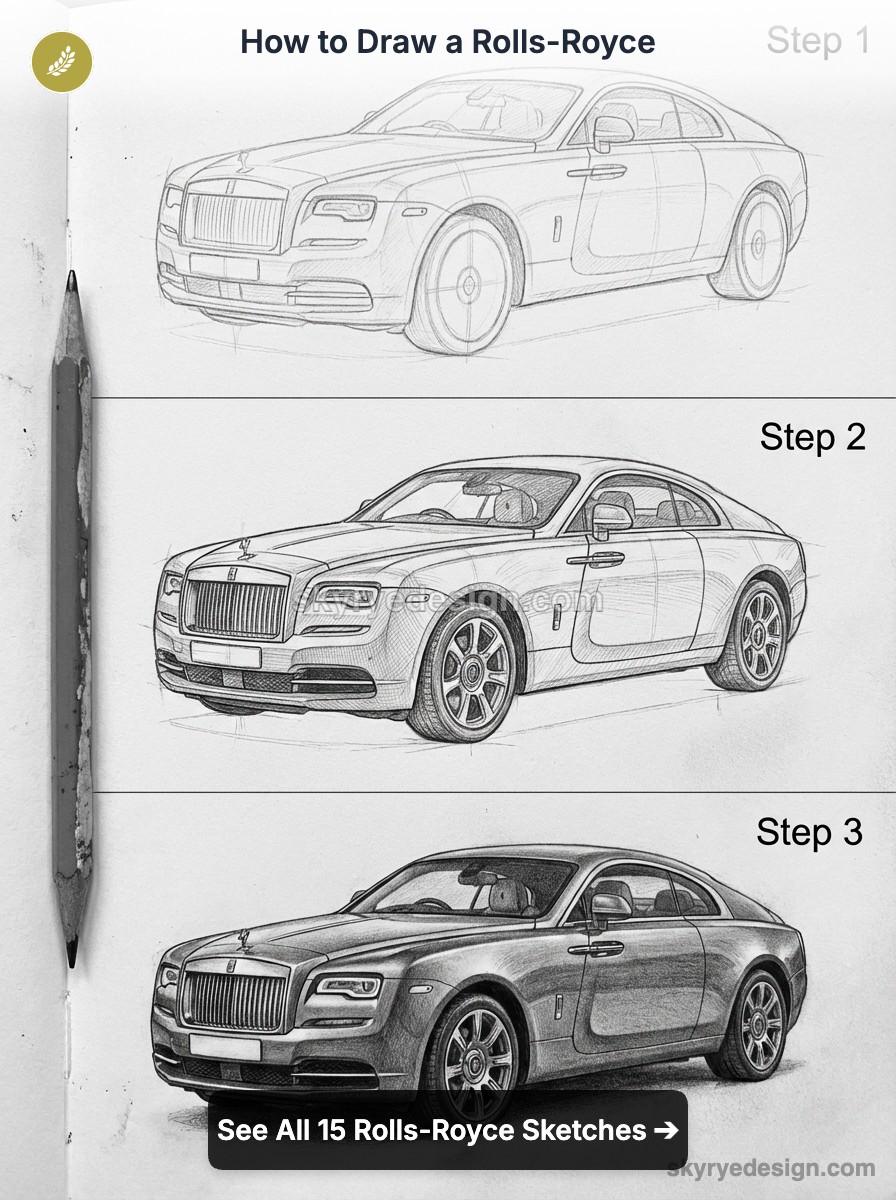
The 6.6-litre twin-turbo V12 produced 624 hp. Prices for used examples now start around $250,000.
Drawing challenge: the Wraith’s roofline is the most dramatic of any Rolls-Royce other than the Spectre. It drops steeply from the roof peak to the rear — almost like a shooting brake profile. The rear of the car has very little overhang, which gives the tail an abrupt, purposeful feel.
#6. Rolls-Royce Dawn
The Dawn was the convertible companion to the Wraith and was also discontinued in 2023. It shares the same wheelbase and much of the same visual DNA, but the folded fabric roof (when down) dramatically changes the car’s silhouette, creating an exposed, open-top profile.
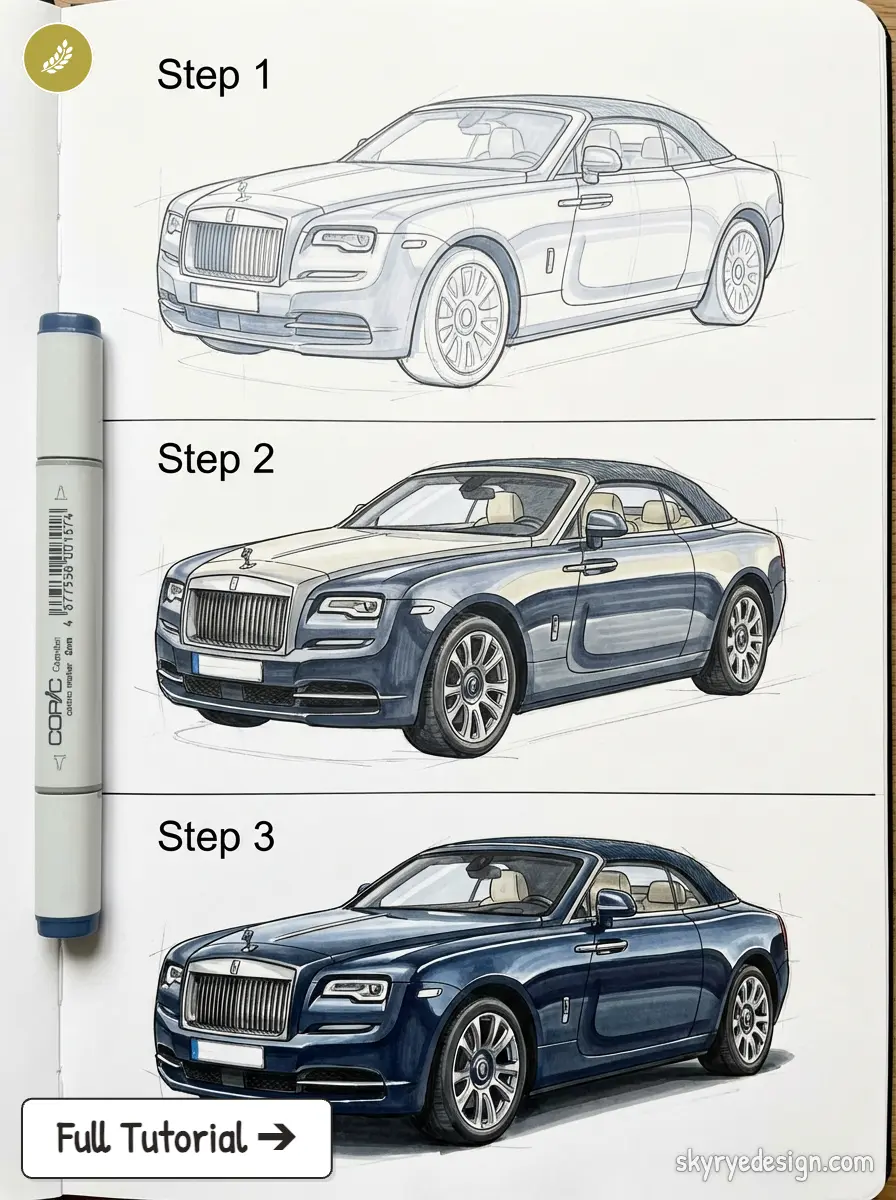
Only around 1,200 were made each year, making it a rare sight and a rewarding sketch subject.
Drawing tip: the Dawn with the roof down presents a unique drawing challenge — the folded roof stack sits behind the rear seats as a complex origami of fabric and mechanism. Simplify this to its basic mass: a rectangular block of material with a slight dome, sitting between the rear headrests and the trunk lid.
#7. Rolls-Royce Phantom Extended Wheelbase
The Phantom Extended adds 220mm to the standard Phantom’s wheelbase, creating one of the longest production cars in the world at nearly six metres. This extra length is all in the rear passenger compartment — the rear doors become even longer, and the rear overhang gains presence.
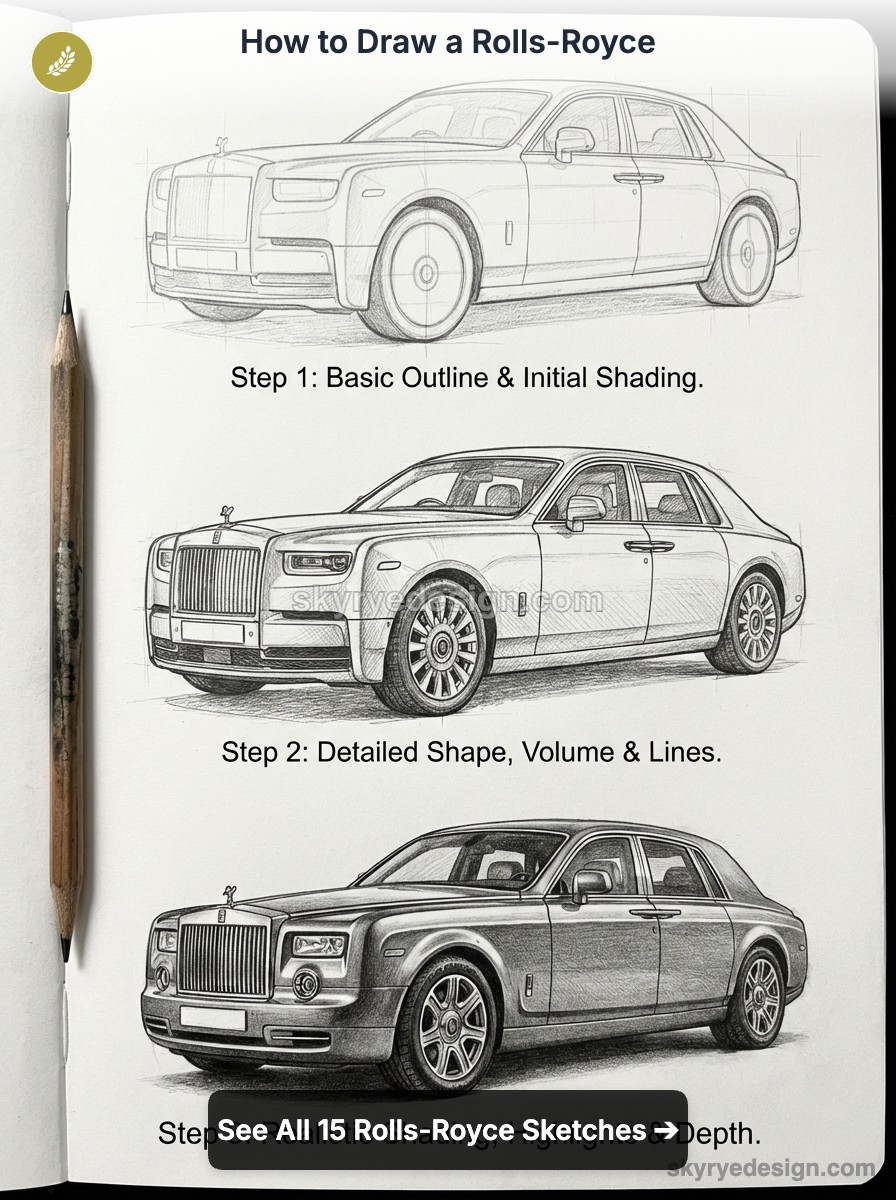
Drawing challenge: keeping an Extended Phantom looking elegant rather than just long requires careful attention to the roof rake. Even a few degrees more tilt on the roofline makes it feel ungainly. The roof should be essentially flat.
#8. Rolls-Royce Silver Shadow (Classic)
The Silver Shadow (1965–1980) is the most-drawn classic Rolls-Royce and a logical step for any sketchbook that covers the brand’s history. The design is famously box-like — a long, formal body with an upright grille, rectangular headlamps, and almost no visible curves on the flanks. Over 30,000 were made, making it the most common Rolls-Royce in existence.
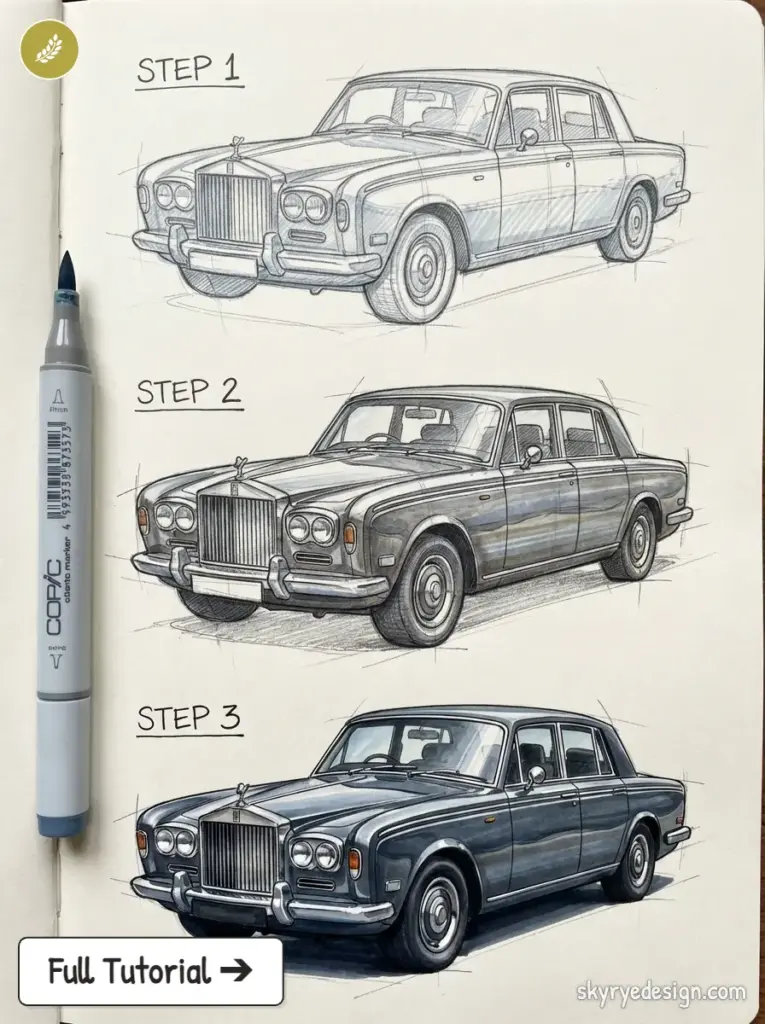
Drawing tip: The Silver Shadow is actually one of the more forgiving Rolls-Royce subjects for beginners. The geometric simplicity of the body — mostly flat planes — means that straightedge-guided construction lines capture the car accurately. Spend your effort on the wheel details and the grille, both of which are characterful.
#9. Rolls-Royce Boat Tail (Coachbuild)
Only three Boat Tails were made, each one unique, each costing reportedly around $28 million. The Boat Tail is Rolls-Royce’s most dramatic modern design: an open-top rear-deck barchetta body with a distinctive wooden ‘boat tail’ deck that opens to reveal a hosting suite. The visual drama is extraordinary.
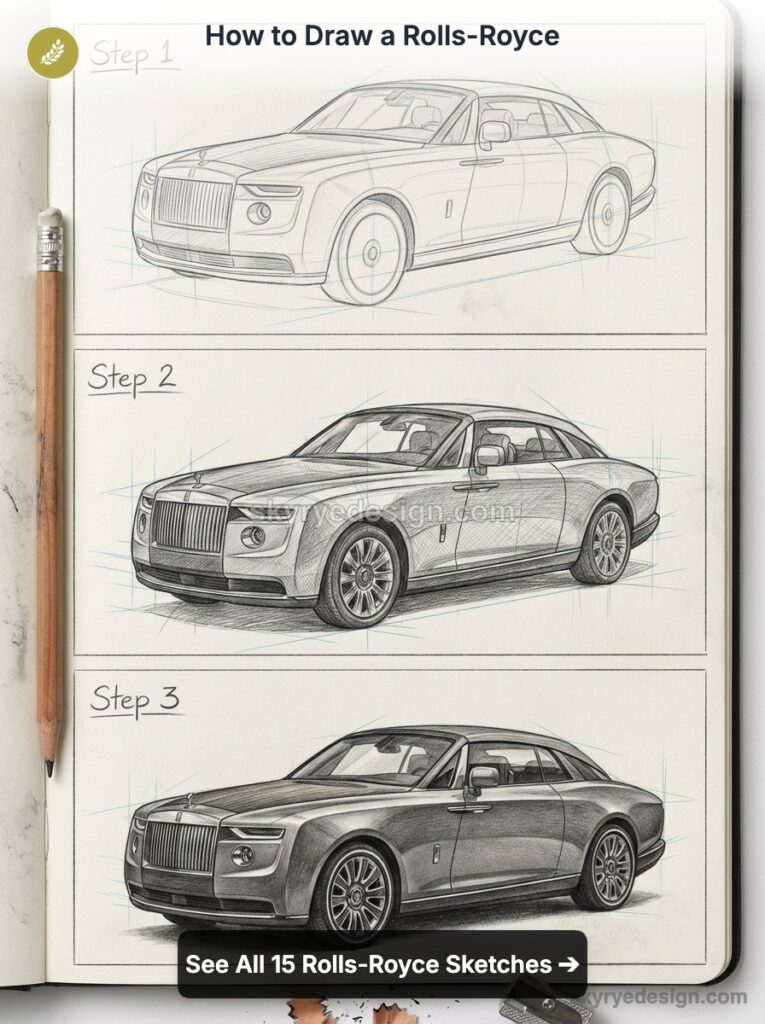
Drawing challenge: after the Boat Tail, use a rounded Volkswagen Beetle drawing as a compact contrast. The Rolls-Royce is long and ceremonial; the Beetle is short, soft, and all about keeping the roof arc believable.
#10. Rolls-Royce Droptail (Coachbuild)
The Droptail is the spiritual successor to the Boat Tail — another small series of coachbuilt open-top cars from Rolls-Royce’s Coachbuild division. It takes a different approach to the rear deck: where the Boat Tail has a wooden deck, the Droptail has a more fluid, sculptural rear form.
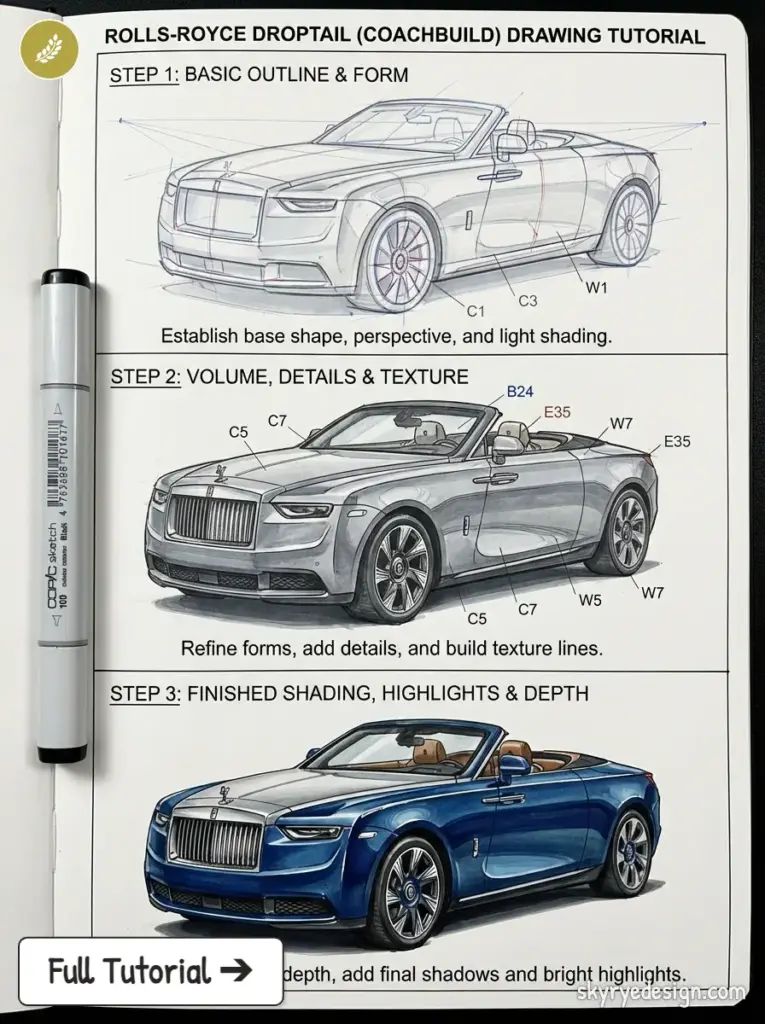
The interior is notable for its use of the world’s largest piece of wood veneer ever installed in a car — a single continuous piece spanning the entire dashboard.
Drawing tip: the Droptail’s most distinctive feature from a sketch perspective is the way the rear bodywork forms a complete, enclosed shape behind the cockpit — like a smooth fuselage tail. No sharp edges, no transitions. It’s an exercise in drawing a perfect compound curve.
Common Rolls-Royce Drawing Mistakes — and How to Avoid Them
Making the Grille Too Narrow
The Pantheon grille is wide and dominant on the front face. Beginners consistently make it too narrow — perhaps from habit drawing sportier cars with narrower intakes. On the Phantom, the grille should span almost the full width of the front end. If your grille looks modest or recessed, widen it.
Luxury SUVs use some of the same formal drawing problems: upright grille, heavy body mass, clean shoulder line, and large wheels. This SUV exterior sketching guide is a useful bridge before drawing the Cullinan or other tall luxury vehicles.
Getting the Coach Door Wrong
The rear-hinged coach door is the most technically specific detail on any Rolls-Royce sedan. In a side view, the B-pillar (the central pillar where both doors meet) sits roughly above the rear edge of the front wheel arch — not in the middle of the car as beginners often assume. Mark this point first before drawing either door.
The Spirit of Ecstasy Too Large
The Spirit of Ecstasy mascot is surprisingly small relative to the car. On the actual Phantom, she’s about 10cm tall — tiny on a 5.8-metre car. In a sketch, she should be barely noticeable at distance, readable only as a silhouette. Beginners tend to draw her too large, which makes the front end look like a trophy rather than a car.
Forgetting the Formal Roofline
Every Rolls-Royce sedan has an essentially flat roofline from roughly the B-pillar rearward. It’s one of the brand’s most distinctive proportional choices — a deliberate rejection of the raked, sporty rooflines that characterise almost every other modern luxury car. If your sketch shows a roofline that drops noticeably toward the rear, straighten it.
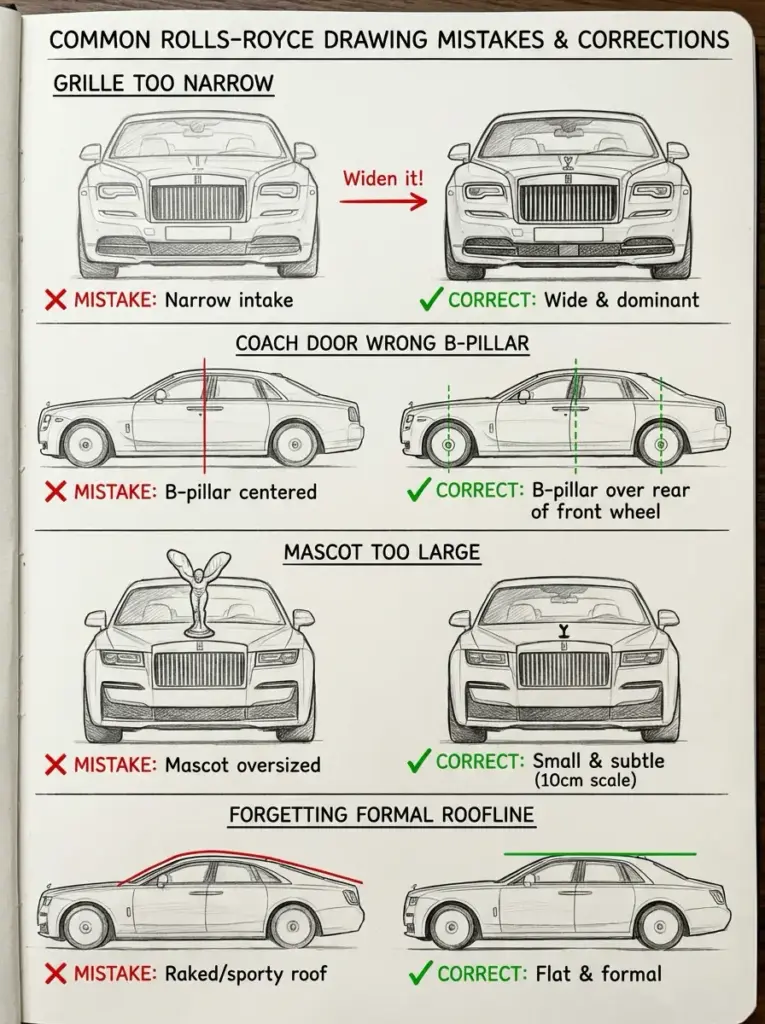
| Pro Tip: A useful proportion check for any Rolls-Royce sketch: hold a ruler along the roofline. It should be nearly horizontal. Then hold it along the front grille face — it should be nearly vertical. If both checks pass, your sketch has the fundamental Rolls-Royce proportional identity right. |
Frequently Asked Questions
Q: What is the easiest Rolls-Royce model to draw for beginners?
The Rolls-Royce Silver Shadow (1965–1980) is the most approachable starting point due to its very geometric, box-like body. The flat panels and simple rectangular shapes are more forgiving than the subtle curves of modern models like the Ghost or Spectre. Once you’ve mastered the Silver Shadow’s proportions and grille placement, the modern lineup becomes much more manageable.
Q: How do you draw the Spirit of Ecstasy mascot?
At sketch scale, the Spirit of Ecstasy is best approached as a silhouette rather than a detailed figure. Draw a wide T-shape for the arms and torso, add a slight forward lean, then sweep the robes back into a triangular tail. The figure is tiny relative to the car — typically 1–2cm in a full-size sketch — so restrain the detail. A sharp 2B pencil works well for the final lines.
Q: What makes Rolls-Royce cars harder to draw than other luxury cars?
Rolls-Royce’s design DNA relies on formal architectural proportions — vertical grilles, flat rooflines, coach doors — rather than the flowing curves of, say, a Ferrari or even a Bentley. These near-geometric shapes demand precision. A line that’s 5 degrees off vertical on a Pantheon grille is immediately visible, whereas a similar error on a rounded bumper is barely noticeable.
Q: How long does it take to draw a detailed Rolls-Royce Phantom sketch?
A fully rendered Phantom sketch typically takes 4–7 hours for someone with drawing experience. The flat surfaces and architectural lines reward careful, patient work. Many artists split this across three sessions: proportions and construction, grille and details, final shading. Rushing the grille detail in particular tends to undermine the entire drawing.
Q: What paper and pencils work best for Rolls-Royce car sketches?
Smooth-surface Bristol board is essential for Rolls-Royce’s flat panel surfaces — Strathmore Bristol 270gsm or Canson Bristol 250gsm. For pencils, a range from H (construction lines) through HB and 2B (bodywork and grille) to 4B and 6B (deep shadows) covers everything. Faber-Castell 9000 and Staedtler Mars Lumograph are both excellent pencil ranges for automotive work.
Q: What is the Rolls-Royce Pantheon grille and why is it significant?
The Pantheon grille is Rolls-Royce’s signature front design element: a tall, rectangular grille with vertical bars, inspired by the columns of the Parthenon in Athens. It’s been a consistent feature of Rolls-Royce design since the early twentieth century, evolving from a simple functional shape to the illuminated, backlit design on the 2025 Phantom Series II. It’s the single most important detail to get right in any Rolls-Royce sketch.
Q: Which Rolls-Royce model is the most dramatic to draw?
The Rolls-Royce Boat Tail coachbuilt model. Only three exist, each reportedly around $28 million, with a sweeping open rear deck in the style of a classic racing boat. The silhouette is unlike any other modern car. The Spectre electric coupe is the most dramatic from the current production lineup, with a fastback roofline that drops in a single unbroken curve from A-pillar to tail.
- 995shares
- Facebook0
- Pinterest995
- Twitter0
- Reddit0