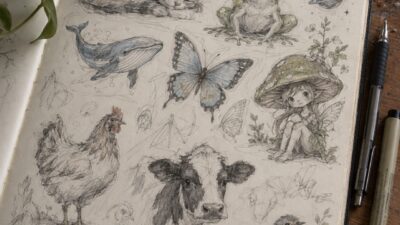
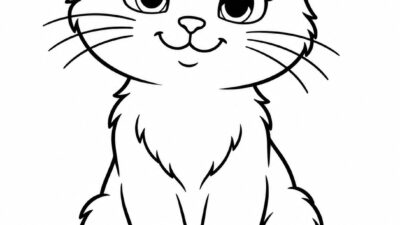
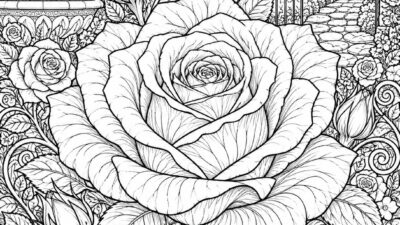
The first double-page spread I ever decorated in a bullet journal took me two hours and came out looking like a crime scene involving a botanical garden and a box of Stabilo pens. The mushrooms were misshapen, the wildflowers had stems that bent at inexplicable angles, and whatever I’d intended to be a delicate vine border had turned into something resembling a hostile root system.
I photographed it anyway. Posted it. And seventeen people told me it was ‘so cosy’ and asked what pen I used.
If you came here for bullet journal doodles you can actually copy, start with tiny shapes: leaves, moons, mushrooms, mugs, clouds, and simple food sketches. Most of the 75 ideas below fit in a 1cm margin, a weekly spread corner, or a monthly cover page, and each one has a quick construction note so you know where the first line goes.
- Tools that make bullet journal doodles easier
- 75 Aesthetic Bullet Journal Doodles
- Theme 1: Cottagecore Botanicals — Doodles 1 to 12
- 01. Classic Mushroom — Easy
- 02. Mushroom Cluster — Easy
- 03. Single Wildflower — Easy
- 04. Daisy Chain — Easy
- 05. Simple Leaf Wreath — Medium
- 06. Fern Frond — Easy
- 07. Blackberry Sprig — Medium
- 08. Lavender Stem — Easy
- 09. Potted Succulent — Easy
- 10. Hanging Vine Banner — Medium
- 11. Acorn and Oak Leaf — Medium
- 12. Wildflower Bouquet — Detailed
- Theme 2: Celestial and Moon Doodles — Doodles 13 to 22
- 13. Crescent Moon — Easy
- 14. Star Cluster — Easy
- 15. Saturn — Easy
- 16. Sun with Face — Easy
- 17. Constellation Line Art — Medium
- 18. Moon Phase Row — Medium
- 19. Shooting Star — Easy
- 20. Celestial Eye — Medium
- 21. Planet Row — Medium
- 22. Galaxy Swirl — Detailed
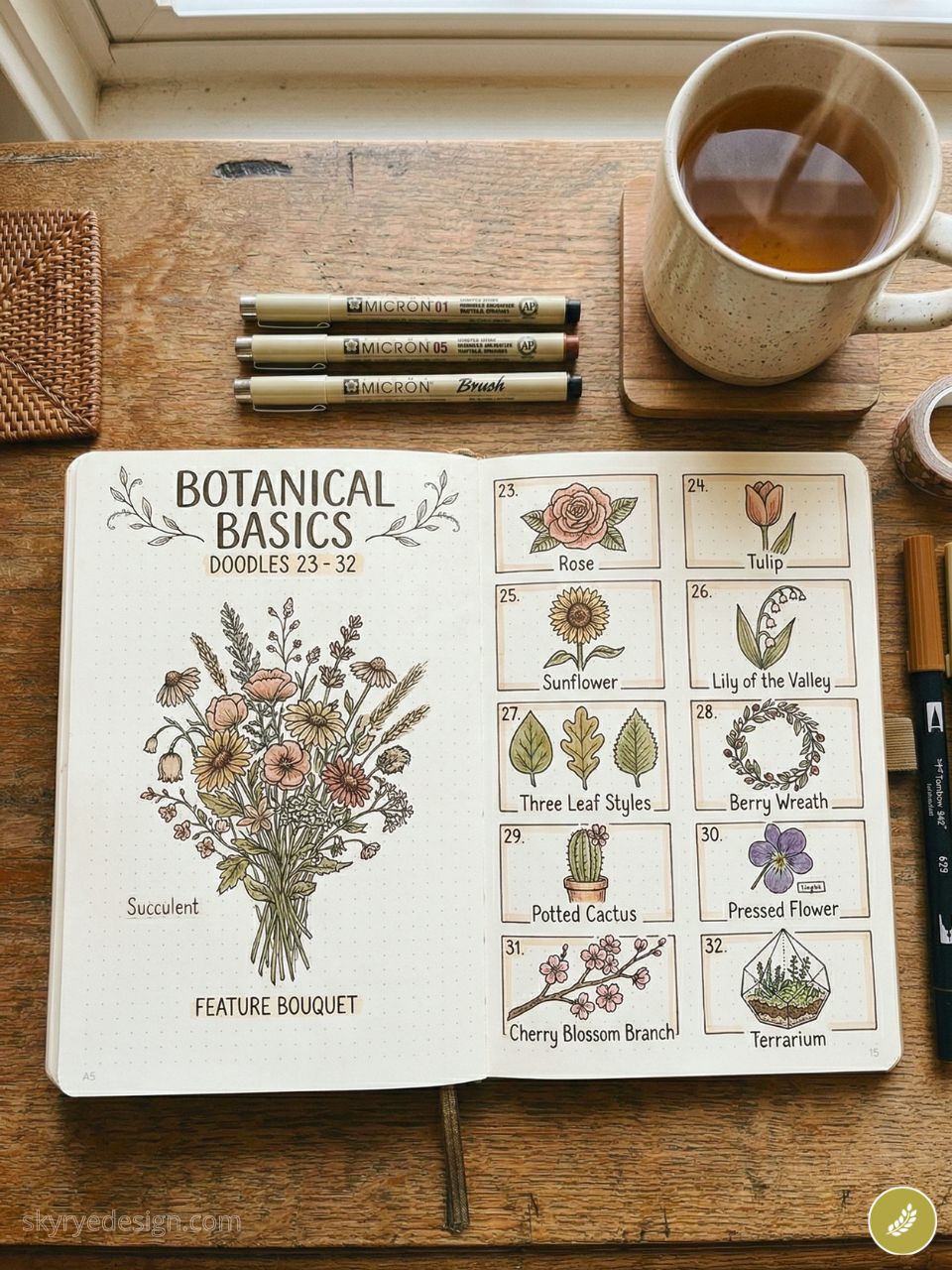
- Theme 3: Botanical Basics — Doodles 23 to 32
- 23. Simple Rose — Medium
- 24. Tulip — Easy
- 25. Sunflower — Medium
- 26. Leaves in Three Styles — Easy
- 27. Cactus — Easy
- 28. Lily of the Valley — Medium
- 29. Simple Wreath with Berries — Medium
- 30. Pressed Flower Effect — Detailed
- 31. Branch with Blossoms — Medium
- 32. Terrarium — Detailed
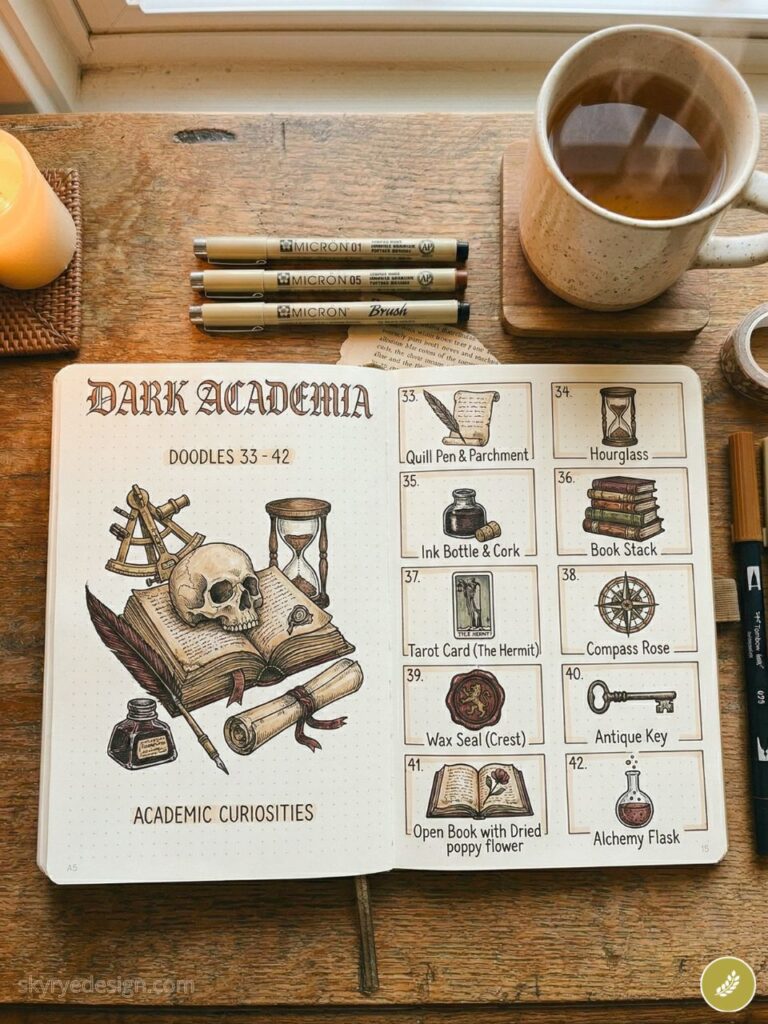
- Theme 4: Dark Academia — Doodles 33 to 42
- 33. Quill Pen — Easy
- 34. Hourglass — Medium
- 35. Ink Bottle — Easy
- 36. Stack of Books — Easy
- 37. Tarot Card — Medium
- 38. Compass Rose — Medium
- 39. Wax Seal — Easy
- 40. Antique Key — Medium
- 41. Open Book with Pressed Flower — Detailed
- 42. Alchemy Flask — Medium
- Theme 5: Y2K and Retro Digital — Doodles 43 to 50
- 43. Pixel Star — Easy
- 44. Old Computer Screen — Easy
- 45. Flip Phone — Easy
- 46. Glitter Starburst — Easy
- 47. CD or Vinyl — Medium
- 48. Retro Camera — Medium
- 49. Butterfly (Y2K Style) — Easy
- 50. Star and Heart Confetti — Easy
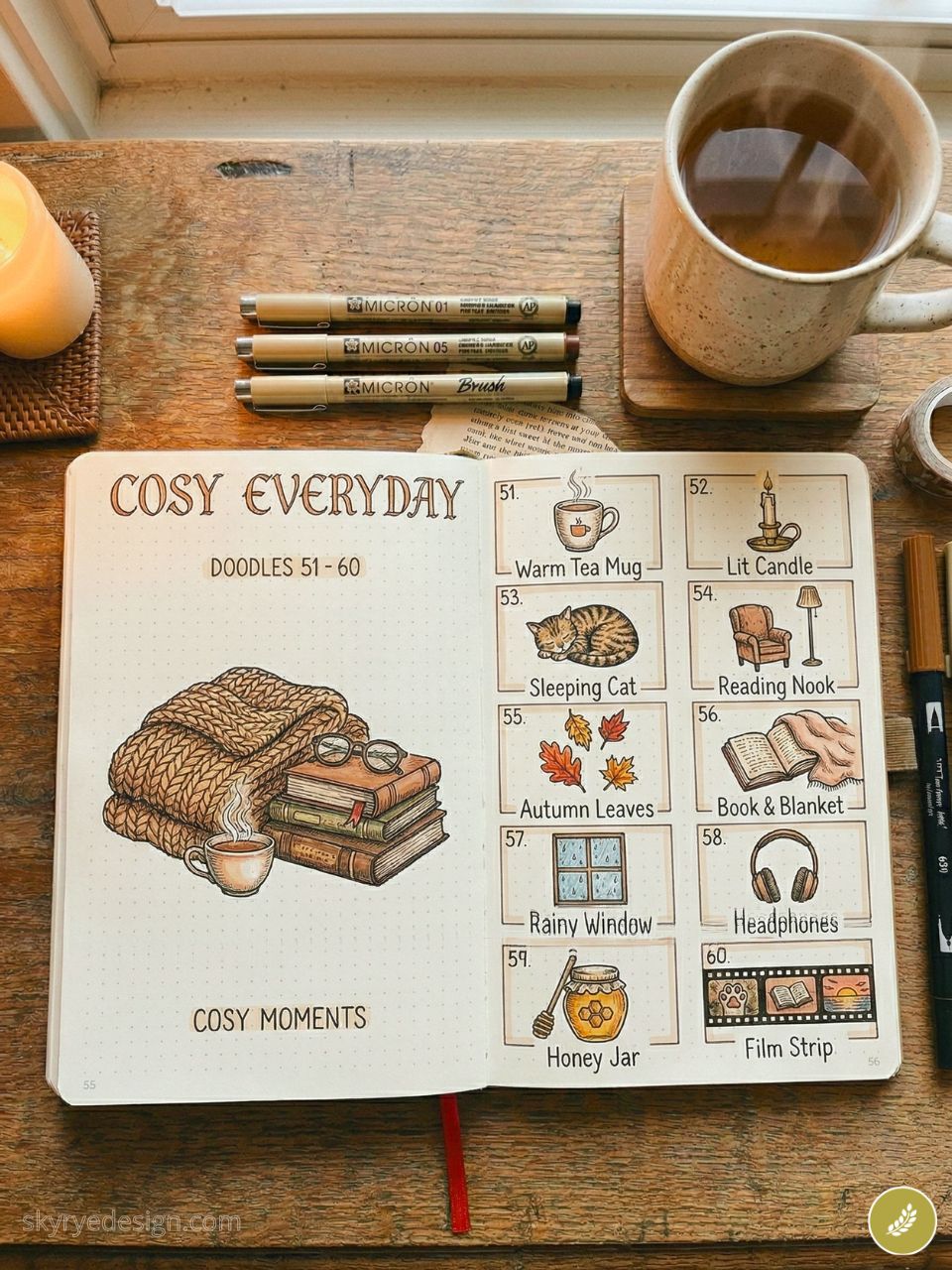
- Theme 6: Cosy Everyday Objects — Doodles 51 to 60
- 51. Mug of Tea or Coffee — Easy
- 52. Candle — Easy
- 53. Cat (Sleeping) — Easy
- 54. Reading Nook Scene — Detailed
- 55. Autumn Leaf Fall — Easy
- 56. Cosy Blanket and Book — Medium
- 57. Rain on a Window — Medium
- 58. Headphones — Easy
- 59. Jar of Honey — Easy
- 60. Film Strip — Medium
- Theme 7: Nature Elements and Weather — Doodles 61 to 68
- 61. Cloud Varieties — Easy
- 62. Rainbow Arc — Easy
- 63. Snowflake — Medium
- 64. Ocean Wave — Easy
- 65. Mountain Silhouette — Easy
- 66. Butterfly in Flight — Easy
- 67. Spider Web Corner — Medium
- 68. Fox in Autumn Leaves — Detailed
- Theme 8: Food, Drink, and Tiny Treats — Doodles 69 to 75
- 69. Croissant — Easy
- 70. Slice of Cake — Easy
- 71. Ramen Bowl — Medium
- 72. Strawberry — Easy
- 73. Latte Art Cup — Medium
- 74. Macaron Stack — Easy
- 75. Picnic Spread — Detailed
- How to Use These Doodles in Your Bujo Spreads
- Pens, Paper, and Learning Resources
- The Wonky Mushroom Is the Point
- FAQ: Bullet Journal Doodles
- Q: What are the best pens for bullet journal doodles?
- Q: How do I start doodling if I cannot draw?
- Q: What bullet journal doodles are best for beginners?
- Q: How long does it take to decorate a bullet journal spread?
- Q: What paper is best for bullet journal doodles?
- Q: What are the most popular bullet journal doodle themes in 2026?
That was the moment I understood what bullet journal doodles actually are: not a test of artistic skill, but a practice of presence. The slightly wonky mushroom is not a failure. It’s proof that a real person with a real pen sat with that page for a while. The aesthetic bullet journal doodle doesn’t compete with graphic design or fine art — it occupies a different category entirely, one where personality and effort matter more than technical precision.
This collection of 75 designs covers the eight biggest doodle themes for 2026, from the fast and forgiving to the properly satisfying challenge, with difficulty ratings and drawing notes for each one so you can find your level and start immediately.
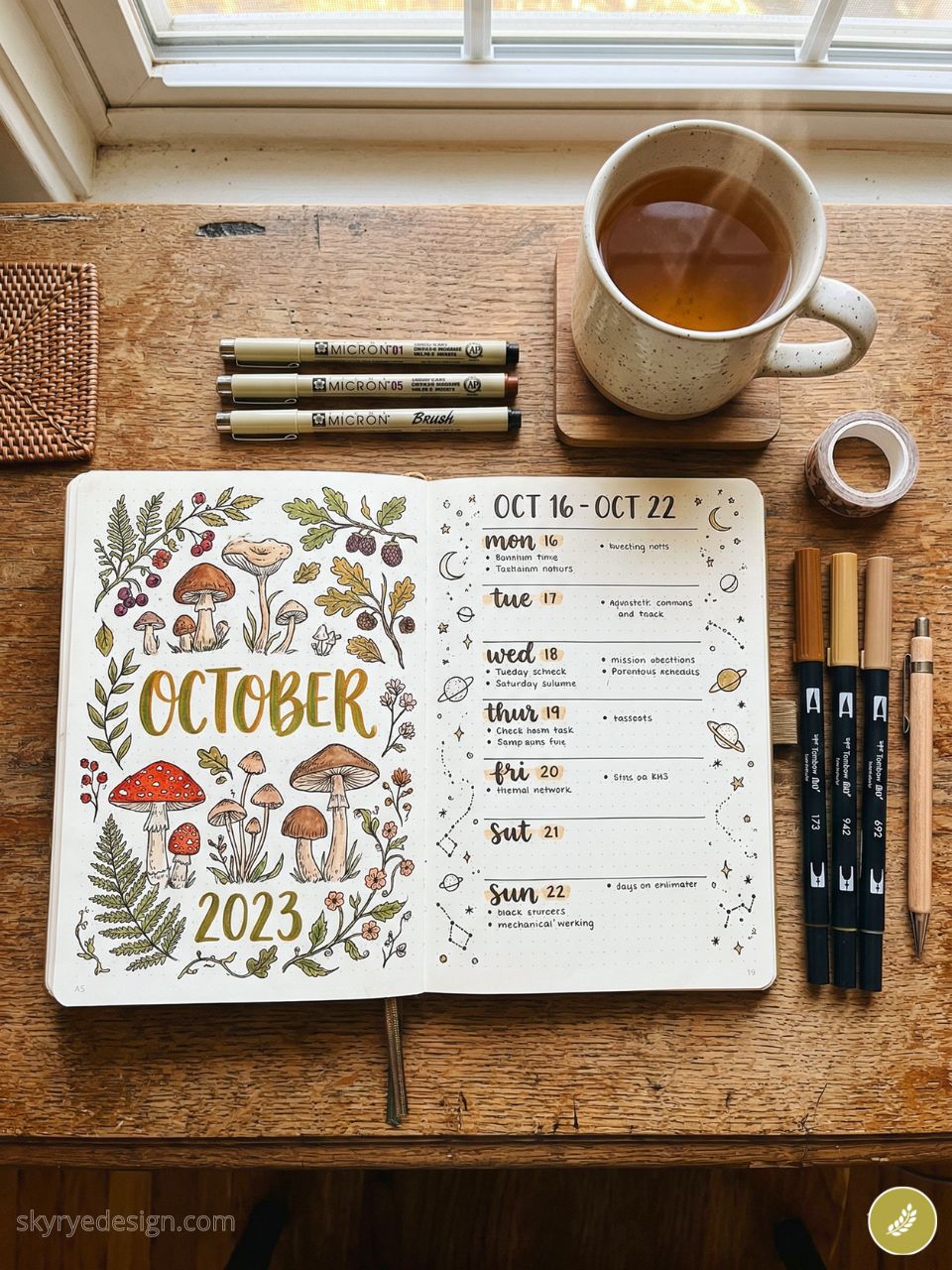
Tools that make bullet journal doodles easier
You don’t need much — but the right tools make a genuine difference to how enjoyable doodling feels and how your finished page looks.
The Essential Pen Kit
- Sakura Pigma Micron fineliners — the most widely trusted bujo doodling pen. Available in sizes 0.05mm through 0.8mm (~$3-4 each). The 0.1mm and 0.3mm cover 90% of doodle needs. Pigment-based ink is waterproof and fade-resistant, and it doesn’t bleed through dotted paper from Leuchtturm1917 or Rhodia.
- Staedtler Triplus Fineliner set (~$15 for 20 colours) — the best entry-level colour option. Consistent line width, good colour range, and a triangular grip that reduces hand fatigue in long doodling sessions.
- Tombow Dual Brush Pens (~$3-4 each, sets from ~$25) — for soft watercolour-style fills and gradient shading. The brush tip creates the characteristic blended look in botanical and celestial doodles. The fine tip is useful for lettering.
- Copic Sketch markers (~$8-9 each) — for serious colour work and smooth gradient fills. Alcohol-based ink blends beautifully but bleeds through standard paper; use on 160gsm or with a bleed sheet underneath.
- White gel pen (Uni-ball Signo UM-153, ~$3-4) — for highlights on dark backgrounds, sparkle effects on celestial doodles, and adding texture to botanicals. Non-negotiable for dark academia and Y2K doodle themes.
Paper and Journal Choice
The Leuchtturm1917 A5 dotted notebook (~$25) is the most popular choice among active doodlers for its 160gsm paper weight and the dot grid that provides alignment without showing in photographs. Rhodia Webnotebook (~$20) uses slightly lighter paper but has a wider page opening that makes double-page spreads easier. For marker-heavy work, consider a Leuchtturm1917 Some Lines A Day or a dedicated Canson marker pad alongside your journal for testing colours before committing to the page.
✏ Tip: Always sketch doodles in pencil first and trace over in fineliner before erasing. The pencil layer takes three seconds and saves the page from unrecoverable mistakes. A Pilot Dr. Grip mechanical pencil with a Sakura Foam eraser is the combination most bujo creators use — the foam eraser lifts graphite cleanly without ghosting on 160gsm paper.
75 Aesthetic Bullet Journal Doodles
The 75 doodles are grouped into eight themes. Each entry has a difficulty rating: Easy (complete beginner, basic shapes only), Medium (some practice helpful, multiple elements), or Detailed (patience required, worth the time).
If the botanical doodles are the part you keep coming back to, the step-by-step flower drawing tutorial is a good next stop. It shows how simple journal flowers turn into fuller daisies, tulips, roses, and loose floral clusters.
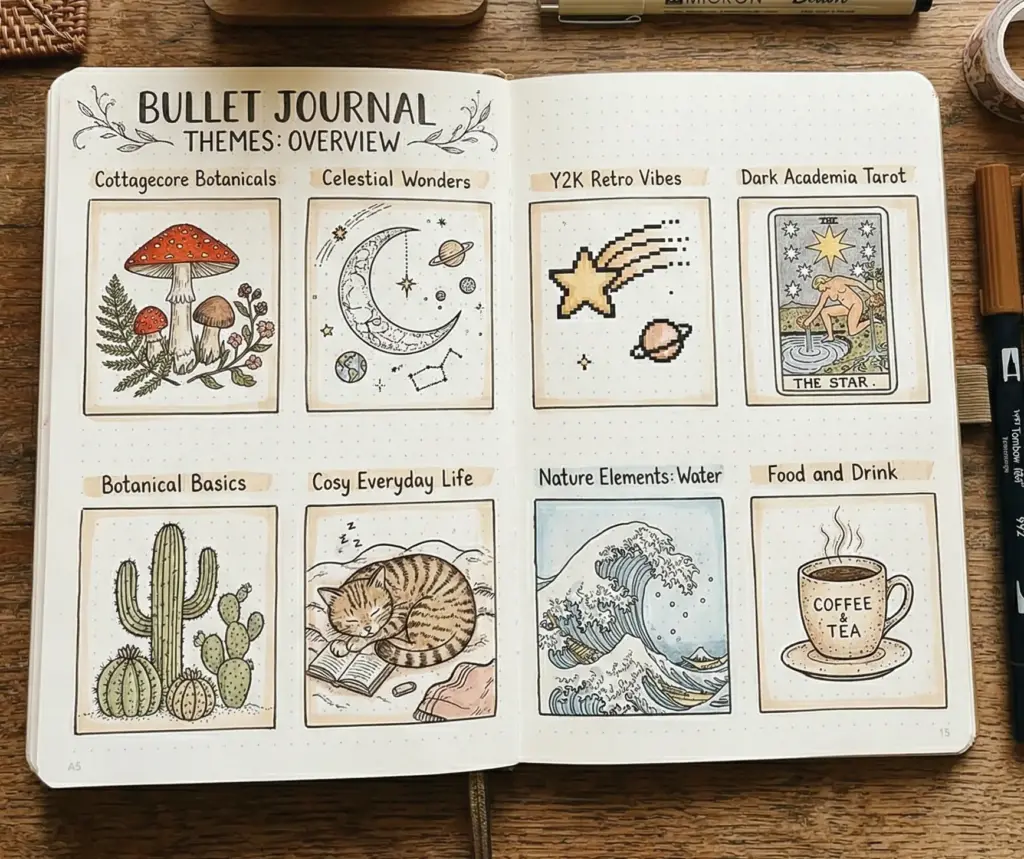
Most people find their natural level is Easy to Medium — that’s exactly where the most satisfying bujo doodles live.
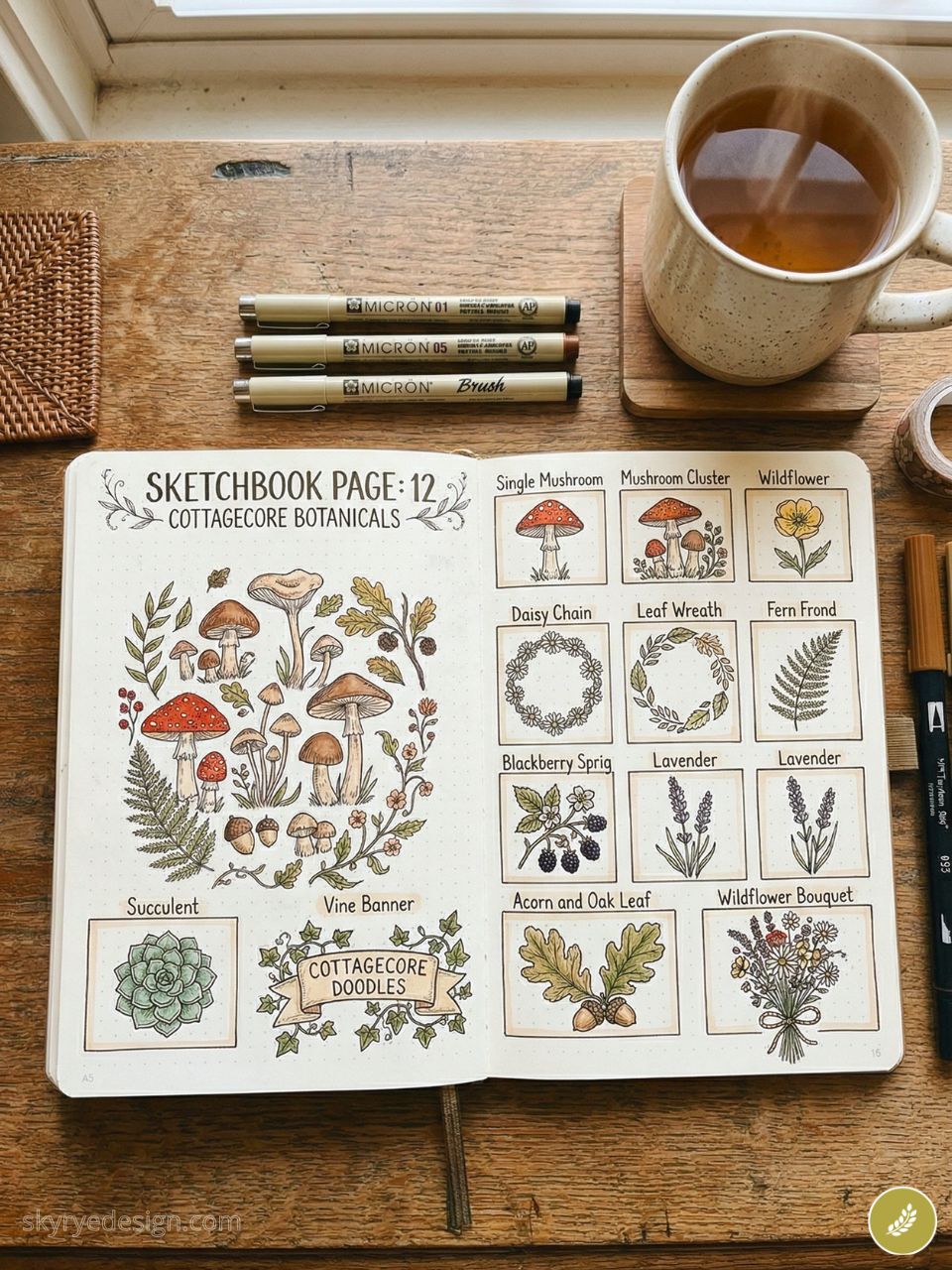
Theme 1: Cottagecore Botanicals — Doodles 1 to 12
Cottagecore botanical doodles are the most forgiving of any theme because organic shapes are meant to be irregular. A slightly asymmetrical mushroom is a correct mushroom. This theme dominates bujo aesthetic content in 2026 alongside dark academia.
01. Classic Mushroom — Easy
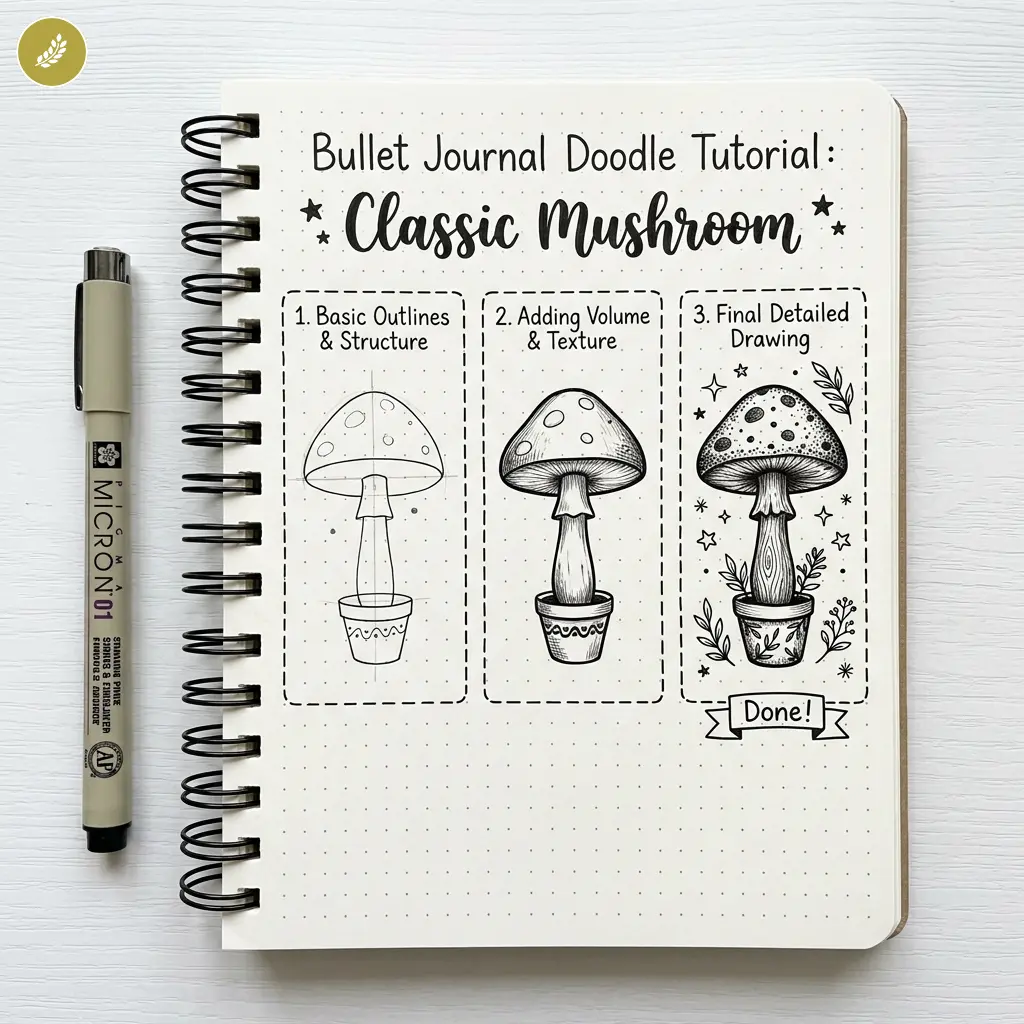
Draw a slightly flattened arch for the cap. Add a straight or gently curved stem below. Add 2-3 small dots on the cap. The rounder and softer the cap arch, the cuter the result. Add tiny lines on the stem for texture.
02. Mushroom Cluster — Easy
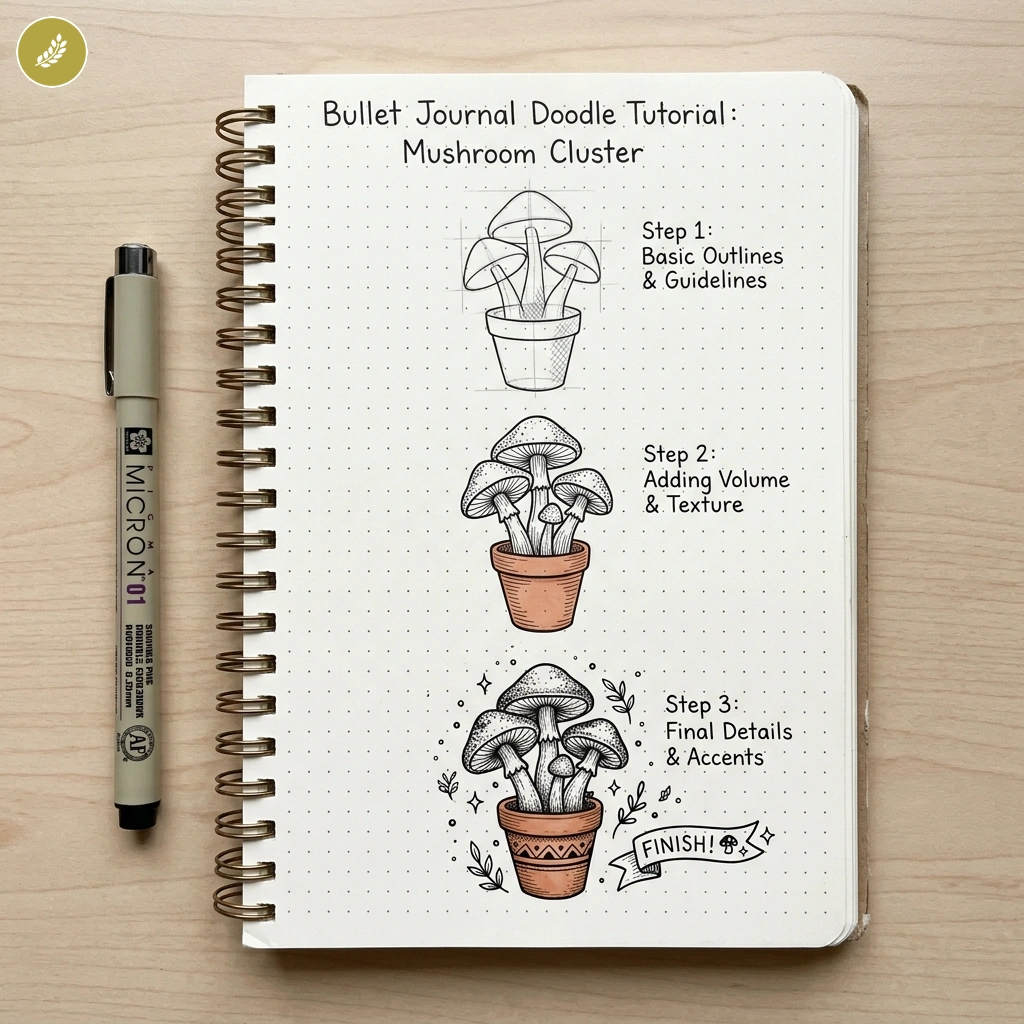
Draw three mushrooms at slightly different heights side by side. The tallest in the centre, two smaller ones flanking. Overlap the stems slightly so they look like they share ground. Add grass tufts between the stems with short upward strokes.
03. Single Wildflower — Easy
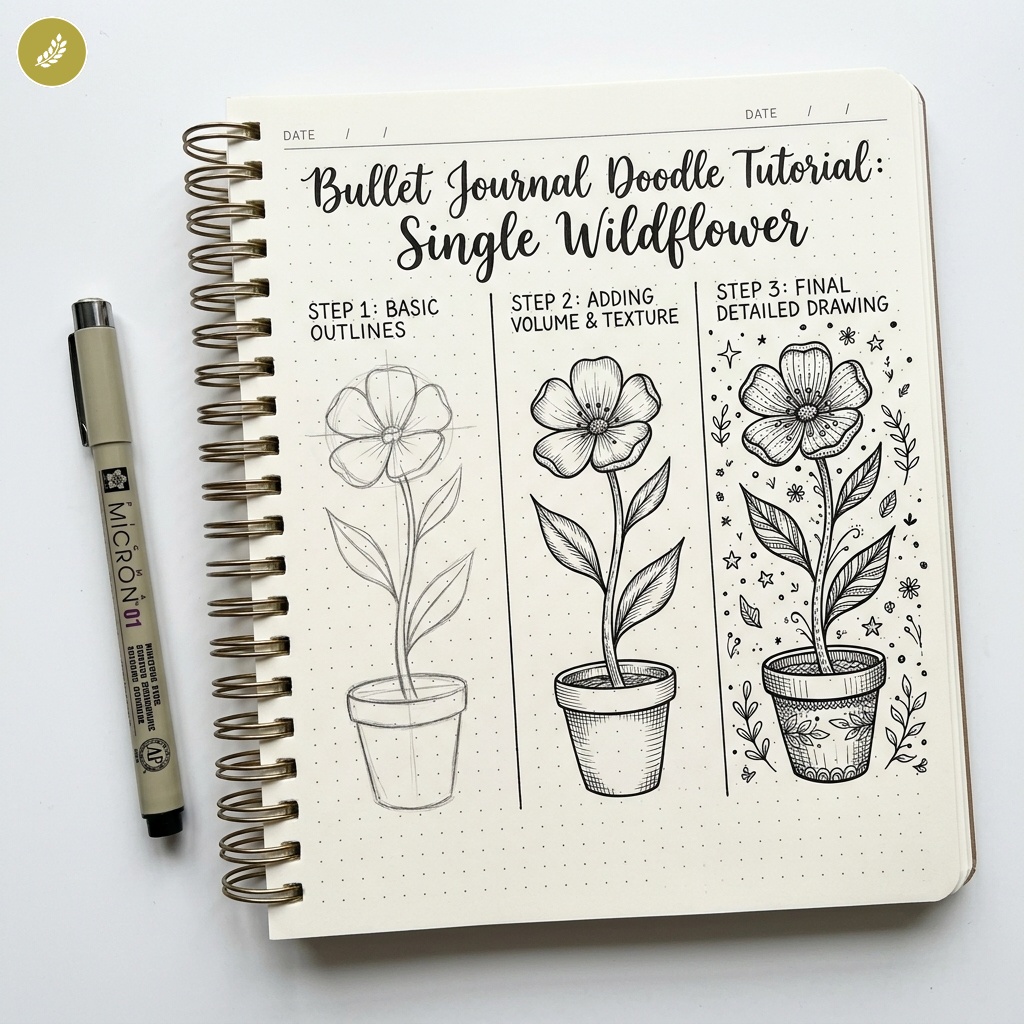
Five oval petals radiating from a small central circle. The petals don’t need to be identical — slight size variation looks natural. Add a thin stem with a leaf on one side. The leaf is a pointed oval with a single centre vein line.
04. Daisy Chain — Easy
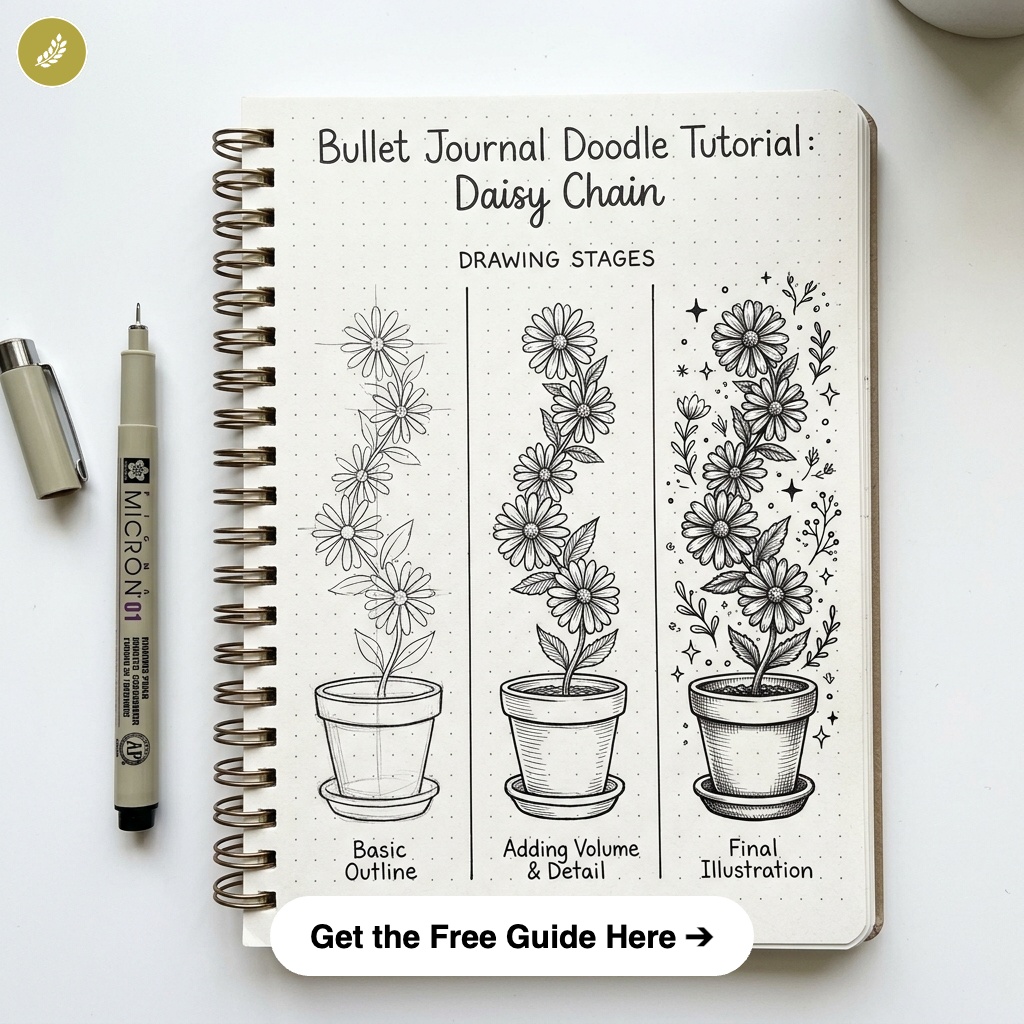
Draw a long curving stem first. Add small daisy heads (five rounded petals around a tiny circle) at intervals along the stem. Vary the angle of each daisy head so they face slightly different directions. Adds beautiful horizontal movement to a margin or header border.
05. Simple Leaf Wreath — Medium
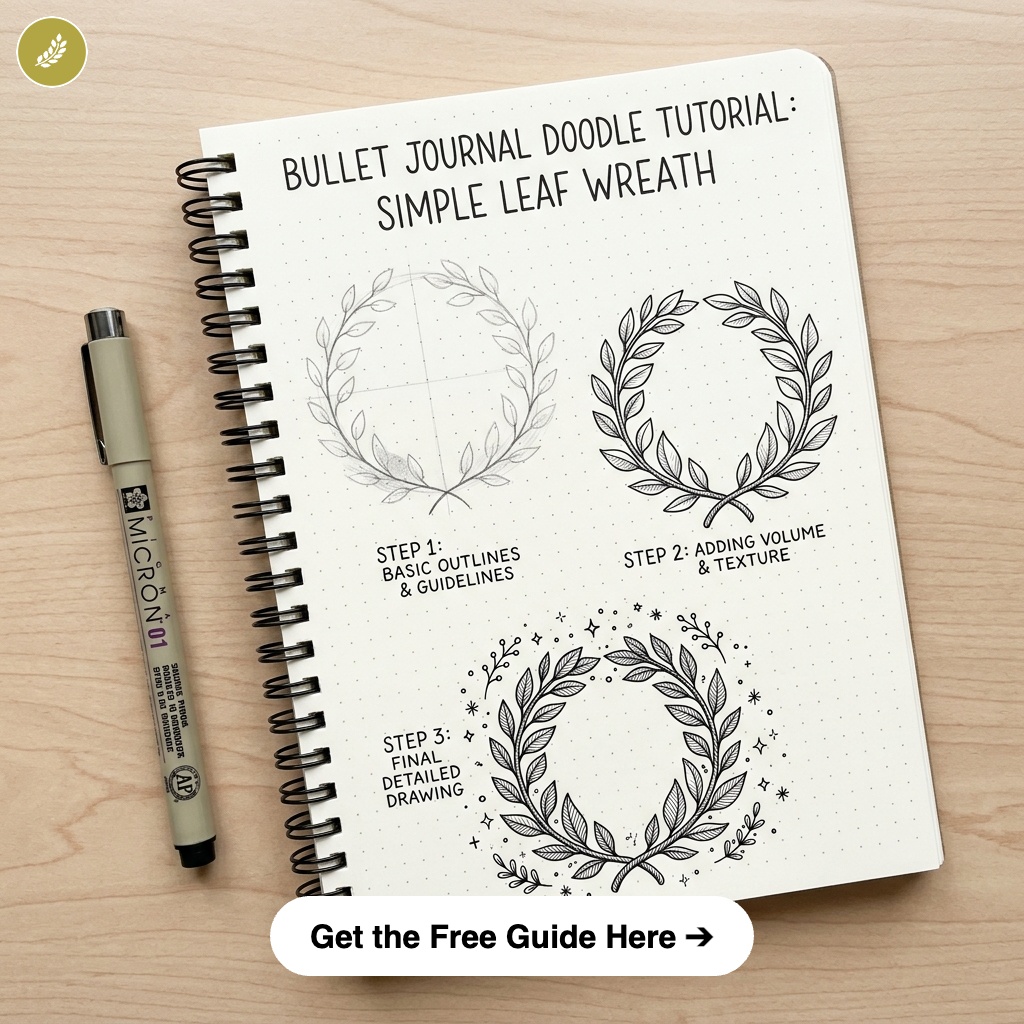
Lightly draw a circle in pencil as a guide. Draw pointed oval leaves around the circle alternating directions, so each leaf points slightly outward. Leave a gap at the bottom for text or a date. Three berry clusters (three small dots on short stems) fill any gaps naturally.
06. Fern Frond — Easy
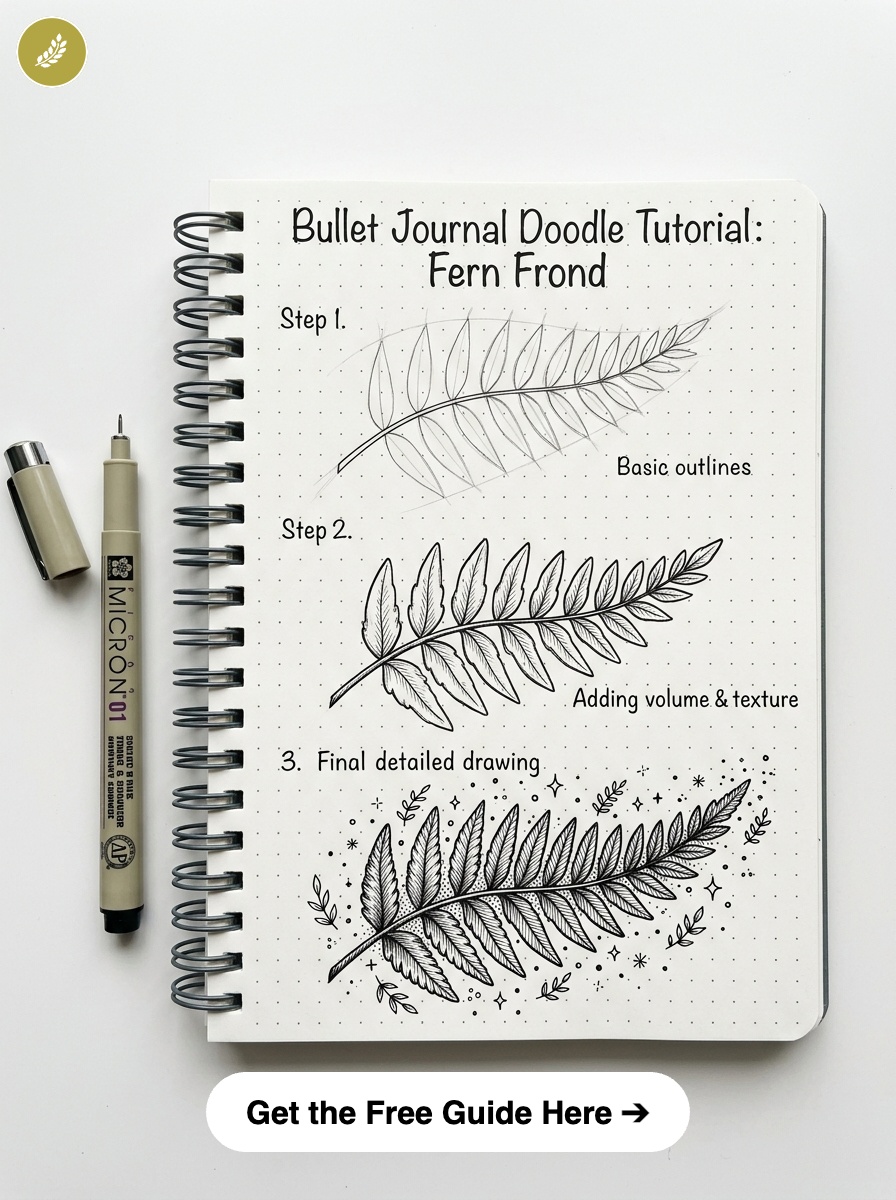
Draw a single curved line as the frond’s spine. Add small teardrop shapes on alternating sides of the spine, largest at the base and smallest at the tip. The key is keeping the teardrop shapes consistently angled toward the tip, not perpendicular to the spine.
07. Blackberry Sprig — Medium
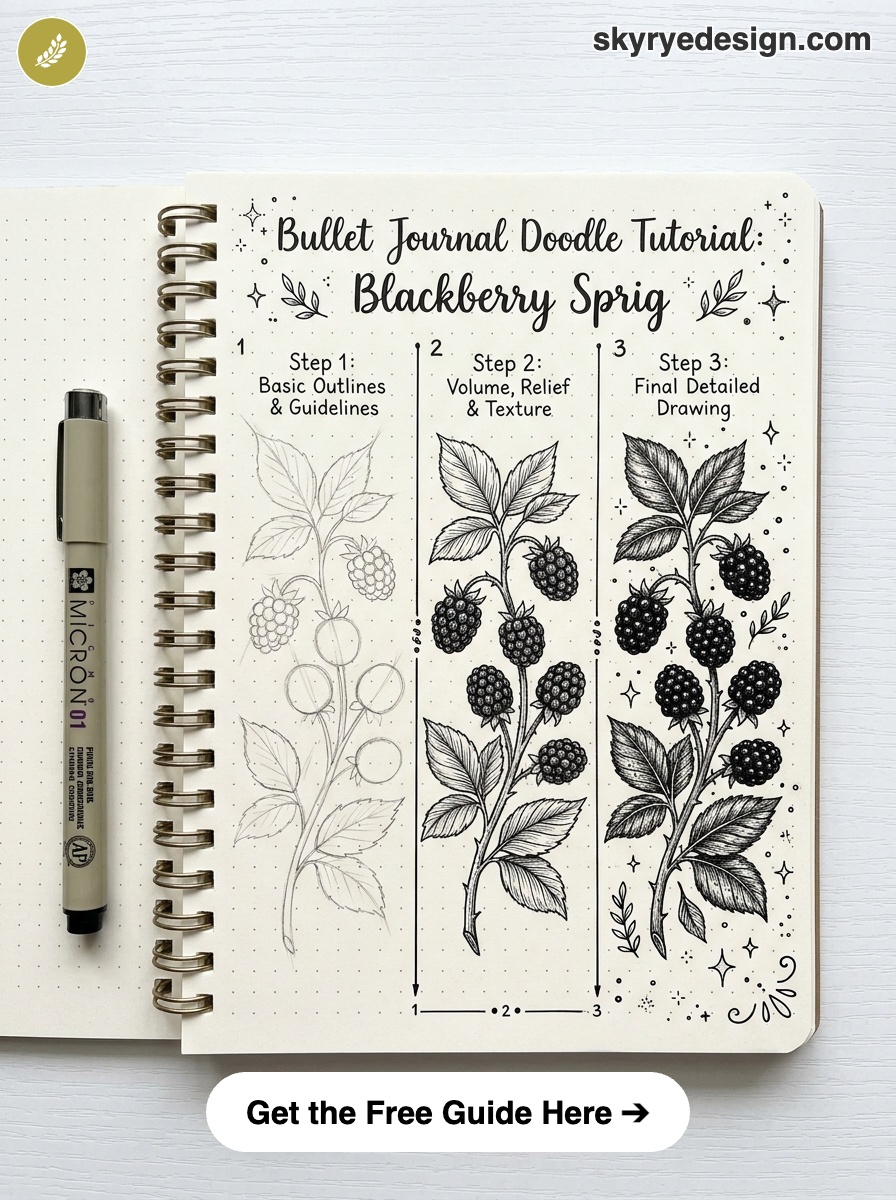
Draw a thin curved branch. Add oval leaf clusters at intervals — each cluster is 2-3 overlapping ovals. At the branch tips, add blackberry clusters: small circles grouped together, with tiny Y-shapes at the top of each berry (the calyx).
08. Lavender Stem — Easy
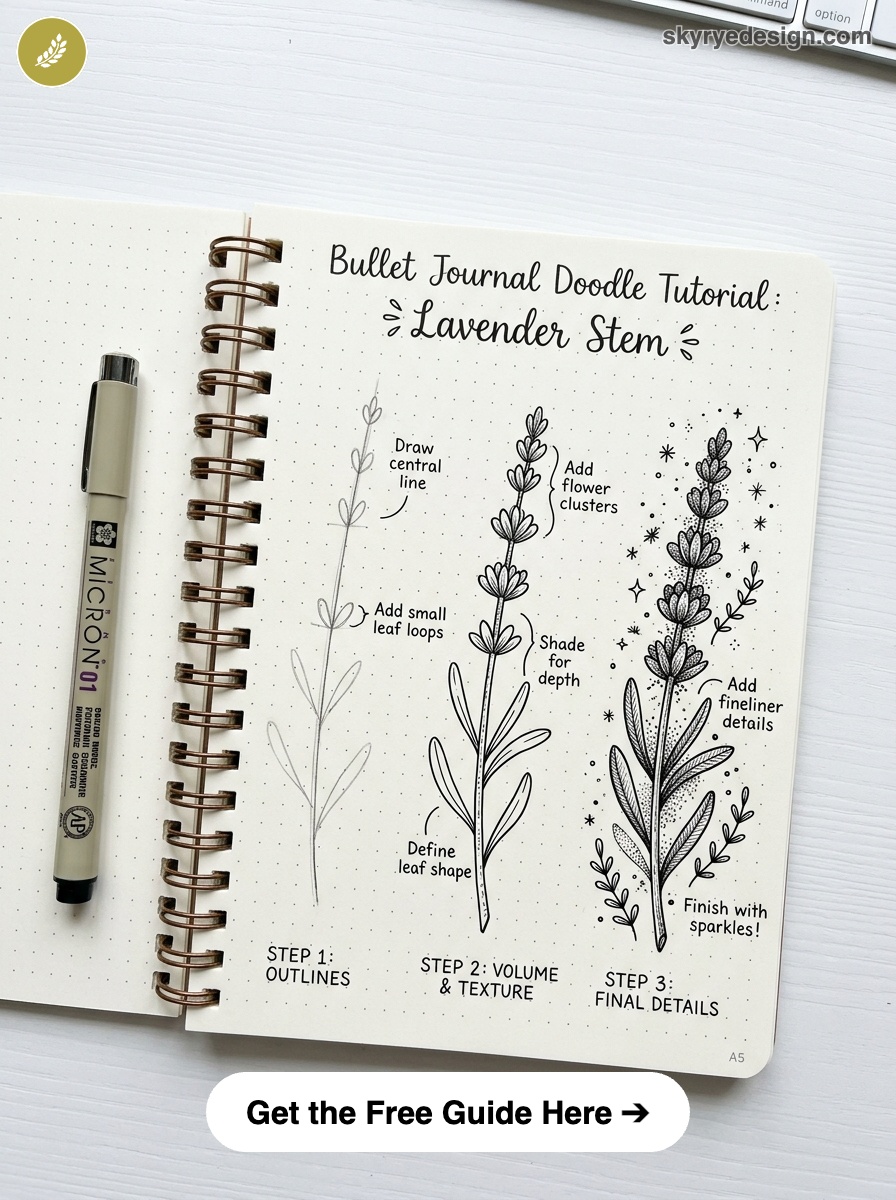
A single straight or gently curved stem. Add small oval buds in tight clusters near the top, with the buds becoming smaller and more widely spaced as you move upward. Two narrow lance-shaped leaves low on the stem. One of the fastest high-impact doodles in this category.
09. Potted Succulent — Easy
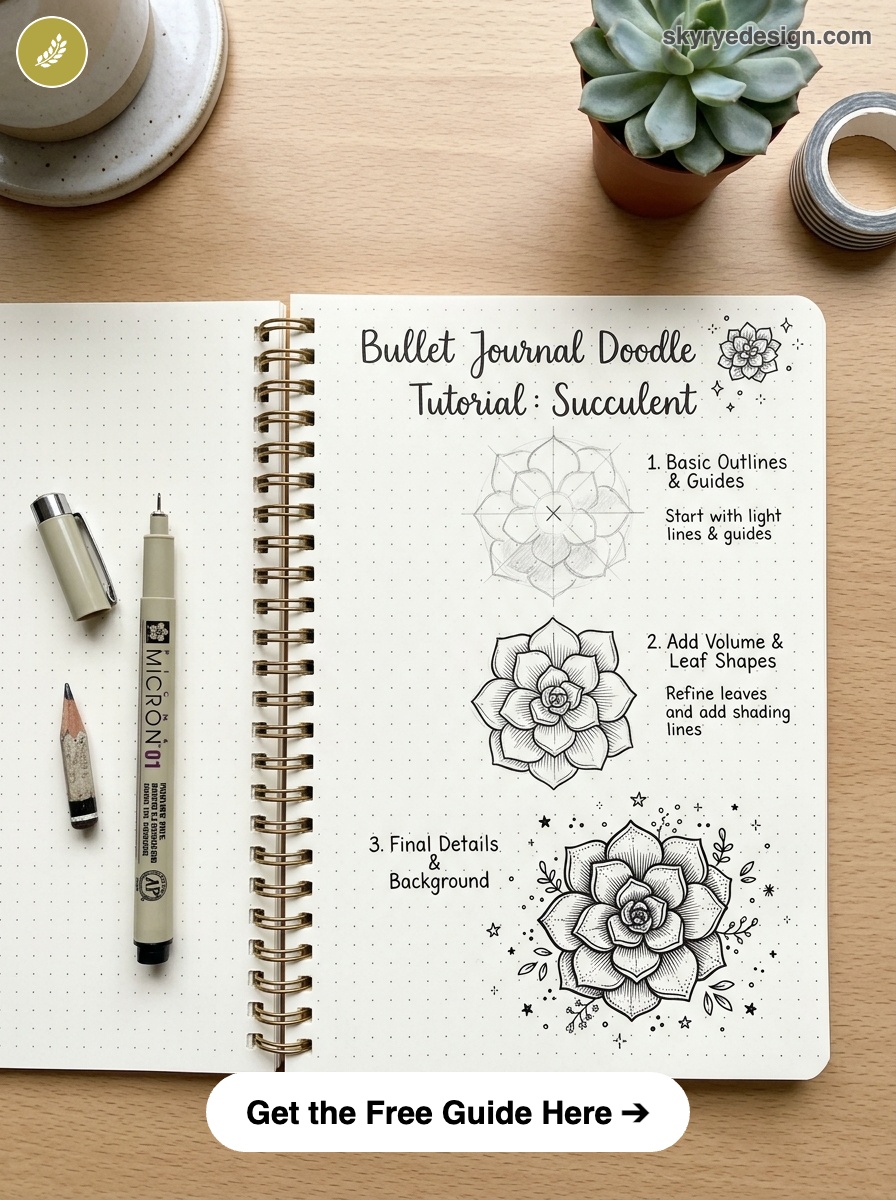
Draw a small trapezoid for the pot (wider at top than bottom). Inside the pot, draw overlapping pointed oval leaves radiating from a central point — 5 to 7 leaves works well. Each leaf has a slightly rounded tip. Add a small rim line at the top of the pot.
10. Hanging Vine Banner — Medium
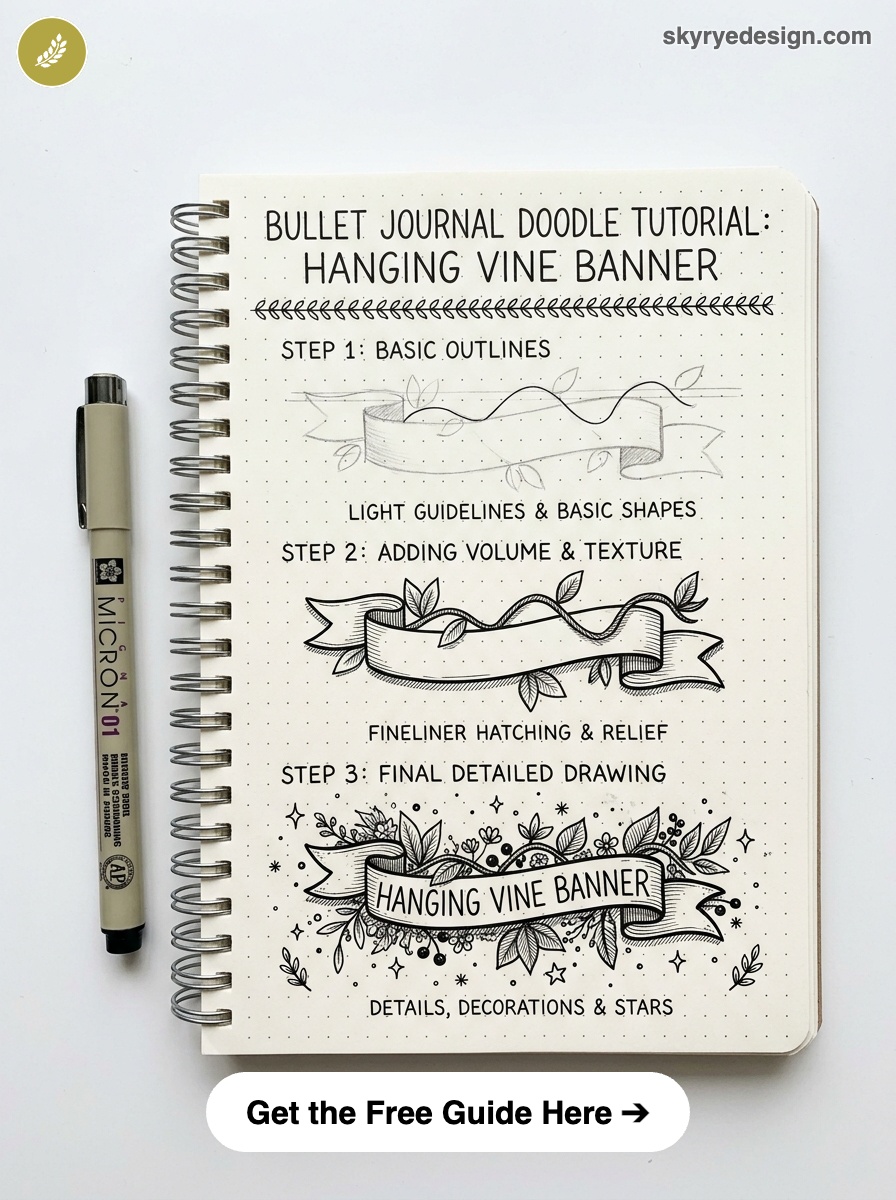
Draw two small dots or hooks at the top corners of your banner space. From each, hang a looping vine line that dips in the centre. Add small leaf pairs along the vine at intervals. This creates a natural-looking frame for headers or monthly titles.
11. Acorn and Oak Leaf — Medium
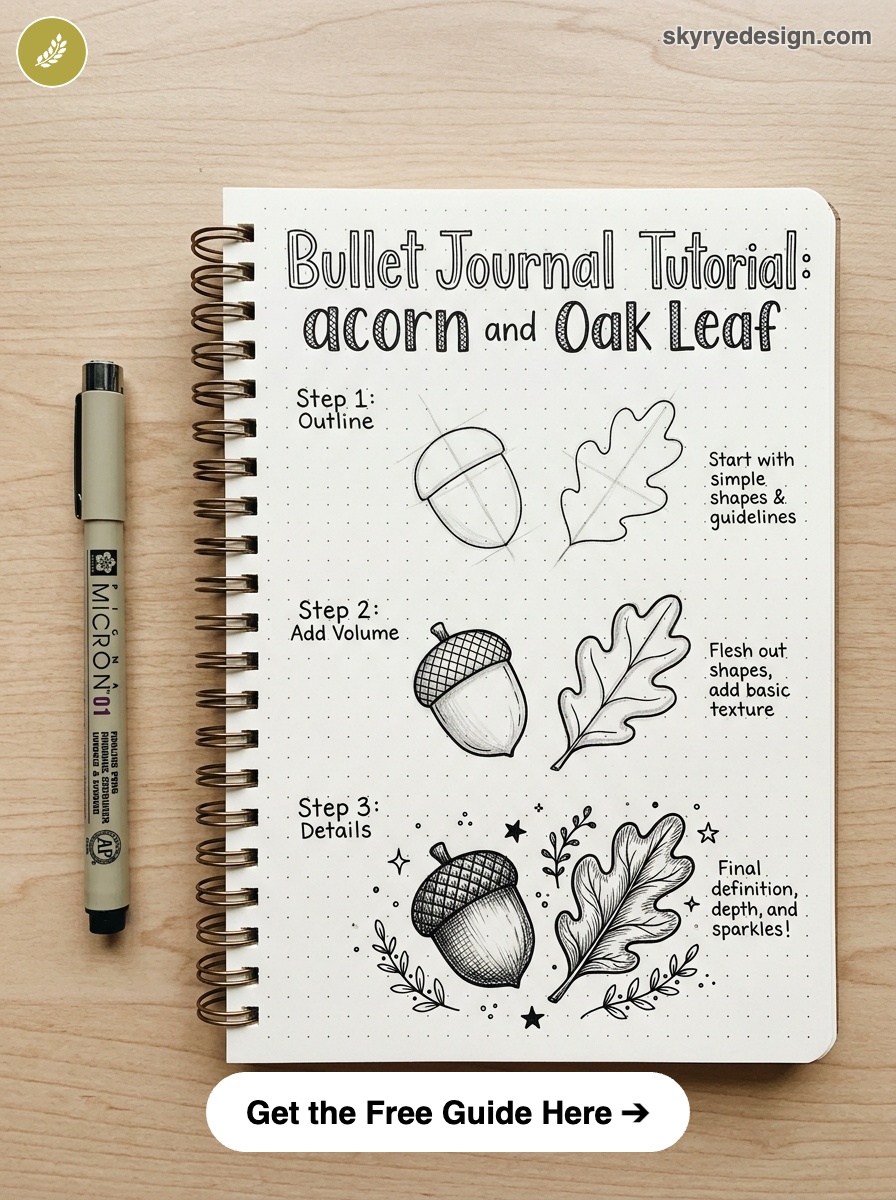
Oak leaf: draw the irregular lobed outline — the key is making each lobe slightly different in size. Add a single midrib and short secondary veins. Acorn: a rounded teardrop for the nut, a hatched cap shape on top (a semicircle with close parallel horizontal lines inside it).
12. Wildflower Bouquet — Detailed
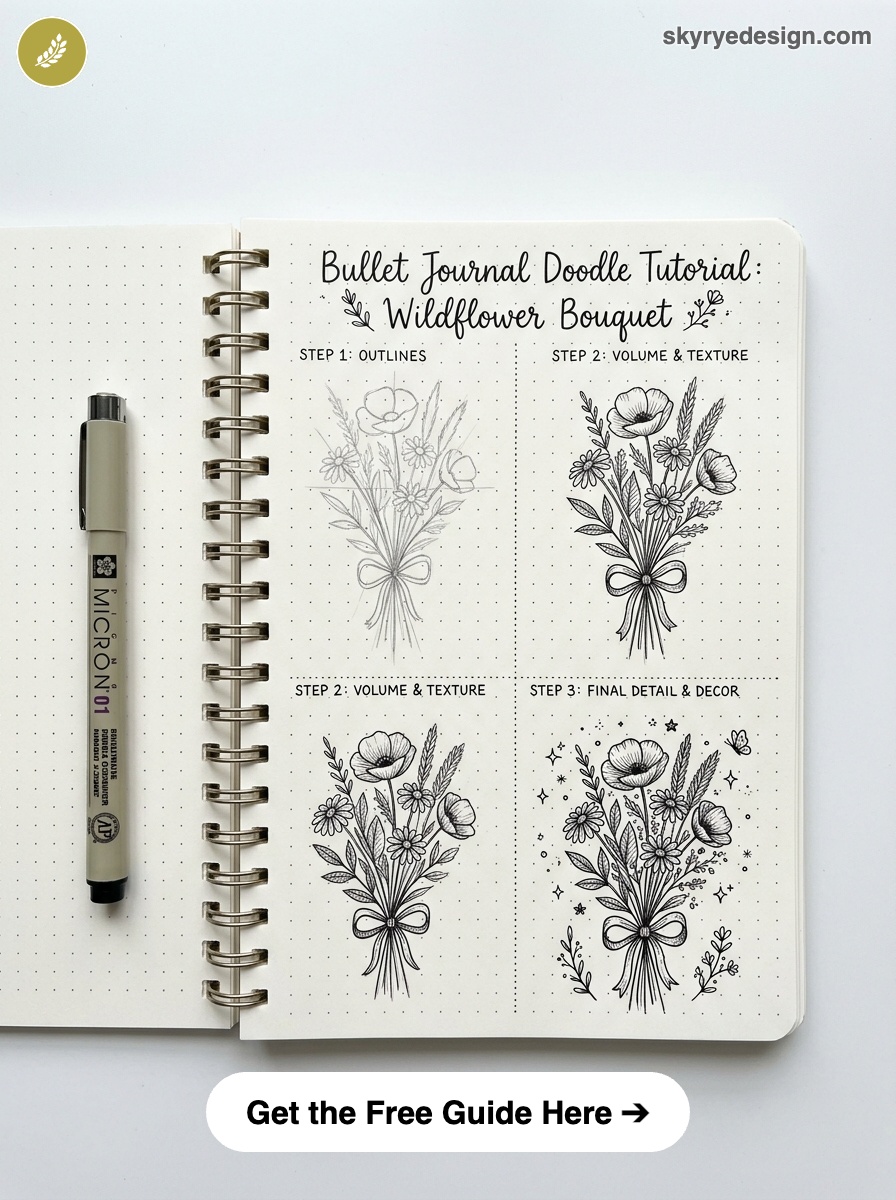
Build from the stems up. Draw 4-5 crossing stems in a loose hand-held arrangement, tying them with a simple ribbon or twine wrapping (overlapping diagonal lines). Add different flower types at each stem tip — a daisy here, a lavender sprig there, a round flower head elsewhere. The asymmetry is the charm.
Theme 2: Celestial and Moon Doodles — Doodles 13 to 22
Celestial doodles are the second most-searched bujo aesthetic in 2026. They work on any colour background, scale from tiny margin accents to full-page focal points, and combine naturally with dark academia and Y2K themes.
13. Crescent Moon — Easy
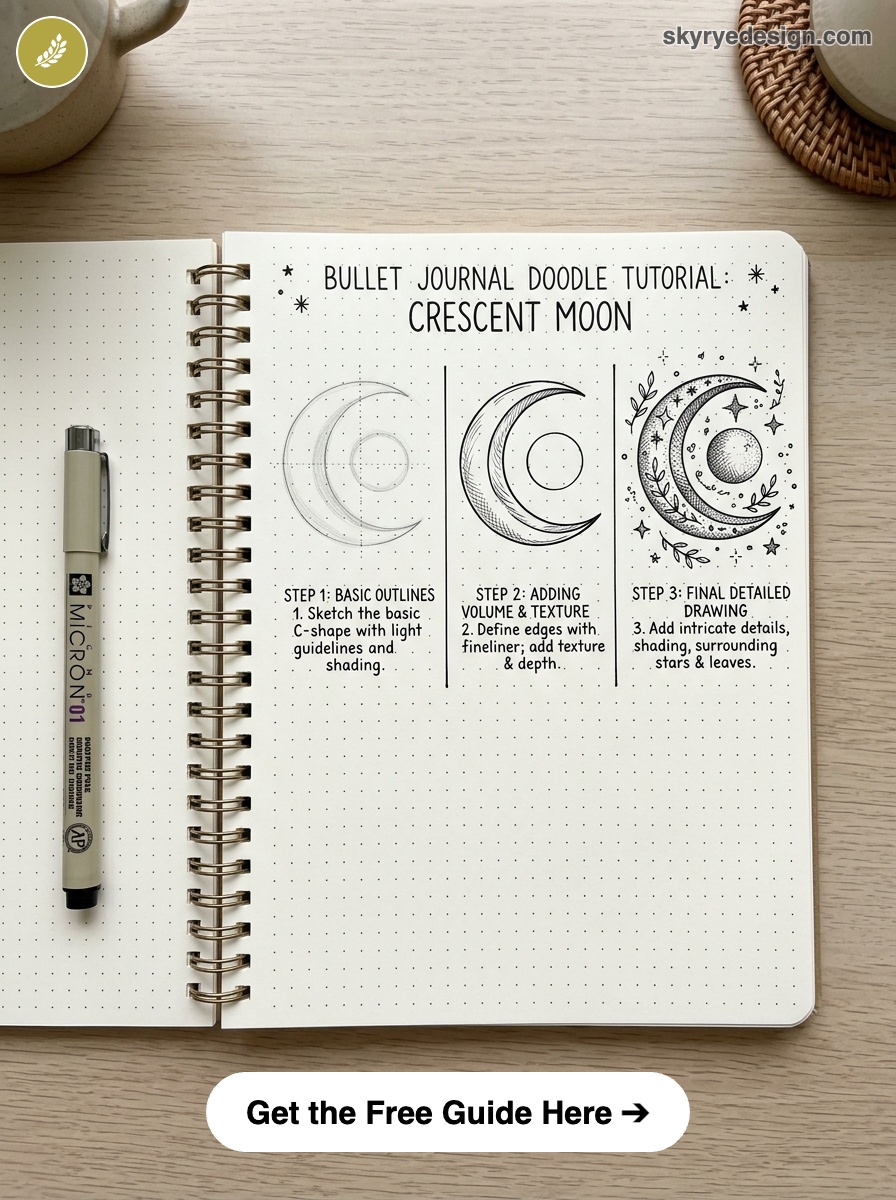
Draw a full circle. Draw a slightly offset smaller circle overlapping it. Erase or ignore the inner circle’s overlapping area — the remaining shape is the crescent. Alternatively: draw the crescent directly as two curved lines meeting at points. Add a small face (two dots for eyes, a gentle curved line for a smile) for the classic bujo moon.
14. Star Cluster — Easy
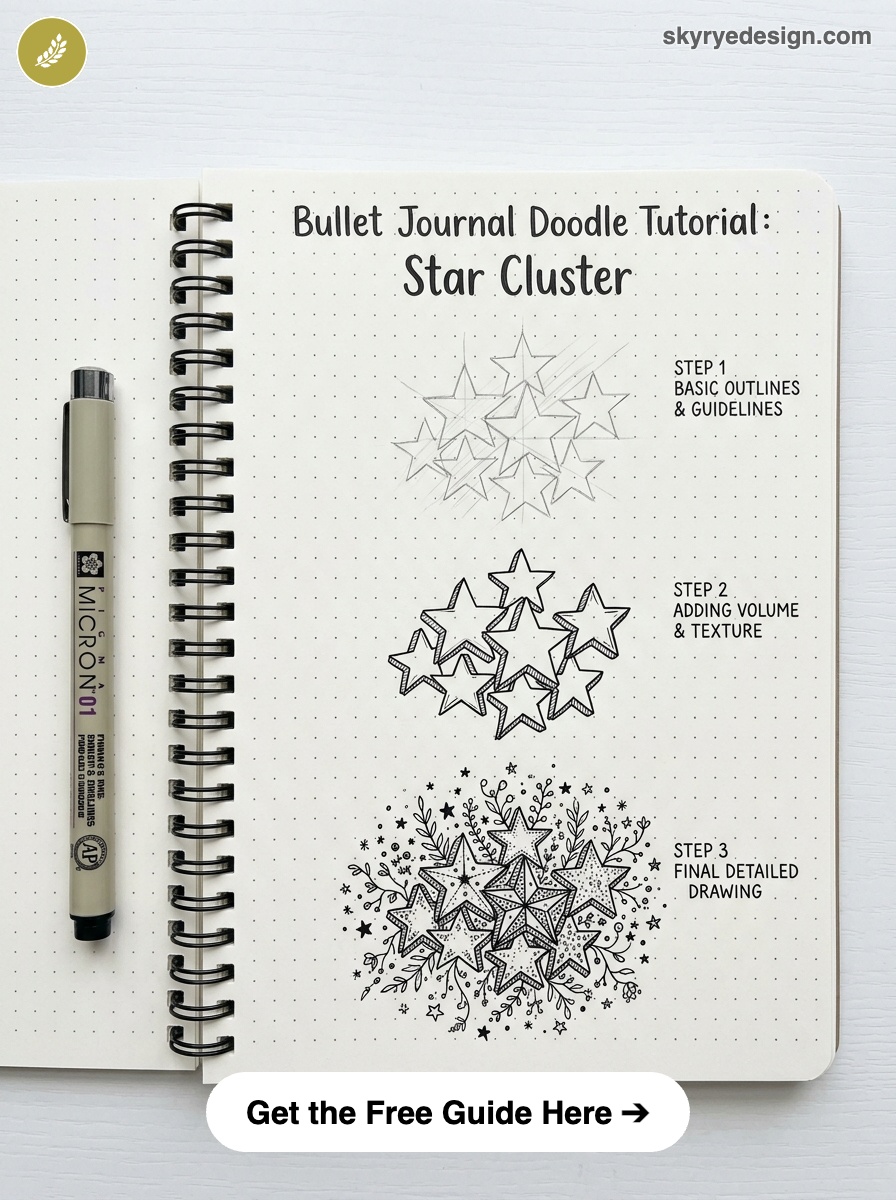
A mix of four-pointed stars (two crossing lines), six-pointed stars (Star of David geometry), and simple dot stars. Vary the sizes from tiny dots to stars about 1cm across. Scatter them with intentional spacing rather than uniform grid placement. A cluster of 8-12 stars fills a corner beautifully.
15. Saturn — Easy
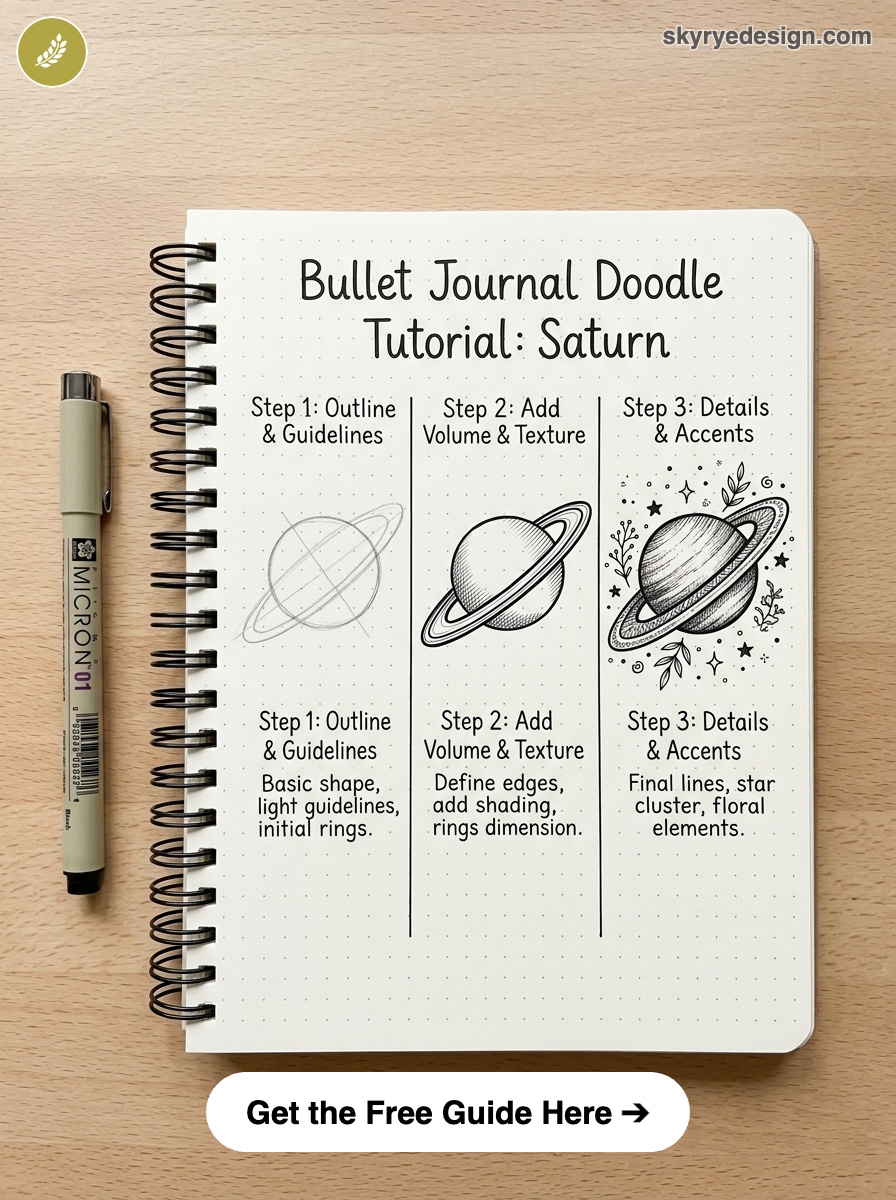
Draw a circle for the planet’s body. Add an elliptical ring that crosses in front of the planet at the lower half and behind at the upper half — erase the ring section hidden behind the planet. Add faint horizontal bands on the planet’s surface with a light pencil or pale ink.
16. Sun with Face — Easy
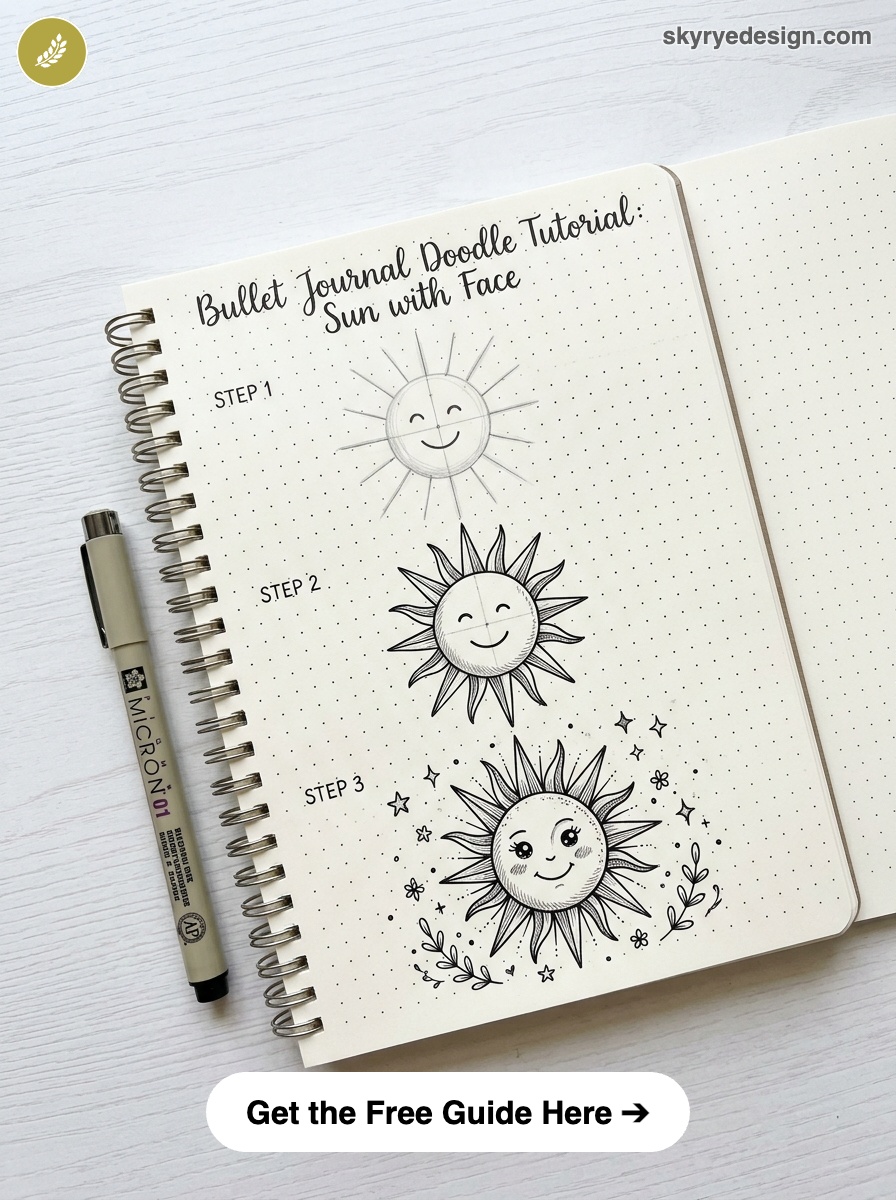
A circle with straight or wavy rays radiating from all sides. Alternate long and short rays for a more dynamic look. Add simple face details: two closed curved lines for peaceful eyes, a small curved mouth. The sun-with-face is a classic bujo element that works equally well at 1cm or 4cm scale.
17. Constellation Line Art — Medium
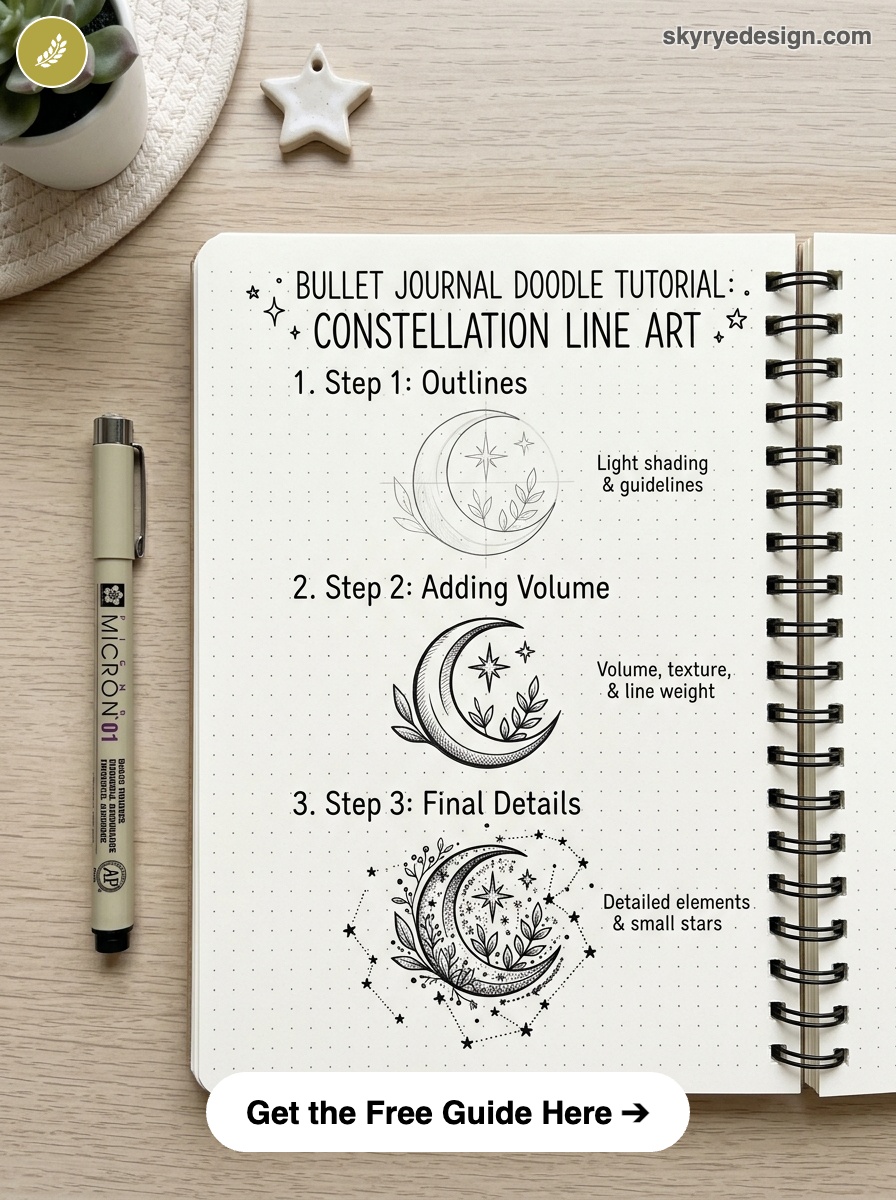
Choose a recognisable constellation (Orion, Cassiopeia, the Big Dipper). Place small dots for the stars. Connect them with thin straight lines. Add a tiny label or constellation name in small lettering below. Simple but satisfying as a recurring element in monthly headers.
18. Moon Phase Row — Medium
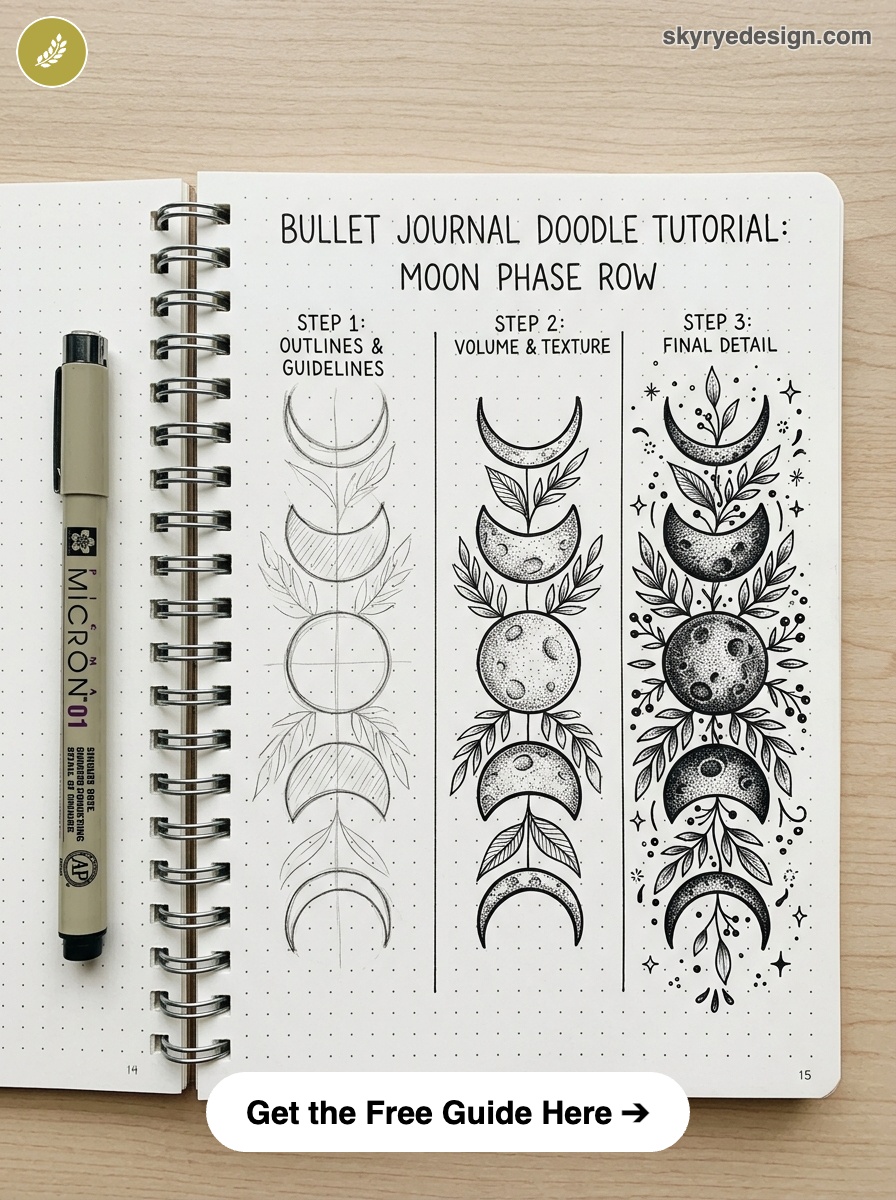
Draw eight circles in a row. The first is empty (new moon, filled with dark ink). Then incrementally show a crescent appearing, growing to a quarter circle, a three-quarter circle, and finally a full circle — then mirror in reverse. Label beneath each phase in tiny text. A perfect horizontal header element.
19. Shooting Star — Easy
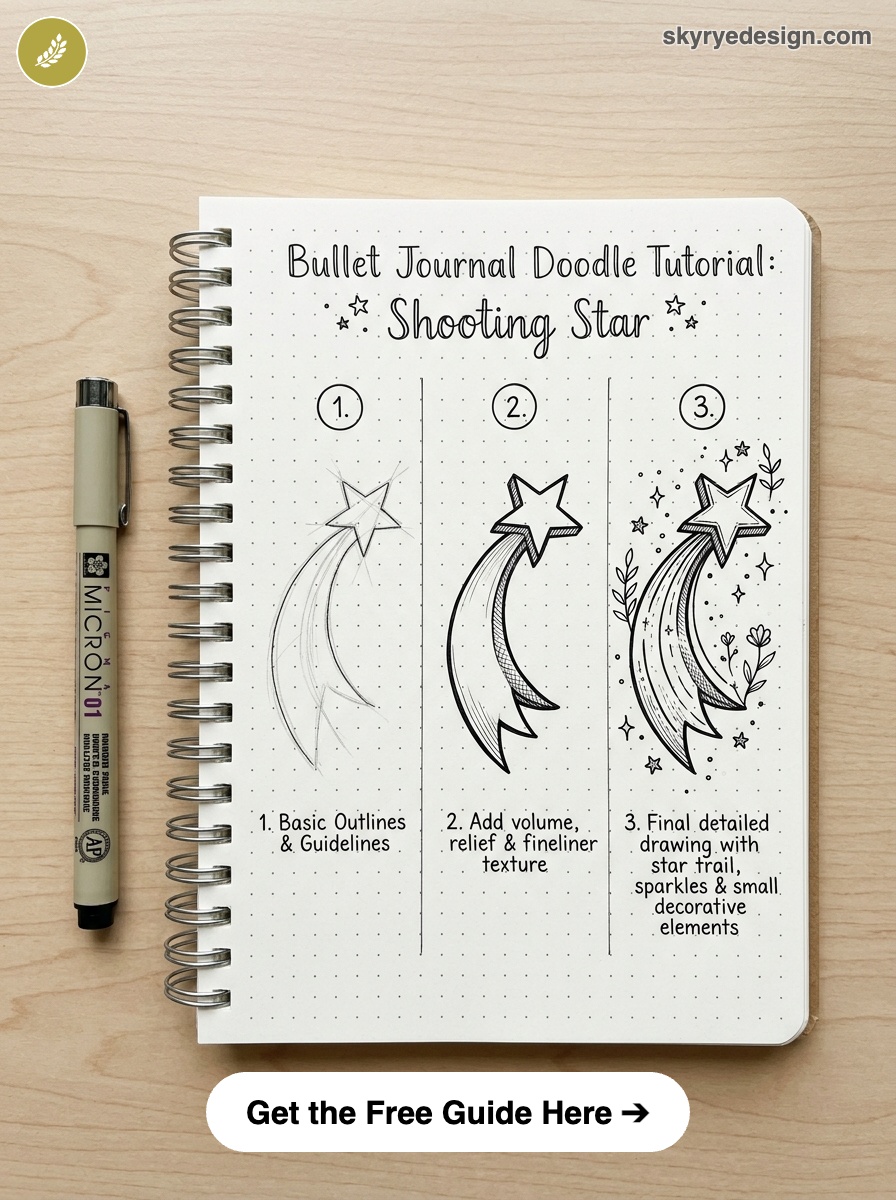
A small four-pointed star with one longer tail trailing behind it at a diagonal angle. The tail tapers from the star width to a fine point over about 2-3cm. Add 2-3 tiny parallel lines beside the tail to suggest motion.
20. Celestial Eye — Medium
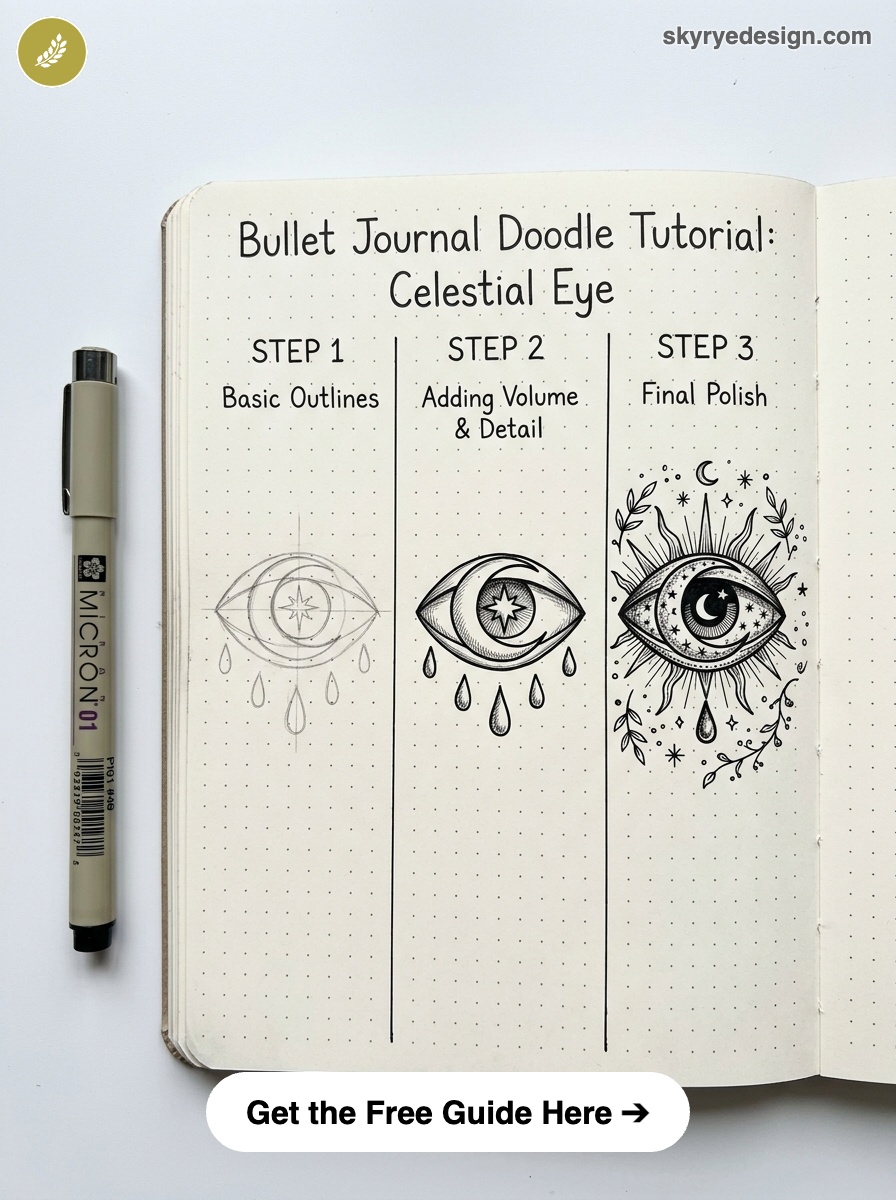
An almond-shaped eye (two curved lines meeting at points). Inside: a circle for the iris, a smaller filled circle for the pupil, a tiny white dot highlight. Above and below the eye: long curved eyelashes. Add a crescent moon or star cluster above the eye for the celestial connection.
21. Planet Row — Medium
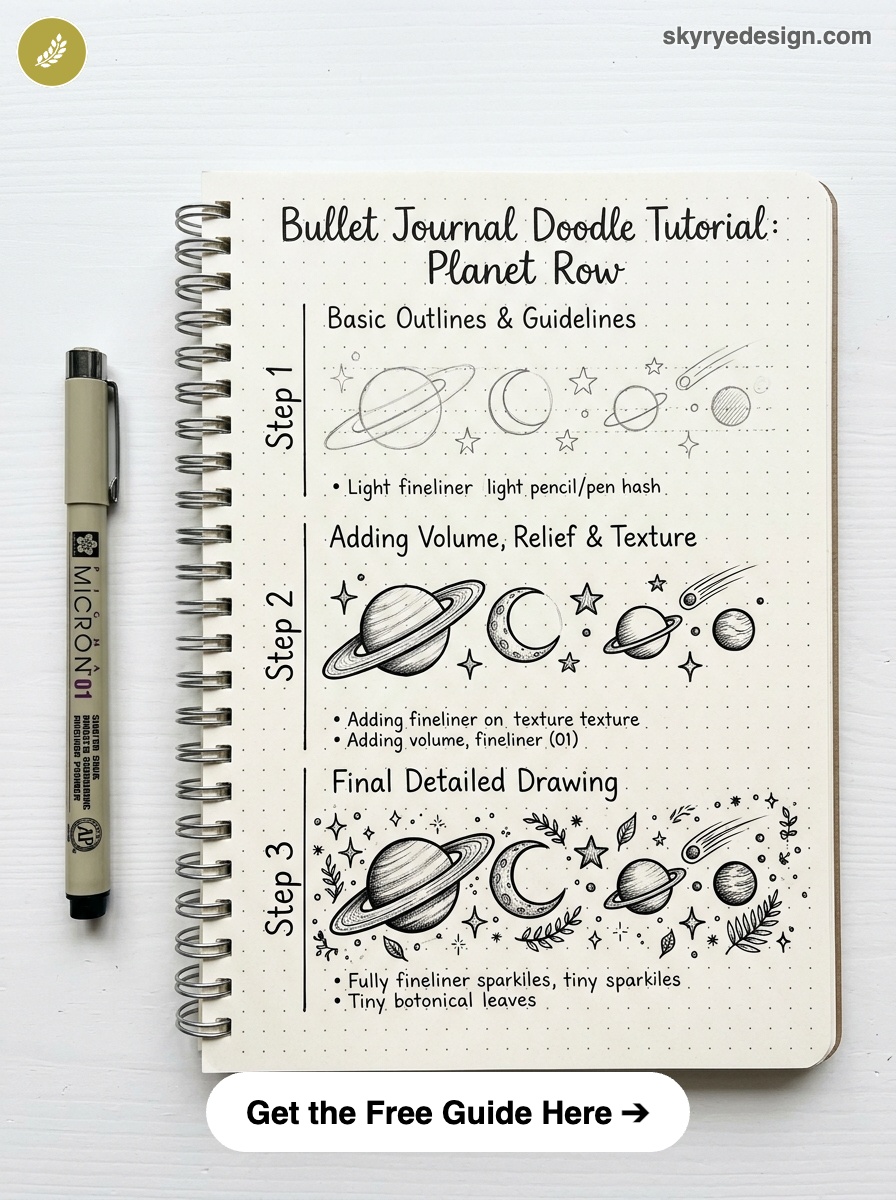
Six circles of varying sizes in a row, each with a distinct personality: Saturn has rings, Jupiter has stripes, Earth has irregular continent shapes, Mars is slightly reddish-tinged, Venus is plain, Mercury is small with crater dots. Works as a horizontal border or as individual margin doodles.
22. Galaxy Swirl — Detailed
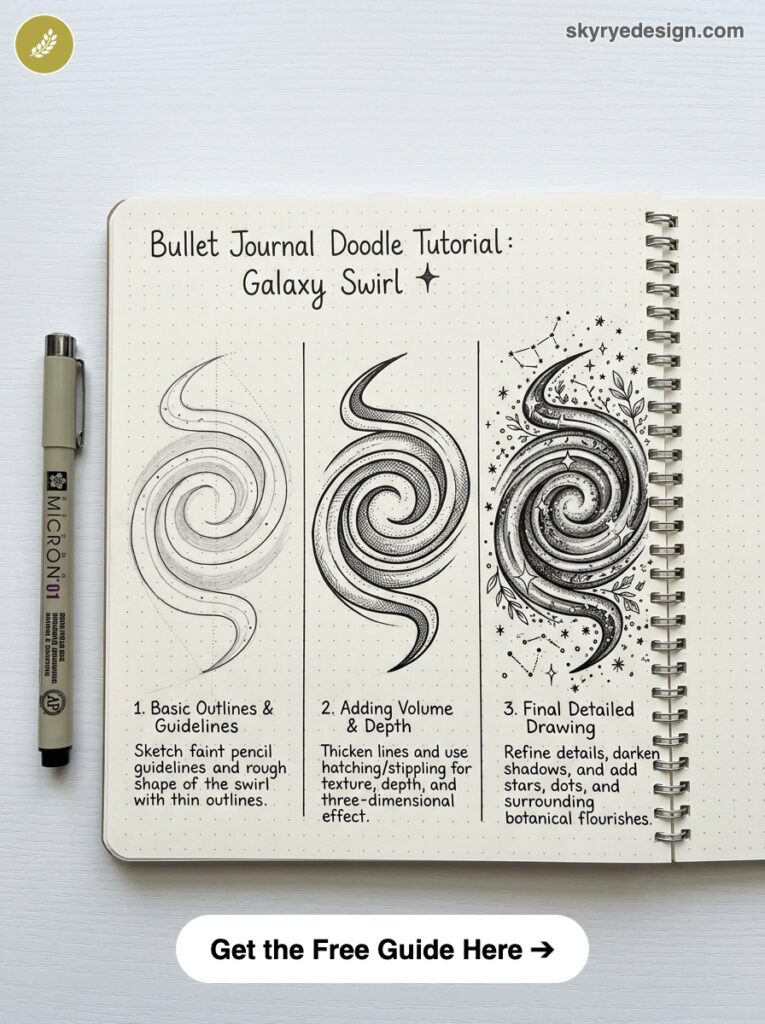
Start with a small tight spiral at the centre. Add larger arching arms spiralling outward. Fill the space between arms with tiny dots and small stars using a white gel pen on a dark ink background, or use dark ink dots on light paper. The key is density variation — denser toward the centre, sparser at the edges.
Theme 3: Botanical Basics — Doodles 23 to 32
Botanical basics are the everyday workhorses of bujo decoration. These are the doodles you learn once and use indefinitely — in margins, as borders, as small accents beside tracker elements and headers.
23. Simple Rose — Medium
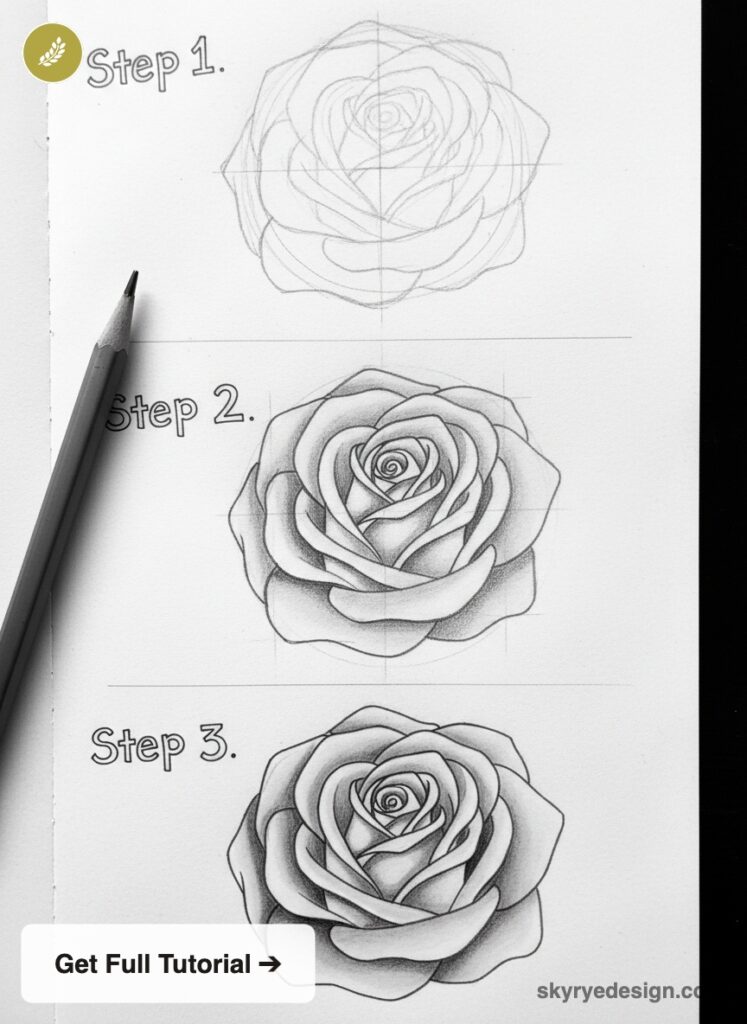
Draw a tight spiral at the centre. Add rounded C-shaped petals wrapping outward around the spiral, each one slightly overlapping the previous.
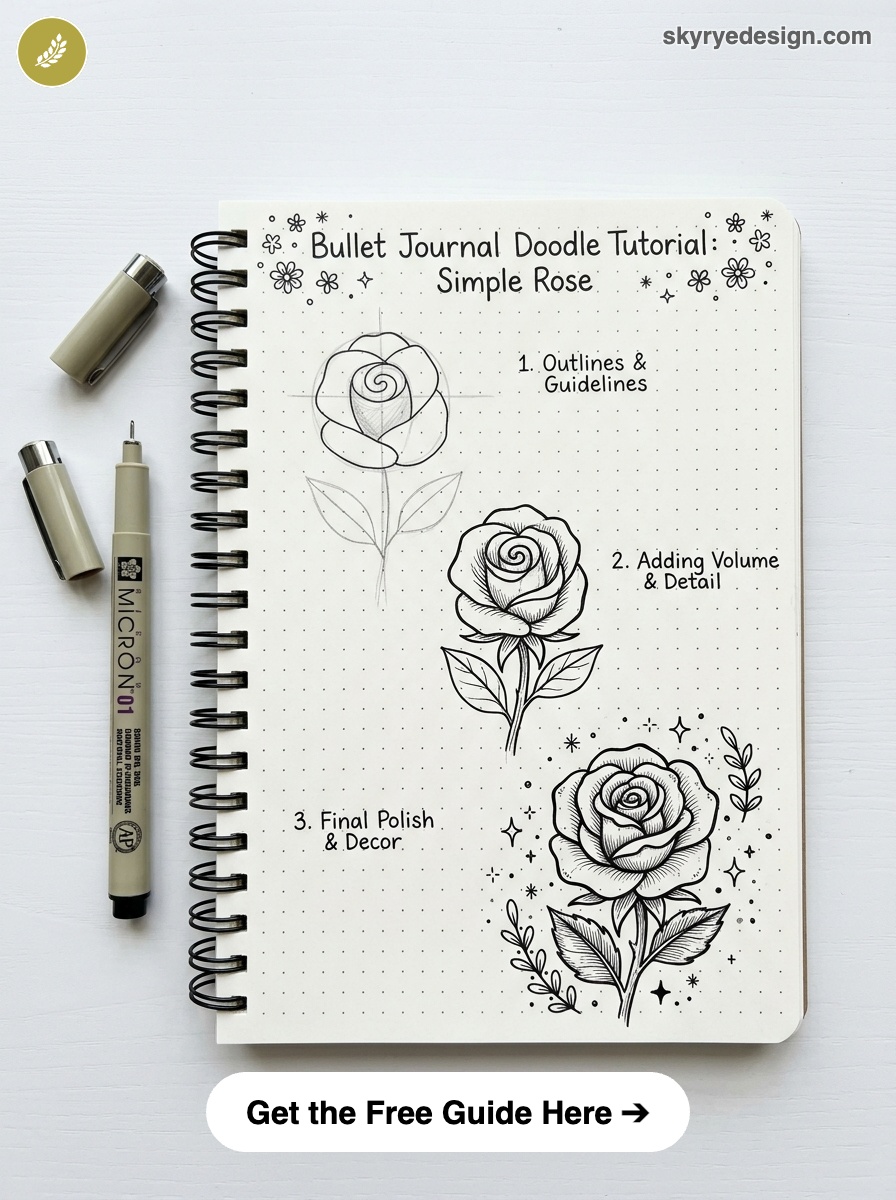
Five to seven petals creates a satisfying rose without becoming complex. Add two small pointed leaves below on a short stem.
24. Tulip — Easy
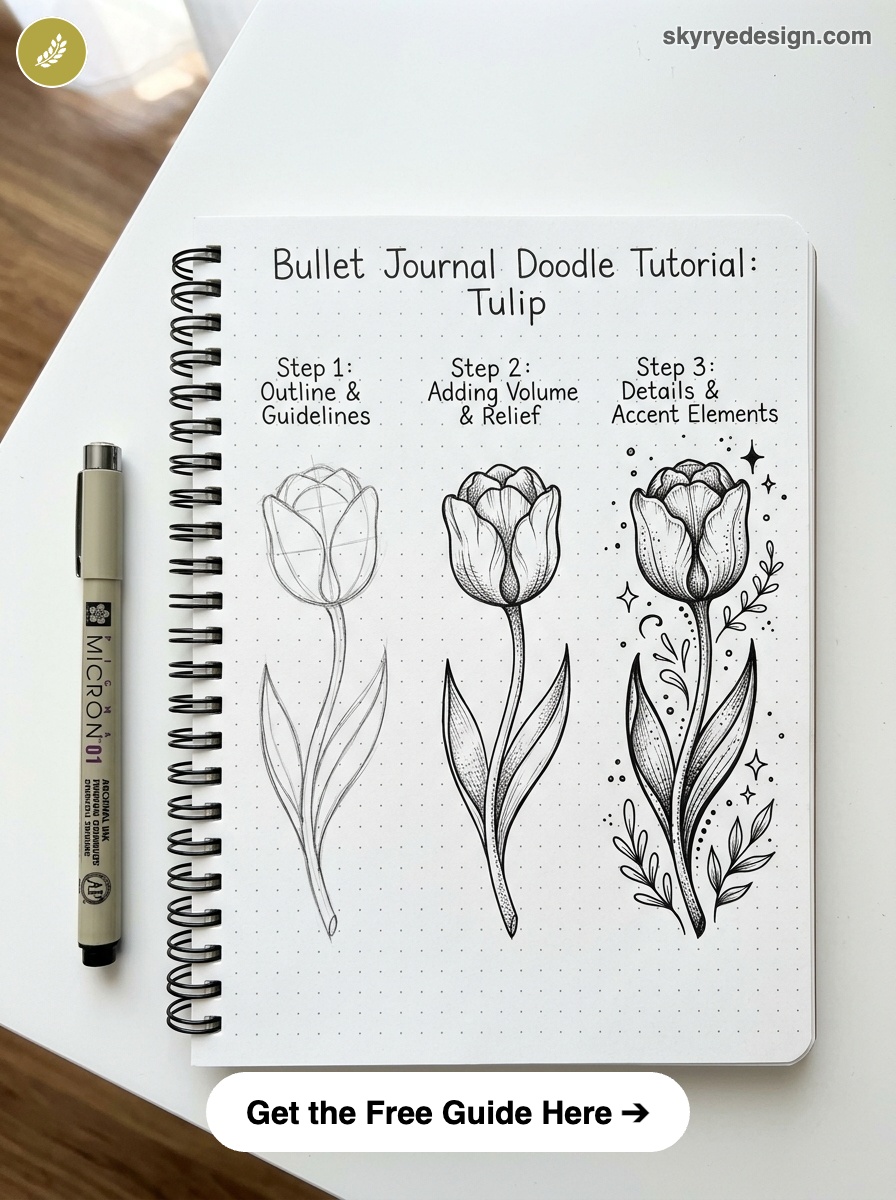
Three rounded petals: a central tall one, and two flanking ones that curve outward. Add a straight stem and two long narrow strap leaves. The silhouette is the key — make the central petal noticeably taller than the side petals.
25. Sunflower — Medium
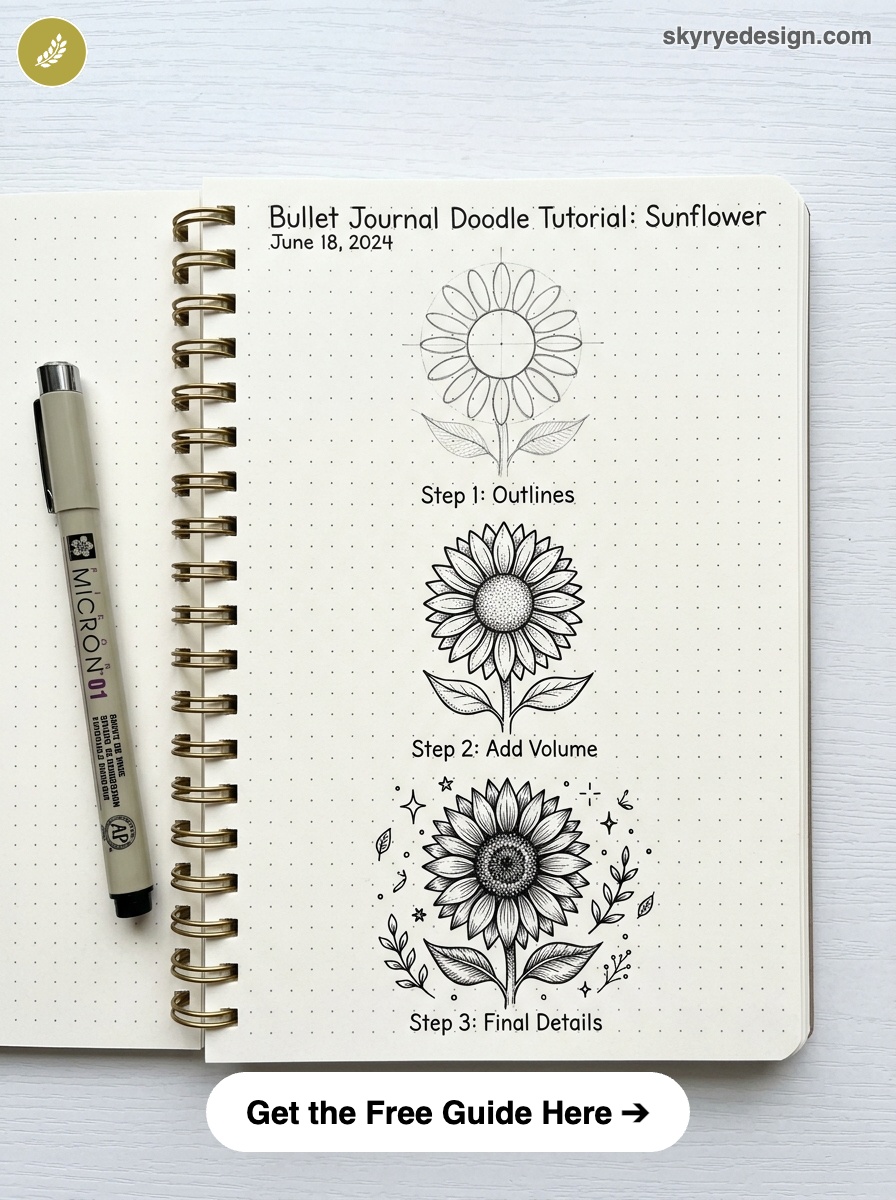
A large circle for the centre. Add elongated oval petals all around, slightly overlapping. Fill the centre circle with a cross-hatch or spiral pattern to suggest the seed head. Two broad leaves on the stem. Scale this up to 4-5cm for a statement doodle or down to 1cm for a margin accent.
26. Leaves in Three Styles — Easy
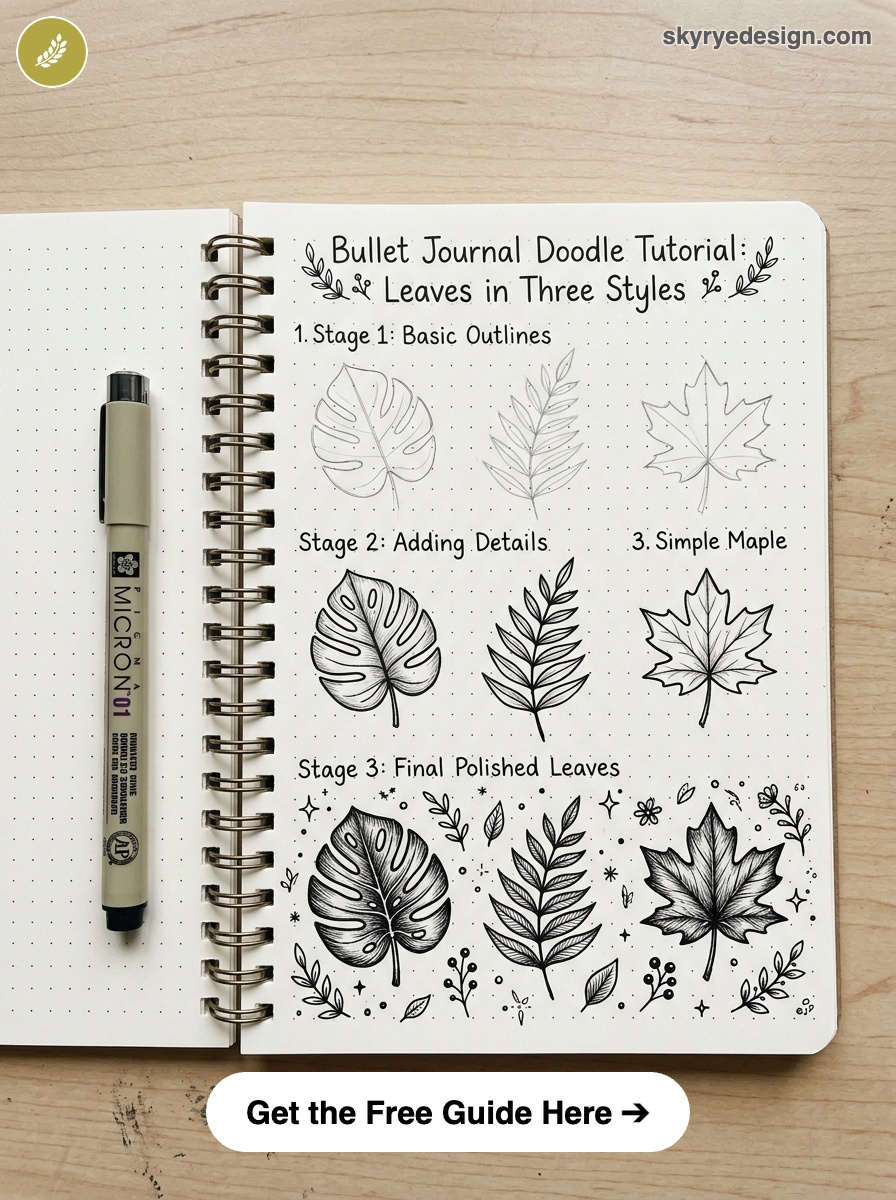
Practice three leaf types in a row: a simple oval with midrib (generic leaf), a pointed willow-style leaf with curved sides, and a lobed oak leaf with irregular edges. These three cover 90% of bujo leaf needs and can all be drawn in under 30 seconds each.
27. Cactus — Easy
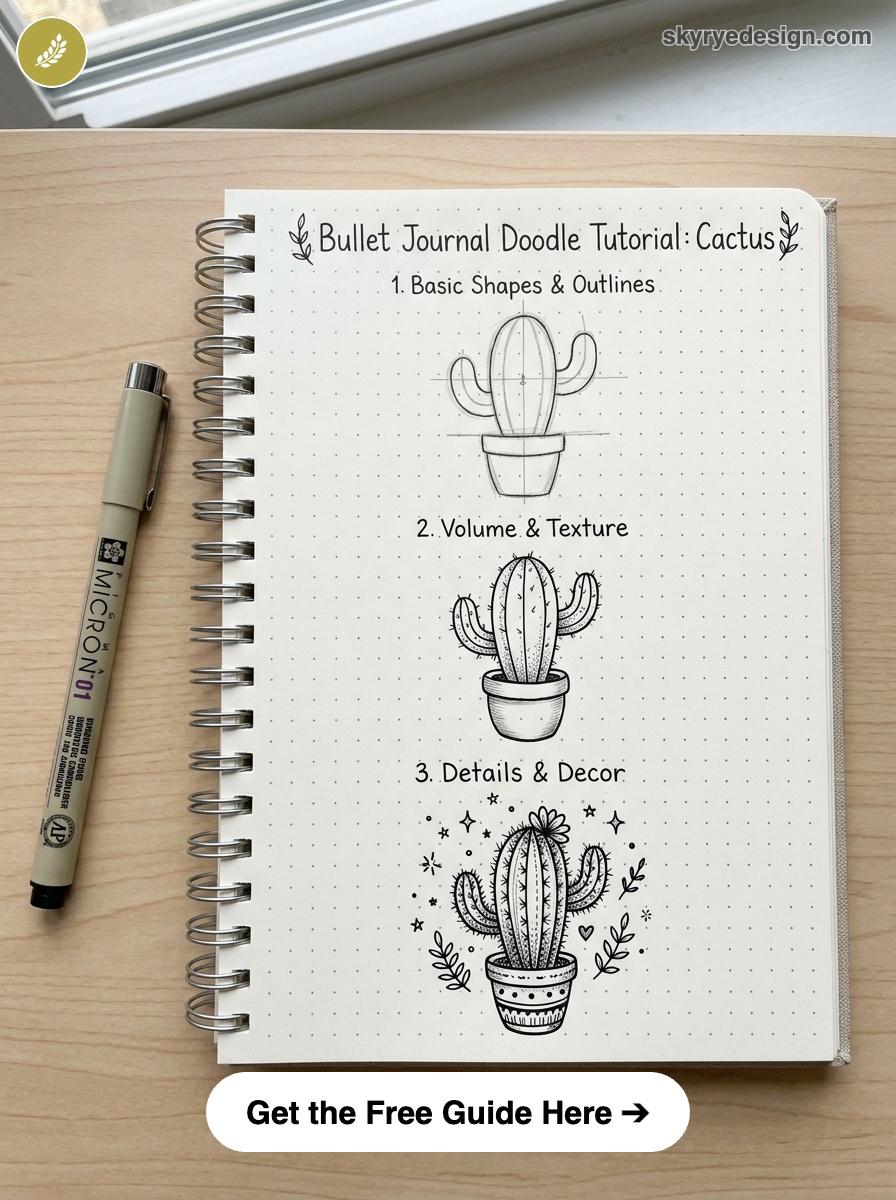
A rounded rectangle for the main body. One arm curves upward on each side — draw these as thick rounded protrusions. Add short parallel lines across all surfaces for spines. A single small flower on top (five petals around a circle) elevates this from basic to cute.
28. Lily of the Valley — Medium
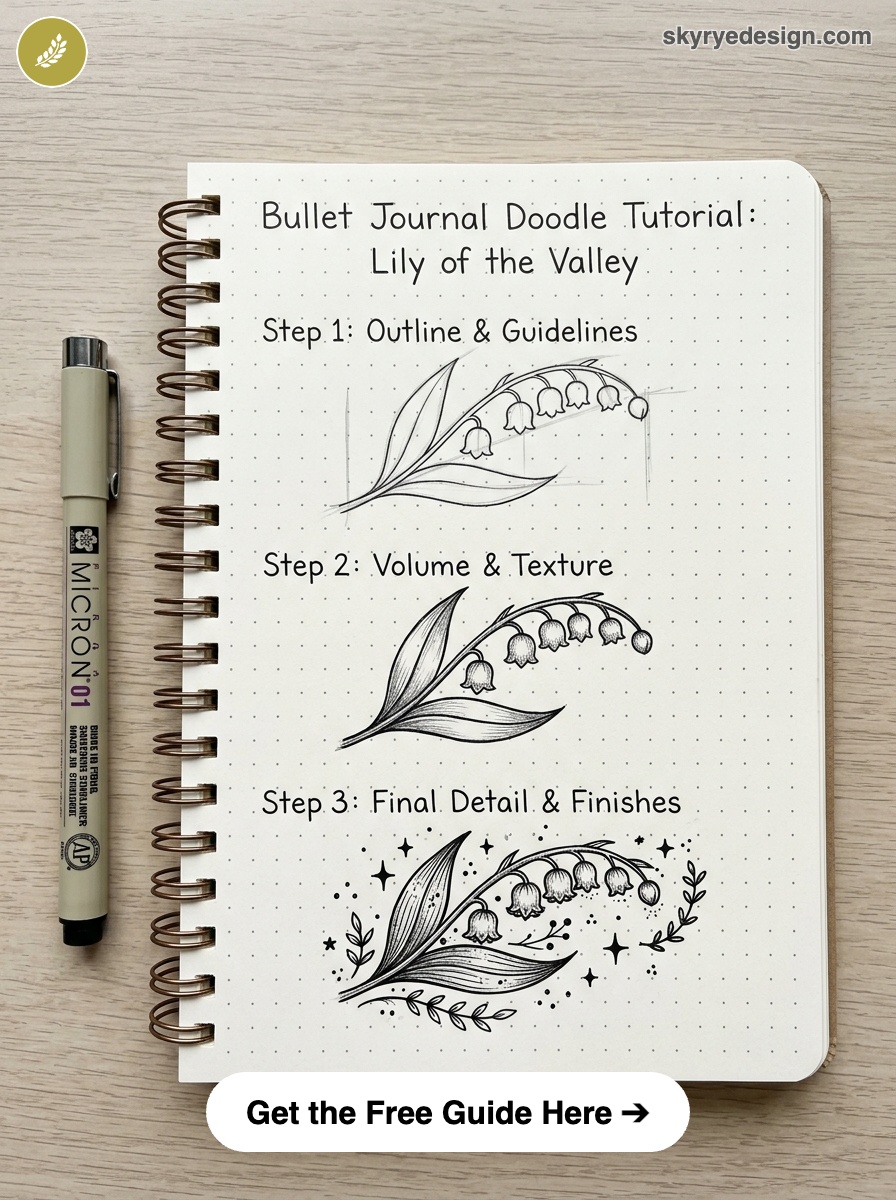
A single arching stem with small round bell-shaped flowers hanging from it on tiny individual stems. Each bell is a small oval with a scalloped or curved open bottom. 4-6 bells per stem. Add two large lance-shaped leaves at the base.
29. Simple Wreath with Berries — Medium
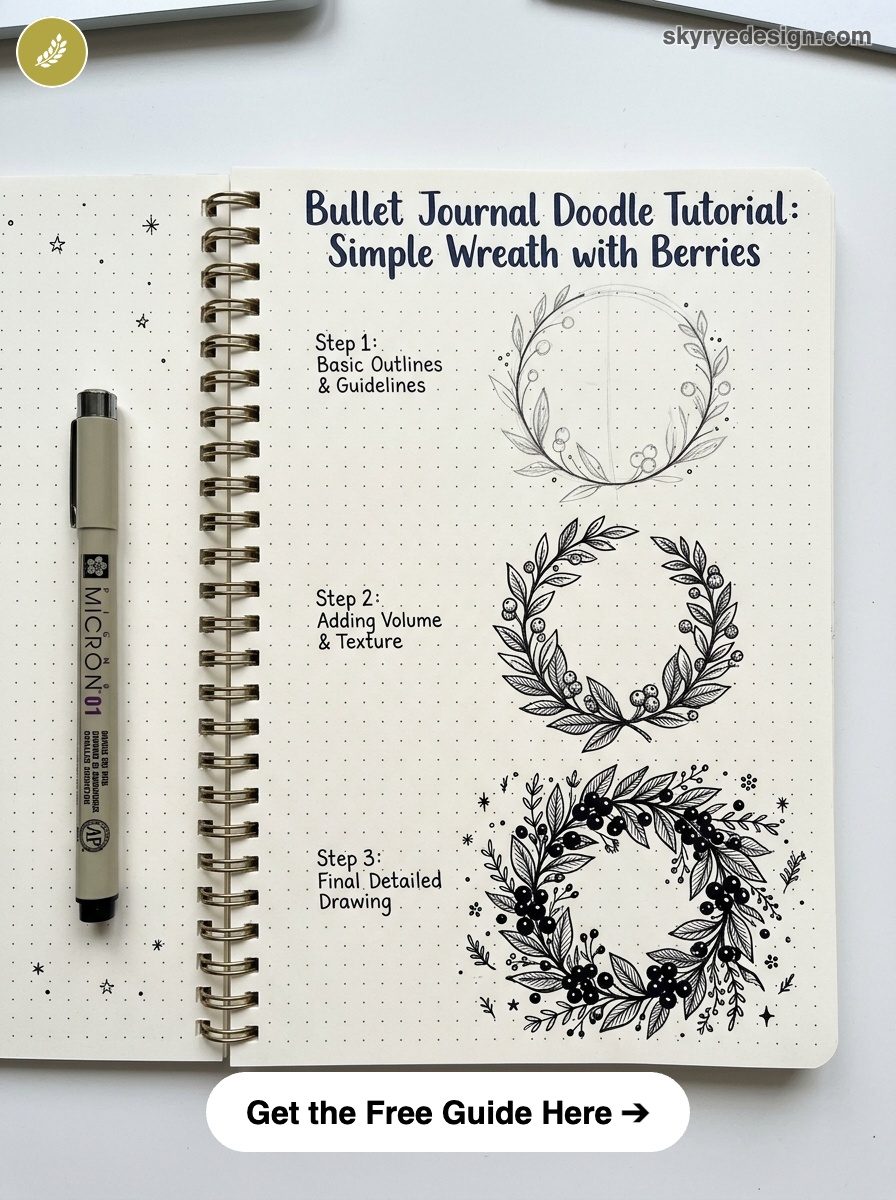
A circular arrangement of small leaves (simple ovals) interspersed with small berry clusters (3 dots grouped together on a short stem). Leave a 3cm gap at the top for a date or word. The wreath doesn’t need to be a perfect circle — slight irregularity looks handcrafted.
30. Pressed Flower Effect — Detailed
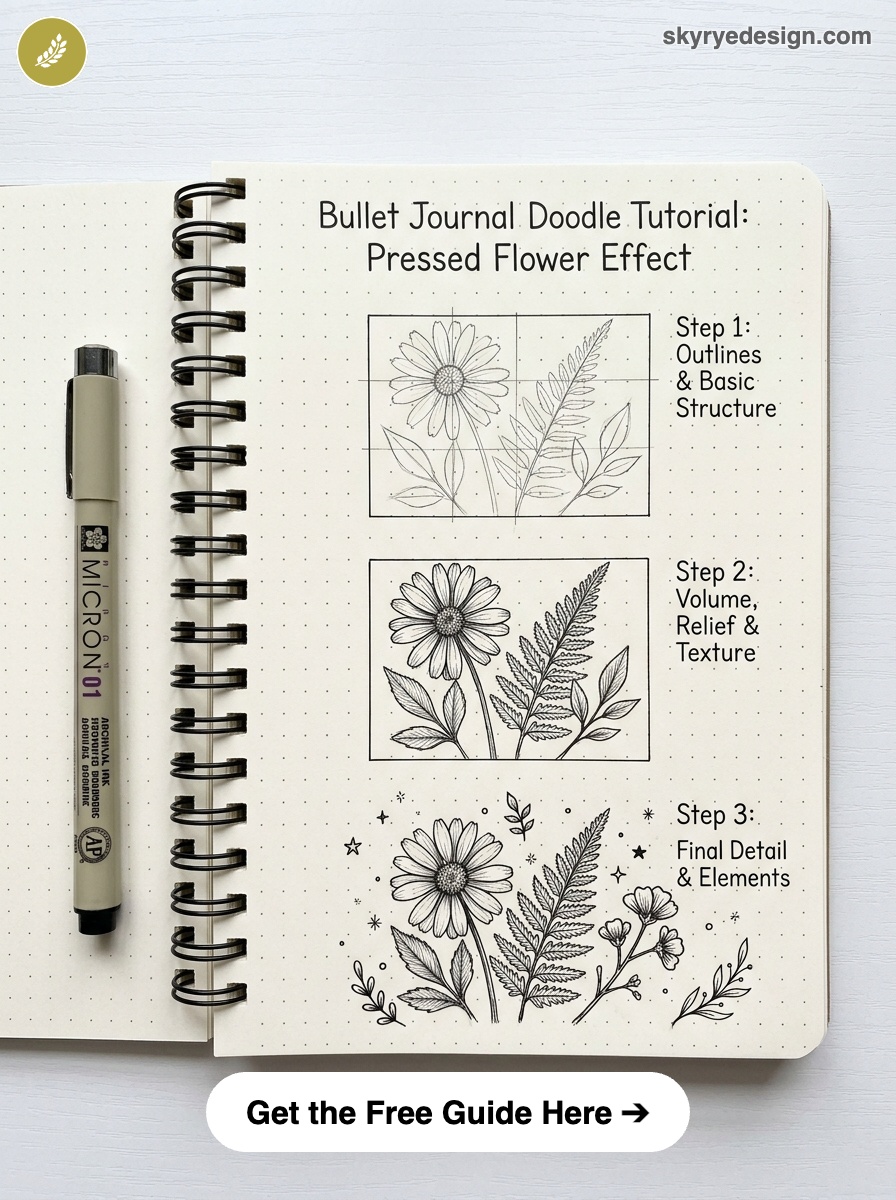
Draw a flower head from directly above — the petals appear flattened and splayed. Add pressure-pressing lines on the petals (light parallel lines in the direction of the petal length). This gives the impression of a dried pressed flower. Beautiful as a page focal point with a watercolour wash underneath.
Pair the doodle exercises with these journaling ideas when you want each practice page to include a prompt, a small illustration, and a clear visual hierarchy.
31. Branch with Blossoms — Medium
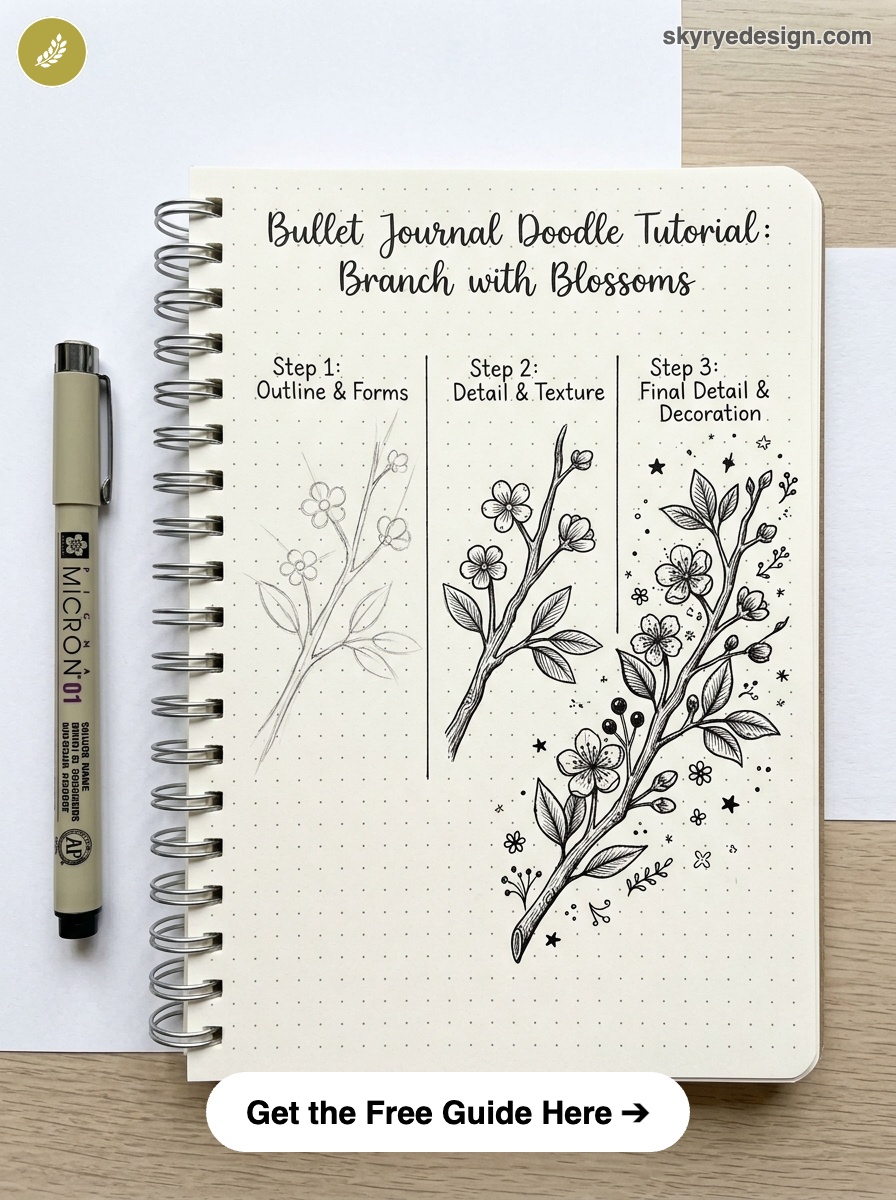
A bare branch drawn with confident single strokes branching at natural-looking angles. Add small five-petal cherry blossom flowers at the branch tips and along the upper edges of branches. Some branches have open blossoms, some have small oval buds. A few falling petal shapes (curved teardrop shapes) below.
32. Terrarium — Detailed
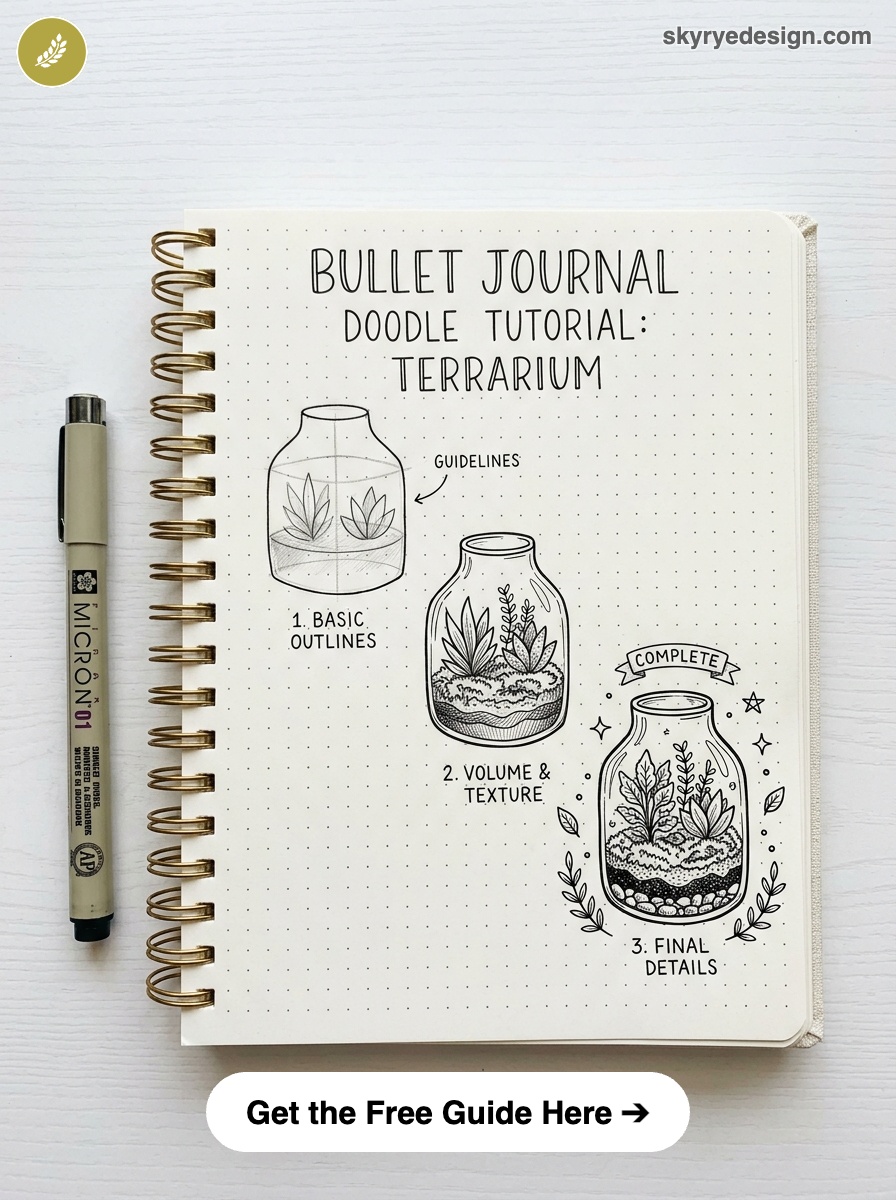
Draw a geometric glass container (a pentagon or hexagon shape, or a bottle silhouette). Inside, arrange small plants: a succulent, a fern frond, some pebbles at the base, maybe a tiny mushroom. The clear glass is indicated by subtle reflective lines on the sides and the fact that the plant details are visible through the frame.
Theme 4: Dark Academia — Doodles 33 to 42
Dark academia is the fastest-growing bujo aesthetic in 2026 alongside cottagecore. The palette is deep — midnight blue, forest green, burgundy, black — and the subject matter borrows from gothic libraries, alchemical illustrations, and classical scholarship.
33. Quill Pen — Easy
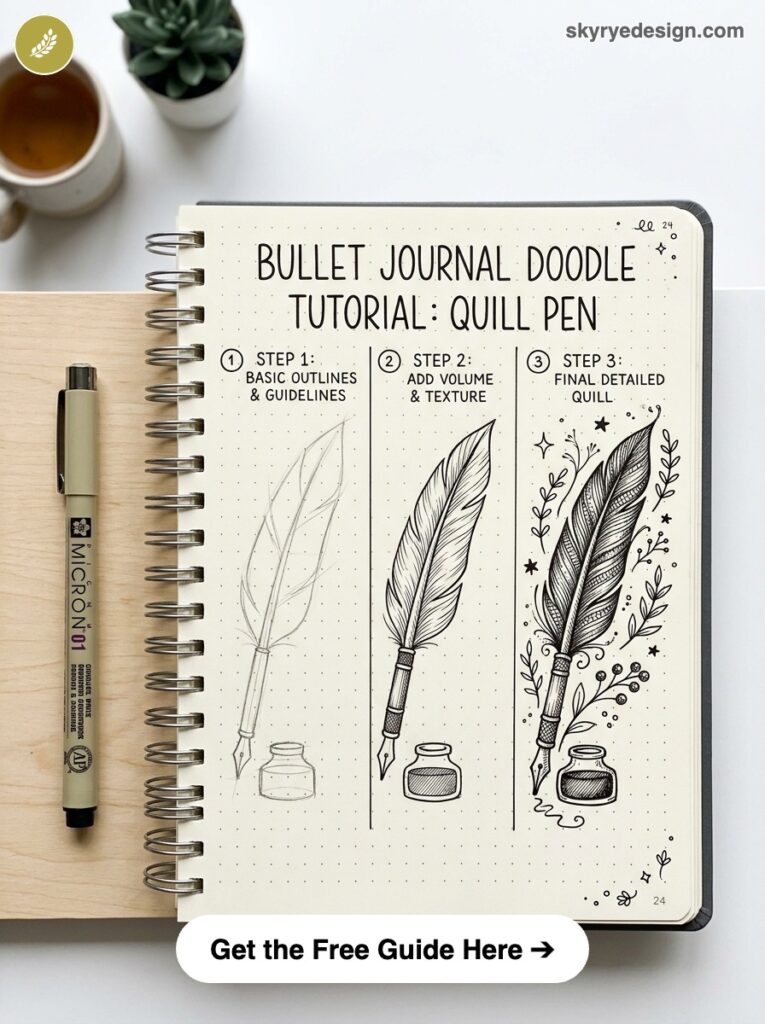
A long tapered feather shape: wide at the base, curving to a sharp point at the tip. Add the barb lines on the feather (short diagonal strokes from the central spine outward). Add a small ink drop at the quill tip. Works as a standalone doodle or as a header accent beside ‘notes’ or ‘ideas’ sections.
34. Hourglass — Medium
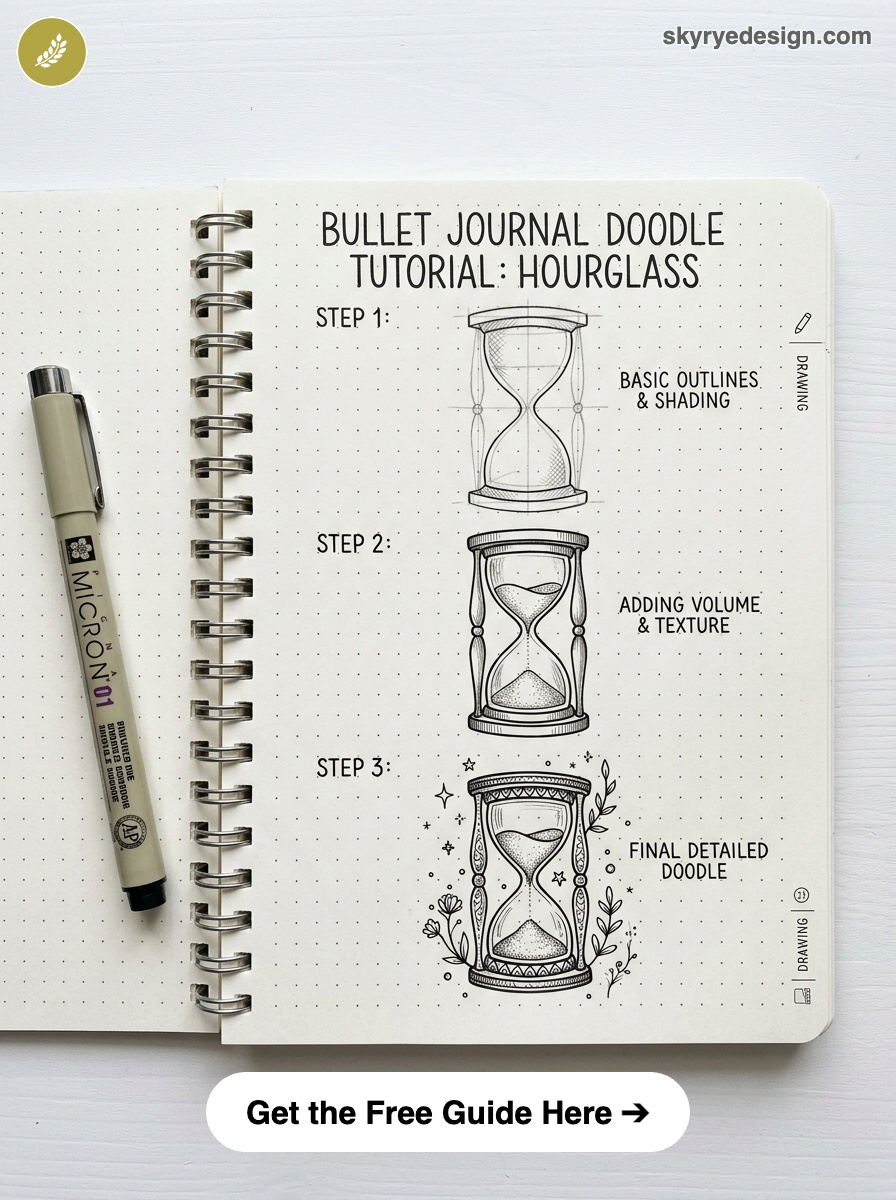
Two triangles meeting point-to-point, with rounded connections at the waist. Add a rectangular frame around the outside (the hourglass housing). Fill the lower chamber with a flat colour or crosshatch. Add a few diagonal lines in the upper chamber to suggest falling sand. A tiny star or sparkle above or below elevates it.
35. Ink Bottle — Easy
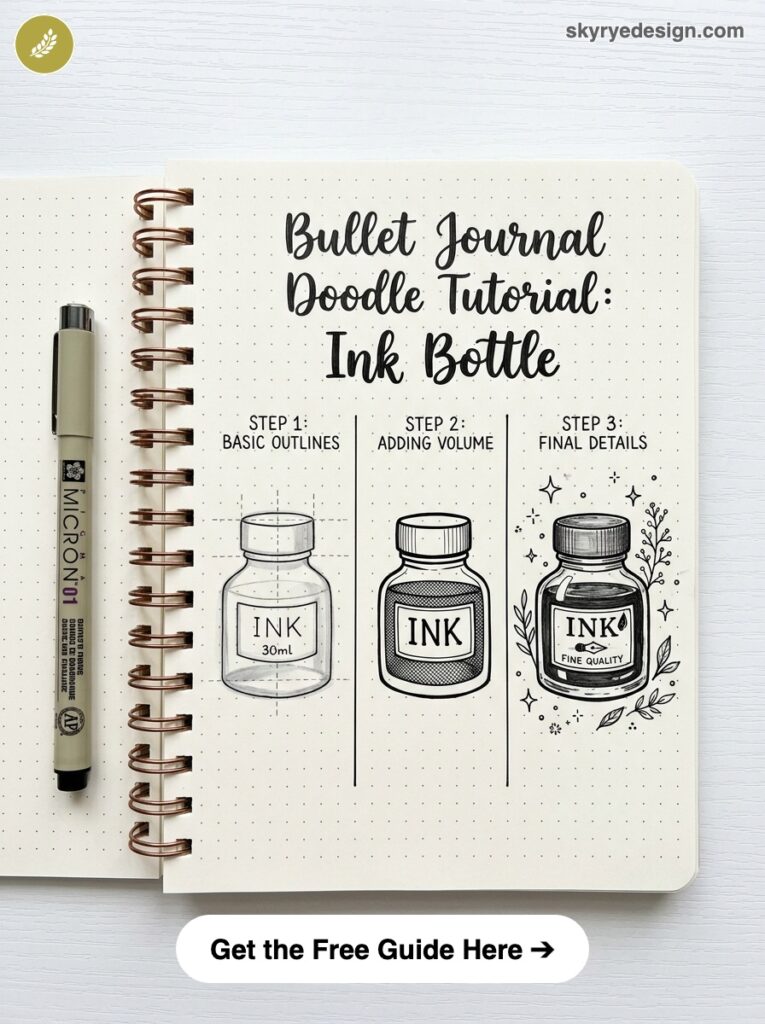
A small rectangular or rounded bottle with a narrow neck and a cork or cap. Add a label shape on the front. Draw the ink level at about 60% full with a flat horizontal line inside the bottle. A subtle ink drip running down the outside of the bottle adds character.
36. Stack of Books — Easy
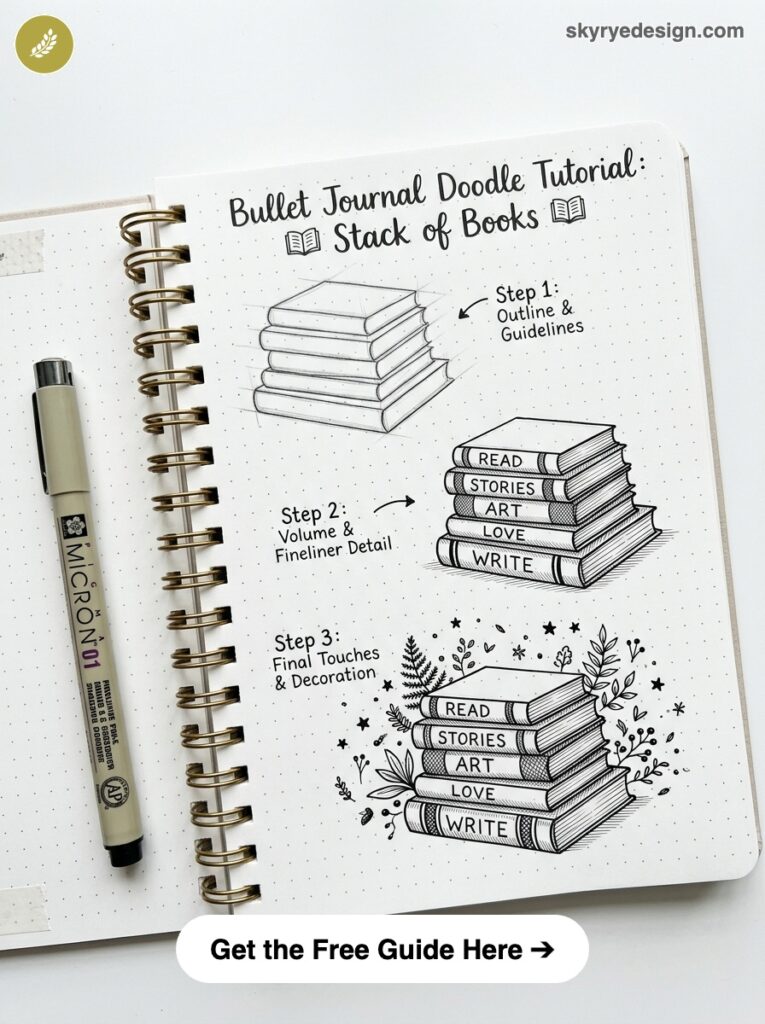
Three to four rectangles stacked at slightly irregular angles — not all perfectly aligned. Add a thin vertical line on each book’s spine and a small horizontal line near the top of the spine for the title area. The books can lean at a slight angle or sit in a tidy stack. One open book flat at the bottom of the stack is a nice variation.
37. Tarot Card — Medium
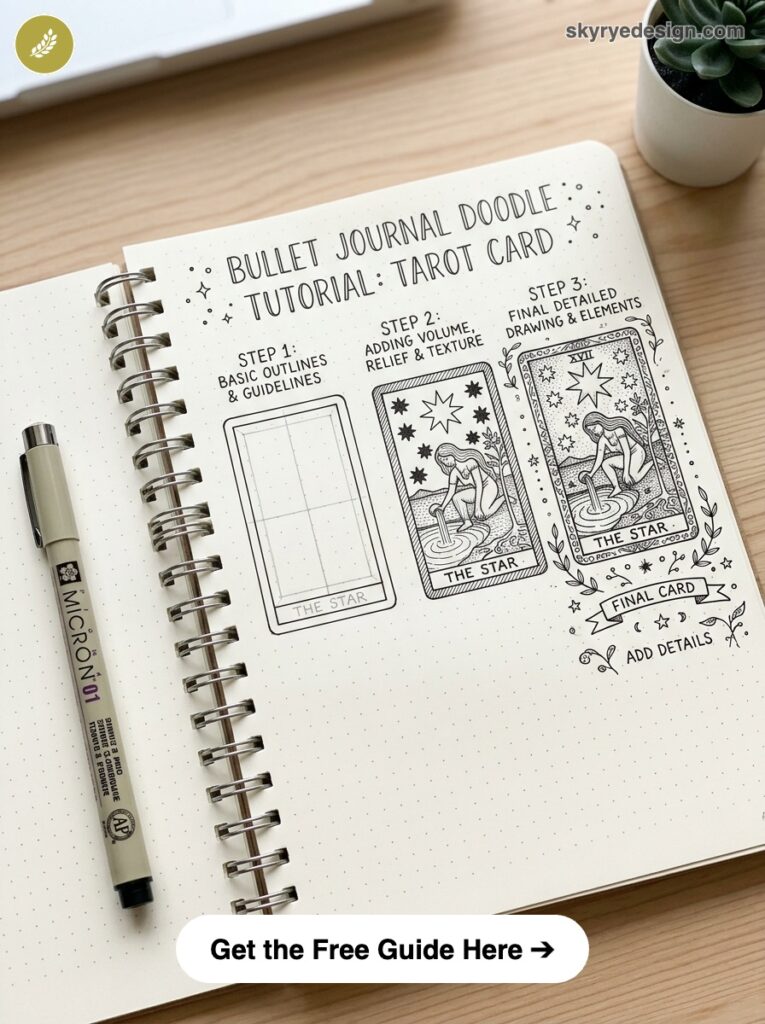
A vertical rectangle with a decorative border (a simple frame of dots or a thin double line). Inside: a simple central symbol (moon, sun, star, eye, hand). A small Roman numeral at the top and a short text banner at the bottom. The key is the border detail — it transforms a plain rectangle into a recognisable tarot aesthetic.
38. Compass Rose — Medium
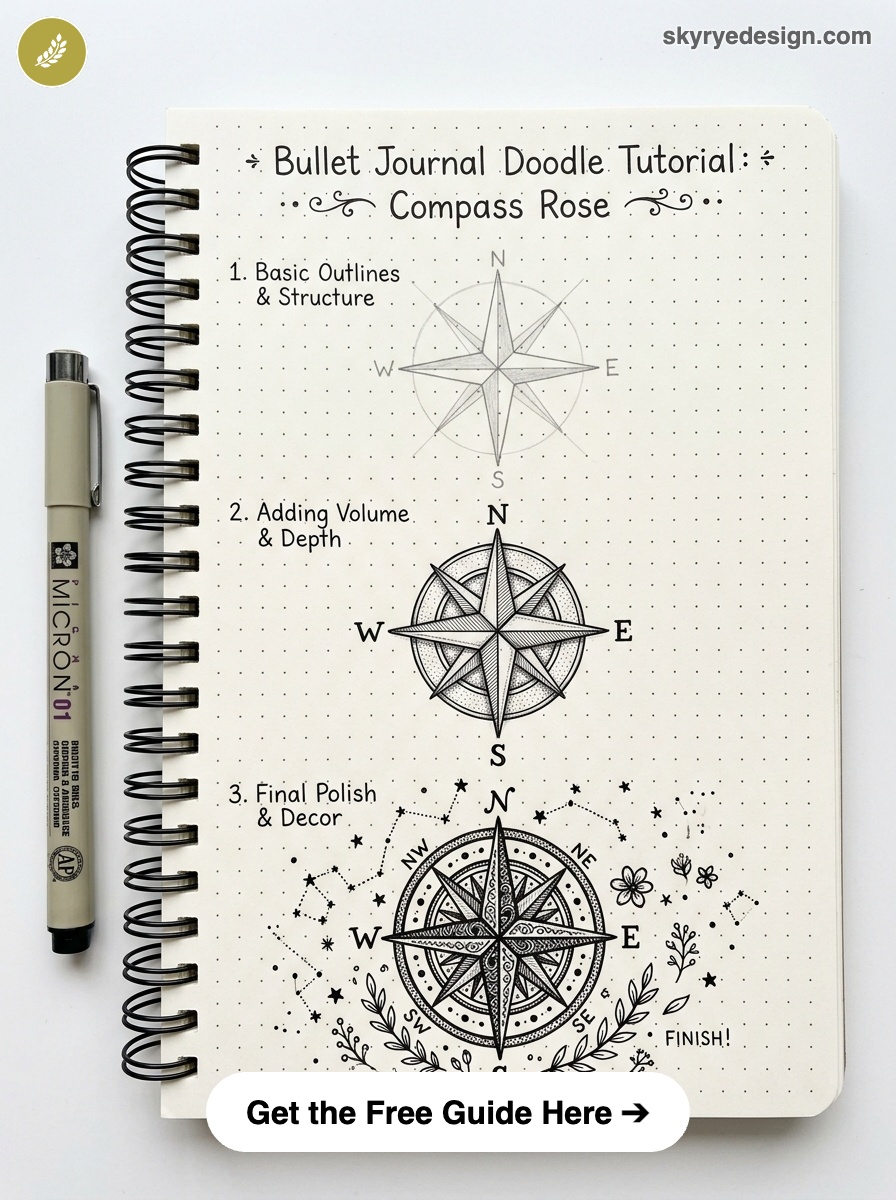
Eight directional points from a central circle: four cardinal points (N, S, E, W) are longer and more elaborate, four intercardinal points shorter and simpler. The cardinal points use a diamond shape — a long narrow diamond. Add N, S, E, W labels. Works as a central decorative element in travel or planning spreads.
39. Wax Seal — Easy
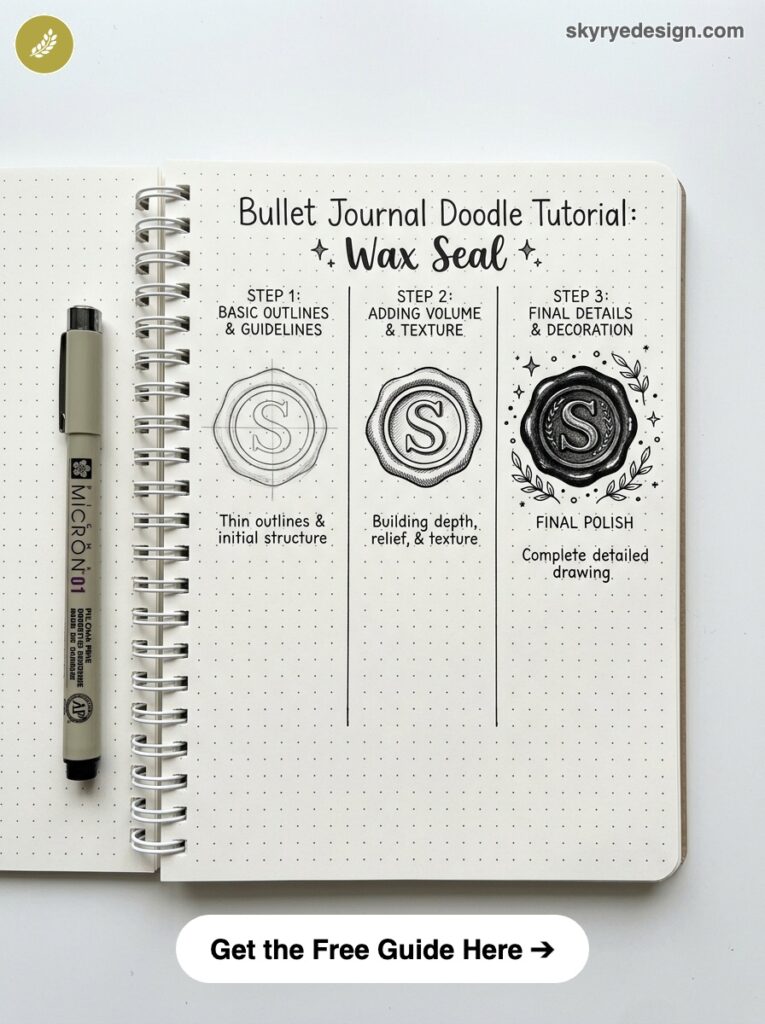
A circle with irregular edges (press lightly so it looks like poured wax, not a drawn circle). Inside: a simple symbol (initials, a small star, a key, a fleur-de-lis). Add a faint impression shadow on one side. A sealing wax colour fill (deep red, forest green, midnight blue) makes this immediately recognisable.
40. Antique Key — Medium
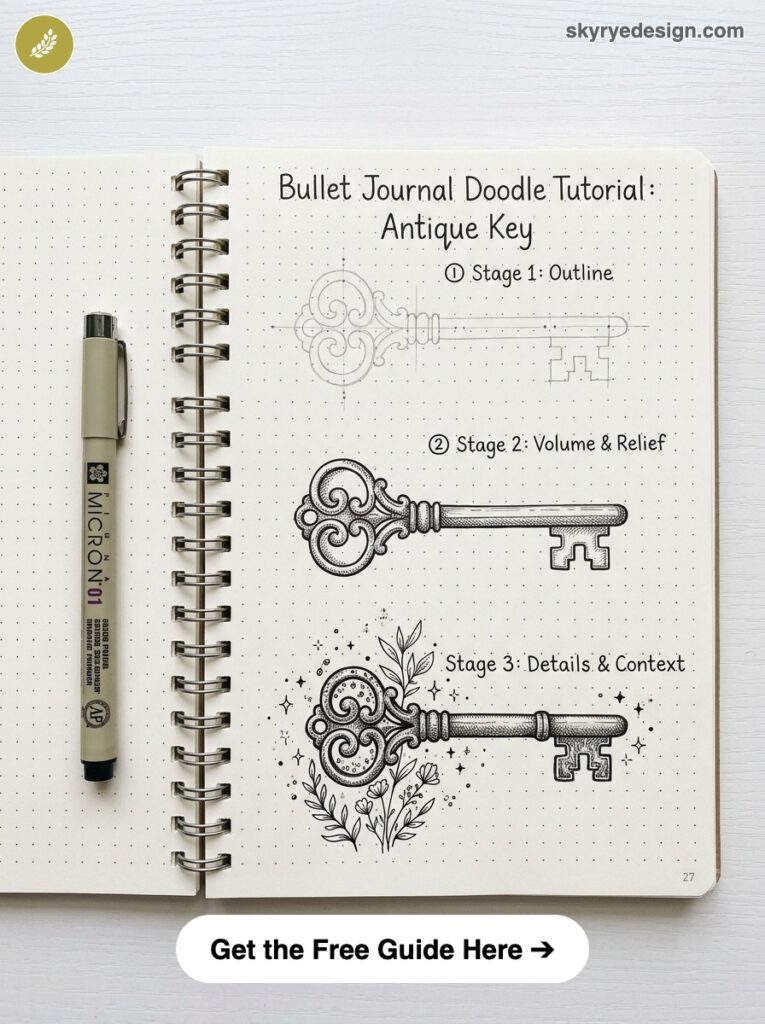
Draw the bow (the decorative ring at the top) as an ornate shape — a circle within a circle, or a gothic arch. The blade is the rectangular notched section at the bottom. The shaft connects them. Add 1-2 notches cut into the blade. A small bow-tie shape where the shaft meets the blade adds vintage character.
41. Open Book with Pressed Flower — Detailed
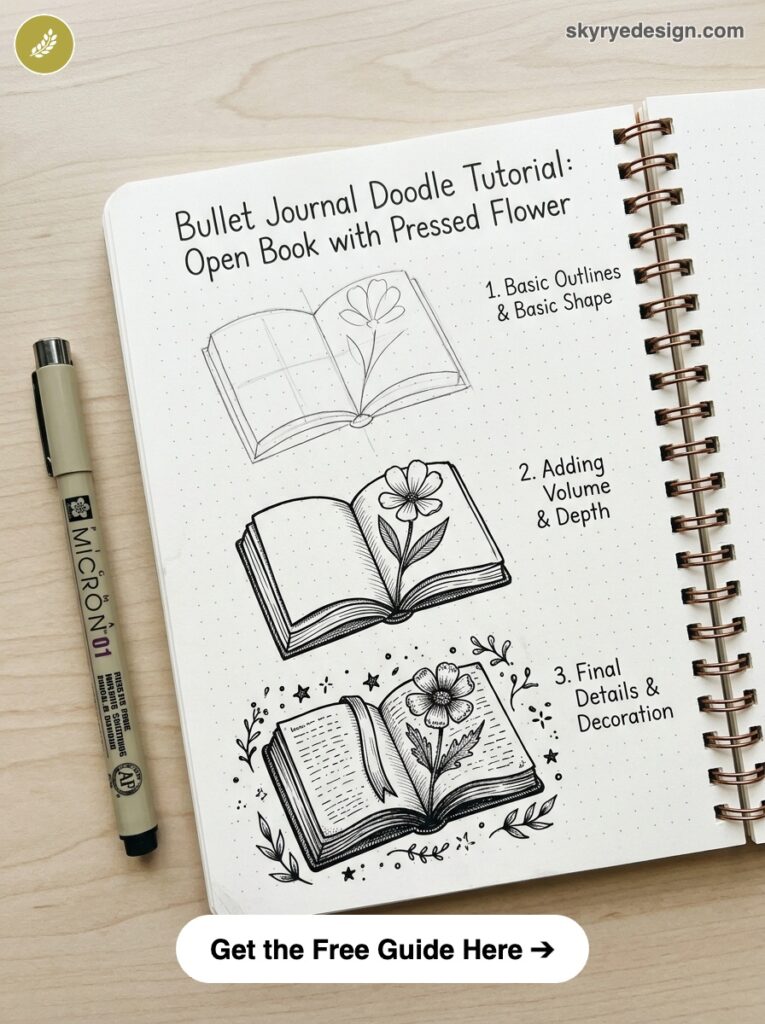
An open book from above: two facing pages with a spine in the centre and slightly curved page edges. On the left page, ruled lines for text. On the right page, a pressed flower or leaf. Add tiny handwriting-style marks on the lined page. A ribbon bookmark trailing from the bottom completes the image.
42. Alchemy Flask — Medium
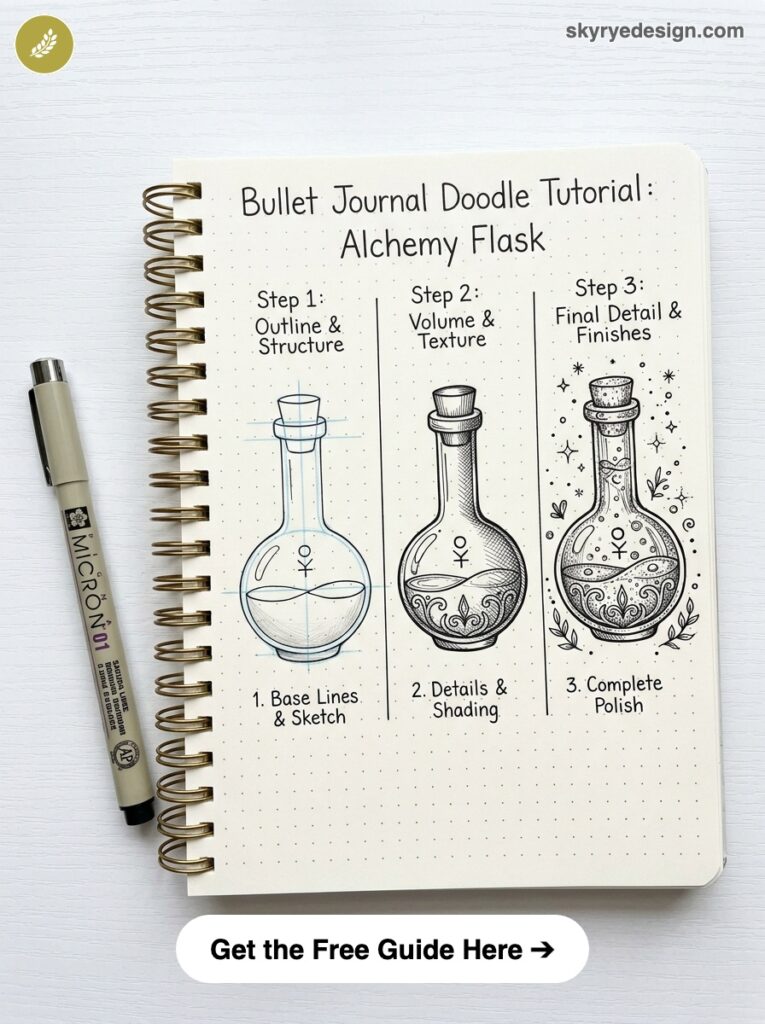
A rounded flask body (globe or teardrop shape) with a long narrow neck. Add a cork at the top. Inside the flask, draw a crescent moon, a star, or a small cloud of swirling liquid. Tiny bubbles rising inside. A label tied around the neck with string. The magic is in the contents — make them mysterious.
Theme 5: Y2K and Retro Digital — Doodles 43 to 50
Y2K aesthetic has returned emphatically to bujo doodles in 2025-2026. Think pixel shapes, retro tech objects, glitter-star clusters, and the particular colour palette of early-2000s graphic design: hot pink, electric blue, lime green, silver.
43. Pixel Star — Easy
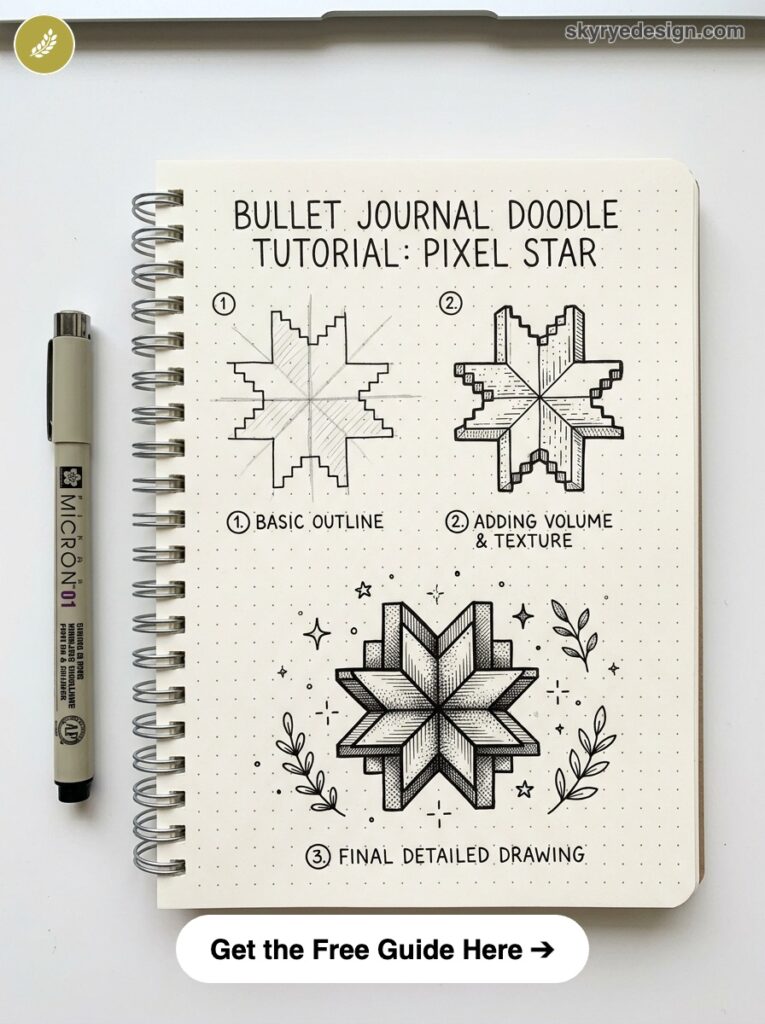
Draw a 5×5 grid very lightly in pencil. Fill in squares to create a star shape — the classic pixel art star uses the centre column top and bottom, the centre row left and right, and the four diagonal corner squares. Erase grid. The result is an instantly recognisable pixel star that can be scaled up or made tiny.
44. Old Computer Screen — Easy
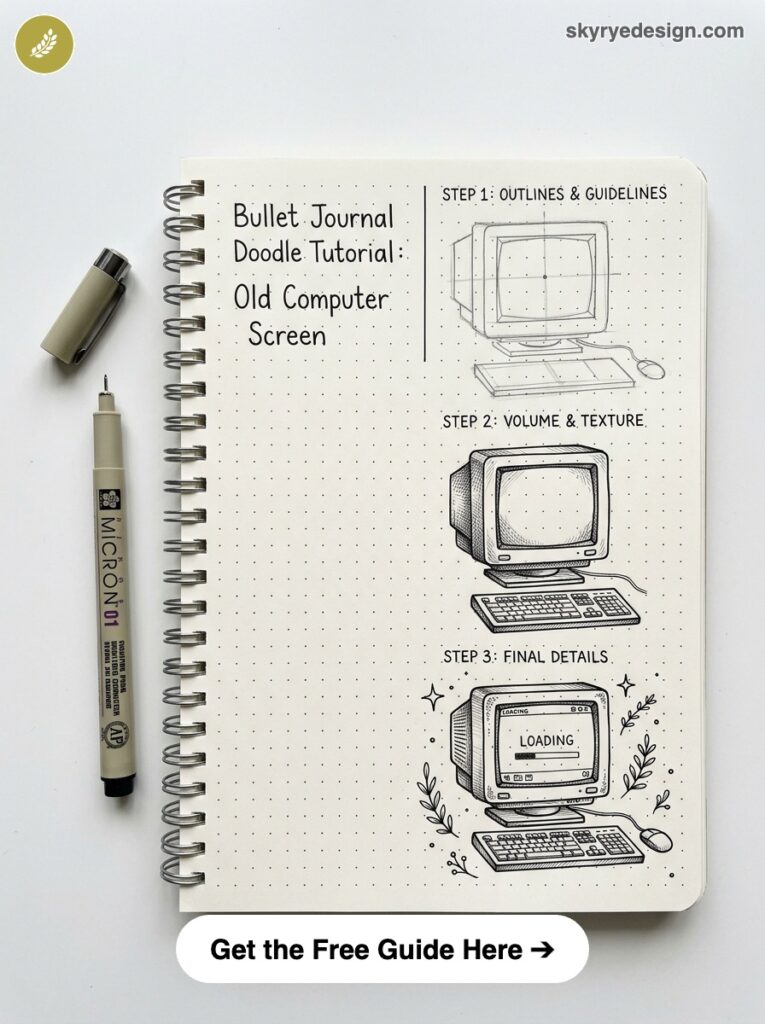
A rounded rectangle for the monitor housing. A slightly recessed rectangle inside for the screen. Short stubby legs at the base. Add a simple image on the screen — a tiny heart, a star, a smiley face. A small circular button to the right of the screen. Nostalgic and quick.
45. Flip Phone — Easy
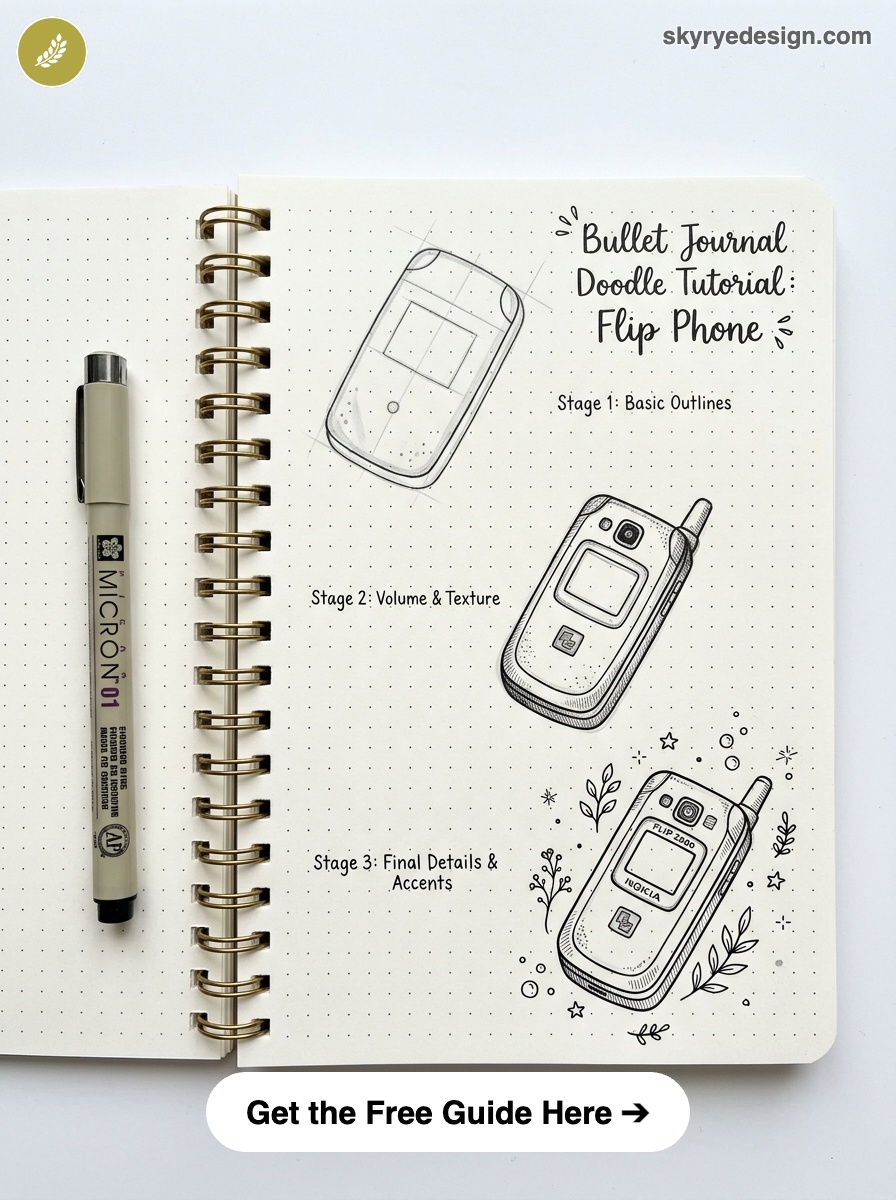
Two rectangles connected by a small hinge in the middle, the phone in open position. Upper rectangle: a small screen with a simple graphic. Lower rectangle: rows of small circles for the number pad. The rounded corners and the flip hinge are the key identifying details.
46. Glitter Starburst — Easy
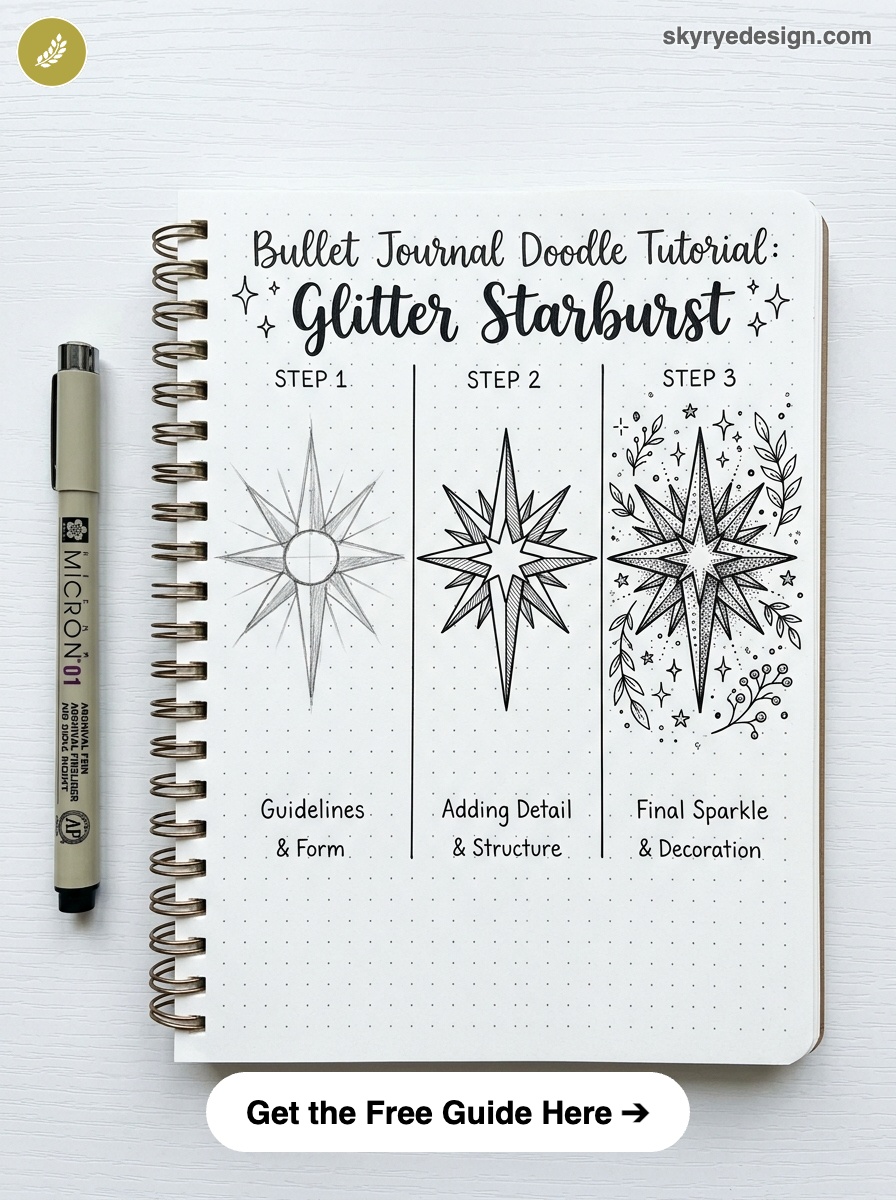
A central point with many lines radiating outward at irregular angles — not evenly spaced. Some lines are longer than others. Add a tiny diamond or star shape at the end of the longer lines. Clusters of 3-4 dots between the lines suggest scattered glitter. Works in any colour but looks best in gold, silver, or hot pink.
47. CD or Vinyl — Medium
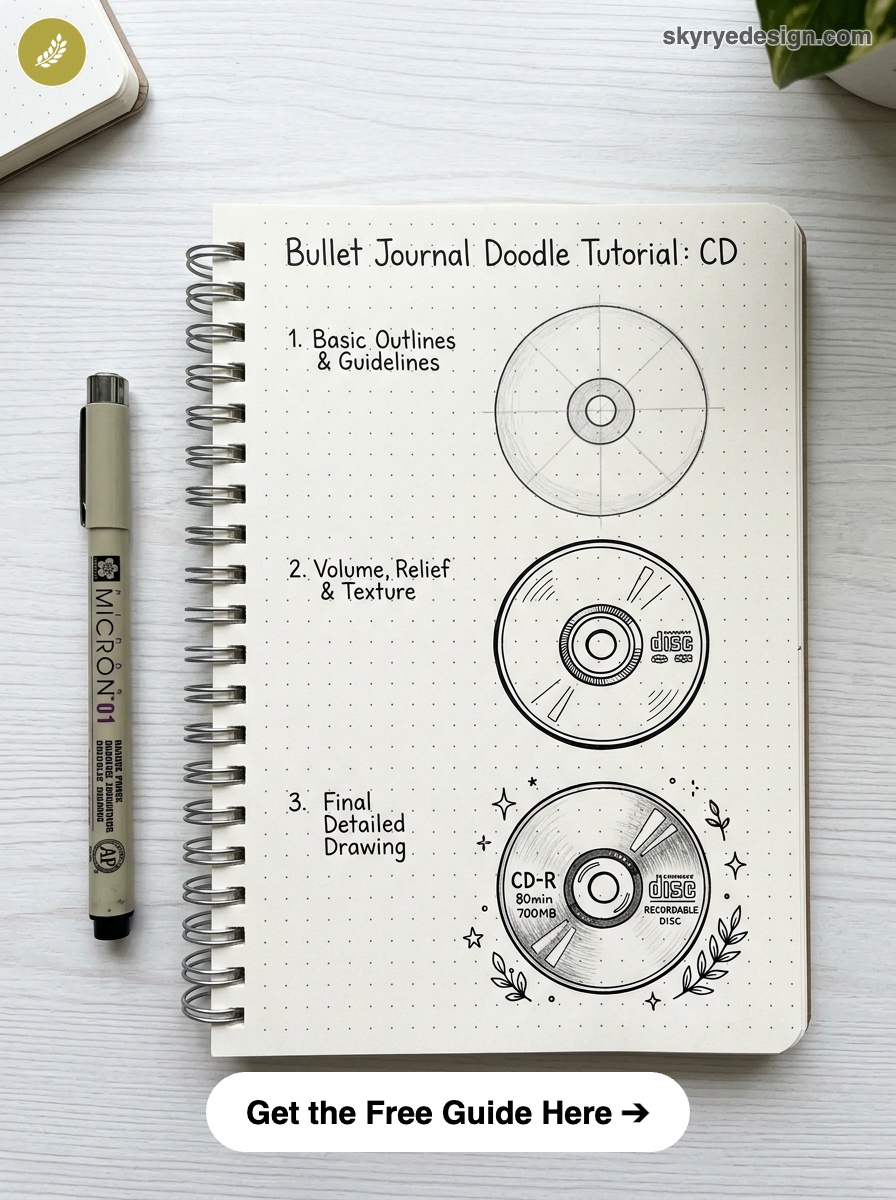
A circle with a small circle in the centre (the hole). For a CD: fine concentric rings suggesting the data surface, and a small label area around the centre hole. For vinyl: wider concentric grooves and a label with text. A tiny reflection highlight (a small white arc) on one side.
48. Retro Camera — Medium
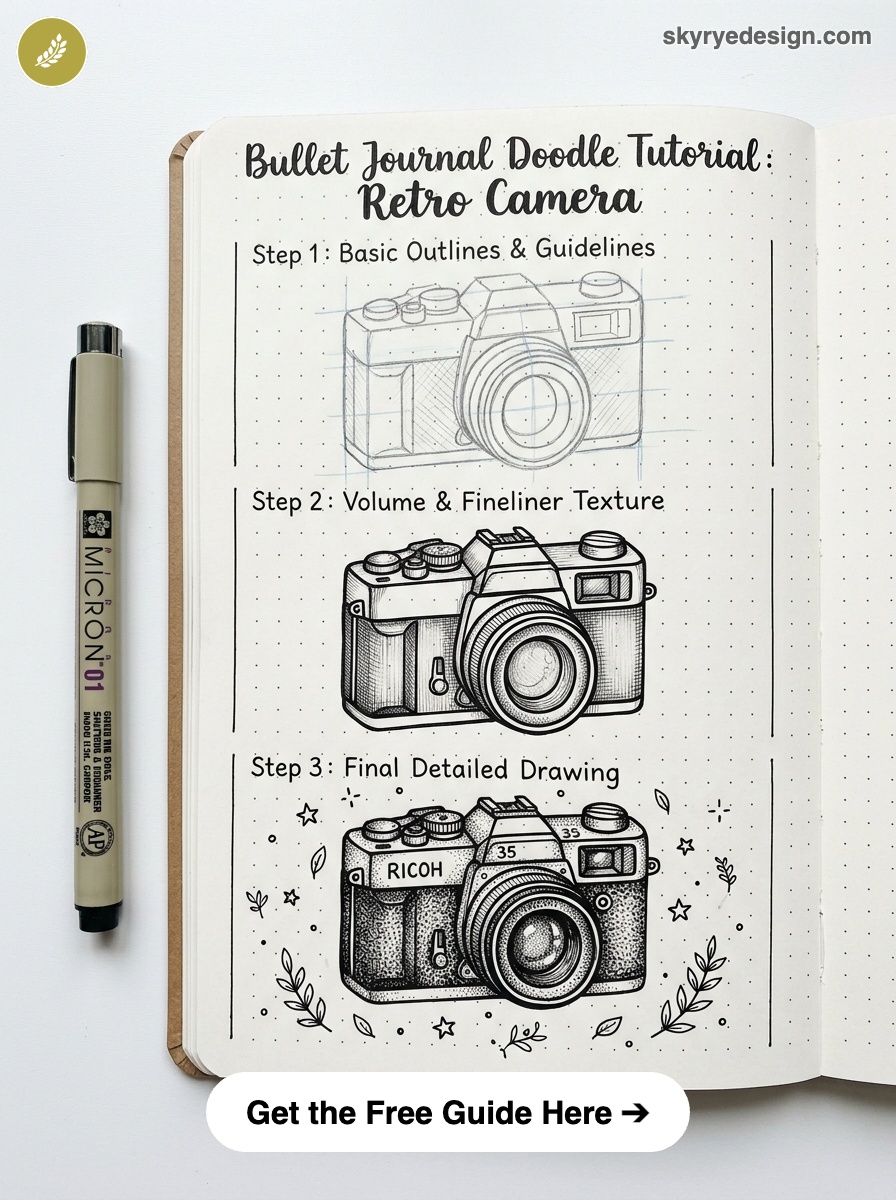
A rounded rectangle for the camera body. A large circle on the front for the lens (two concentric circles). A small rectangular viewfinder on top. A shutter button. The camera strap loops from each side. Polaroid variant: a square camera body with a rectangular slot at the bottom.
49. Butterfly (Y2K Style) — Easy
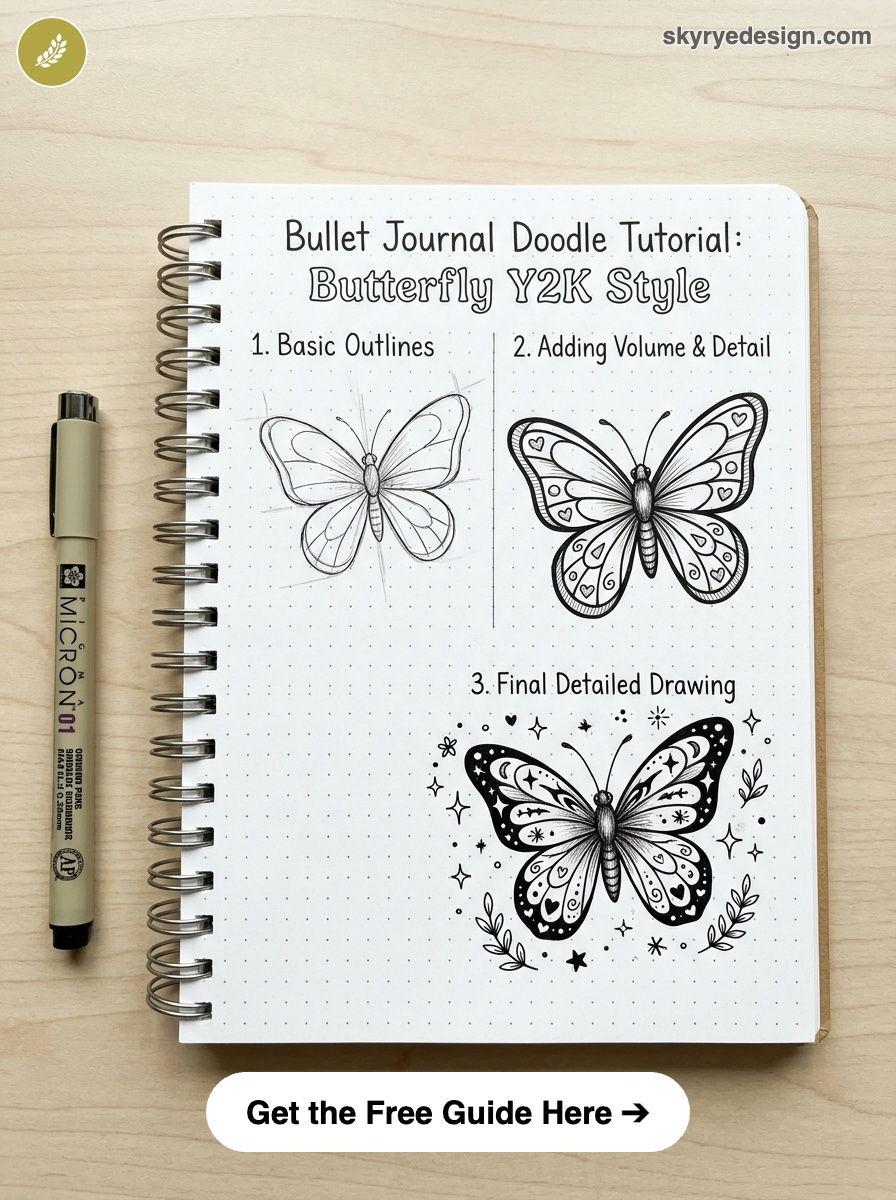
Four wing shapes: two upper wings (rounded, larger) and two lower wings (more elongated). Draw the wings with slightly curved outlines rather than perfectly smooth. Add simple patterns on the wings: circles, small lines, or simple petal shapes. The Y2K butterfly is more symmetrical and graphic than a realistic butterfly.
50. Star and Heart Confetti — Easy
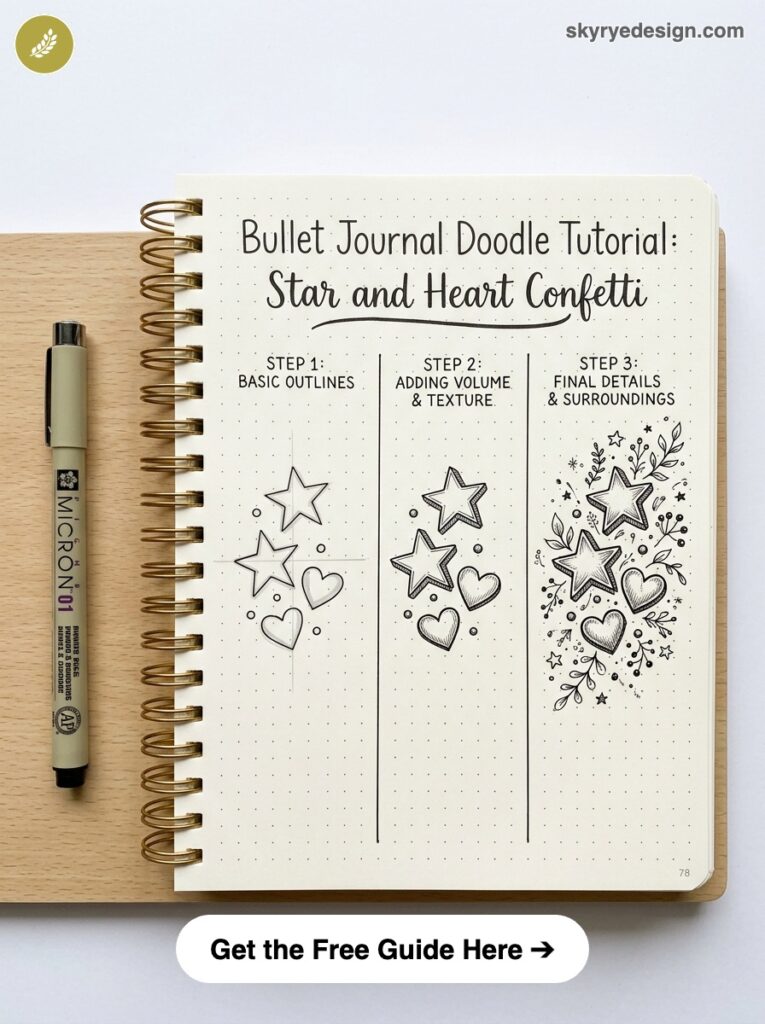
A scatter of small four-pointed stars, hearts of varying sizes, and small circles across a defined space — a corner, a border, or a floating cluster. Vary the orientation of each shape slightly. This is perhaps the single fastest aesthetic bujo element — a minute of doodling produces a page section that looks intentionally decorated.
Theme 6: Cosy Everyday Objects — Doodles 51 to 60
Cosy doodles are the most adaptable theme in any bujo practice — they reference daily life and therefore sit naturally beside task lists, habit trackers, and weekly spreads without demanding a thematic commitment.
51. Mug of Tea or Coffee — Easy
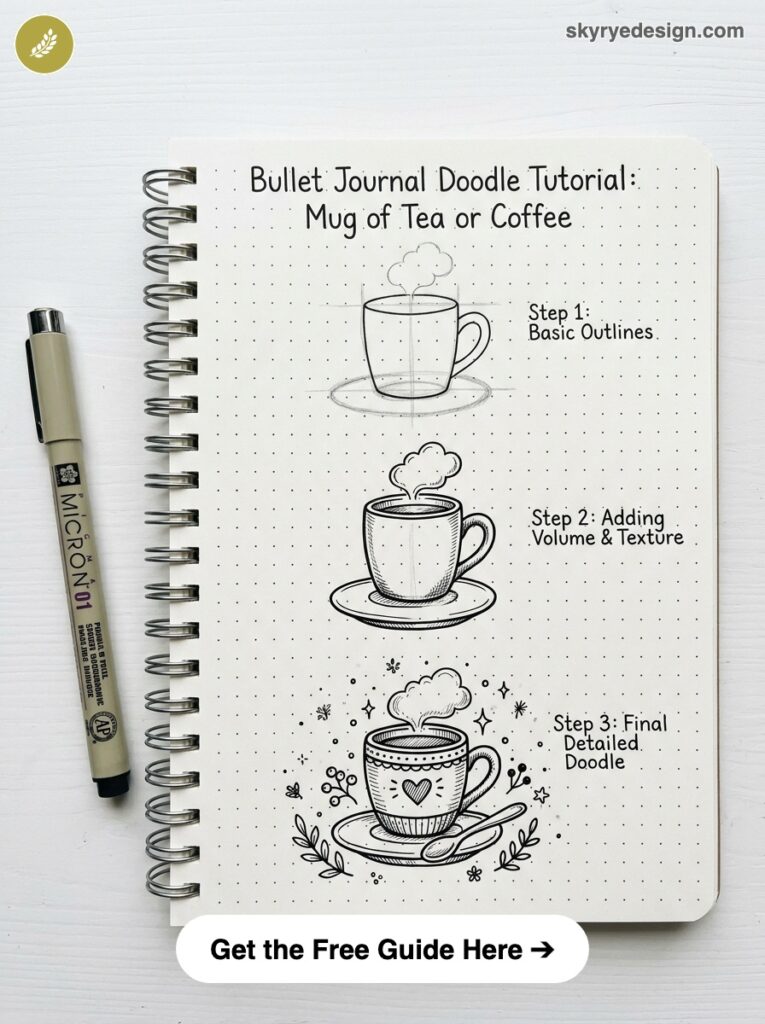
A cylinder (trapezoid from the front) with a curved handle on the right side. Add a thin horizontal line near the top for the liquid level. Three small curved lines rising from the surface for steam. A small tag hanging from the handle on a thin string for a tea bag. Done in under 60 seconds.
If you want to move beyond journal symbols, this collection of doodle art ideas groups everyday objects, animals, flowers, patterns, and daily prompts into fuller sketchbook pages.
52. Candle — Easy
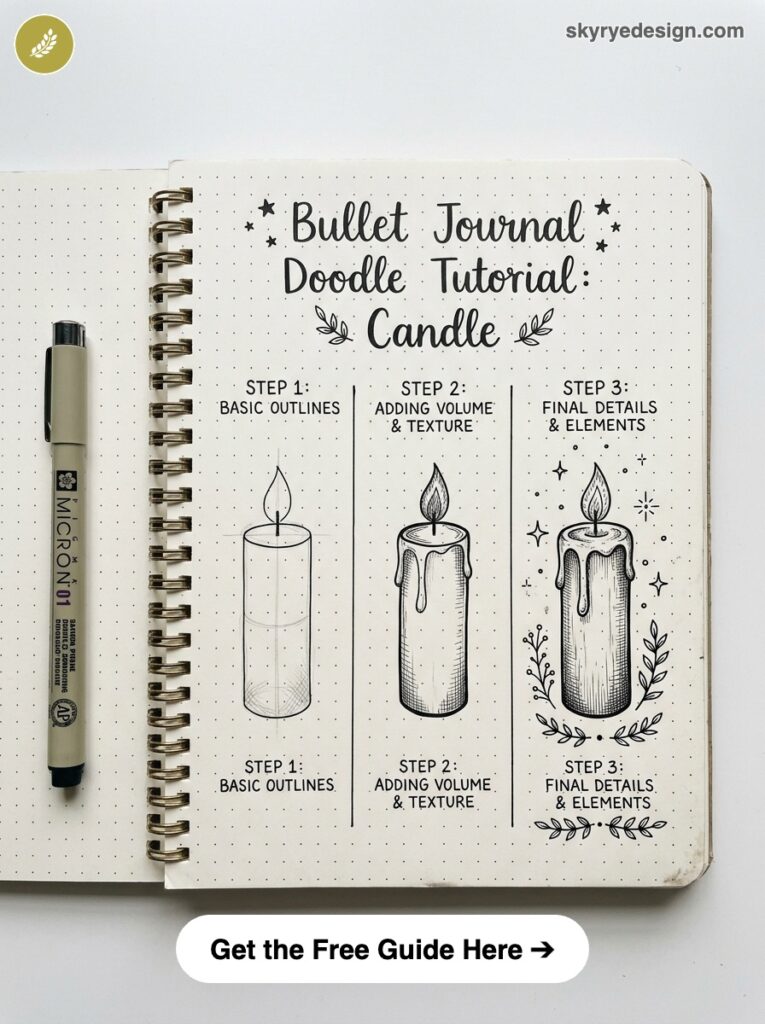
A rectangle for the candle body, with slightly melted wax drips on the sides (smooth irregular bumps). A small oval at the top for the wax pool. A thin vertical line for the wick, with a small almond shape at the top for the flame (a yellow-orange inner shape inside a slightly larger pale outer shape).
53. Cat (Sleeping) — Easy
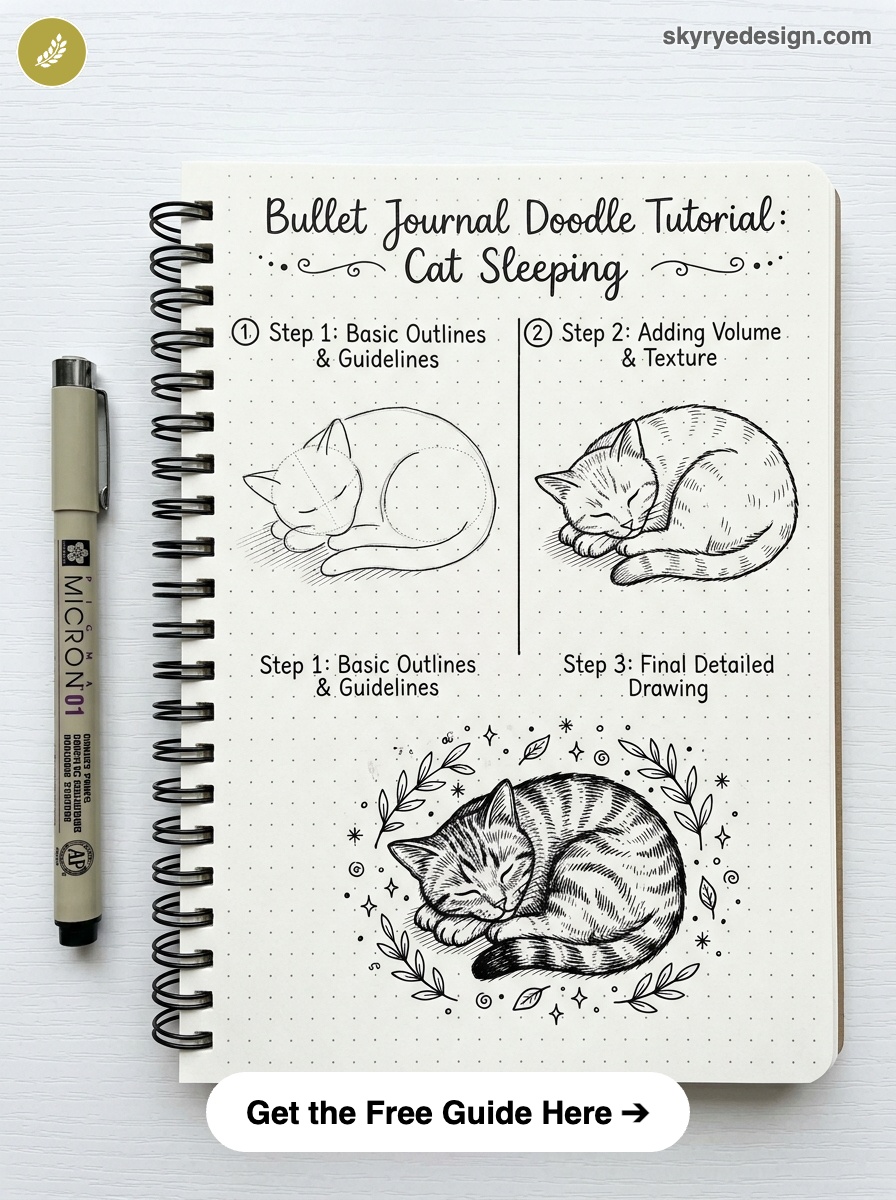
An oval for the body, curled slightly. A smaller oval for the head, overlapping the body. Two small triangles on top for ears. Two small curved lines on the face for closed eyes. A curved tail wrapping around the body. The charm of this doodle is in the extreme simplicity — resist the urge to add detail.
54. Reading Nook Scene — Detailed
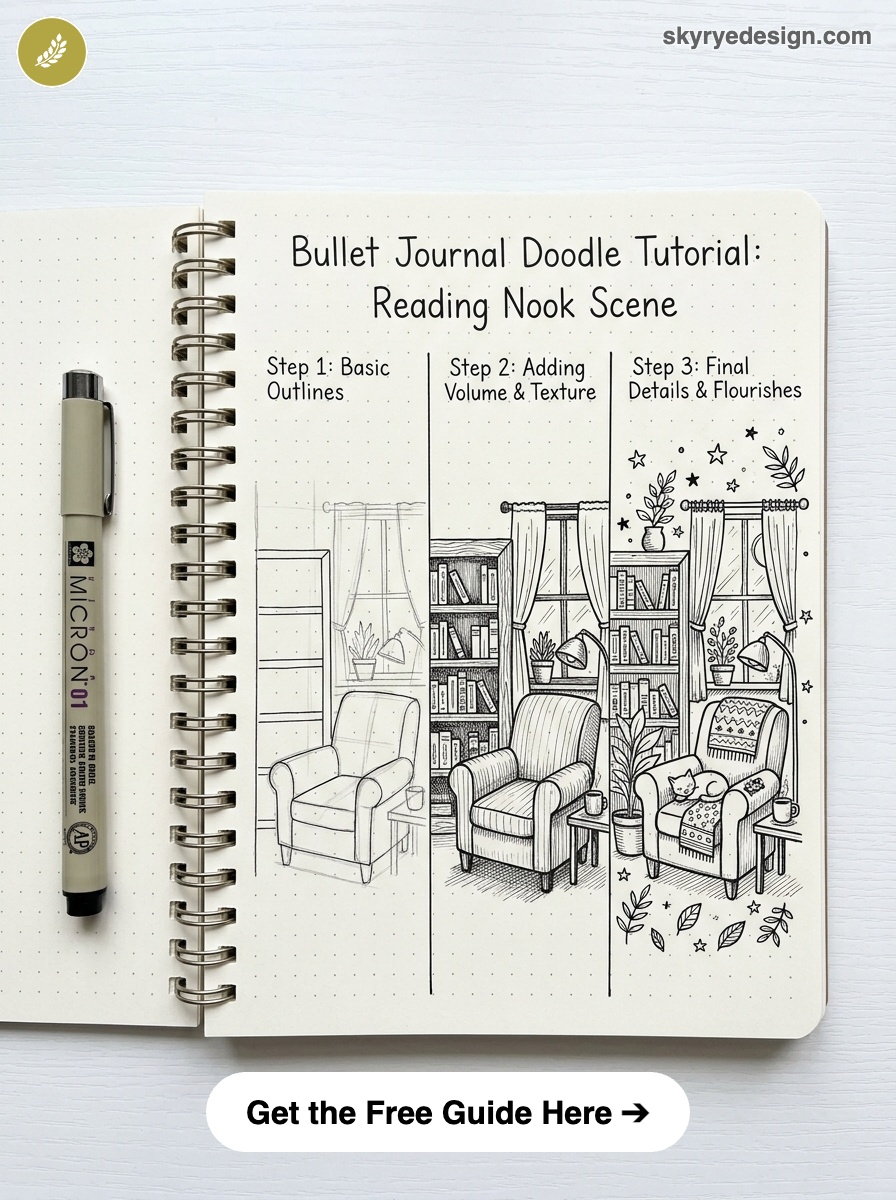
A corner composition: a low bookshelf or stack of books, a small plant beside it, a mug on top, and a pair of glasses or bookmarks tucked in. This works as a small vignette illustration in a corner of a spread rather than a standalone doodle.
55. Autumn Leaf Fall — Easy
For a cleaner tiny doodle, practice a simple fall leaf drawing first, then shrink the same vein-and-edge idea into your journal spread.
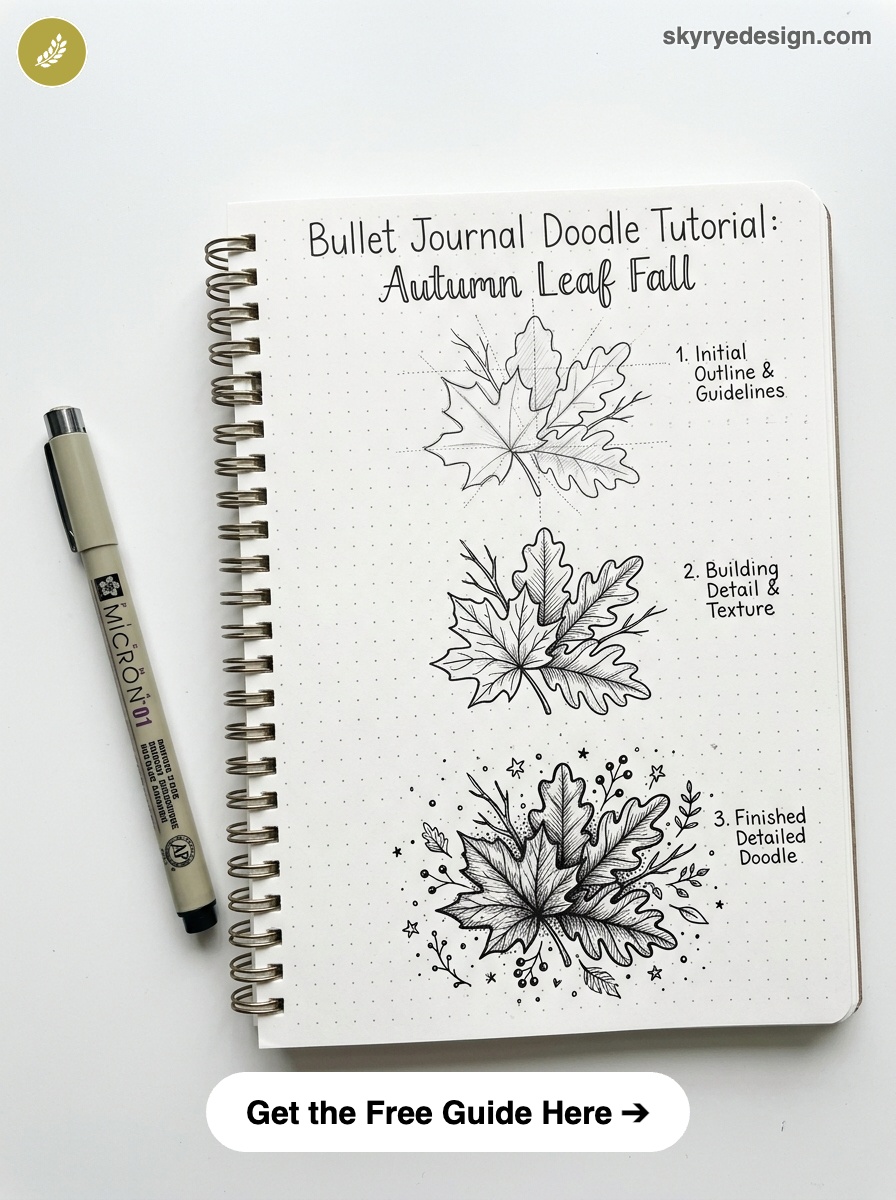
Three to five single maple or oak leaves scattered at different angles, as if falling. Each leaf is a simplified shape — the full detailed leaf drawing is not necessary here. Add a few tiny dots below each leaf to suggest they’ve just touched down. Perfect for September and October spreads.
56. Cosy Blanket and Book — Medium
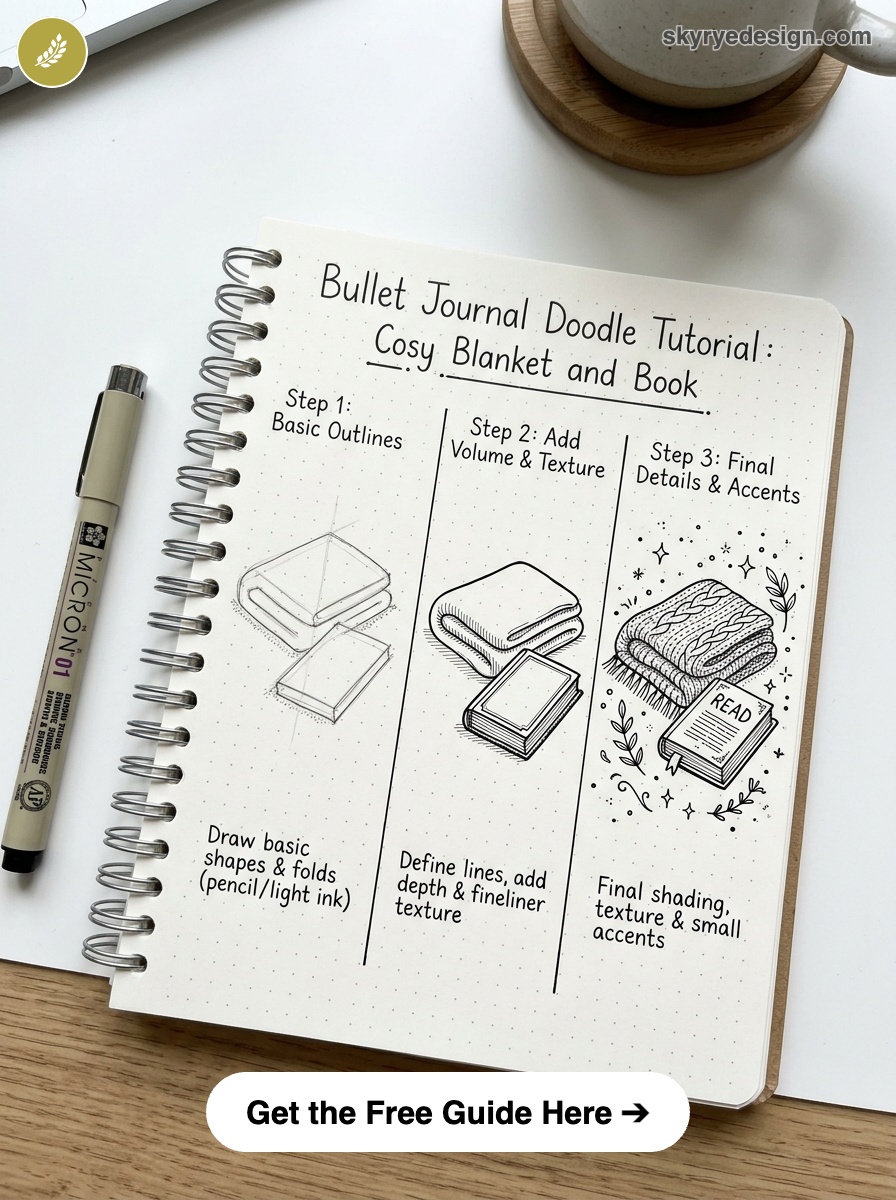
An open book (rectangle with a spine line and slightly curved pages). Over the bottom third of the book, a blanket with visible fabric folds — the blanket is indicated by gentle curved parallel lines and a slightly irregular edge. A small mug beside it completes the hygge scene.
57. Rain on a Window — Medium
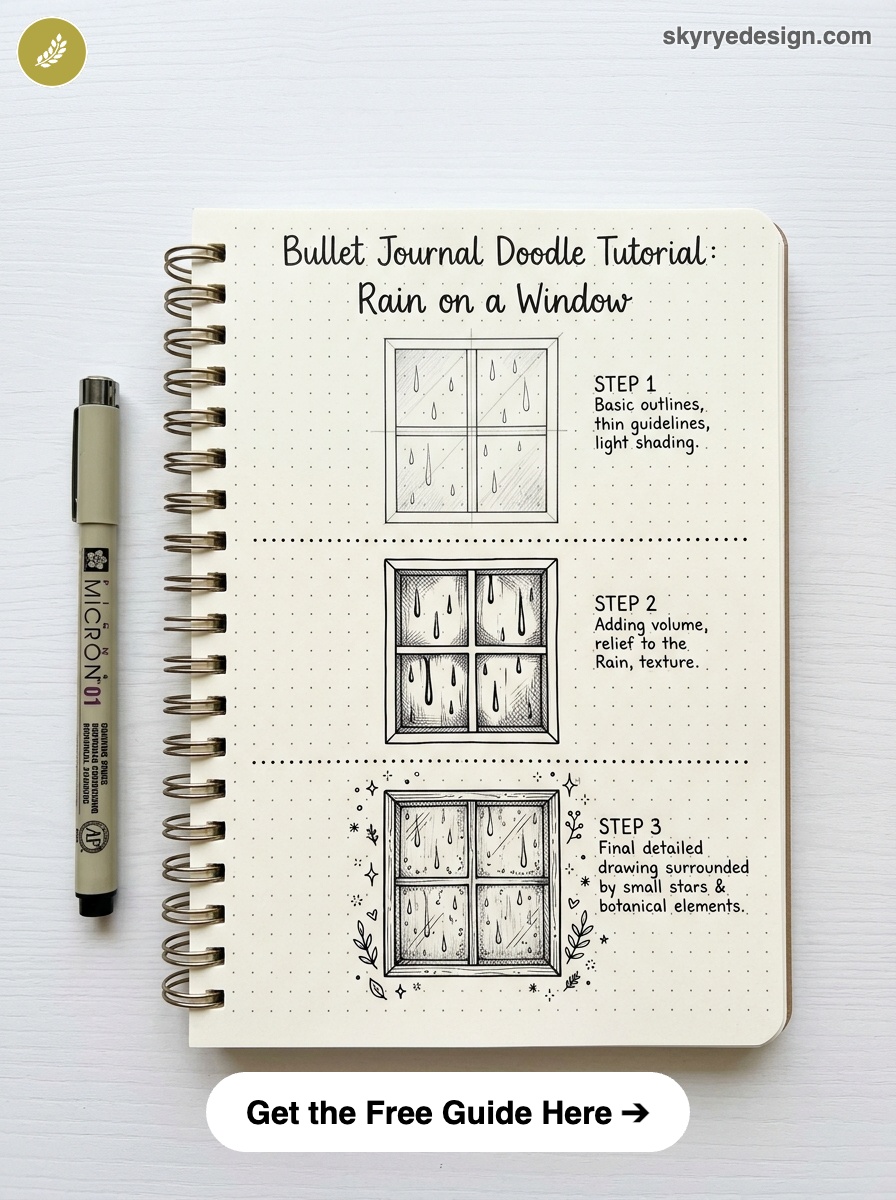
A rectangular window frame with four panes. On the glass surface, draw thin diagonal lines suggesting rain streaks, each ending in a small drop. Beyond the window: simple cloud shapes or a plain coloured sky. Inside the window frame edge: a small plant on the sill.
58. Headphones — Easy
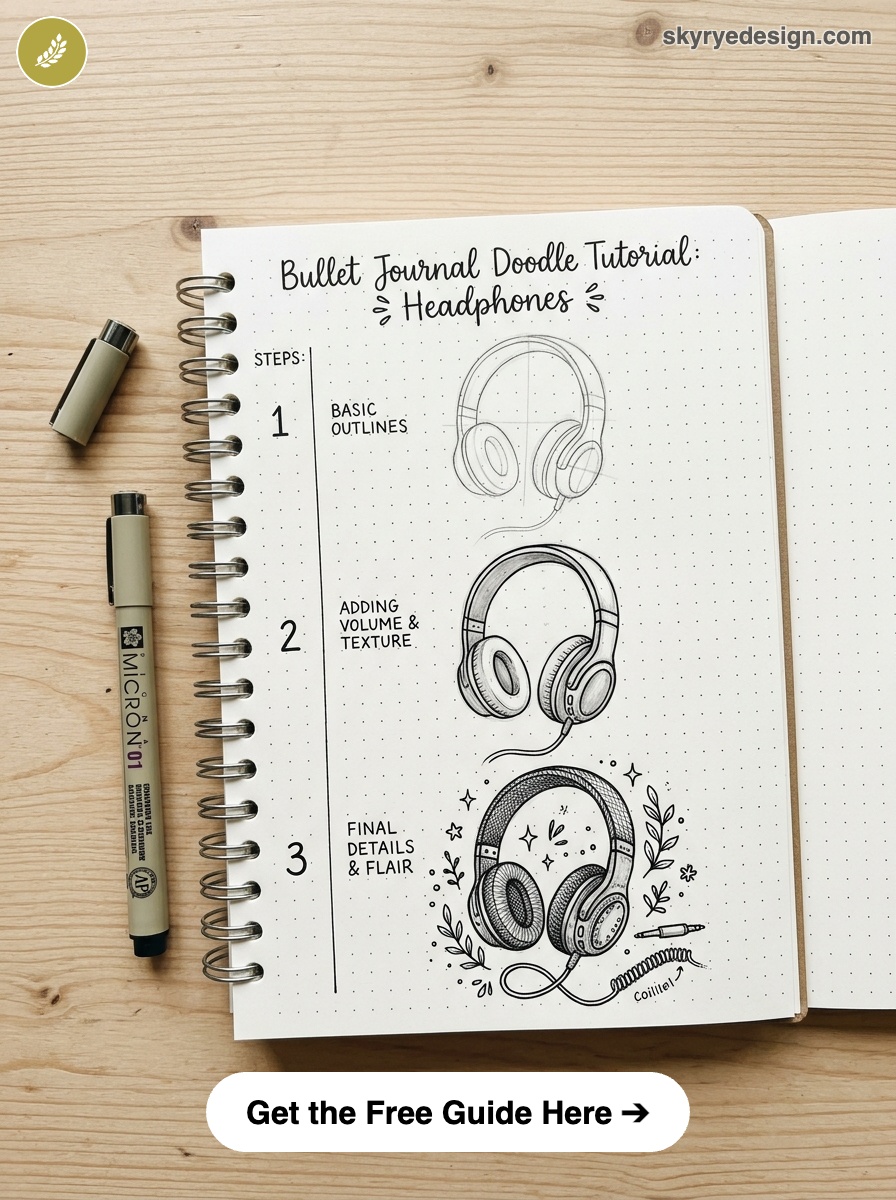
Two oval ear cup shapes connected by a curved arch (the headband). Add a small circle in the centre of each ear cup. A thin spiral wire hanging from the bottom of one ear cup. Works as an accent beside a music or playlist tracker element.
59. Jar of Honey — Easy
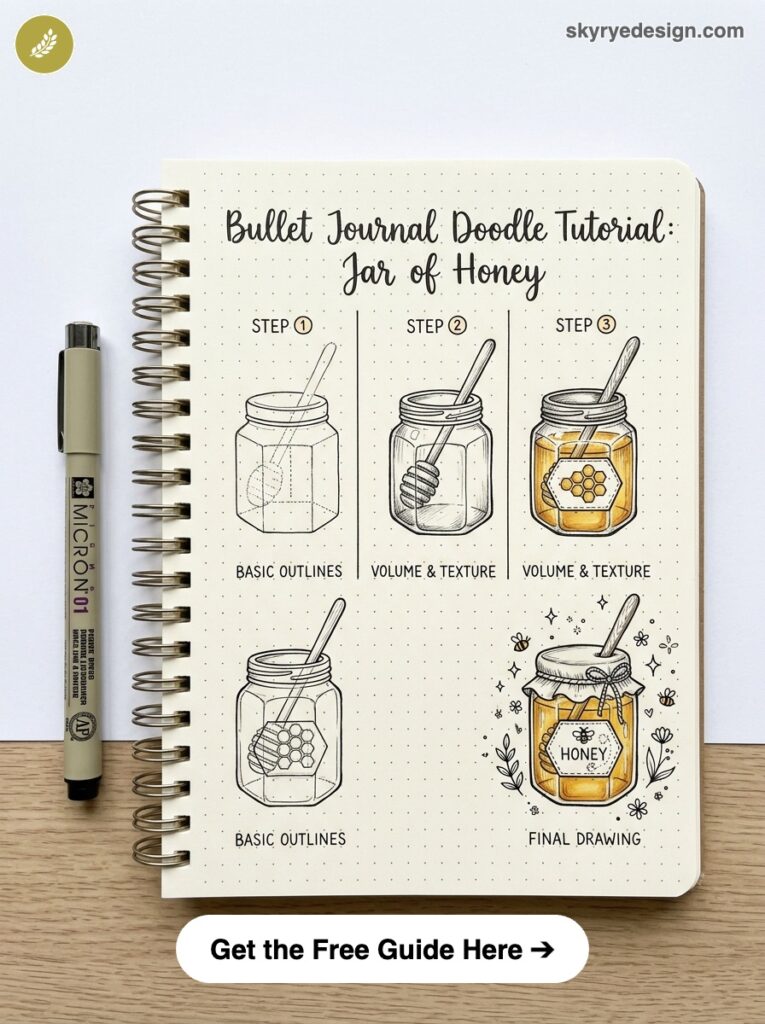
A hexagonal or round jar body with a fabric cap tied with string at the neck (the classic honey jar aesthetic). A small honeycomb pattern on the jar label. A small bee or dipper stick beside the jar. The hexagonal honeycomb pattern (interlocking hexagons) is the key visual element.
60. Film Strip — Medium
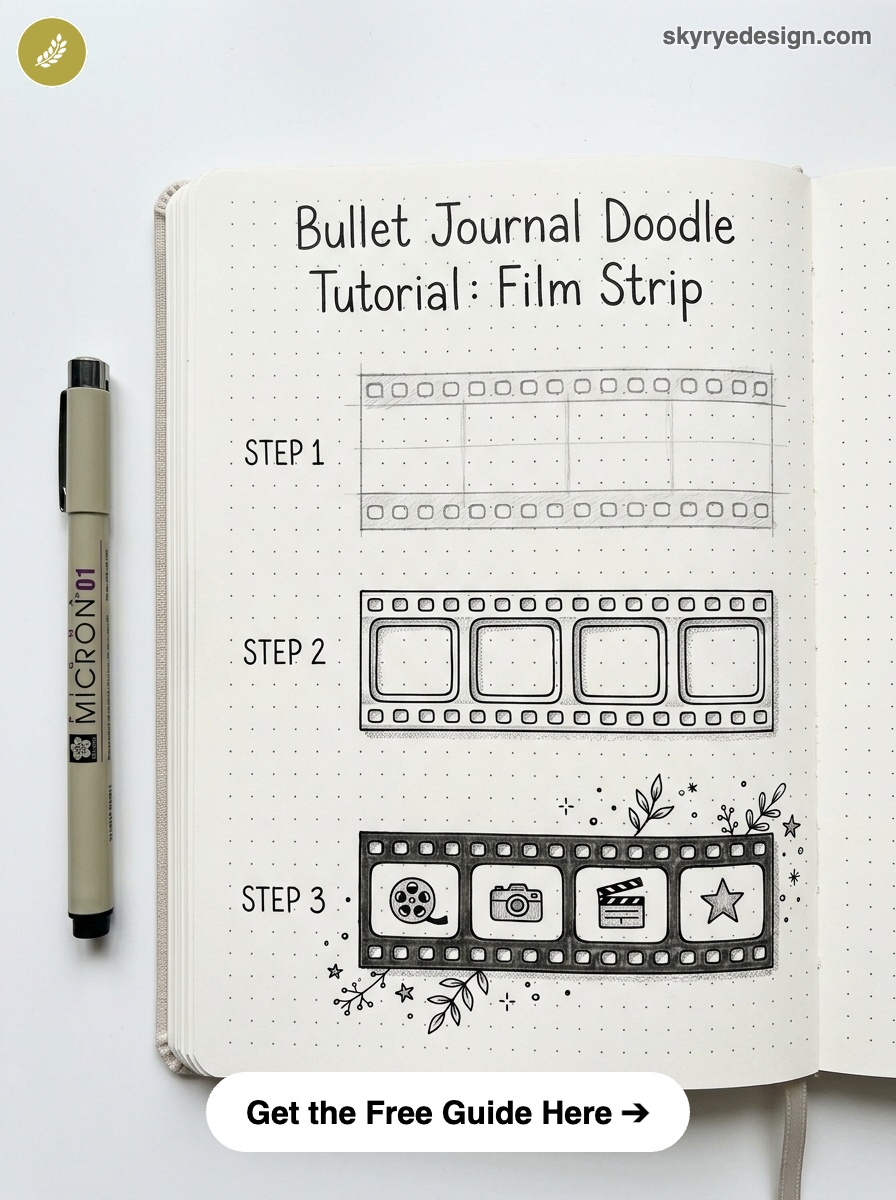
A horizontal rectangle divided into frames by vertical lines. Each frame contains a tiny image: a star, a flower, a face, a moon. Sprocket holes along the top and bottom edges (small rectangles cut from the film edge). Works as a horizontal header or memory-tracking element.
Theme 7: Nature Elements and Weather — Doodles 61 to 68
61. Cloud Varieties — Easy
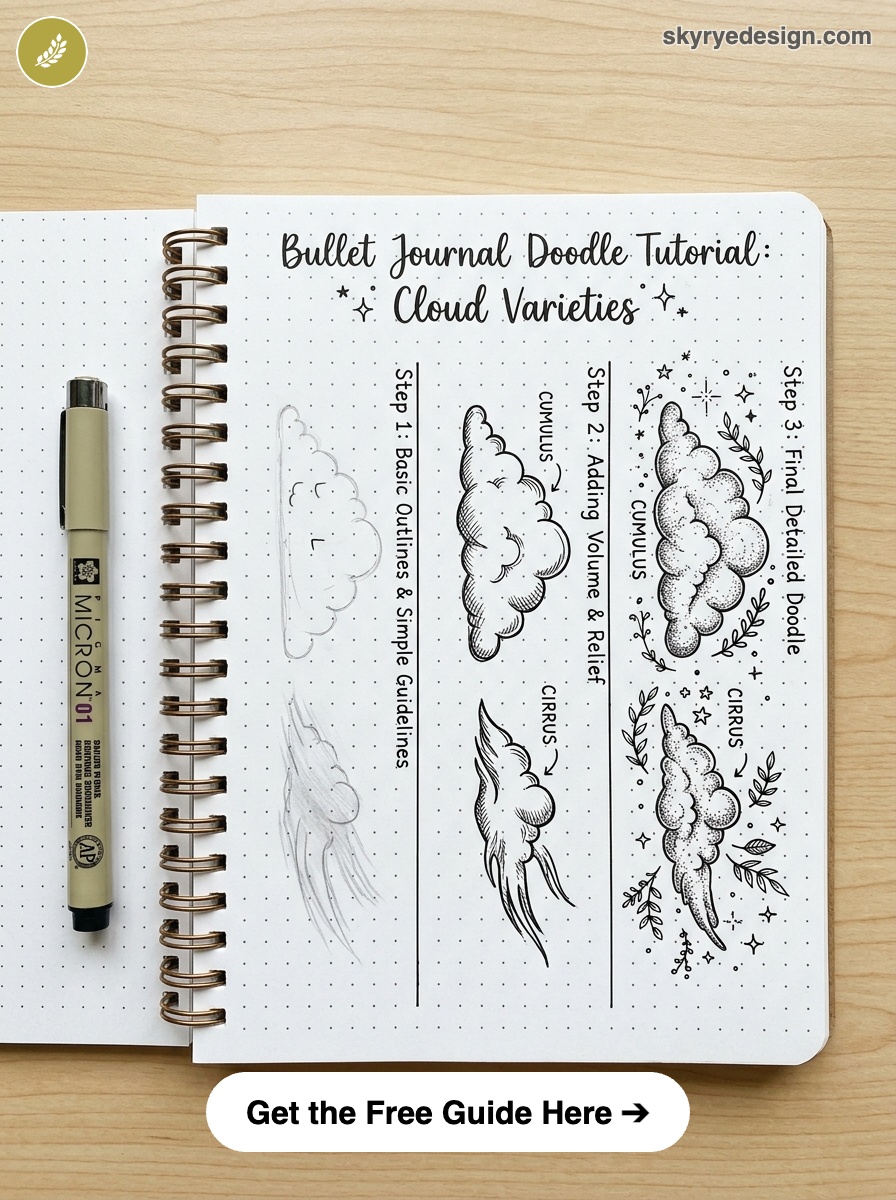
Practice three cloud types: a simple cumulus cloud (overlapping circles along the top, flat bottom line), a wispy cirrus cloud (curved feather-like strokes), and a dark storm cloud (same as cumulus but with rain lines below). All three can be drawn in under 30 seconds and used as section dividers or mood indicators.
62. Rainbow Arc — Easy
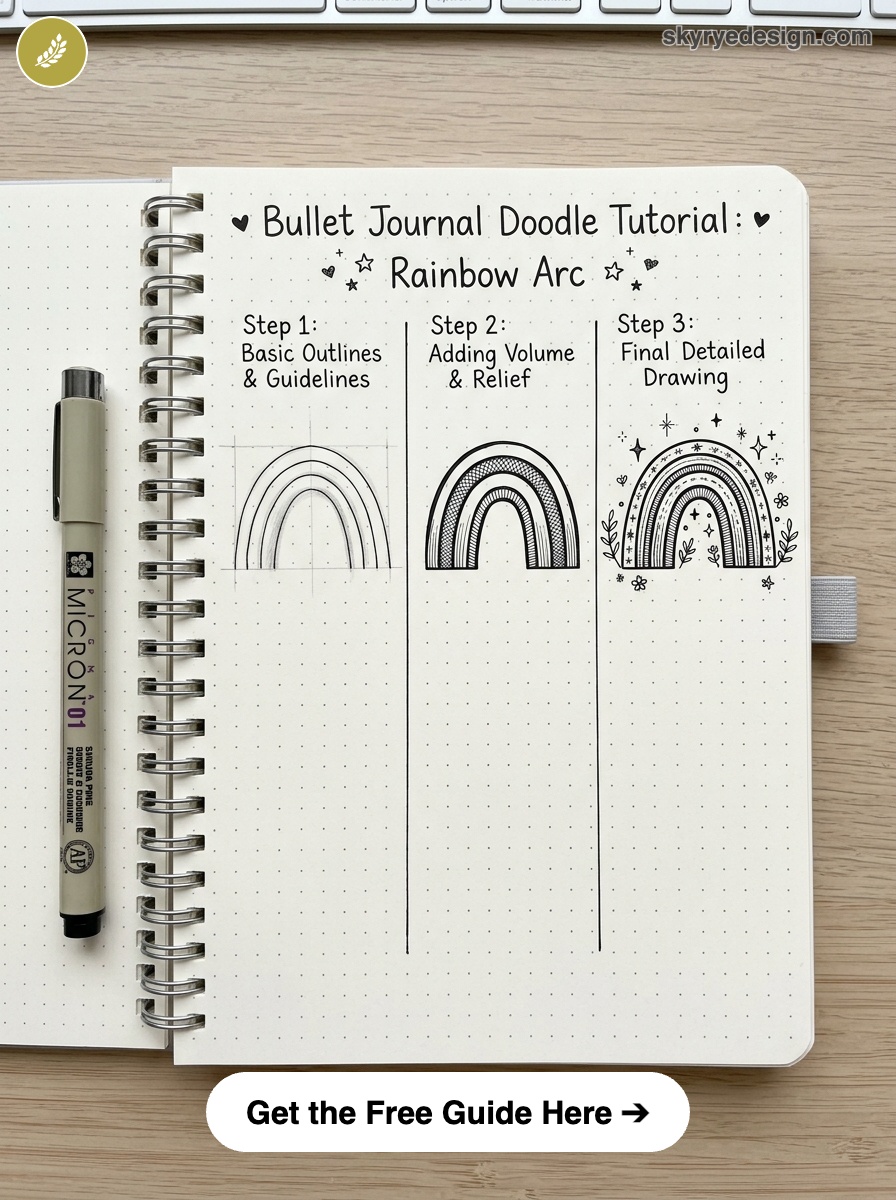
Five concentric arcs from the same baseline, each drawn in a different colour. Below the baseline, small cloud shapes on each side. A rainbow is one of the most reliably cheerful border or header elements in any seasonal bujo spread.
63. Snowflake — Medium
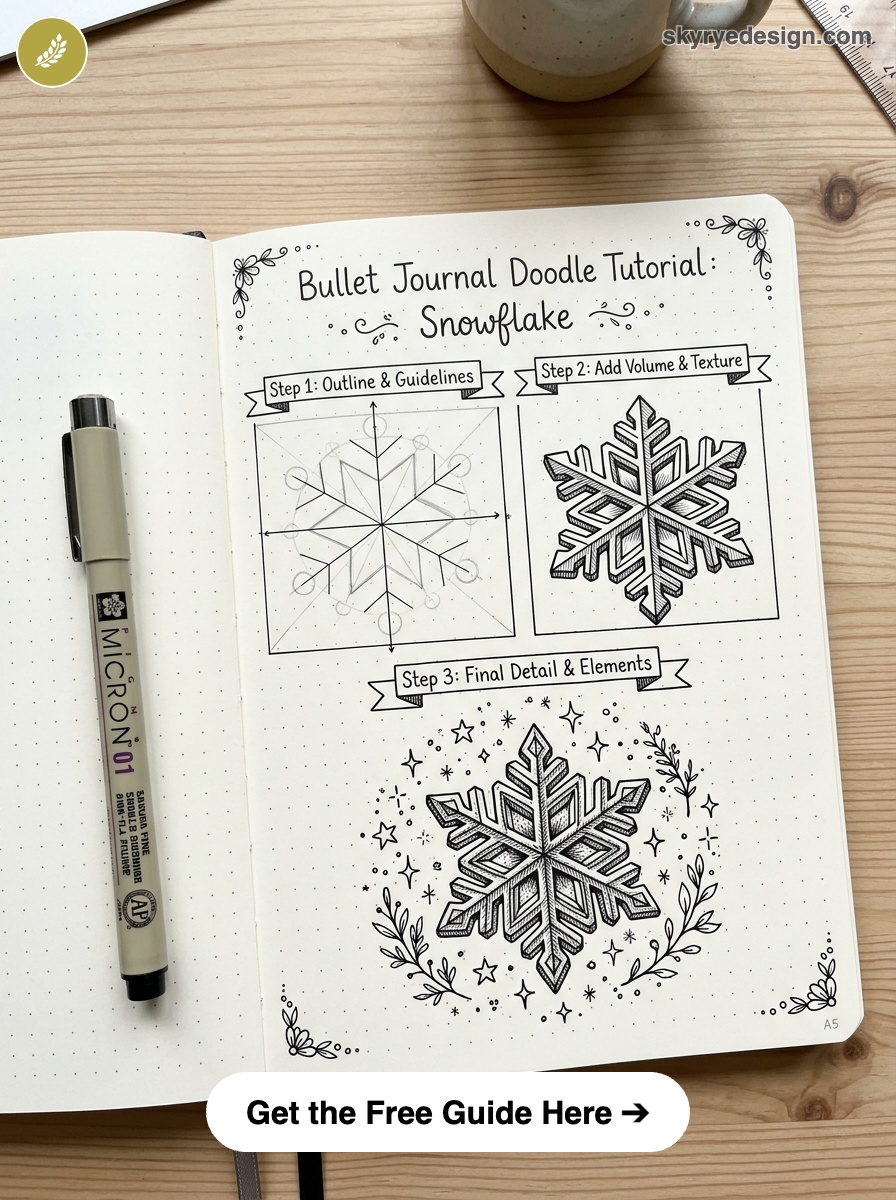
Six equally spaced lines radiating from a centre point (use a clock as a guide: 12, 2, 4, 6, 8, 10 o’clock). Add small V-shaped or diamond branches on each line at equal distances from the centre. No two snowflakes need to be identical — vary the branch shapes for interest.
64. Ocean Wave — Easy
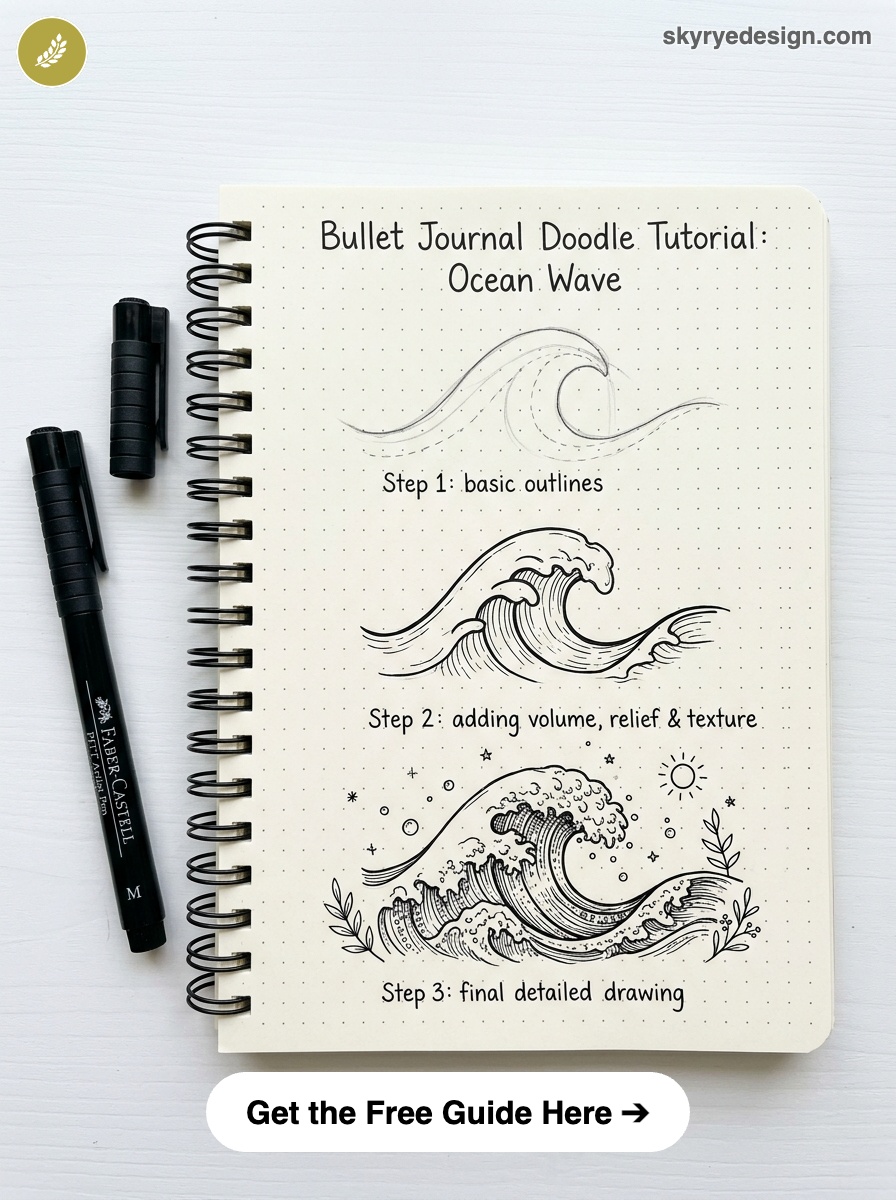
A curling wave: a horizontal curved line that rises to a curl at the left or right end, with the water falling as a cascade below. The foam at the crest is indicated by a small C-curve. Below the main wave: two or three smaller wavy parallel lines suggesting the ocean surface.
65. Mountain Silhouette — Easy
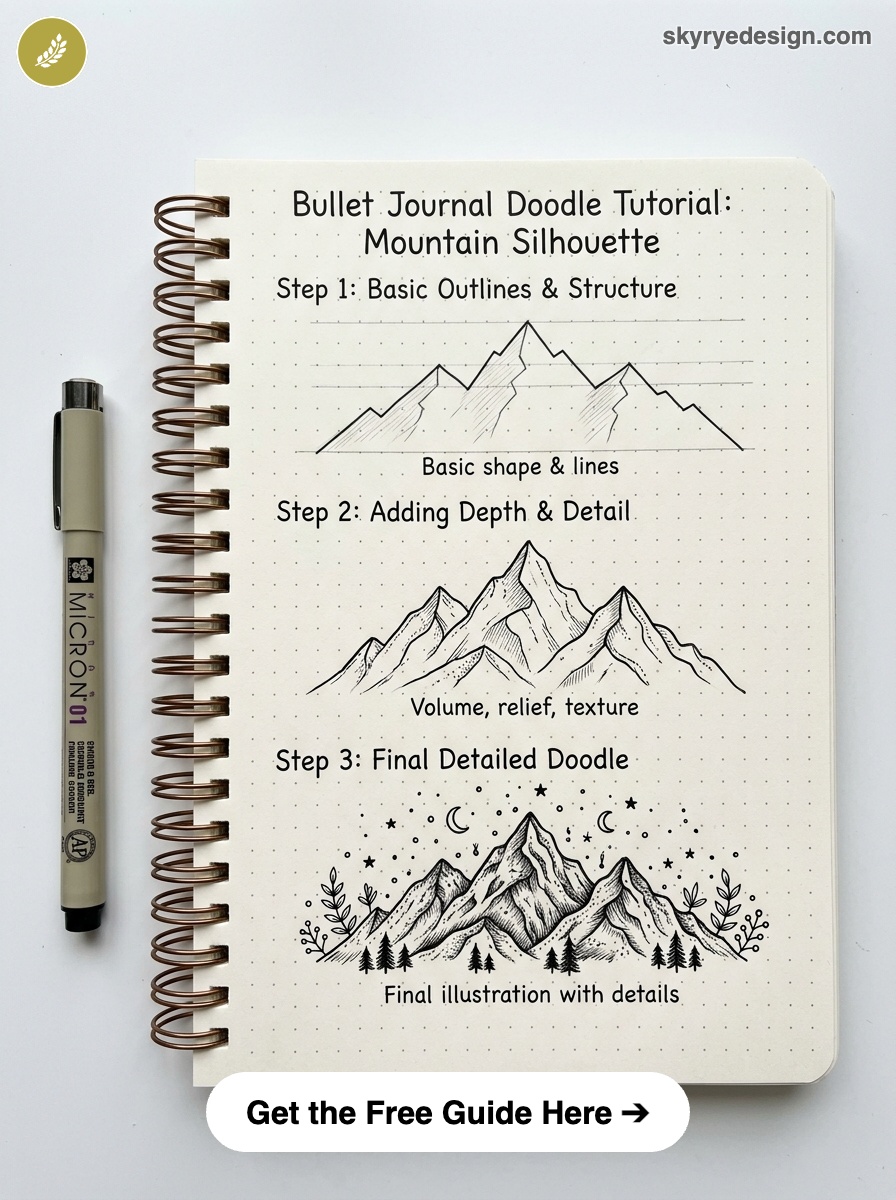
Three overlapping triangles of different heights. The tallest in the centre, the others slightly lower and offset. Add a snowcap on the tallest peak (a white patch near the summit). A simple pine tree silhouette at the base of each mountain completes the composition.
66. Butterfly in Flight — Easy
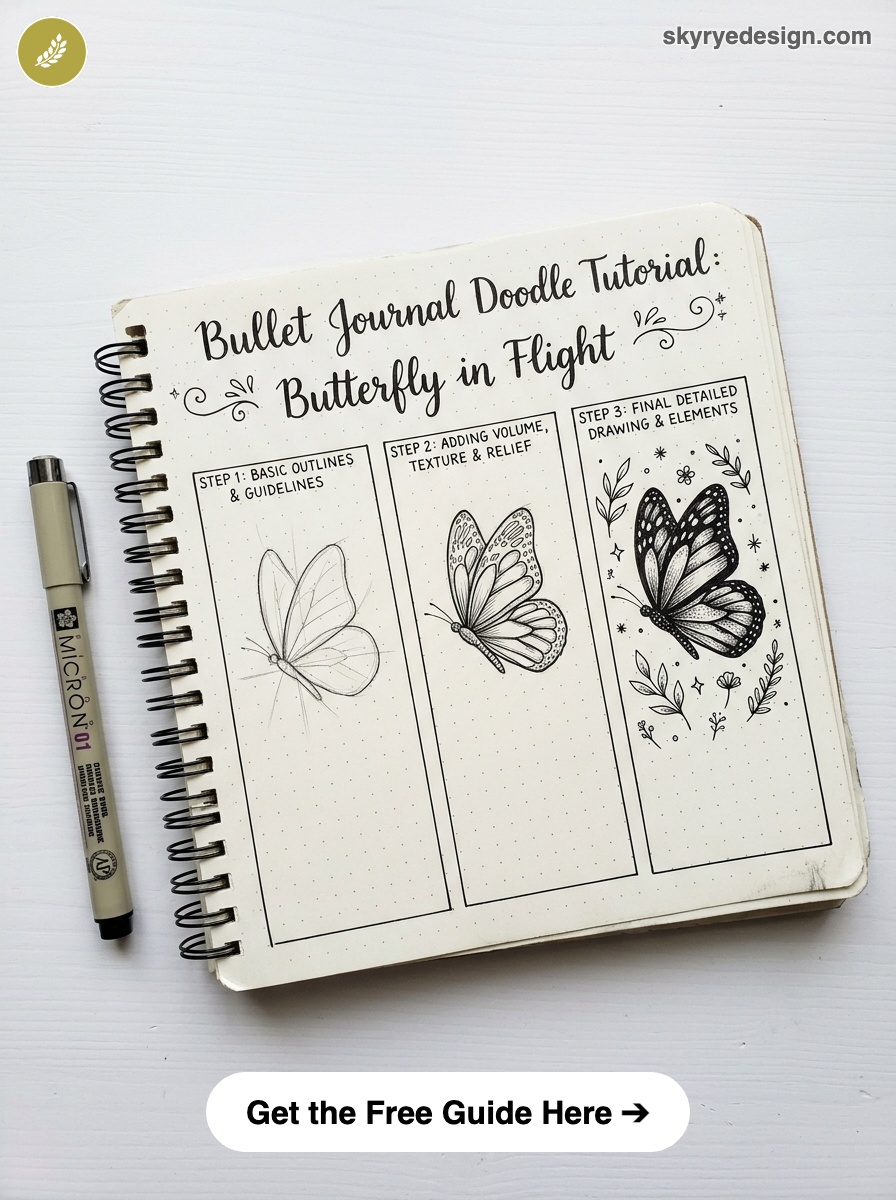
Four wings, each a simple curved shape — upper wings are larger rounded shapes, lower wings smaller. Leave a small body (a narrow oval) between them. The butterfly is defined by its silhouette and the wing symmetry more than by internal pattern. A simple dot pattern on each wing is sufficient.
67. Spider Web Corner — Medium
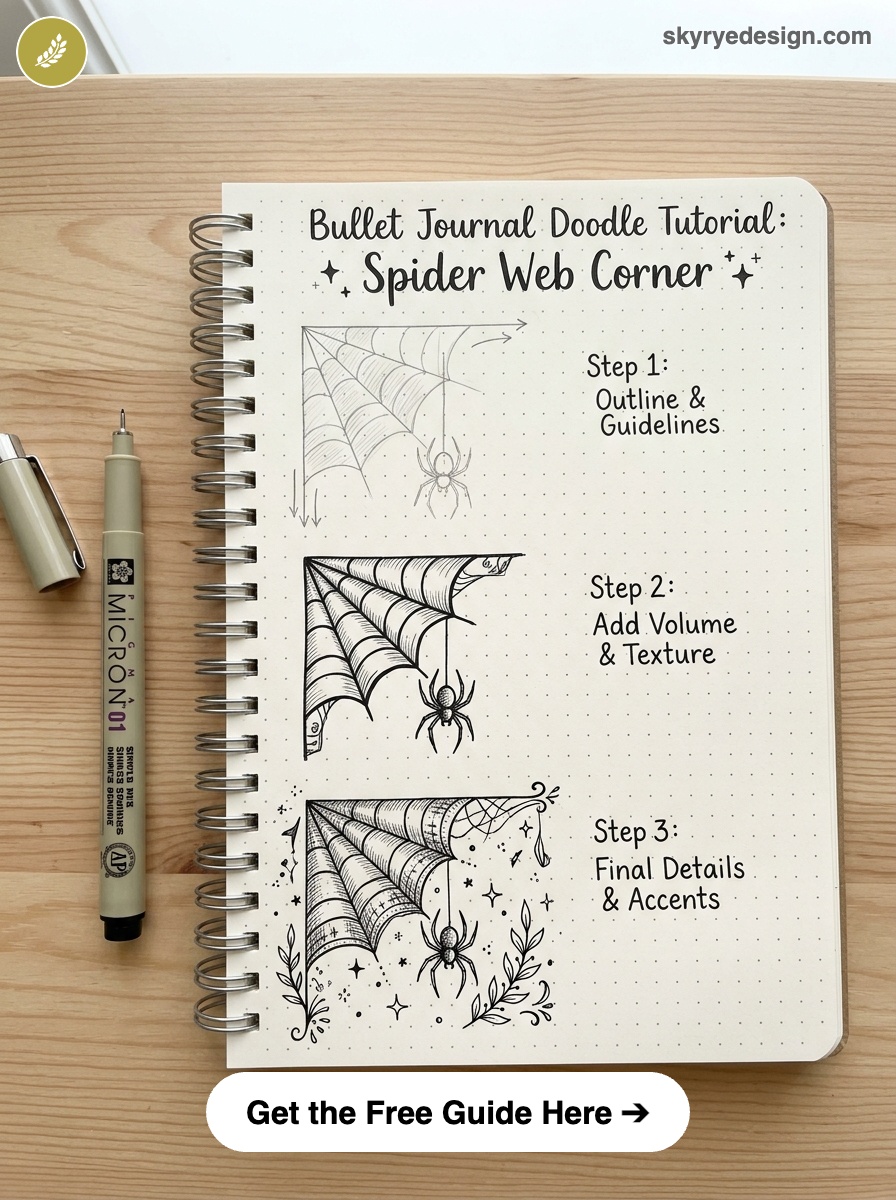
Place at a corner of the page. Draw three straight lines from the corner point outward at equal angles. Connect them with gently curved arcs at increasing distances from the corner. The arcs don’t need to be perfectly smooth — slight wobbles add character. Add a tiny spider on one of the radial lines.
68. Fox in Autumn Leaves — Detailed
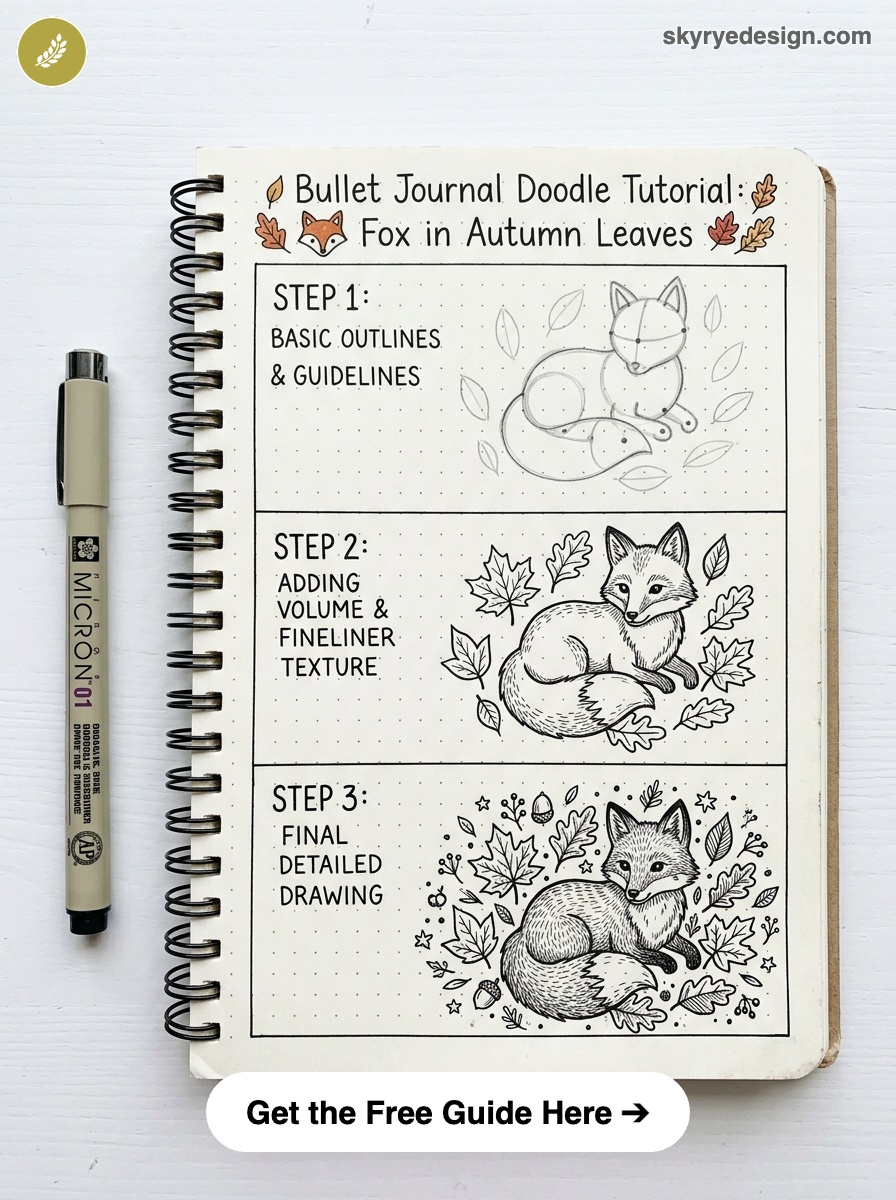
A simple sitting fox: triangular ears, round face with a pointed muzzle, a fluffy tail curled around the body. Surround with falling autumn leaves drawn at different angles. The leaves are simple maple or generic leaf shapes. The combination of the warm fox colours and the scattered leaves creates a complete seasonal scene.
Theme 8: Food, Drink, and Tiny Treats — Doodles 69 to 75
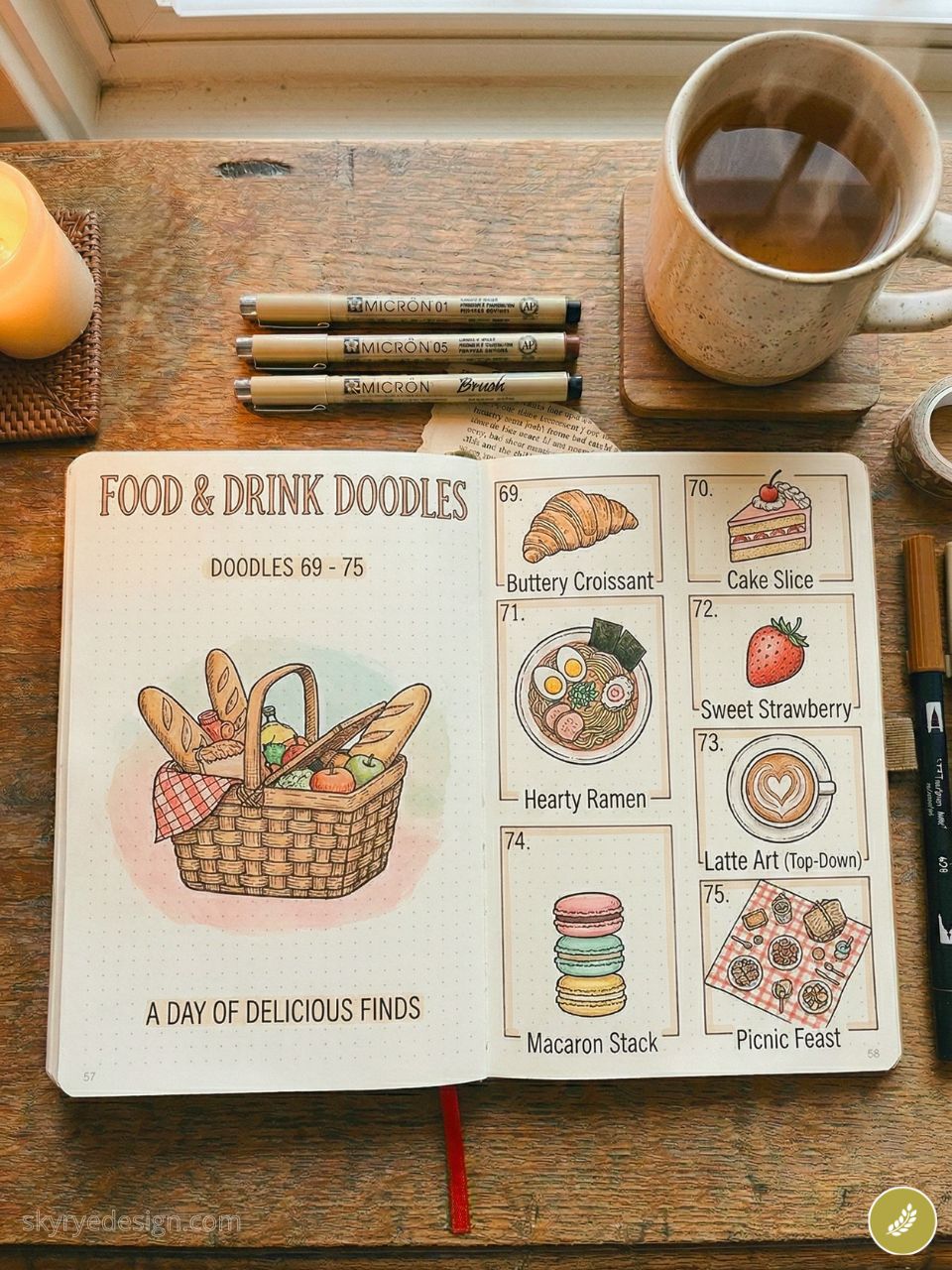
Food doodles have surged in popularity as a bujo category in 2025-2026, particularly as accent elements in meal planning spreads, gratitude pages, and daily logging. They’re also extremely forgiving — an imperfect croissant is still immediately recognisable.
69. Croissant — Easy
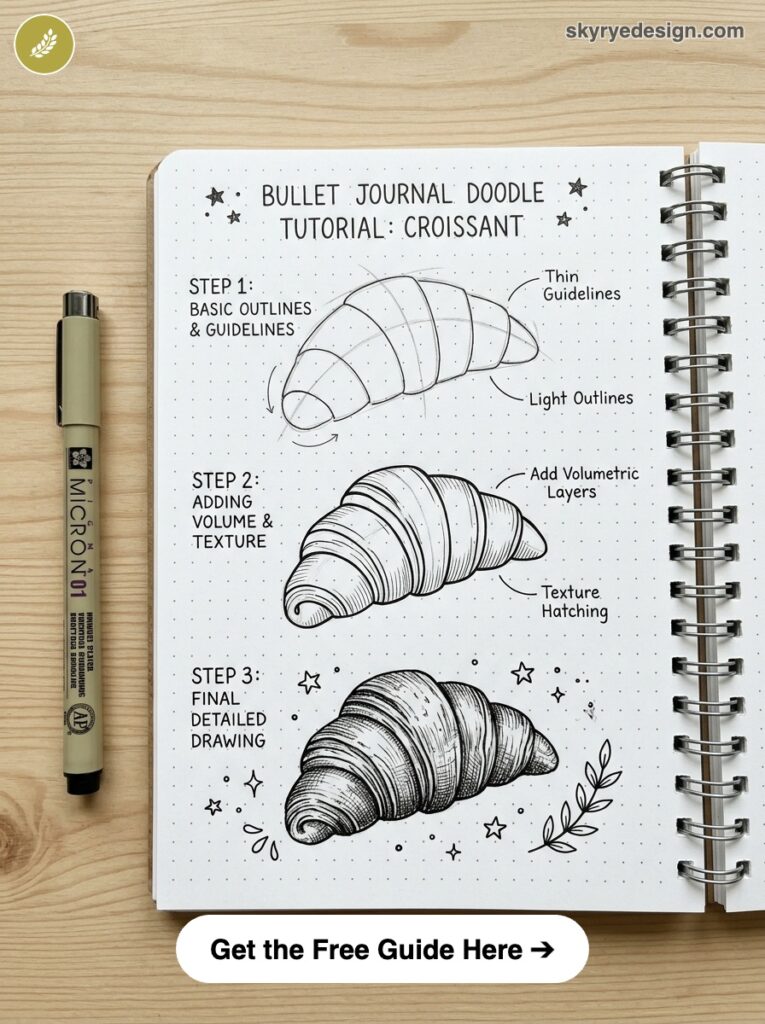
A rounded crescent shape with slightly tapered ends. Add 3-4 curved parallel lines across the surface to suggest the layers of pastry. A small dot of shadow beneath adds depth. The silhouette is the key — the curved body with tapered tips is instantly readable.
70. Slice of Cake — Easy
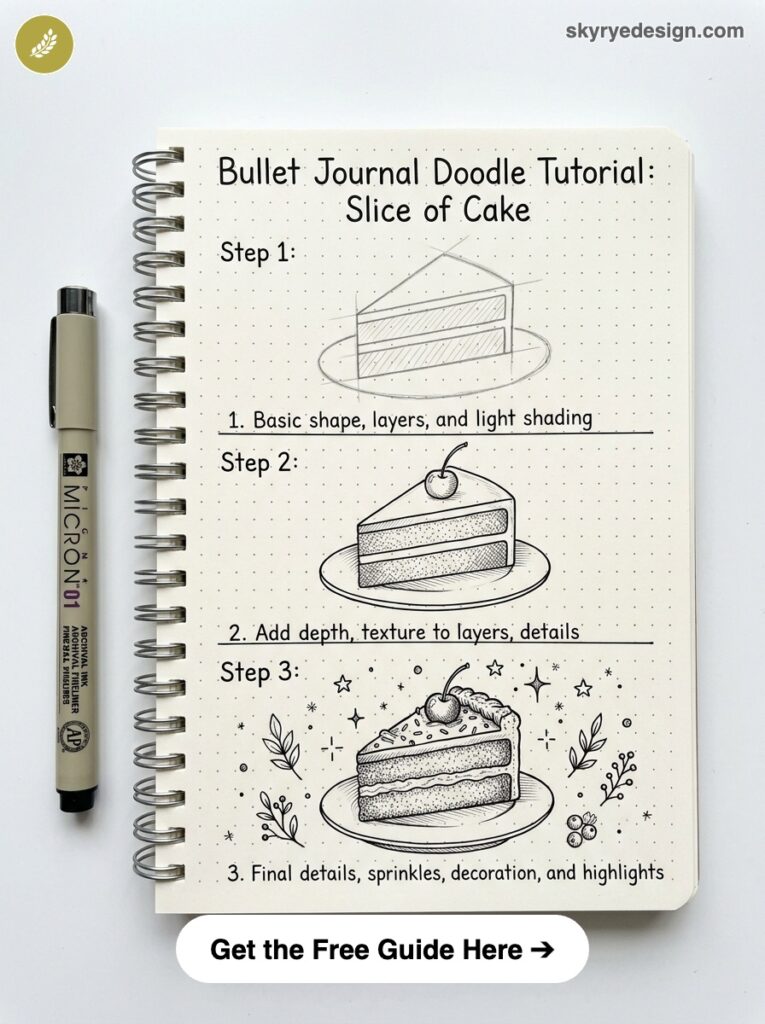
A triangle (the slice cross-section). Add a layer line near the bottom for the base, and curved lines for the frosting on top that overflow the triangle slightly. A small cherry or berry on top of the frosting. Add small dots inside the cake for texture (seeds, chocolate chips, fruit pieces).
71. Ramen Bowl — Medium
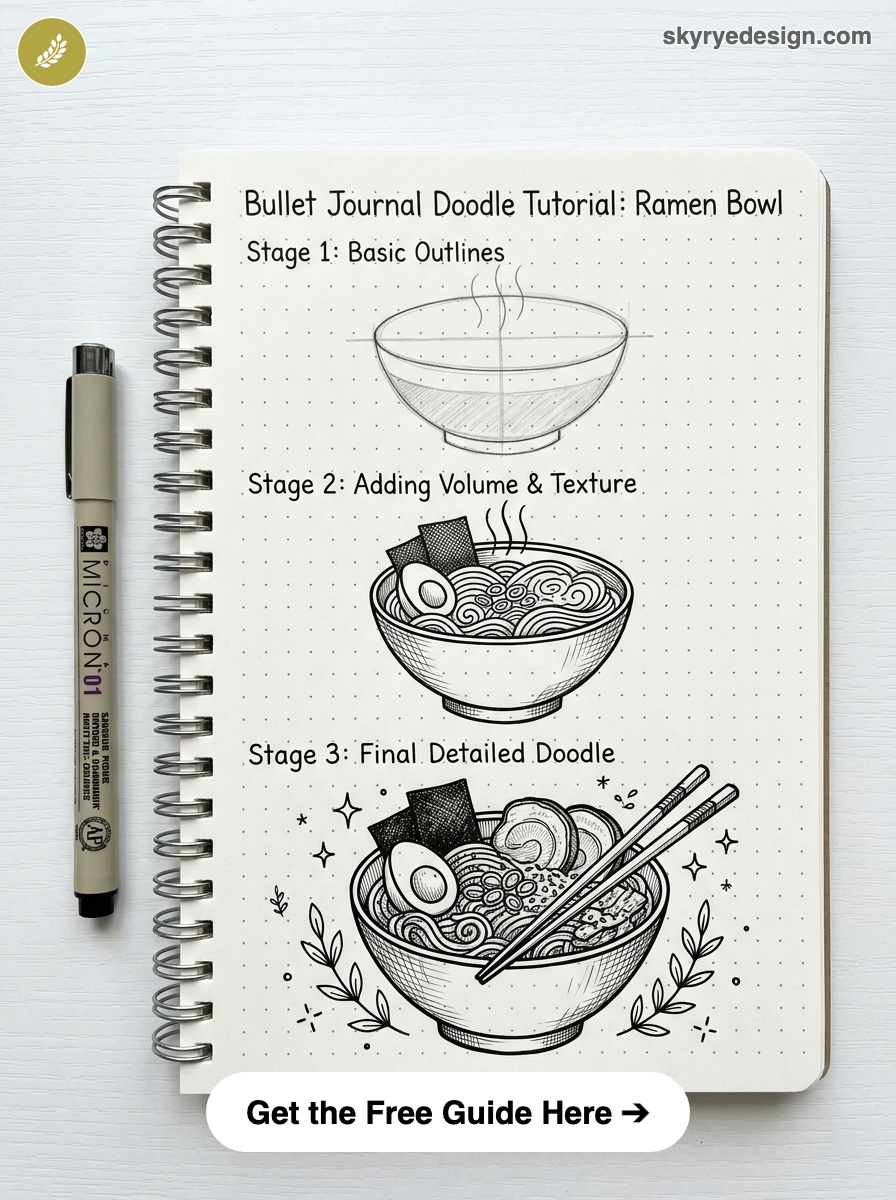
A wide ellipse for the bowl opening, a curved line below for the bowl profile. Inside the ellipse: a few wavy noodle lines, a soft-boiled egg half (circle with a filled yolk), a small piece of nori (black rectangle), and spring onion rings (small circles in a row). The variety of elements inside the bowl is the design challenge.
72. Strawberry — Easy
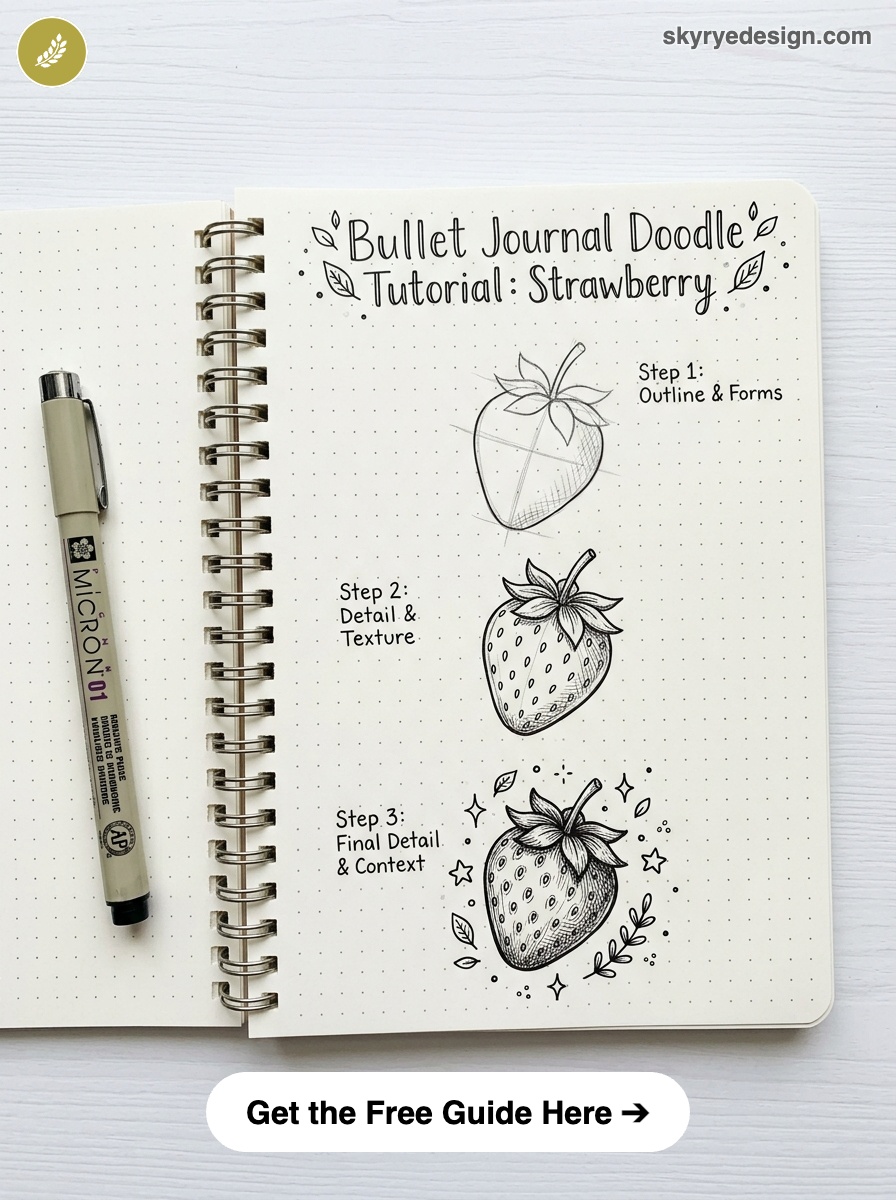
A heart shape with the bottom point rounded and the top slightly flattened. Add a small leaf cluster at the top (three overlapping rounded leaf shapes). Tiny dots all over the surface for seeds. This is one of the fastest recognisable fruit doodles — it takes about 20 seconds.
73. Latte Art Cup — Medium
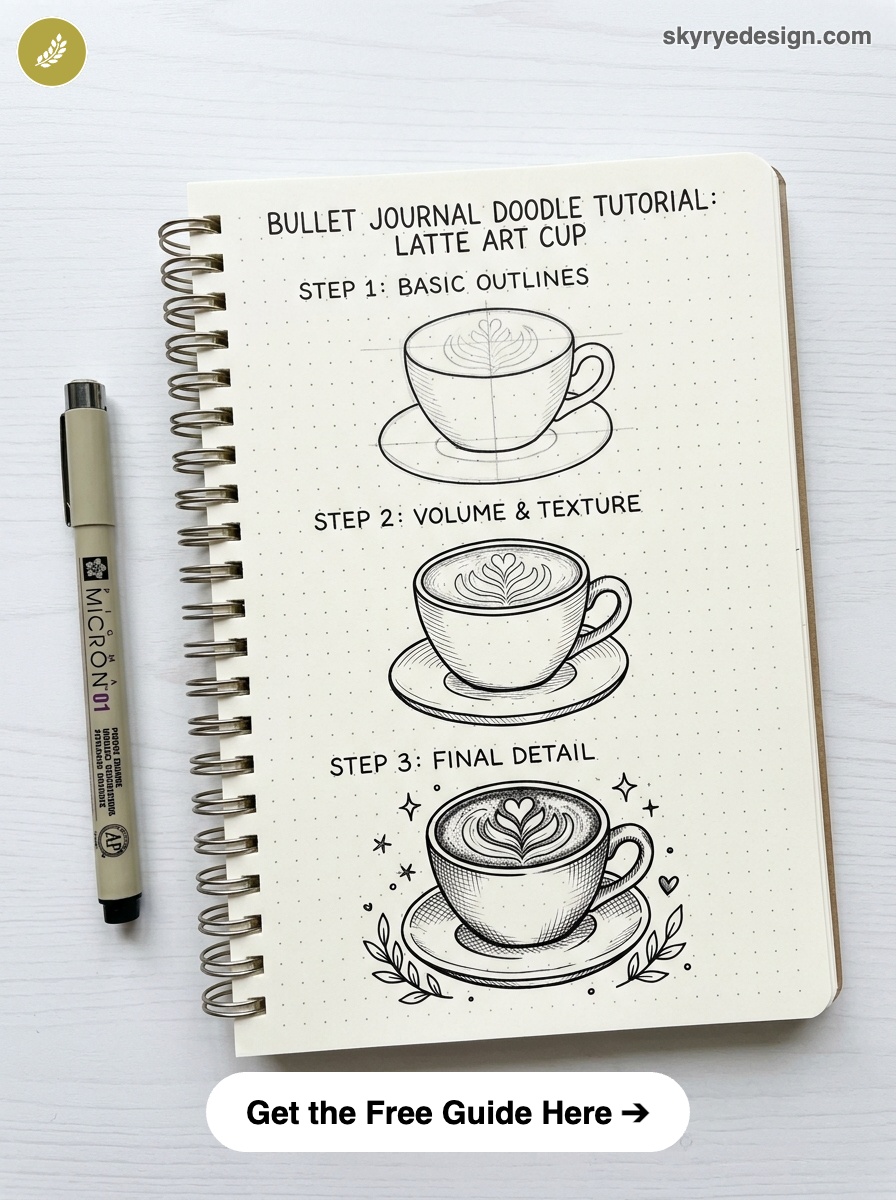
A coffee cup from above: a perfect circle for the cup rim, with the handle visible as a small arc on the right side. Inside the circle: a heart shape drawn in foam (the classic latte art heart — a teardrop below pointing upward into an inverted heart). The visual interest is in the contrast between the dark coffee and light foam.
74. Macaron Stack — Easy
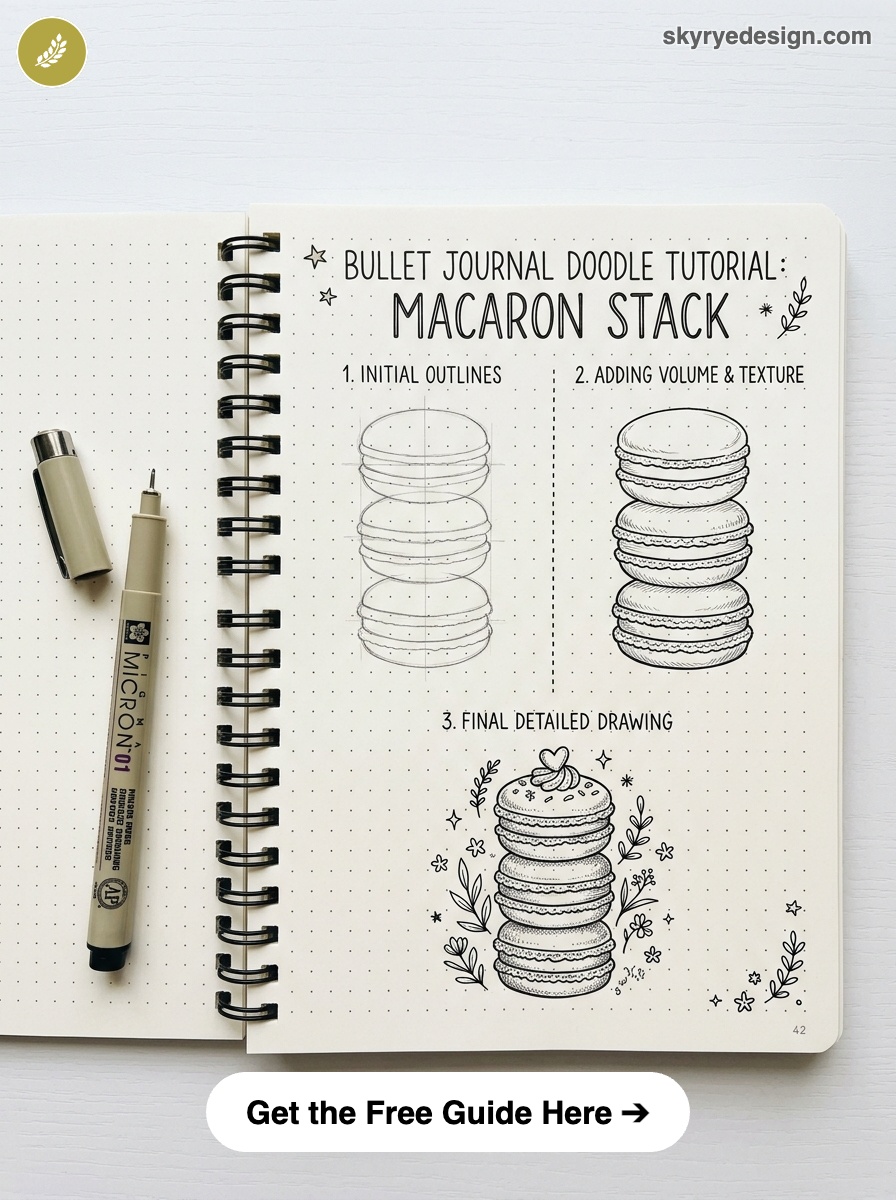
Three macarons stacked vertically. Each macaron is two circles (top and bottom cookies) with a squiggly filling layer between them. The filling layer protrudes slightly beyond the cookie edges. Each macaron in the stack can be a different colour. A ribbon bow around the stack is an optional finishing touch.
75. Picnic Spread — Detailed
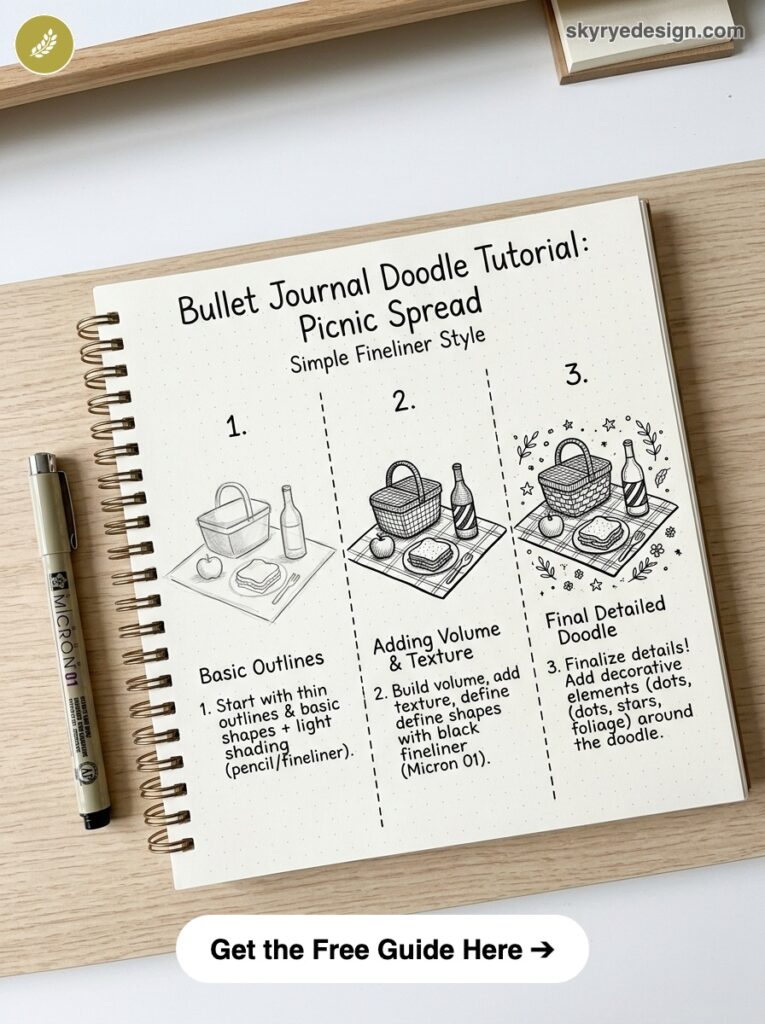
A top-down view of a picnic blanket: a square with small triangle border pattern at the edges. On the blanket surface: a round cheese, a small baguette, grapes, a wine glass, a tiny jar of jam, and scattered flowers or napkins. This is the most complex doodle in the collection and the most satisfying to complete — it functions as a full page focal point for a summer spread.
How to Use These Doodles in Your Bujo Spreads
Monthly Cover Pages
A monthly cover page needs one strong central focal point doodle and a supporting cast of smaller accent doodles around the header. For January: a snow globe containing a winter scene, with snowflake doodles scattered around the title. For May: a wildflower bouquet as the central element with a leaf wreath framing the month name. The design principle is consistent: one dominant doodle, 3-5 smaller accents, and white space for the month name and any introductory text.
Weekly Spread Borders
The most time-effective way to use bujo doodles in a weekly spread is a consistent corner or margin treatment: pick one theme per month (celestial for January, botanical for April, cosy for November) and add 3-5 small doodles from that theme to the corners and top border of each weekly spread. This takes 5-10 minutes per spread setup and creates visual cohesion across the whole month without requiring a different doodle design every week.
Habit Tracker Decoration
Habit trackers become significantly more engaging to use when each habit row has a small dedicated doodle icon. A water droplet beside the water intake row. A crescent moon beside the sleep tracker. A small running figure or sun beside the exercise row. A book beside reading. The doodle doesn’t need to be elaborate — 1cm is sufficient for a row icon — but it creates a visual association that makes the tracker easier to scan and more rewarding to fill in.
✏ Tip: The single most effective bujo doodle habit: draw one small doodle — any doodle from this list, at whatever quality level — every day as the first thing you do when you open your journal. Not a full spread decoration, just one small thing. After 30 days, the line quality and confidence improve noticeably, and the doodle habit becomes self-sustaining.
Pens, Paper, and Learning Resources
- Sakura Pigma Micron 6-pen set (~$15, sizes 005-08) — the most useful single pen purchase for a new bujo doodler. The range of nib sizes covers fine detail, standard outlines, and bold fills.
- Tombow Dual Brush Pen 10-colour set (~$25) — soft blendable colour for botanical and celestial fills. The brush tip creates the watercolour look that dominates aesthetic bujo content in 2026.
- Leuchtturm1917 A5 Dotted Notebook (~$25) — the standard journal choice for dedicated doodlers. The 160gsm paper handles most pens without bleed-through.
- @journalwithpurpose on Instagram — consistent, high-quality bujo content with clear how-to breakdowns for complex doodles.
- Kara Benz (Boho Berry) — bohoberry.com — one of the longest-running and most trusted bujo content creators. Her tutorials on botanical doodles and monthly cover design are the clearest available.
- ‘The Bullet Journal Method’ by Ryder Carroll (~$18) — the original system guide. The doodling in this collection exists within the bujo framework Carroll established; understanding the system makes the decoration more purposeful.
Related doodle and sketchbook practice
When your doodle page needs a stronger focal point, these 3D art on paper ideas are useful for practicing depth without a full scene.
Once you have a few favourites, use them as a tiny practice loop instead of hunting for a brand-new idea every time. These related guides keep the same small-page energy but move into sketchbooks, food drawings, colour themes, and creative page layouts.
- Use sketchbook prompts when you want a full-page idea instead of a margin doodle.
- Try these sketching ideas for your sketchbook when a bujo icon starts turning into a bigger study.
- Pair this list with cool mini things to draw for tiny filler drawings and page corners.
- When you are out of ideas, pull a quick prompt from things to draw when you are bored.
- For broader practice, move from bujo icons into art drawing ideas that build real drawing habits.
- Food spreads work well with this how to draw food guide.
- Botanical and weather themes pair naturally with nature drawing ideas.
- For colour-themed pages, borrow palettes from pink drawing ideas.
- If you mix paper scraps, stickers, and doodles, look at these scrapbooking ideas.
- For paper choice, compare the best sketchbooks for artists before buying a new journal.
The Wonky Mushroom Is the Point
The seventeen people who told me my first messy botanical spread was ‘cosy’ were not being polite. They were identifying something real: that a hand-drawn page with visible effort and slight imperfection communicates something that a perfectly designed template cannot. It communicates presence. Someone sat with this page. Someone chose these specific doodles. Someone’s hand moved across this paper.
The 75 doodles in this collection span the full range from beginner to genuinely challenging. You don’t need to draw all of them. You need to find the ten or fifteen that feel like yours — the ones you keep coming back to, the ones that start appearing in your margins when you’re thinking, the ones that make you want to open the journal and start a new spread.
Start anywhere. Start badly. The mushrooms improve.
FAQ: Bullet Journal Doodles
Q: What are the best pens for bullet journal doodles?
Sakura Pigma Micron fineliners are the most widely recommended — available in sizes 0.05mm through 0.8mm (~$3-4 each). The 0.1mm and 0.3mm cover most bujo doodle needs. Pigment-based ink is waterproof and doesn’t bleed through standard dotted journal paper. For colour, Tombow Dual Brush Pens (~$3-4 each) create the soft blended look that dominates aesthetic bujo content. For highlights and sparkle on dark ink areas: Uni-ball Signo white gel pen (~$3-4) is non-negotiable.
Q: How do I start doodling if I cannot draw?
Start with geometric shapes: circles, ovals, triangles, and rectangles. Almost every doodle in this guide is built from those four shapes. Draw in pencil first, trace over in fineliner, then erase the pencil. A lightly sketched pencil layer costs three seconds and saves the page. Repetition matters more than talent — ten minutes of doodling per day for two weeks produces visible improvement in line confidence that feels dramatic to the person who does it.
Q: What bullet journal doodles are best for beginners?
Simple botanical elements are the most forgiving starting point: single leaves, basic flower petals, a small mushroom, a simple succulent. The irregular organic shapes mean minor inconsistencies read as natural variation rather than mistakes. Stars, crescents, and simple geometric banners are also reliable because they have clear construction logic and scale from tiny to large without becoming complicated.
Q: How long does it take to decorate a bullet journal spread?
A decorated weekly spread with a consistent margin treatment and small accent doodles takes 20 to 45 minutes including writing the headers and dates. A heavily illustrated monthly cover takes 45 to 90 minutes. Individual small doodle elements — a tiny flower in a margin, a star cluster beside a date — take 2 to 5 minutes. The key is choosing a complexity level that matches available time so doodling feels like a treat rather than an obligation.
Q: What paper is best for bullet journal doodles?
Leuchtturm1917 A5 dotted notebooks (160gsm) and Rhodia Webnotebooks (90gsm Clairefontaine) are the most popular choices. Both resist bleed-through from fineliners and most brush pens. For alcohol-based markers like Copics, 160gsm or a separate marker paper is necessary — always test a new pen on the last page of a journal before using it on a spread. The dot grid pattern is preferred over ruled or plain because it provides alignment guidance without appearing in photographs.
Q: What are the most popular bullet journal doodle themes in 2026?
The five dominant themes in 2026 are: cottagecore botanical (mushrooms, wildflowers, berries, vines — the most searched category), dark academia (quills, hourglasses, books, tarot cards, alchemy flasks), Y2K retro (pixel stars, retro tech, glitter starbursts), cosy hygge (candles, mugs, cats, rainy windows), and celestial (moon phases, constellations, planets). The shift from minimalist headers to more layered, story-driven spreads is the main aesthetic evolution from the 2023-2024 bujo style.
Q: What are easy aesthetic bullet journal doodles to start with?
Start with small leaf sprigs, crescent moons, tiny mushrooms, simple mugs, clouds, stars, and fruit slices. They use basic curves and short lines, so they still look intentional when your spacing is imperfect. Keep each doodle about 1cm to 2cm wide at first; that size is big enough to control but small enough to tuck into a weekly spread.
Q: Can I use these journal doodles outside a bullet journal?
Yes. These journal doodles also work in sketchbooks, study notes, scrapbooks, planner margins, handmade cards, and digital notes. The trick is to match the doodle scale to the page: tiny icons for margins, grouped motifs for headers, and one larger focal doodle for a cover page or scrapbook spread.
Small planner doodles often work best as simplified people, not detailed portraits. Practice tiny human figure drawing with a clear head, torso, limb rhythm, and gesture, then shrink the pose into a running icon, reading pose, or mood tracker mark.
Doodling is not just for layouts; it is also a powerful cognitive tool. Integrating structured drawing practice exercises into your bullet journaling routine can help train your line precision and build creative confidence on every blank page.
- 2.2Kshares
- Facebook0
- Pinterest2.2K
- Twitter0
- Reddit0