Third year architecture school. My staircase didn’t work — not aesthetically, structurally. The total rise was 3,200mm, I’d divided it into 16 risers at 200mm each, and the going was 280mm, which put my total run at 4,200mm. The staircase fit the plan, cleared the headroom, looked right in section. The tutor walked over, looked at the drawing for ten seconds, and said: ‘Your 2R + G doesn’t check out.’
She was right. 2 × 200 + 280 = 680. The formula requires 630mm. My staircase was theoretically uncomfortable to use — the relationship between riser height and tread depth was off by 50mm, which doesn’t sound like much until you’re climbing a flight of stairs and your body keeps expecting a rhythm that isn’t there. I’d spent three days on that staircase. The geometry was wrong from the first calculation, and everything built on top of it — the section, the elevation, the spatial sequence — was based on a number I hadn’t checked.
- The Calculation Gap in Design Education
- The Mathematics Architects and Designers Actually Use
- Five Real Design Scenarios Where Calculation Changes the Decision
- What Makes a Calculation Tool Actually Useful for Design Work
- The Calculations by Design Discipline
- Calculation Confidence as a Design Competency
- FAQ: Math for Architecture and Design
That experience is specific but not unusual. Architecture and design education is heavy on concept and light on calculation practice. Students learn that the golden ratio exists but not how to apply it to a facade grid. They learn that rooms need to be acoustically considered but not how to calculate reverberation time. They learn that structure matters but not how to run a preliminary span check before the structural engineer gets involved. The math is always somewhere in the background, unglamorous and postponed — until a deadline makes it urgent.
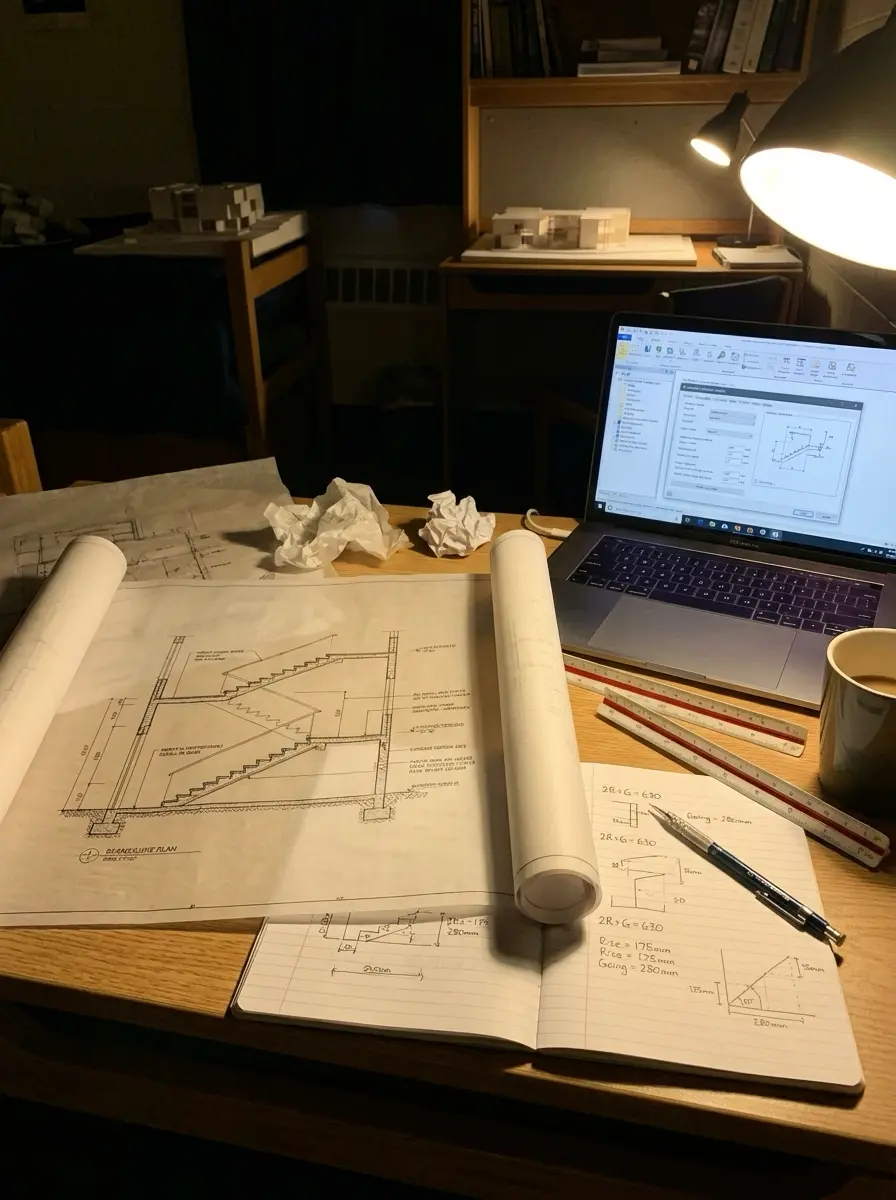
This guide covers the math that actually appears in architecture and design practice, the specific formulas worth knowing, the kinds of problems they solve, and why having an immediately accessible calculation tool changes the speed and confidence of the design process.
The Calculation Gap in Design Education
Most architecture and interior design programs spend significant time on design theory, history, representation, and concept development. They spend comparatively little time on applied mathematics — not because the math isn’t important, but because it’s unglamorous and hard to teach in a studio context where the emphasis is on spatial thinking.
The result is a specific type of graduate: strong on concept, uncertain on calculation. They know what needs to be calculated but not always how to calculate it. They know structural spans matter but can’t quickly verify whether a preliminary beam size makes sense. They know staircase geometry has rules but have to look up the formula every time. They know acoustic performance is a design consideration but treat it as something for a specialist to sort out later.
Later is expensive. In architecture, the cost of a calculation error scales with how far into the project it goes undiscovered. A wrong staircase geometry caught in first-year studio costs nothing. The same error caught during construction documentation requires significant rework. Caught during construction itself, it costs time, money, and potentially a variation order. The argument for calculation fluency is not academic — it’s economic and professional.
✏ Studio note: The most useful shift a design student can make is treating calculations as design tools rather than technical obligations. A quick span check informs whether a structural concept is achievable before you’ve committed hours to developing it. A reverberation time calculation tells you whether a room’s proportions and material palette will produce the acoustic quality the brief requires. These are design decisions, and the calculation is the evidence that supports them.
The Mathematics Architects and Designers Actually Use
Staircase Geometry: The Formula That Trips Everyone
The standard staircase comfort formula — 2R + G = 630mm — relates riser height (R) to going (tread depth, G) in a way that produces a climbing rhythm comfortable for most adults. Building regulations typically specify R between 150mm and 220mm, G between 220mm and 300mm. The calculation sequence: divide the total floor-to-floor rise by the number of risers to get the individual riser height, then solve for going using the formula. Check headroom at the steepest point — minimum 2,000mm clear measured vertically from nosing to the obstruction above.
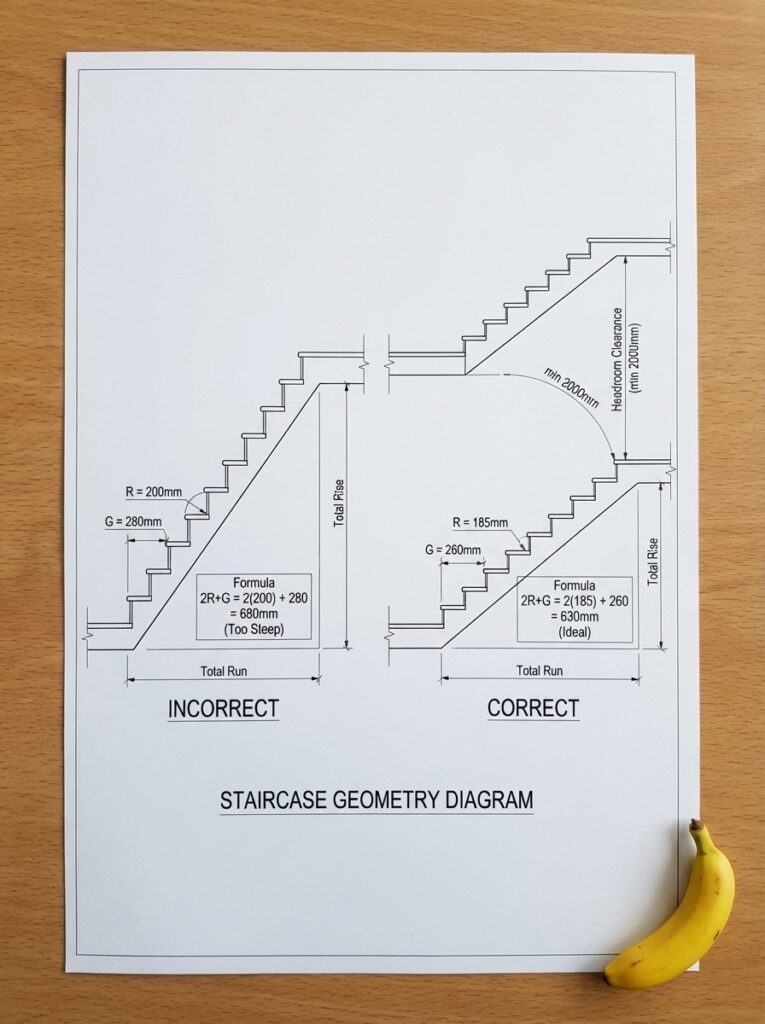
A staircase calculation has five variables: total rise, number of risers, riser height, going, and total run. If you fix two, the rest follow. The common mistake is fixing the staircase footprint in plan first and then trying to make the formula work — which sometimes produces riser heights outside the acceptable range. The correct sequence is to calculate the comfortable geometry and then check whether it fits the available space, not the reverse.
The Golden Ratio and Proportional Systems
The golden ratio — approximately 1:1.618, expressed as phi (φ) — appears in architecture and graphic design as a proportioning tool for relationships between elements. The algebraic expression: if two quantities a and b satisfy (a+b)/a = a/b, that ratio is phi. In practice, a rectangle where the long side is 1.618× the short side is a golden rectangle. Dividing that rectangle produces a square and a smaller golden rectangle — the basis of the golden spiral.
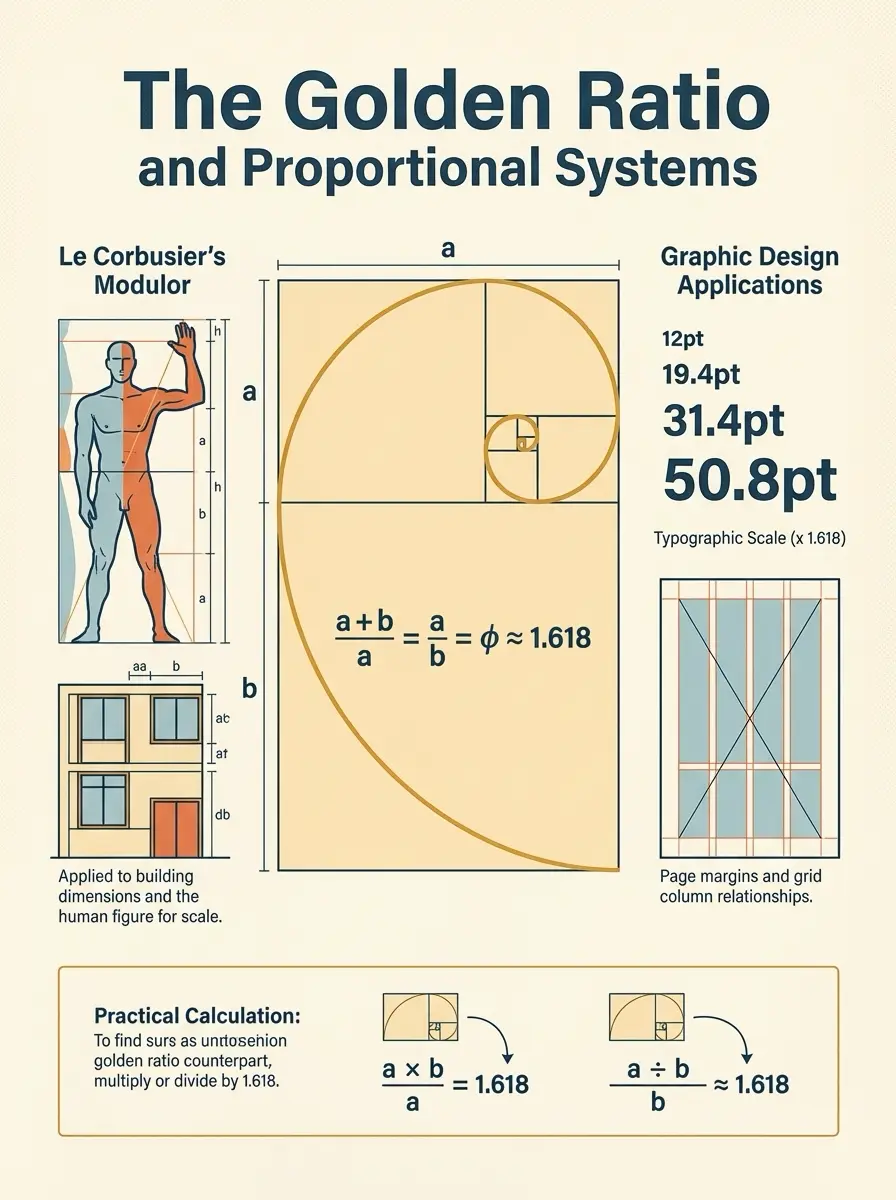
Le Corbusier developed the Modulor system partly from golden ratio principles, applying it to building dimensions and the human figure. In graphic design, the ratio appears in typographic scale systems (the golden ratio type scale produces font sizes at approximately 1.0, 1.618, 2.618, 4.236 — each step multiplied by phi), in page margin proportions, and in grid column relationships. The practical calculation: if you know one dimension and want the golden ratio counterpart, multiply by 1.618 or divide by 1.618 depending on direction.
The Sabine Formula: Acoustic Reverberation Time
Reverberation time — how long a sound takes to decay by 60 decibels after the source stops — determines whether a space feels live, dead, intimate, or overwhelming. The Sabine formula: RT60 = 0.161 × V / A, where V is the room volume in cubic metres and A is the total absorption (the sum of each surface area multiplied by its absorption coefficient at the relevant frequency). Concert halls target RT60 of 1.8-2.2 seconds for orchestral music. Lecture theatres target 0.6-0.8 seconds. Recording studios target 0.3-0.5 seconds.
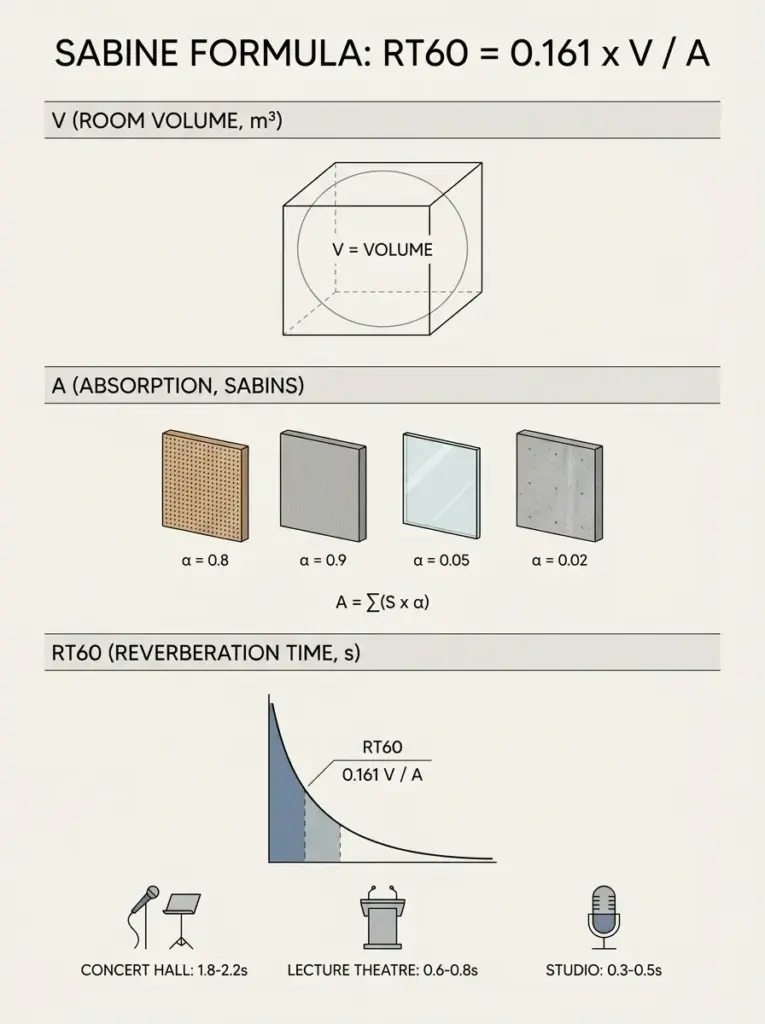
The design implication: room volume and material choices are not independent decisions. A large volume with hard reflective surfaces (concrete, glass, plaster) produces a long reverberation time. The same volume with heavy absorptive finishes (carpet, upholstered seating, acoustic panels) produces a shorter one. Getting this calculation right during design — before specification is finalised — is significantly cheaper than acoustic remediation after construction.
Structural Span: Preliminary Beam Sizing
Architects are not structural engineers, but preliminary span checks during concept design are essential for producing a structurally credible scheme. The rule-of-thumb for steel I-beam depth: span in mm ÷ 20 gives approximate beam depth in mm for typical office loading. For timber joists: span in mm ÷ 24. These are preliminary estimates only — actual structural design requires engineering calculation — but they allow architects to check whether a structural concept is geometrically possible before committing to it in a scheme.
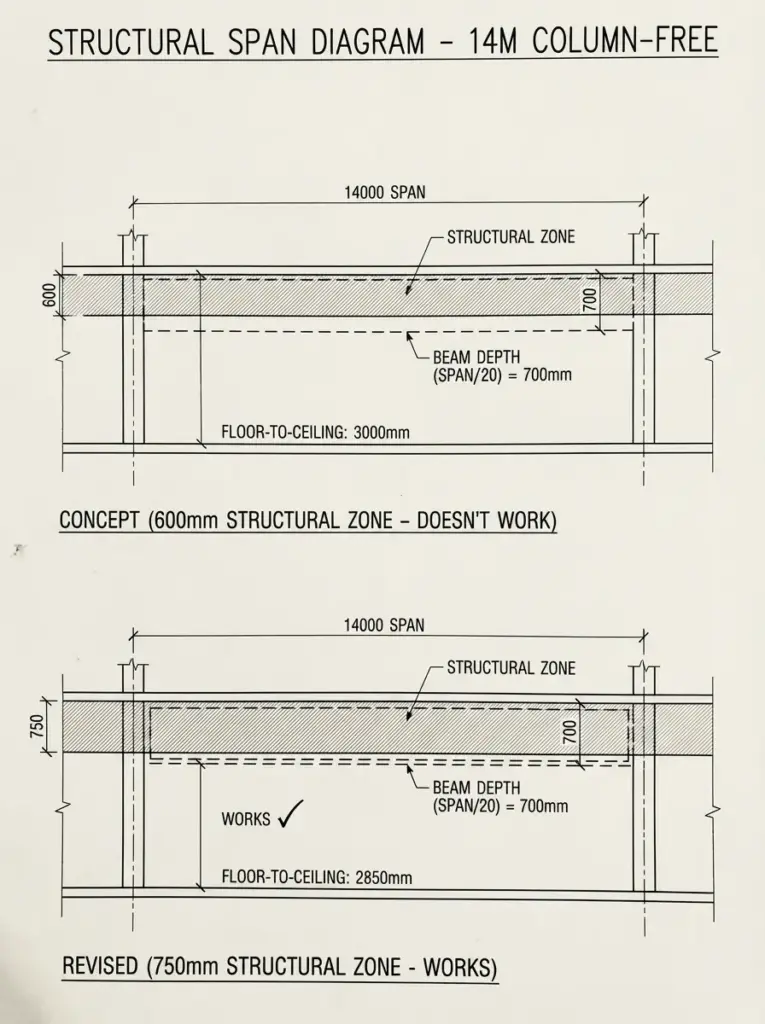
The specific calculation students consistently get wrong: they design open-plan spaces with spans that would require beams so deep they destroy the floor-to-ceiling height they’ve been designing around. A 12-metre steel span at 1/20 depth requires a 600mm beam, which may consume most of the structural zone allowance and reduce usable ceiling height below the minimum for the space type. Knowing this at the concept stage prevents a cascade of coordination problems downstream.
U-Values and Thermal Performance
The U-value measures heat transmission through a building element in watts per square metre per degree Celsius of temperature difference (W/m²K). Lower U-value means better thermal insulation. Current UK Building Regulations Part L requires U-values of approximately 0.18 W/m²K for walls, 0.13 for roofs, 0.18 for floors, and 1.4 for windows in new construction. The calculation: U = 1 ÷ (R_total), where R_total is the sum of thermal resistances of all layers, each calculated as thickness ÷ thermal conductivity.
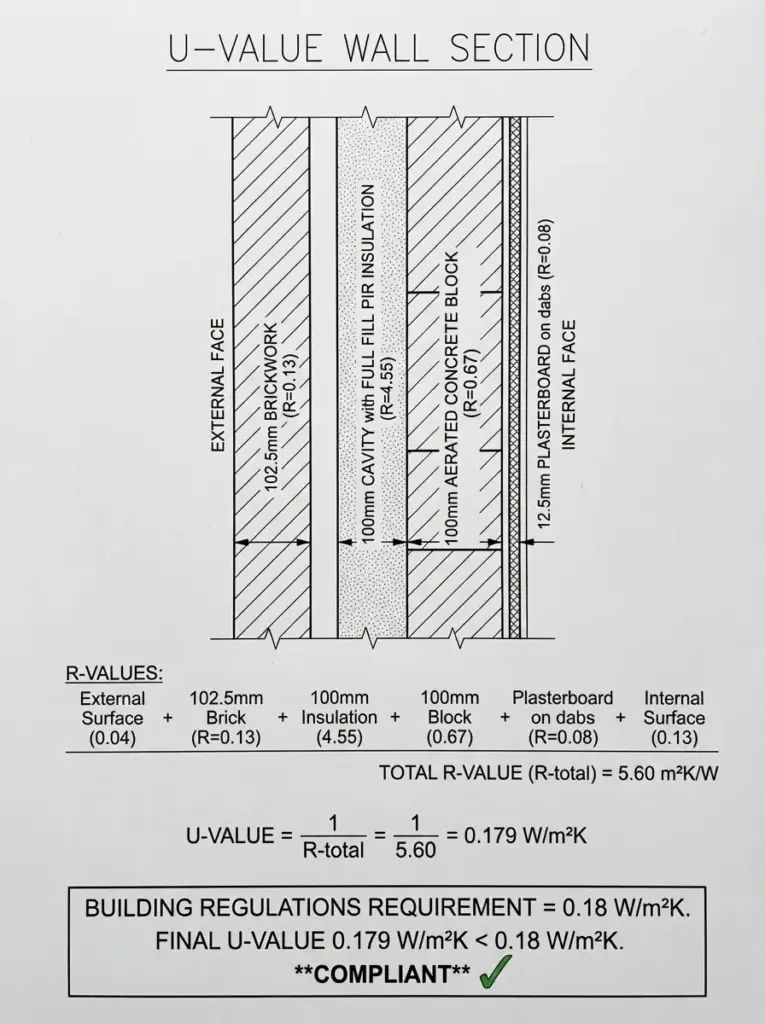
For design students: the U-value calculation is the bridge between specifying a wall construction and knowing whether it meets regulatory requirements. A wall assembly that looks adequate — insulated cavity, external brick, internal plaster — may or may not achieve the required U-value depending on the specific insulation type, thickness, and thermal bridging at structural elements. Checking this during design, rather than relying on the contractor’s specification, is part of the architect’s professional responsibility.
Five Real Design Scenarios Where Calculation Changes the Decision
The Lecture Theatre Acoustic Brief
The problem: A 450-seat lecture theatre with a volume of 3,200m³. The client wants a ‘clear, intelligible acoustic environment for spoken word.’ What’s the reverberation time with the proposed material palette (concrete ceiling, carpet floor, upholstered seats, plastered side walls)?
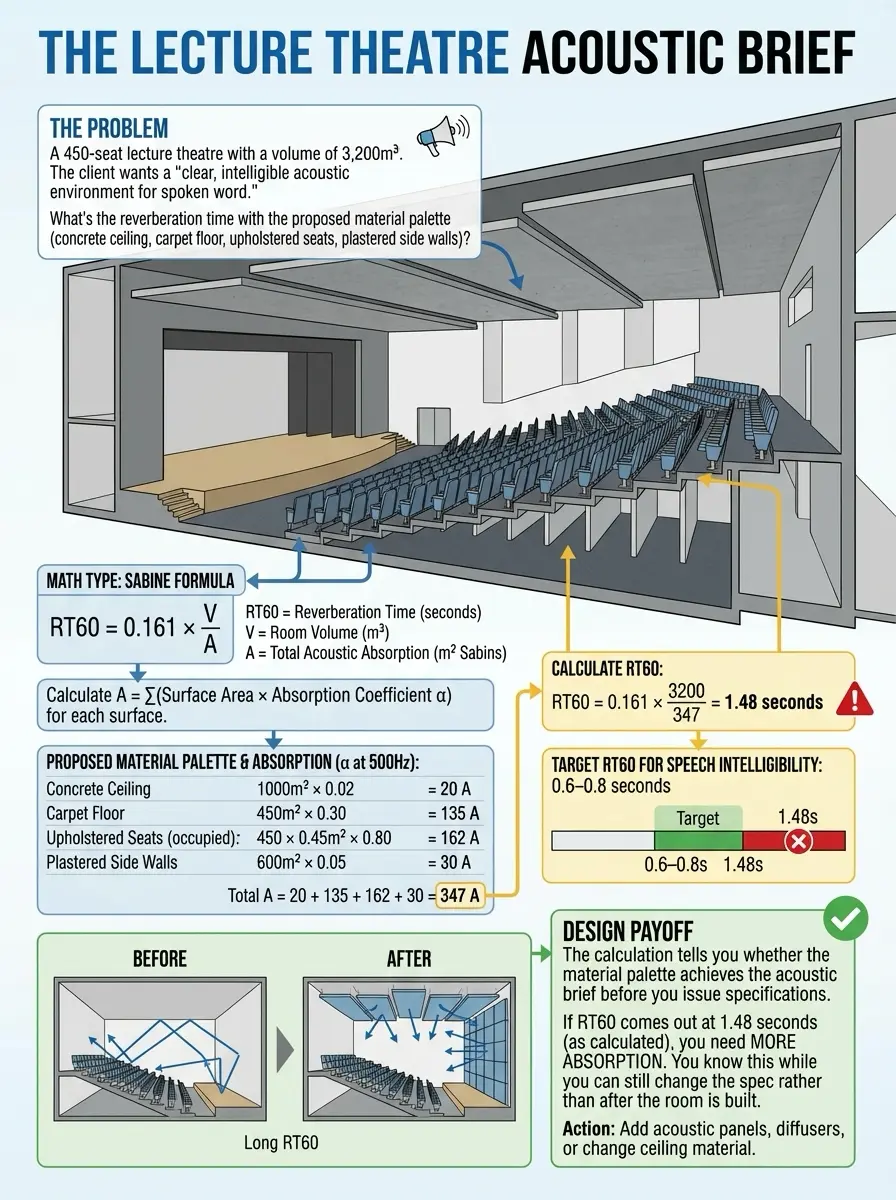
Math type: Sabine formula: RT60 = 0.161 × V / A. Calculate A from each surface’s area × absorption coefficient. Compare the result to the target RT60 of 0.6–0.8 seconds for speech intelligibility.
Design payoff: The calculation tells you whether the material palette achieves the acoustic brief before you issue specifications. If RT60 comes out at 1.4 seconds, you need more absorption — and you know this, while you can still change the spec rather than after the room is built.
The Open-Plan Office Structural Concept
The problem: A competition scheme for a 6-storey office building with 14-metre column-free spans on the main floor plates. The structural zone in the section is 600mm. The architect wants to know if the concept is structurally credible before presentation.
Math type: Preliminary beam sizing: 14,000mm ÷ 20 = 700mm required beam depth for steel. Compare to 600mm available structural zone.
Design payoff: The span requires a beam depth that the section cannot accommodate. The architect has three options: reduce the span (introduce columns), increase the structural zone (lose floor-to-floor height), or change the structural system. Knowing this before the presentation prevents presenting an unbuildable scheme.
The Residential Staircase Spatial Conflict
The problem: A residential extension with a floor-to-floor height of 2,850mm and a maximum plan footprint for the staircase of 3,600mm total run. The designer needs to know if a comfortable staircase fits.
Math type: 2R + G = 630mm, R between 150-220mm. With 14 risers: R = 2,850 ÷ 14 = 203mm. G = 630 – (2×203) = 224mm. Total run = 13 treads × 224mm = 2,912mm.
Design payoff: The staircase fits within the available 3,600mm run with 688mm to spare. The calculation confirms the spatial concept works before any detailed design is developed on top of it.
The Editorial Typographic Scale System
The problem: A brand identity project requires a typographic scale for a design publication — body text at 10pt, and a harmonious progression of heading sizes up through H3, H2, H1, and display.
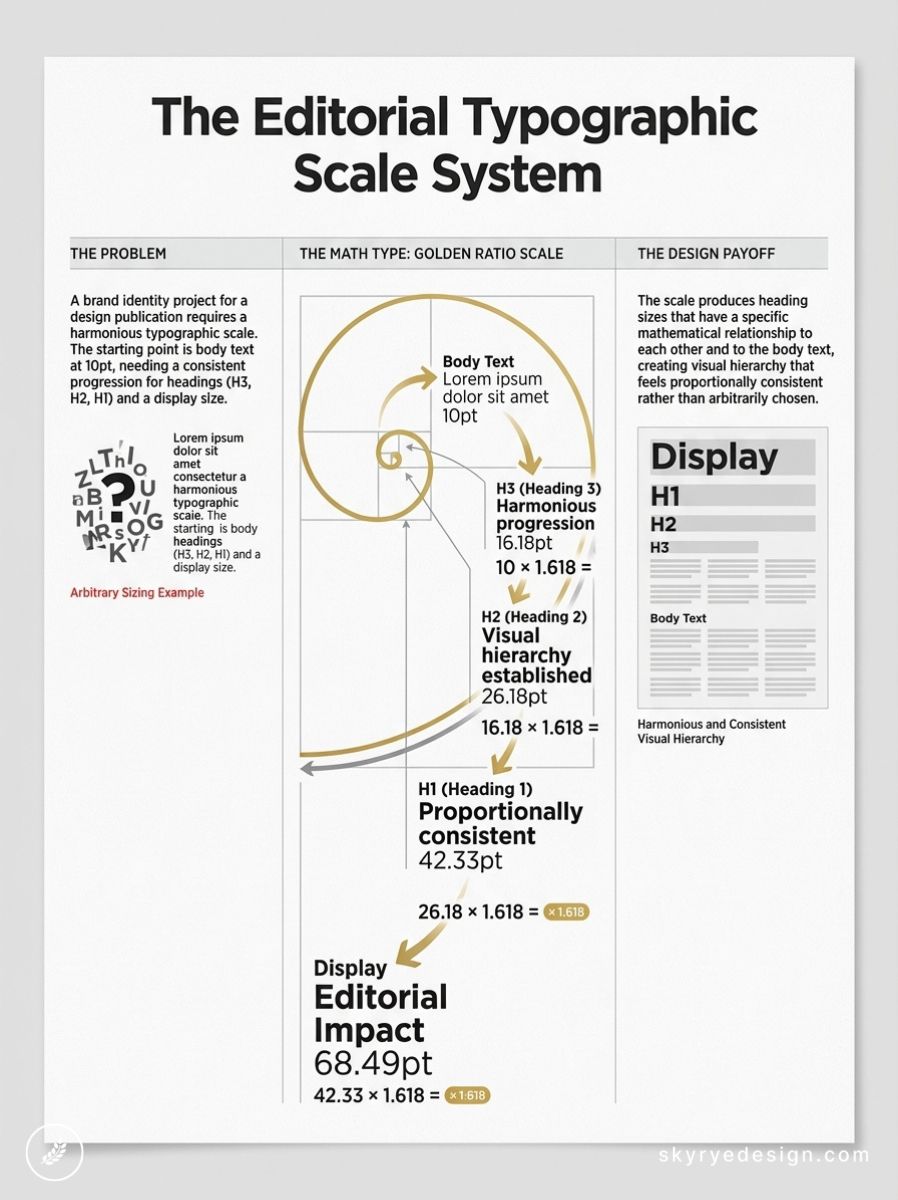
Math type: Golden ratio type scale: each step multiplied by 1.618. 10 × 1.618 = 16.18 (H3), × 1.618 = 26.18 (H2), × 1.618 = 42.33 (H1), × 1.618 = 68.49 (Display).
Design payoff: The scale produces heading sizes that have a specific mathematical relationship to each other and to the body text, creating a visual hierarchy that feels proportionally consistent rather than arbitrarily chosen.
The Flat Roof Drainage Gradient
The problem: A flat roof terrace of 18m × 12m requires drainage to perimeter gutters. Building regulations require a minimum fall of 1:80 on flat roofs. The designer needs to verify the required height difference across the widest dimension.
Math type: Gradient calculation: fall = length ÷ gradient ratio. 18,000mm ÷ 80 = 225mm minimum height difference across the 18m dimension.
Design payoff: The 225mm fall needs to be accommodated within the roof build-up and the parapet height, and the structural engineers need to account for this in the slab profile. The calculation determines whether the roof can drain without a change of level visible above the parapet line.
What Makes a Calculation Tool Actually Useful for Design Work
The calculation friction in design practice doesn’t come from the mathematics being too complex. Most of the formulas architects and designers use regularly — the staircase formula, the Sabine formula, basic span rules, golden ratio proportions — are not advanced mathematics. The friction comes from interruption: having to stop, find the formula, verify the variables, work through the calculation manually, and check the result.
That interruption is what makes a responsive calculation tool genuinely valuable in a design context. When you’re working through a section drawing at 11pm and you need to verify a staircase geometry, you don’t want to open a textbook. You want to photograph the handwritten calculation on your sketch, get an immediate step-by-step verification, and get back to the drawing. The design thinking is the valuable part. The calculation is the check that ensures the design thinking is sitting on correct numbers.
The AI Math Solver addresses this specific friction point — accepting both typed equations and photographed handwritten calculations, returning step-by-step working rather than just an answer, and requiring no account or setup to use. For design students working through the kind of applied calculations this guide covers — staircase geometry, acoustic formulas, span checks, thermal performance — that immediate accessibility matters more than it sounds. The tool doesn’t replace understanding; it removes the friction that gets between a formula you know exists and being able to apply it correctly under deadline pressure.
✏ Studio note: The most useful habit a design student can build is running the calculation before the design — not after. Span check before you commit to column-free space. Staircase formula before you fix the footprint in the plan. Acoustic formula before you finalise the material palette. The calculation informs the design decision rather than validating a decision already made. That sequence change is what separates design thinking from wishful thinking.
The Calculations by Design Discipline
Architecture Students
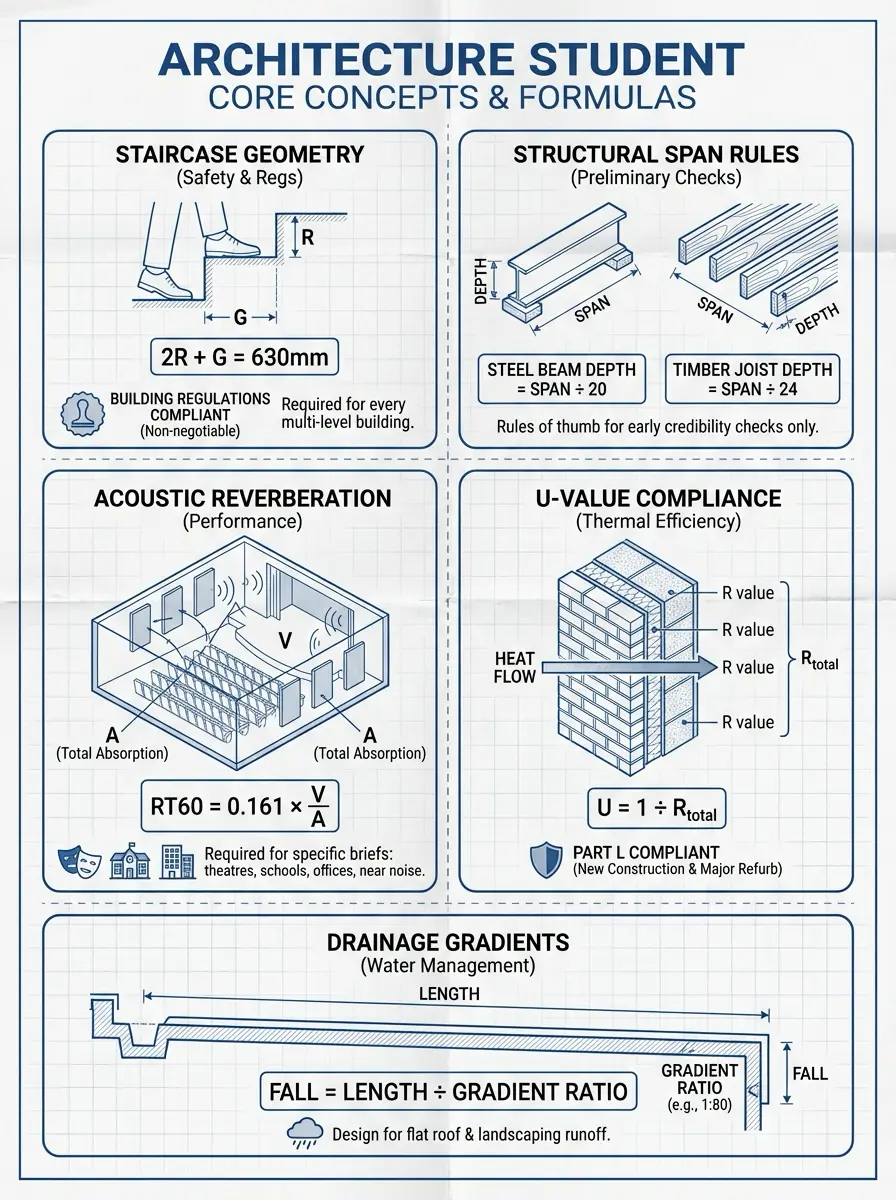
- Staircase geometry: 2R + G = 630mm. Required for every building with multiple levels. Non-negotiable in Building Regulations compliance.
- Structural span rules: Steel beam depth = span ÷ 20. Timber joist depth = span ÷ 24. For preliminary structural credibility checks.
- Acoustic reverberation: RT60 = 0.161 × V / A. Required for any brief with specific acoustic performance requirements — theatres, schools, offices, residential near noise sources.
- U-value compliance: U = 1 ÷ R_total. Required for Building Regulations Part L compliance on new construction and major refurbishment.
- Drainage gradients: Fall = length ÷ gradient ratio. Required for flat roof and landscaping drainage design.
Interior Designers
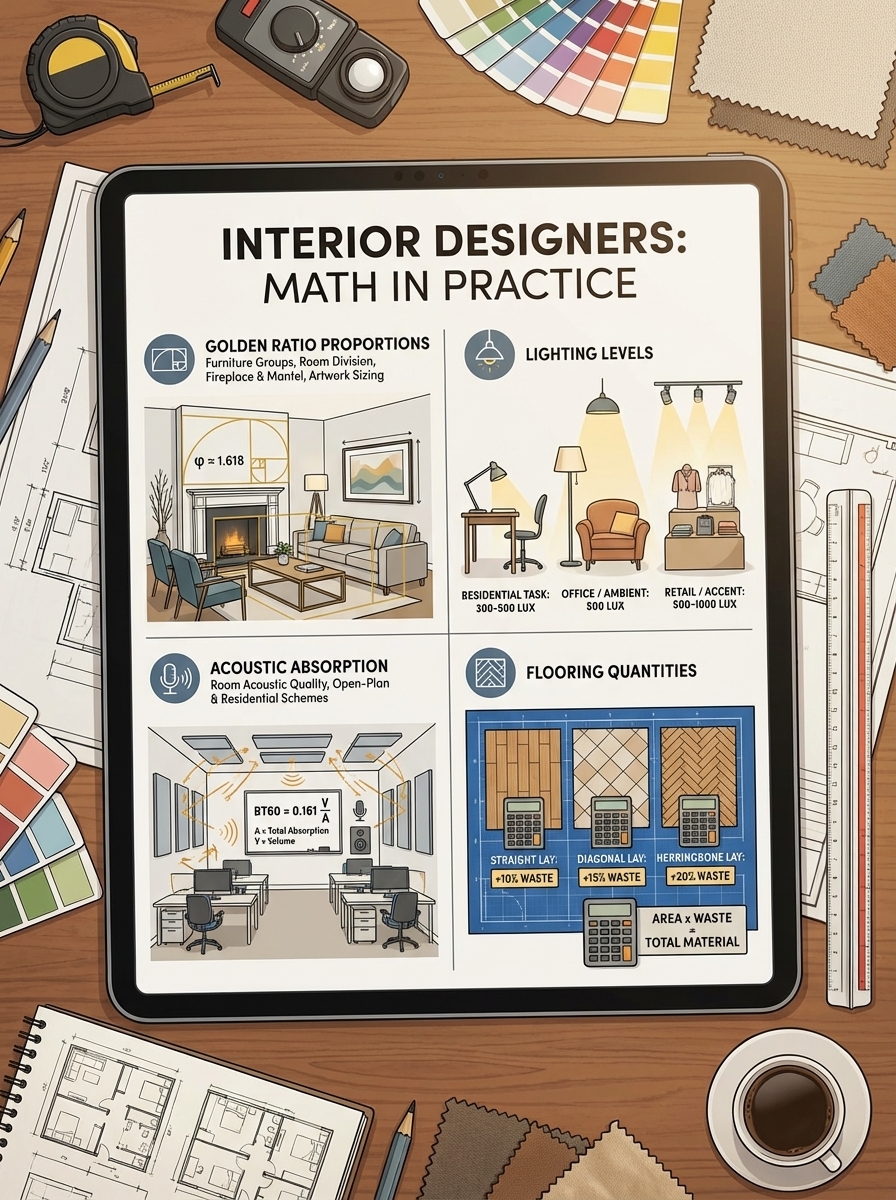
- Golden ratio proportions: Furniture groupings, room division, fireplace surround to mantel ratios, artwork sizing relative to wall area.
- Lighting levels: Lux calculations for task, ambient, and accent lighting. Residential task lighting typically 300-500 lux, office 500 lux, retail 500-1000 lux.
- Acoustic absorption: Sabine formula for room acoustic quality. Particularly relevant for open-plan offices and residential schemes near noise sources.
- Flooring quantities: Area calculation with waste allowances — typically 10% for straight lay, 15% for diagonal, 20% for herringbone pattern.
Graphic and Brand Designers
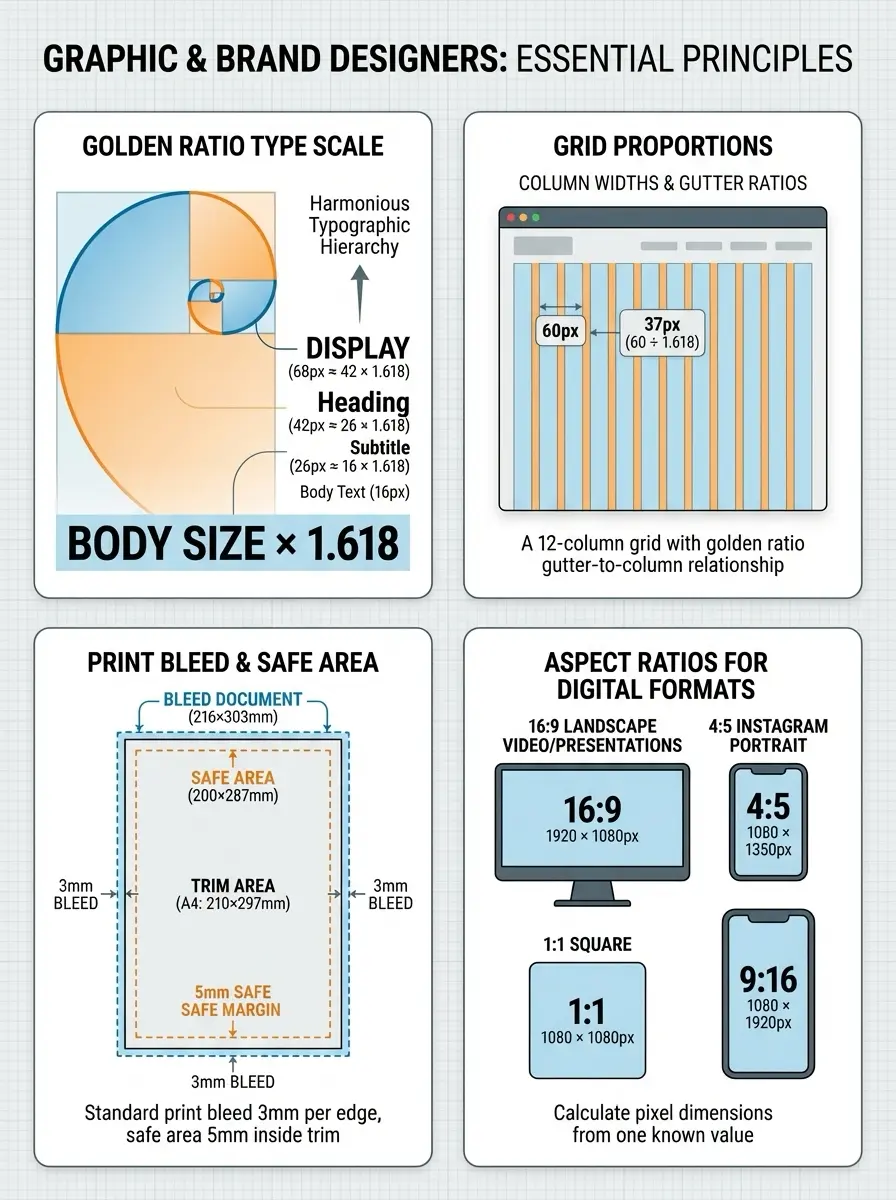
- Golden ratio type scale: Body size × 1.618 at each step. Produces harmonious typographic hierarchy from a single base size.
- Grid proportions: Column widths and gutter ratios. A 12-column grid with golden ratio gutter-to-column relationship: if column is 60px, gutter is 37px (60 ÷ 1.618).
- Print bleed and safe area: Standard print bleed 3mm per edge, safe area 5mm inside trim. For A4: bleed document 216×303mm, trim 210×297mm, safe area 200×287mm.
- Aspect ratios for digital formats: 16:9 for landscape video and presentations, 4:5 for Instagram portrait, 1:1 for square, 9:16 for Stories and Reels. Calculate pixel dimensions from one known value.
Calculation Confidence as a Design Competency
The architect who catches the staircase error before presentation is not more mathematically gifted than the one who doesn’t — they just have a habit of checking. The designer who knows the acoustic implications of a room’s proportions before the specification is issued is not a specialist — they know one formula and how to apply it. The graphic designer whose typographic scale feels effortlessly harmonious is often working from a proportional system rather than intuition.
Design education rightly emphasises spatial thinking, conceptual development, and visual judgment. What it sometimes underemphasises is that these things are built on a foundation of correct numbers. A beautiful section drawing that contains a staircase with wrong geometry is not a beautiful section drawing — it’s a drawing of something that can’t be built as shown.
The tools that make calculation more accessible don’t replace the thinking — they remove the friction that gets between knowing a formula exists and being able to apply it quickly and confidently. In a studio environment where the deadline is always tomorrow morning, that friction reduction is not trivial. It’s the difference between checking the calculation and hoping the numbers are right.
Modern architects don’t just calculate; they visualize. Beyond solving equations, many designers now use an Image to Video AI without login to transform their 2D mathematical models into immersive walkthroughs for clients.
FAQ: Math for Architecture and Design
Q: Do architects and designers really use math daily?
More than most design education prepares students for. Staircase geometry, structural span checks, acoustic reverberation time, thermal U-values, drainage gradients, lighting lux levels — these calculations appear regularly in practice. The math is not always complex, but it must be precise. An error in a staircase rise/run calculation or a beam span estimate has direct implications for buildability and, in some cases, safety.
Q: What is the Sabine formula and why do architects need it?
RT60 = 0.161 × V / A — reverberation time equals 0.161 multiplied by room volume (cubic metres) divided by total sound absorption. Architects use it to verify acoustic performance before construction. Concert halls target 1.8–2.2 seconds, lecture theatres 0.6–0.8 seconds, recording studios 0.3–0.5 seconds. Getting this wrong during design is far cheaper to correct than after the room is built — acoustic remediation is expensive and disruptive.
Q: How do architects calculate staircase geometry?
The comfort formula: 2R + G = 630mm, where R is riser height and G is going (tread depth). Building Regulations typically require R between 150–220mm and G between 220–300mm. Total rise ÷ number of risers = individual riser height. Number of treads × going = total run. The correct sequence: calculate the comfortable geometry first, then verify it fits the available space — not the reverse.
Q: What is the golden ratio and do designers actually use it?
The golden ratio is approximately 1:1.618 (phi). In practice, designers use it to establish proportional relationships between elements — typographic scale (each size step multiplied by 1.618), page margin proportions, grid column relationships, facade divisions. It’s most useful as a proportioning tool that produces visually harmonious relationships rather than as a rigid rule. Le Corbusier’s Modulor system was partly derived from golden ratio principles.
Q: Can AI tools help with structural calculations?
AI math tools can assist with preliminary span calculations, load estimation, and formula-based structural checks during early design — useful for sanity-checking initial structural concepts. They should not replace the structural engineering sign-off on any construction project. The appropriate workflow: use AI tools to understand the calculation logic and verify preliminary numbers during design development, then confirm all structural specifications with a licensed structural engineer.
- 199shares
- Facebook0
- Pinterest199
- Twitter0
- Reddit0