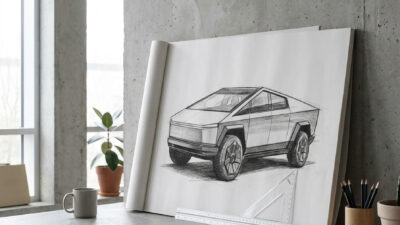
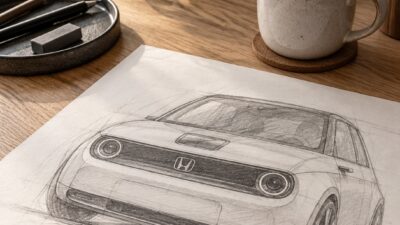
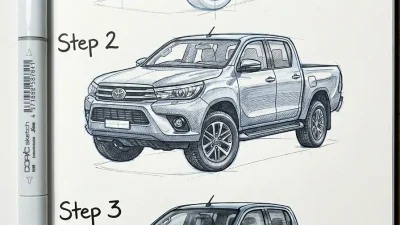
Sports cars to sketch are best chosen by what they teach your hand, not only by how famous they are. A Countach teaches wedge perspective. An E-Type teaches surface tension. A Mustang teaches visual weight. A Porsche 911 GT3 teaches how modern aero changes the silhouette. Use this list as a drawing workout: pick one car from each era, sketch the side view first, then repeat it in three-quarter view.
My first serious car sketch was a Countach. I copied it from a poster on my bedroom wall for three months straight — same angle, same pose, same mistakes. I got very good at drawing that one Countach. What I didn’t get good at was drawing cars. The problem wasn’t the subject. It was that I wasn’t studying across eras, across design philosophies, across the wildly different problems that different decades of automotive design tried to solve.
- How to choose which sports car to sketch first
- Category 1: The Wedge Era — Ruled Lines and Knife Edges (1965–1985)
- Category 2: Classic Curves — Organic Form and Surface Tension (1950–1970)
- Category 3: Muscle Proportions — American Volume and Aggressive Stance (1965–1975)
- Category 4: Modern Aerodynamics — Parametric Surfaces and Active Design (1990–Present)
- FAQ: Sketching Iconic Sports Cars
- Q: What's the best car to start with if I'm a complete beginner?
- Q: What drawing tools should I use for automotive sketching?
- Q: How long should I spend sketching each car before moving on?
- Q: Should I start with the side view or the three-quarter view?
- Q: Which single car on this list teaches the most transferable skills?
- Q: How do I make my car sketches look less stiff and more dynamic?
- The Library You're Building
The fastest way to level up your automotive sketching isn’t repetition — it’s deliberate range. The designer who’s wrestled with the organic surface tension of a 1960s E-Type and also worked through the ruled geometry of a Countach and also unpacked the parametric surfacing of a McLaren 720S has three completely different sets of spatial and line-quality tools available. This list of 20 iconic sports cars to sketch is organized by design era so you’re not just building a portfolio of car drawings — you’re building a vocabulary.
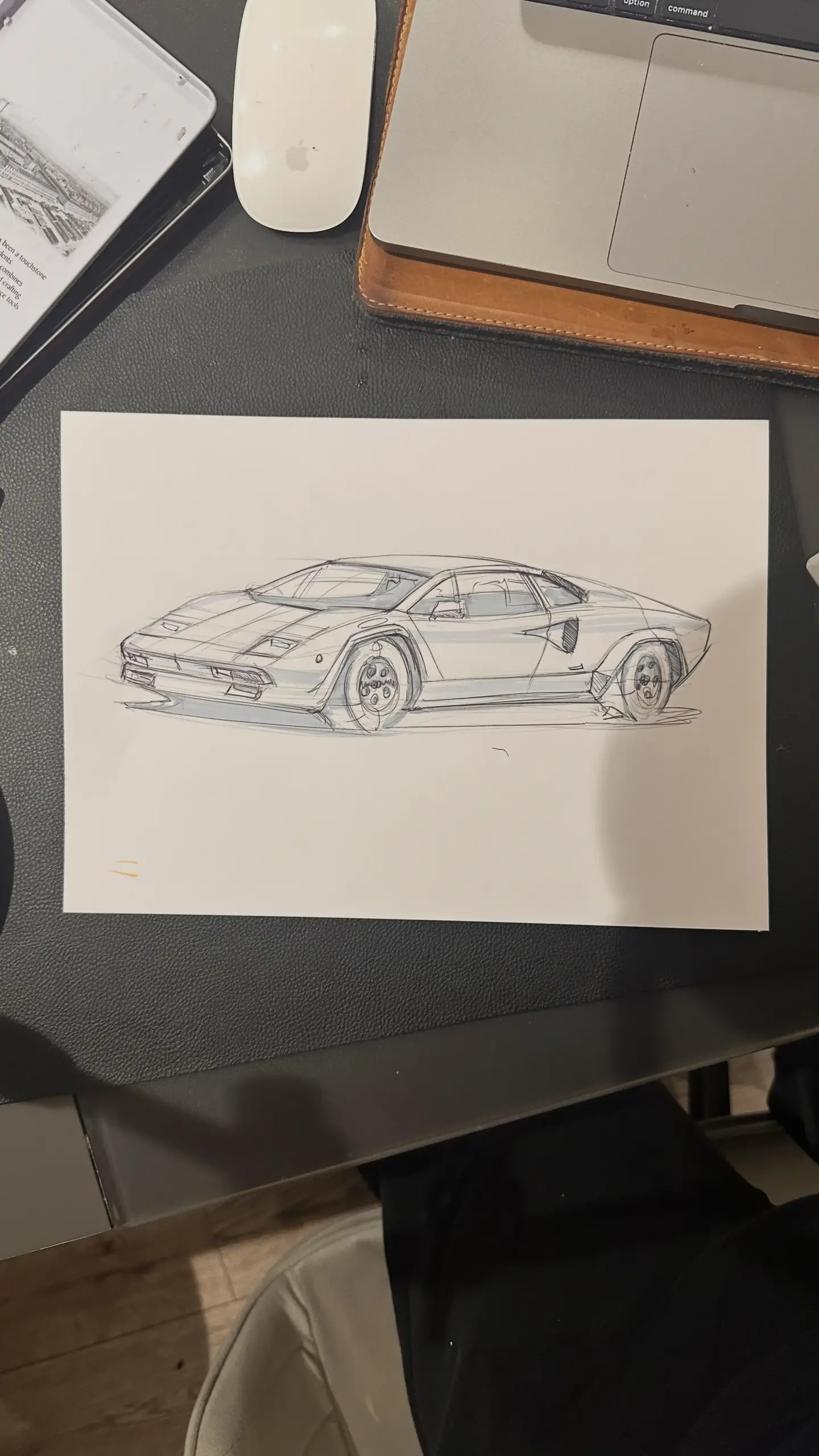
For a more extreme performance-car exercise, add a Formula 1 car drawing study to your sketch list and compare its aero-first silhouette with road-going sports cars.
How to choose which sports car to sketch first
If you are practicing car drawing, choose the model by the problem you want to solve. Do not start with the most complicated render. Start with the shape lesson, then move into surface, stance, and aero detail.
After a few low sports-car silhouettes, it is useful to switch scale completely. An SUV sketch guide forces you to solve height, mass, ground clearance, and utility instead of only chasing speed lines.
| Practice goal | Start with | Why it helps |
|---|---|---|
| Clean perspective | Lamborghini Countach or Lotus Esprit | Flat planes and wedge angles make construction errors obvious. |
| Smooth surface control | Jaguar E-Type or Porsche 356 | Curved bodies force you to draw highlights, not just outlines. |
| Strong stance | Mustang Fastback or Dodge Charger | Long hoods, wide tracks, and heavy shadows teach visual weight. |
| Modern aero detail | Porsche 911 GT3 or Bugatti Chiron | Wings, intakes, splitters, and layered openings train depth and line hierarchy. |
Each car entry focuses strictly on design language, proportions, and what the sketching process itself forces you to understand. Zero engine specs. All form.
A useful side drill is this bike frame geometry guide, because the whole sketch succeeds or fails on the relationship between two wheels and a few angled tubes.
Category 1: The Wedge Era — Ruled Lines and Knife Edges (1965–1985)
The wedge era was a deliberate rejection of everything that came before it. Out went the organic curves and chrome flourishes; in came geometry you could cut yourself on. For a sketching student, these cars are foundational — they’re built from ruled lines, precise angles, and razor-sharp horizon lines that punish imprecise draftsmanship immediately. Get the angle wrong by two degrees and the whole car reads as soft. These five cars will train your hand to commit.
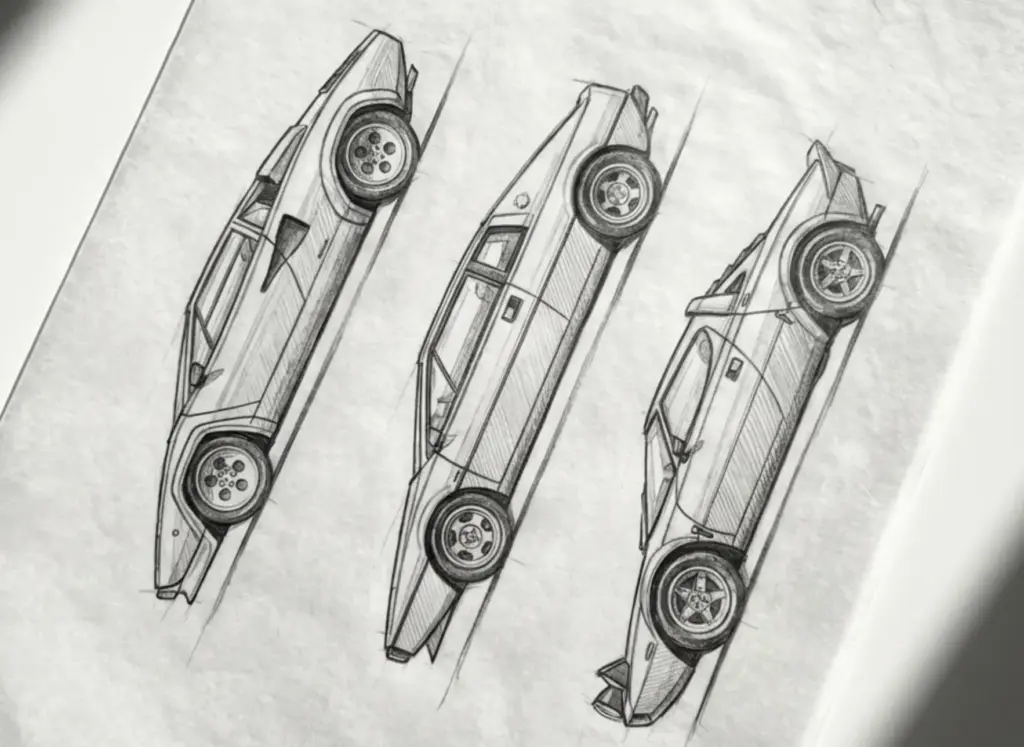
1. Lamborghini Countach LP400 (1974)
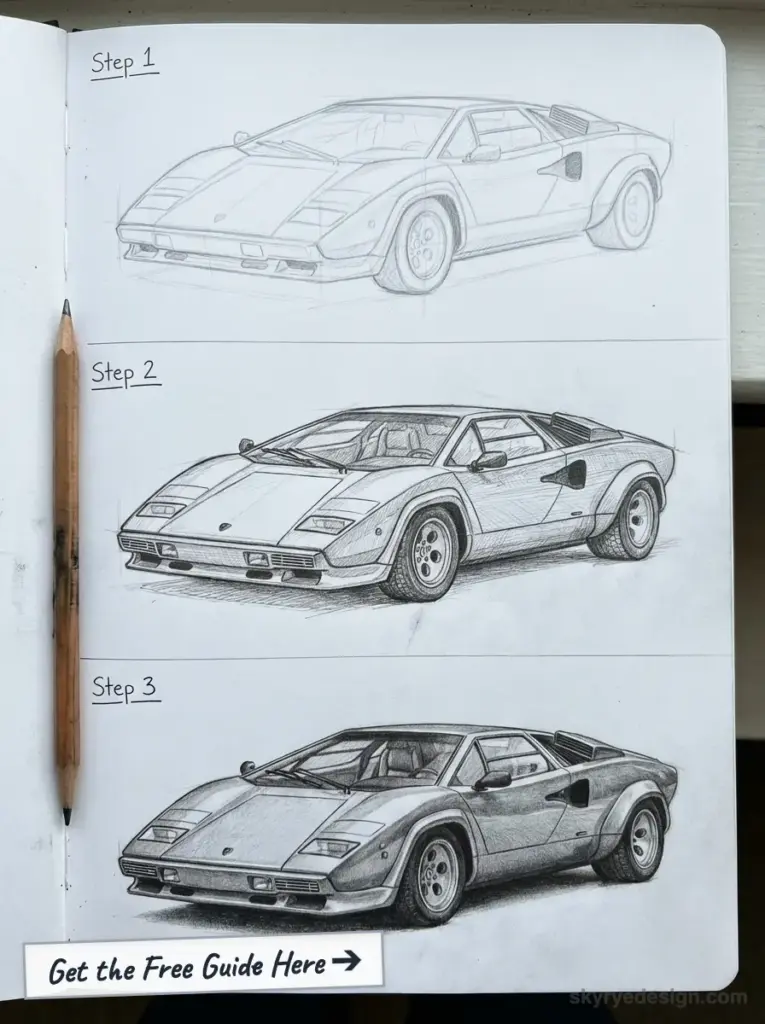
Design Signature: An extreme forward-cab wedge with near-zero front overhang, a near-vertical windshield, and side intakes that break the body surface into distinct angular planes. The profile is essentially a right triangle with a greenhouse squeezed toward the rear. Every line is ruler-straight.
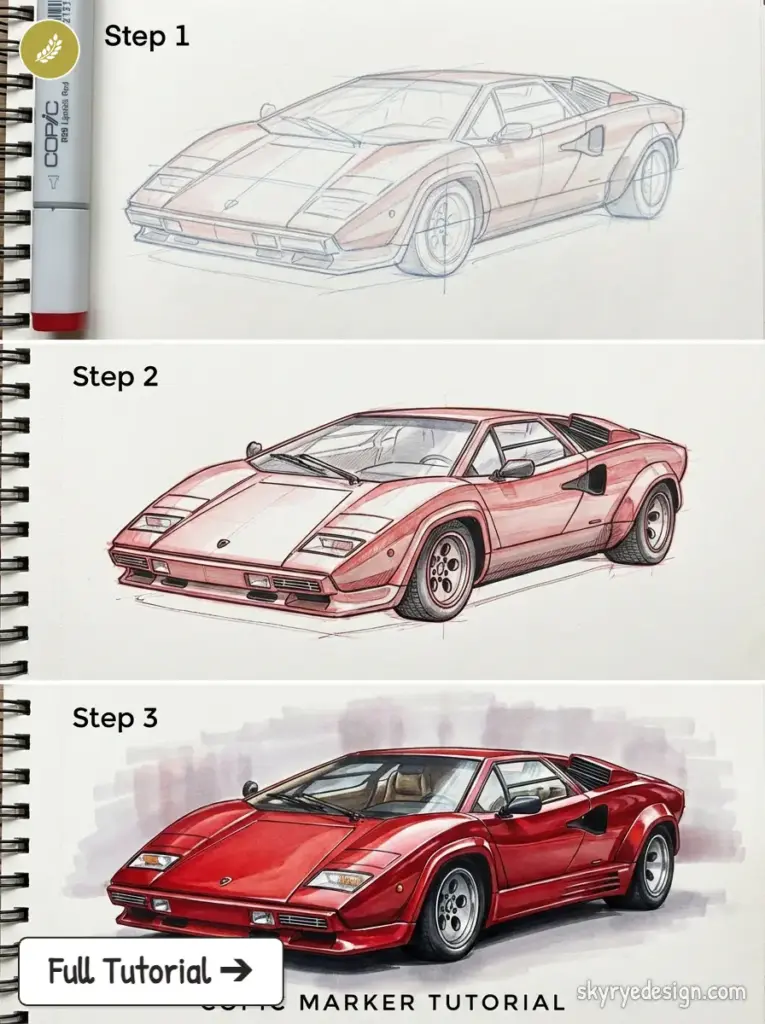
- The Sketching Challenge: The rear three-quarter view. The scissor-door cut line, the NACA duct position on the rear quarter, and the relationship between the vast rear haunches and the tiny greenhouse all compound in perspective. Students consistently either over-inflate the rear volume or flatten the haunches.
- What It Teaches You: Ruled-line precision and perspective discipline. The Countach has almost no surface curvature to hide construction errors — every vanishing point violation shows immediately. Sketching it forces you to establish your horizon line and commit to it across the entire drawing.
2. Lotus Esprit S1 (1976)
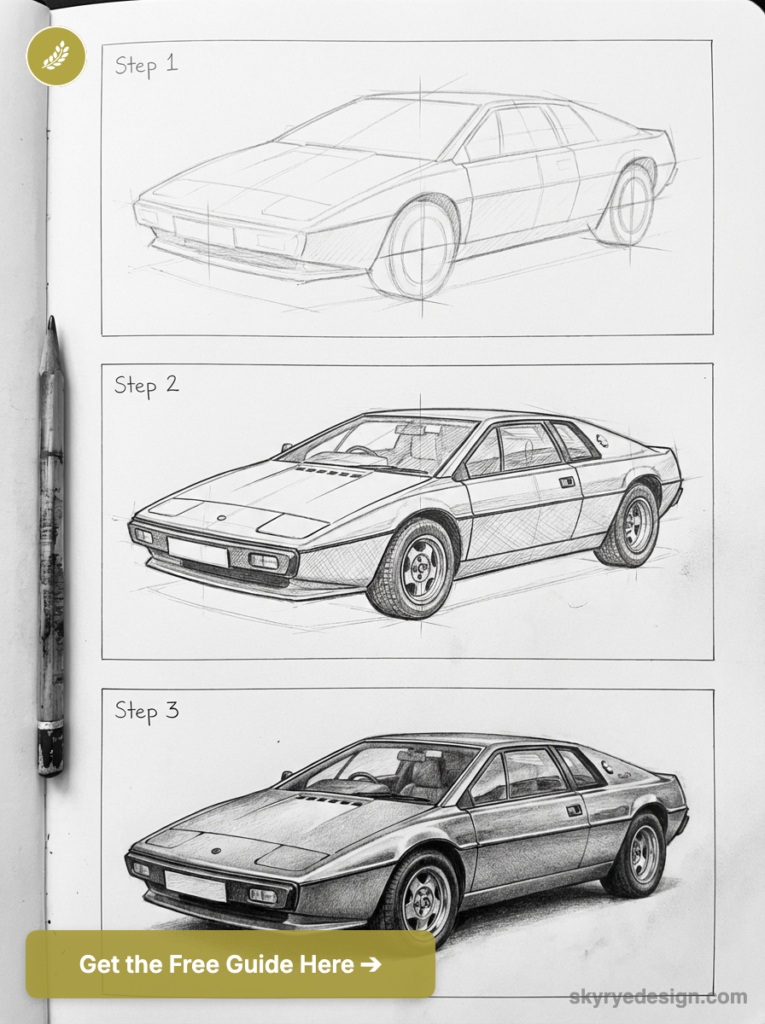
- Design Signature: Giorgetto Giugiaro’s masterclass in origami applied to a car body. Flat panel surfaces folded at sharp dihedral angles, a dramatically low hood, and a greenhouse that’s almost more window than roof. The S1 is a study in faceted geometry — every surface is a defined plane, not a compound curve.
- The Sketching Challenge: The greenhouse-to-body transition. The sharp crease where the side glass meets the roof, and the complex angle of the A-pillar in three-quarter view. Students tend to round this off instinctively, losing the entire character of the car.
- What It Teaches You: Planar surface reading — understanding that a car body is composed of discrete surfaces meeting at intentional angles, not one continuous blob. The Esprit makes this explicit in a way that curved-body cars obscure.
3. Lancia Stratos (1974)
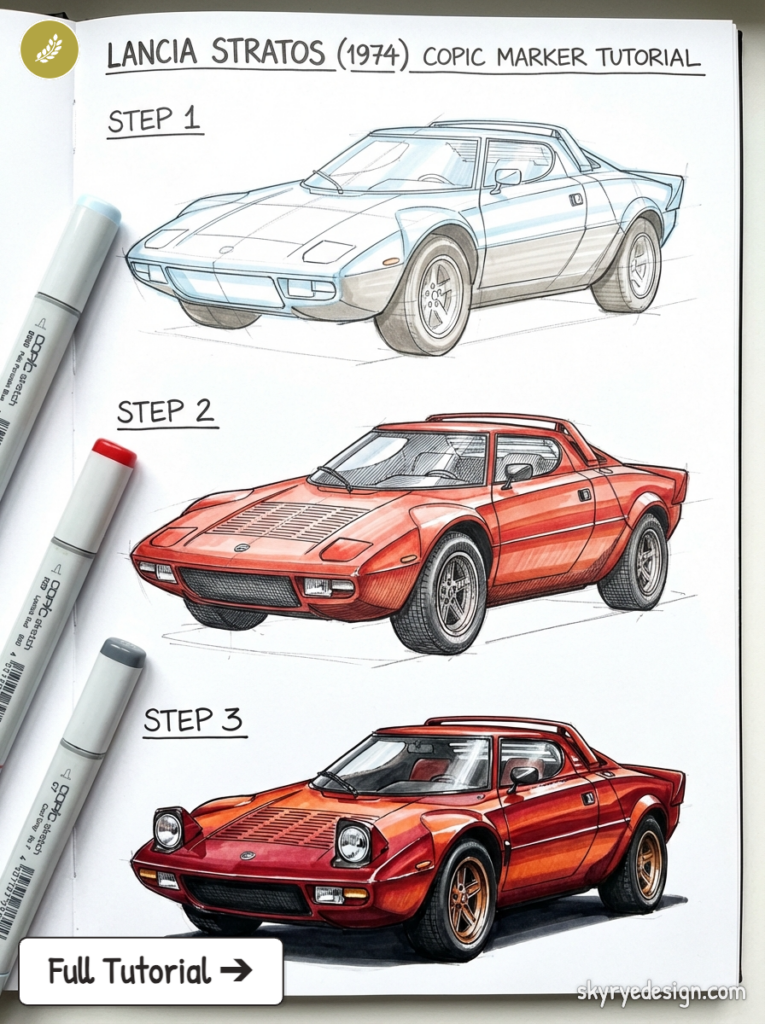
- Design Signature: A near-trapezoidal body with an almost nonexistent nose, a panoramic wraparound windshield that flows into the roof in one continuous curve, and a dramatically wide stance relative to its length. The Stratos is visually almost more helmet than car.
- The Sketching Challenge: The windshield-to-roof surface. It’s one continuous compound-curved surface that wraps around the cockpit — not a flat pane but a form that changes curvature across its entire width. Getting this to read correctly in perspective is genuinely difficult.
- What It Teaches You: How a single dominant surface can define an entire vehicle’s character. The Stratos teaches you to think about ‘the big gesture’ before committing to details — most students draw details first and never establish the primary form.
4. BMW M1 (1978)
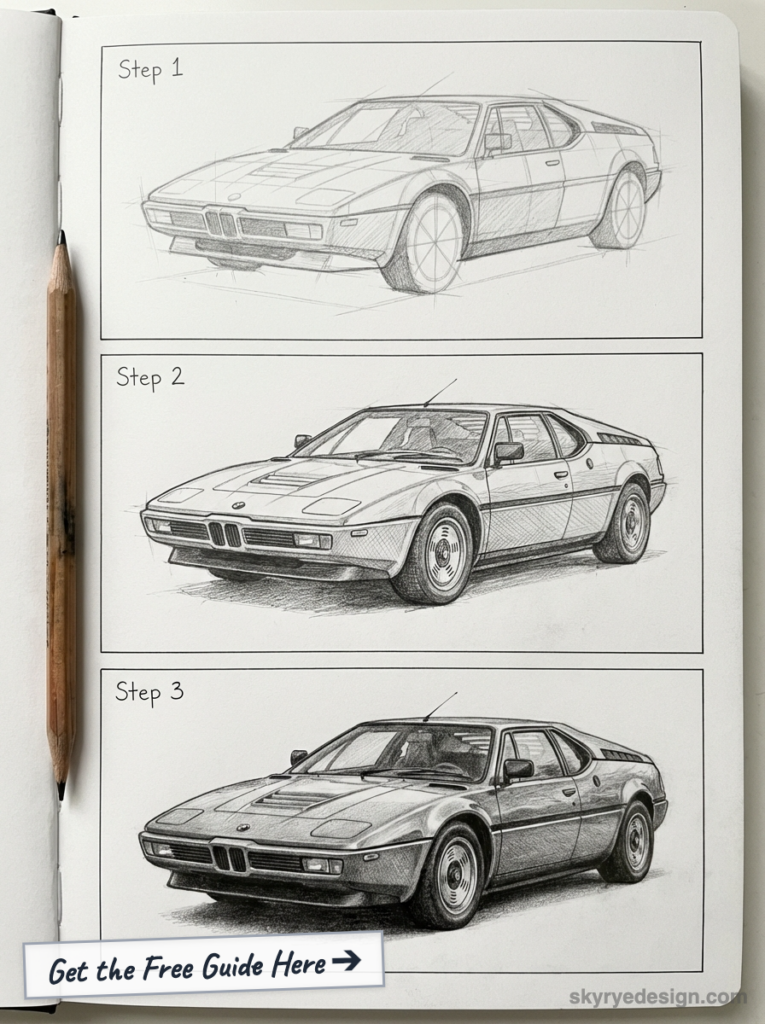
- Design Signature: A rare case of wedge-era geometry softened slightly at the edges — Paul Bracq and Giugiaro’s collaboration produces a car that has the wedge’s low nose and rearward mass bias, but introduces gentle crown to the hood surface and subtle convexity to the door panels. It’s the wedge with just enough warmth to be liveable.
- The Sketching Challenge: The hood-to-nose transition. The BMW M1’s hood has a slight but deliberate convex crown that changes how light reflects across it — sketch it flat and the entire front end dies. The kidney grille placement in forced perspective is also a consistent stumbling block.
- What It Teaches You: Reading subtle surface crown — the difference between a flat surface and a slightly convex one in a sketch. This is the skill that separates drawings that look alive from ones that look like technical diagrams.
If you are studying BMW stance because you like motorsport sketches, it is worth looking at how a real BMW drift build changes the car: more steering angle, lower ride height, wider track, smoke, and a much more aggressive wheel attitude.
5. De Tomaso Pantera (1971)
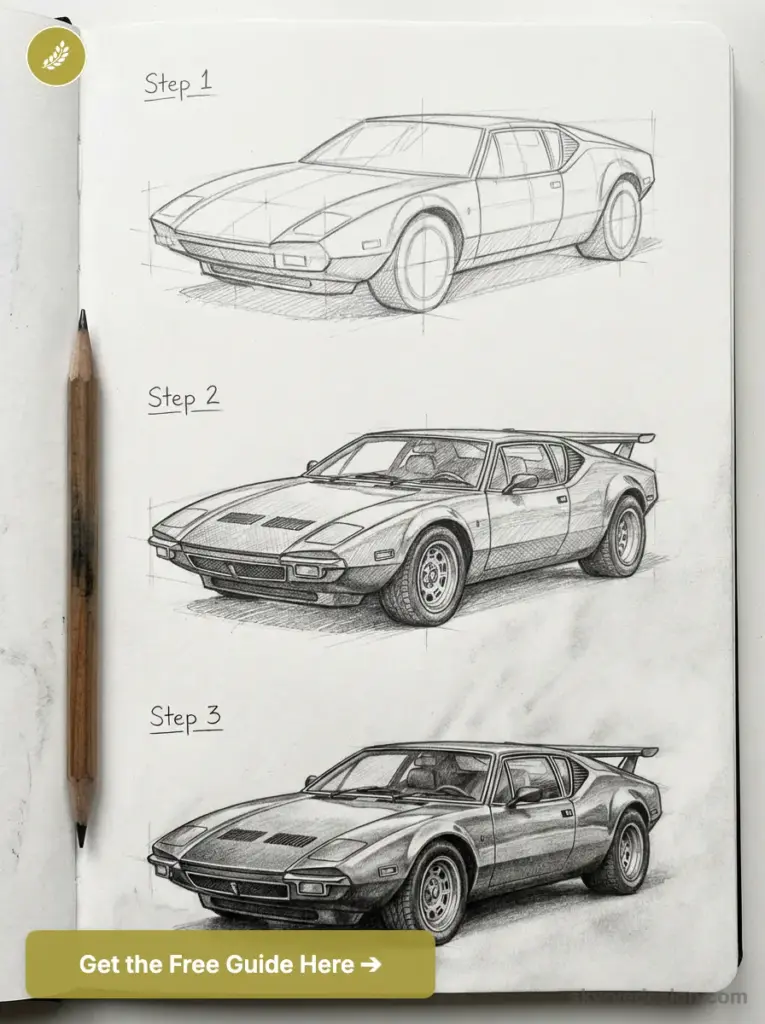
- Design Signature: An American muscle silhouette with Italian wedge vocabulary layered over it — long hood, short deck, but with a mid-engine cab position that creates unusual greenhouse placement well forward of center. The wide hips and flat roof create a near-rectangular profile in side view.
- The Sketching Challenge: Establishing the correct cab-forward proportions in side view. Students trained on front-engine cars instinctively push the greenhouse too far back, making the Pantera read as a GT rather than mid-engine. The relationship between wheelbase, roof placement, and the rear deck overhang is the whole puzzle.
- What It Teaches You: How engine placement changes proportion logic. The Pantera forces you to understand that where the passengers sit relative to the axles determines everything about a car’s visual balance — a lesson applicable to every modern mid-engine sports car design.
Category 2: Classic Curves — Organic Form and Surface Tension (1950–1970)
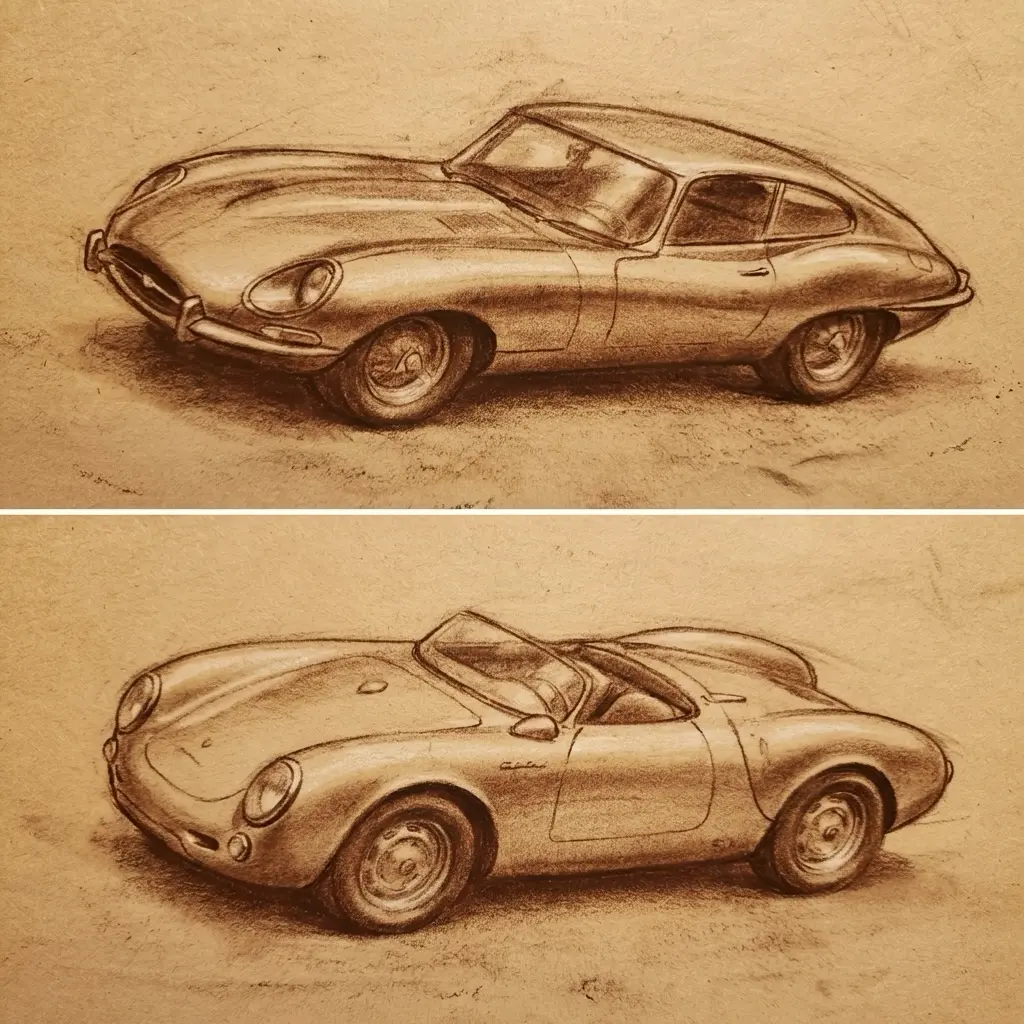
Before the wedge, there was the curve. Not arbitrary curvature — disciplined, surface-tension-driven form where every line resolved into the body with the inevitability of water finding its level. These are the hardest cars to sketch well precisely because they forgive nothing. A ruled-line error is visible; a curvature error is felt. The five cars in this category will train your eye to see surface quality, not just outline.
6. Jaguar E-Type Series 1 (1961)
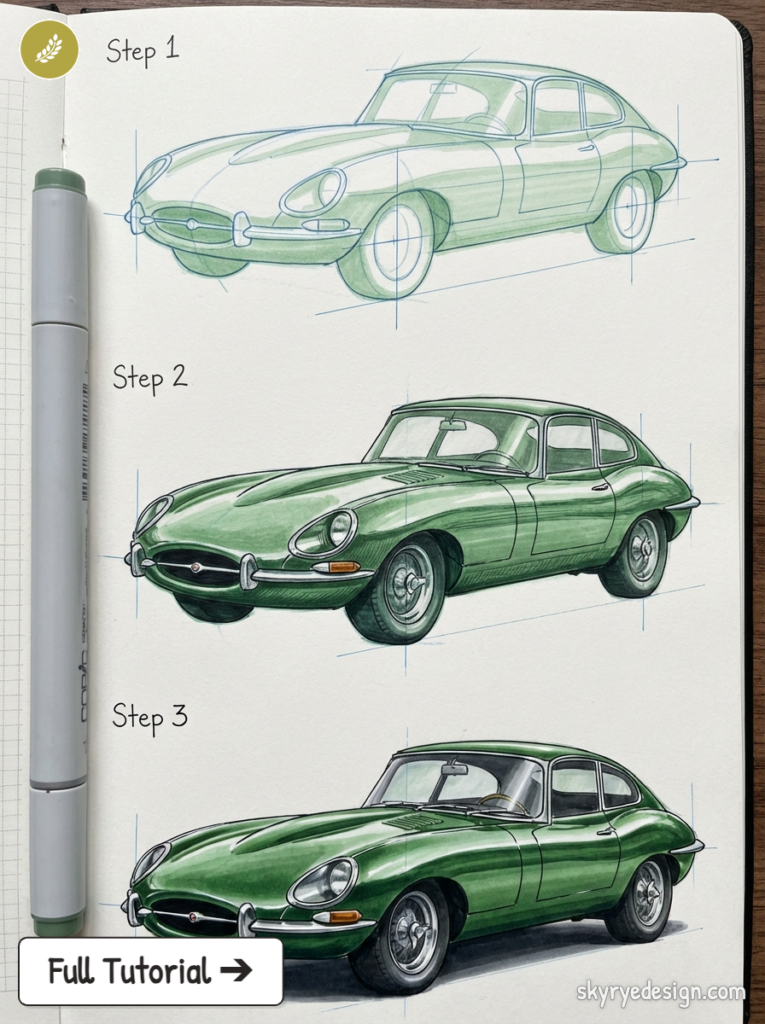
- Design Signature: The longest hood-to-greenhouse ratio in production car history at the time. The hood is almost absurdly long — nearly two-thirds of the car’s total length — tapering to a delicate nose. The body swells at the rear haunches and pinches at the waist, creating a tension that automotive designers call ‘surface pressure.’ Malcolm Sayer used aeronautical mathematics to generate every surface.
- The Sketching Challenge: The hood surface — specifically the way it crests slightly at the center and falls away to the sides while simultaneously tapering front-to-rear. It’s a double compound curve across its entire length, and it has to read as taut rather than soft. Most students either flatten it (dead) or over-crown it (lumpy).
- What It Teaches You: Surface tension and the concept of ‘tautness’ in curved form. The E-Type is the single best car to study if you want to understand how a curved surface can feel fast or slow depending on how you control the highlight line across it.
7. Porsche 356 Speedster (1954)
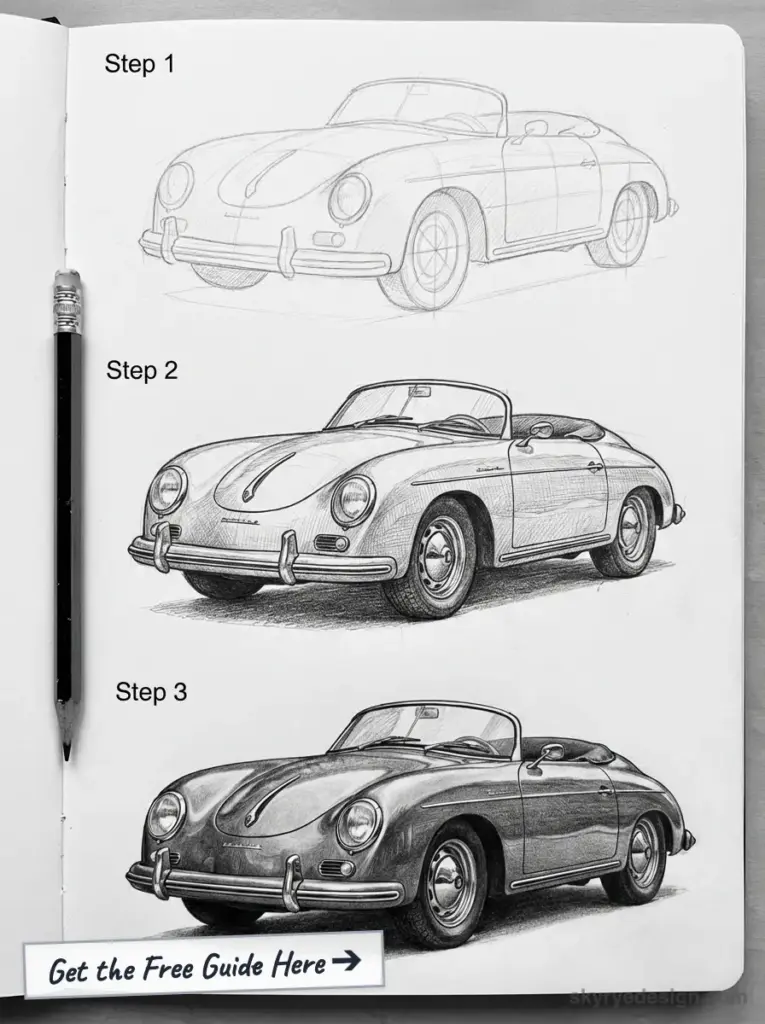
- Design Signature: A near-hemispherical body with maximum curvature at every point — no flat surfaces anywhere, no edges, no creases. The Speedster is a continuous ovoid mass that happens to have four wheels and a cut-away windscreen. The entire vocabulary is crown and fall.
- The Sketching Challenge: Drawing the fender-to-door transition without defaulting to a crease line. Porsche sketch practice has no shoulder line, no feature line, no edge — just a surface that continuously changes curvature. Students reach for a line to anchor the drawing, and there isn’t one.
- What It Teaches You: Drawing with highlight lines rather than edge lines. The 356 forces you to depict form through the behavior of reflected light across a surface — which is ultimately the skill that makes car sketches look three-dimensional rather than flat.
8. Porsche 550 Spyder (1953)
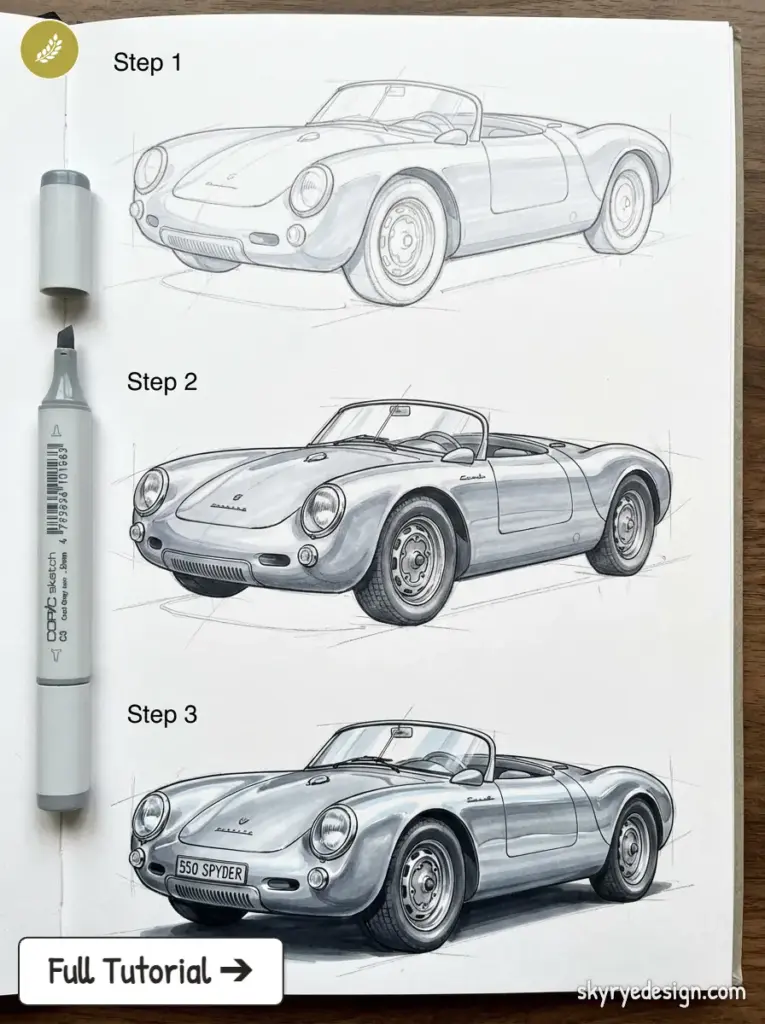
- Design Signature: An ultra-low roadster with a dramatically wide stance, minimal bodywork that reveals rather than conceals the mechanical package beneath, and a form that prioritizes downforce-generating horizontality over aesthetic surface complexity. The 550 is almost pure architecture — structure made visible.
- The Sketching Challenge: Capturing the extreme low stance in three-quarter perspective without the car reading as squashed. The 550 sits genuinely low — the wheel-to-body ratio is dramatically different from a modern car — and students compensate by raising the body height, losing the defining character of the design.
- What It Teaches You: Stance and ground relationship. The 550 teaches you how the distance between the bottom of the body and the ground plane affects a car’s entire visual character — a lesson directly applicable to every ground-effect-influenced modern sports car.
9. Ferrari 250 GTO (1962)
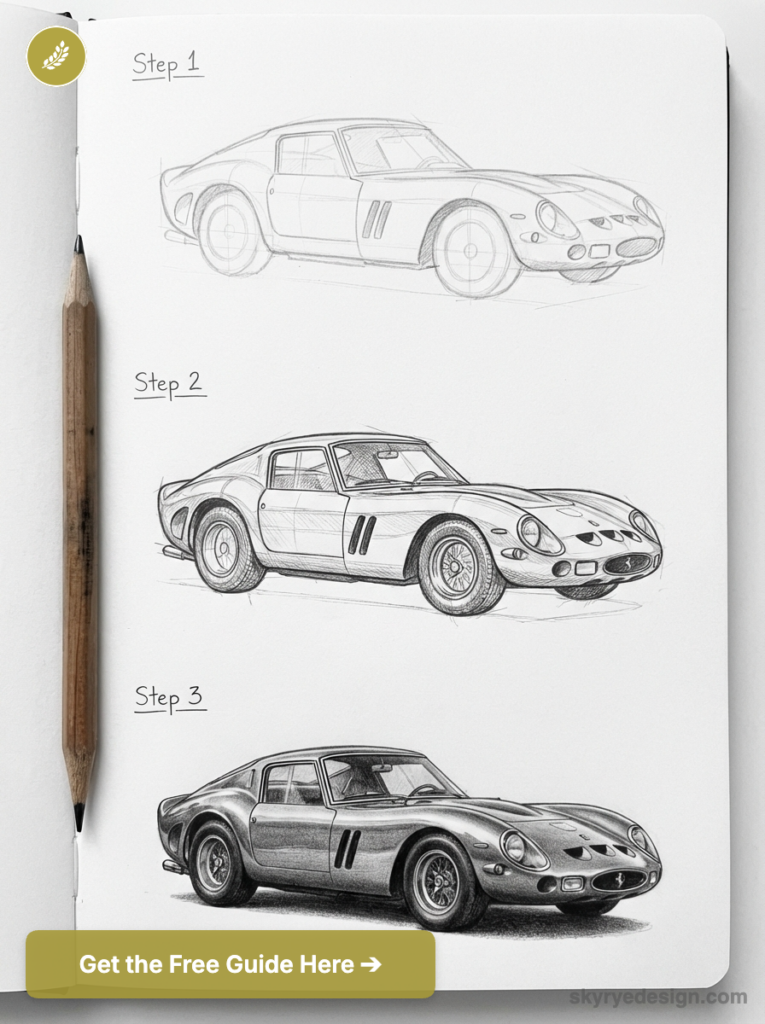
- Design Signature: A body that reads as shaped by airflow rather than styled — the low nose, the arched fenders that swell over each wheel independently, the fastback roofline that drops into a truncated Kamm tail. Each fender is essentially its own sculptural form connected by a relatively narrow body section. Pininfarina’s work here is object design, not surface modeling.
- The Sketching Challenge: The transition from the front fender peak to the door surface. The GTO’s fenders are proud of the body — they stand up and fall away — and the precise shape of that fall determines whether the car reads as muscular or bloated. In three-quarter front view, this transition is the hardest single challenge in the drawing.
- What It Teaches You: Independent volume management — understanding that a complex car body is composed of several distinct volumes (each fender, the body section, the greenhouse) that must each read correctly while also integrating into a coherent whole.
10. AC Cobra 427 (1965)
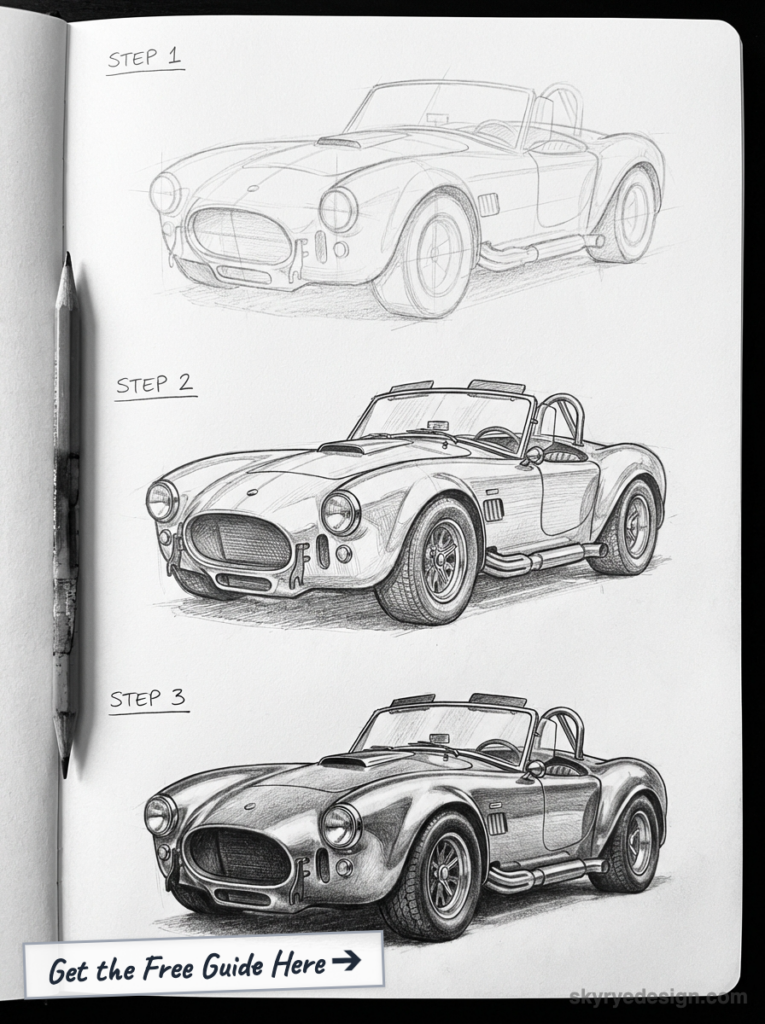
- Design Signature: Massive wheel arch flares bolted over a narrow, curvaceous body — the Cobra is a study in contrast between the aggressive volumetric intrusion of the fenders and the elegant original form beneath them. The flares are almost violent in their scale relative to the body. The long hood, circular headlight pods, and side exhausts create a horizontal reading that emphasizes width over length.
- The Sketching Challenge: Drawing the fender flare in forced perspective — specifically the circular wheel arch opening and how it recedes in three-quarter view while the flare itself projects forward. Students consistently draw this as an ellipse when it should read as a foreshortened circle emerging from the body surface.
- What It Teaches You: Volumetric contrast — how to place two objects of dramatically different scale (slim body, massive flare) in relationship without either dominating incorrectly. This is directly relevant to any modern widebody kit design or custom automotive rendering.
For a Japanese supercar study with a very different design rhythm, add a Lexus LFA drawing to your practice list. It trades the simple wedge for triangular lights, a raised hood spine, and a rear exhaust cluster that rewards slow construction.
Category 3: Muscle Proportions — American Volume and Aggressive Stance (1965–1975)
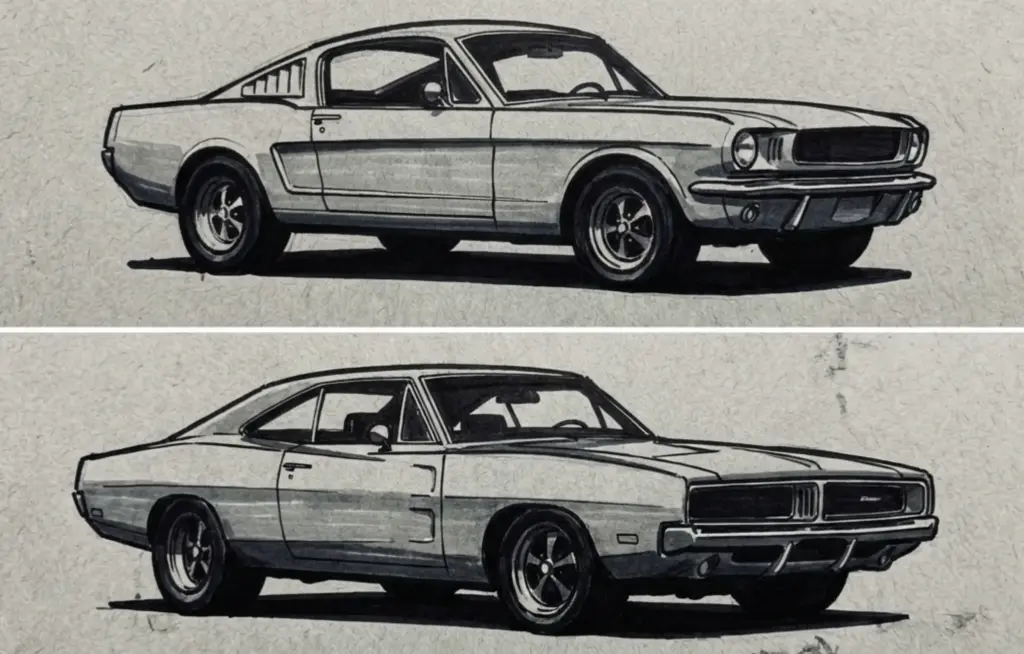
American muscle cars operate on a completely different design logic from European sports cars. Where European design tends toward reduction — the minimum material to enclose the mechanical package elegantly — American muscle design tends toward assertion: the maximum visual presence extracted from the available volume.
These five cars teach proportion through exaggeration. Every dimension is pushed — longer hoods, wider stances, more aggressive rake — and sketching them trains your eye to read and control the most impactful proportion variables in a car design.
11. Ford Mustang Fastback (1965 / 1968)
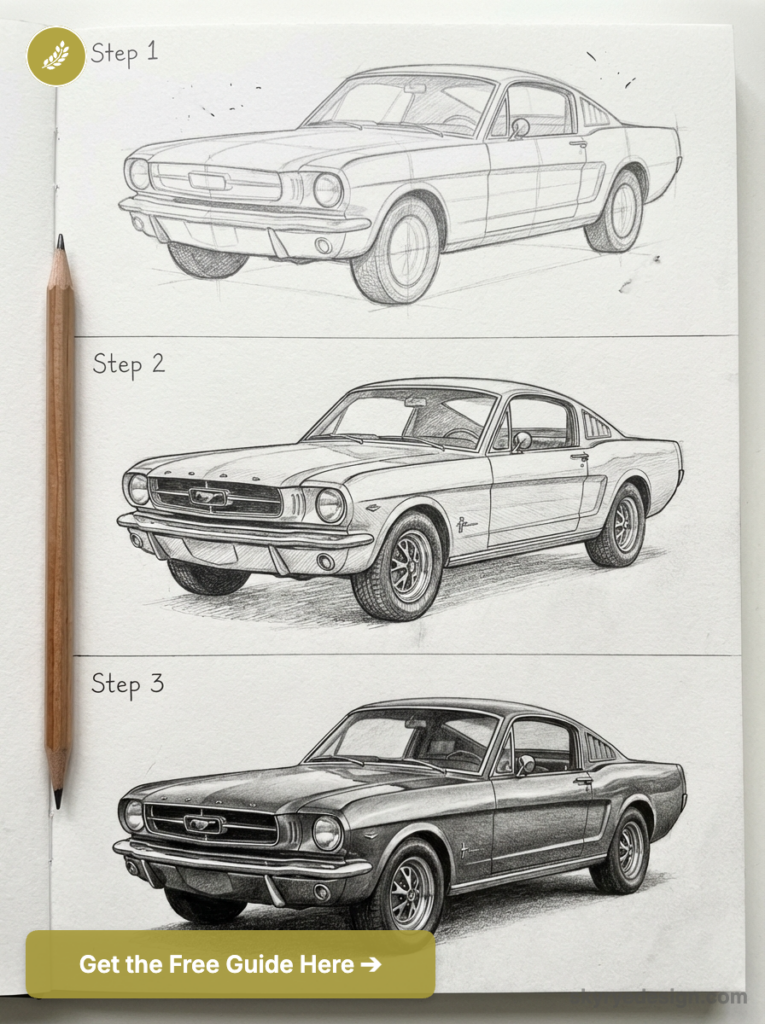
- Design Signature: The archetypal pony car proportion: long hood occupying over 40% of the total body length, short rear deck, aggressive 2+2 fastback roofline that drops steeply into the Kamm-influenced tail. The side profile is almost a single unbroken diagonal from the hood leading edge to the trunk lid — a deliberate expression of forward motion even at rest.
- The Sketching Challenge: The fastback roofline angle and its termination at the rear. The roof-to-rear-deck angle on the ’68 Fastback is extremely specific — too steep and the car looks like a hatchback; too shallow and you lose the signature profile. In three-quarter rear view, getting this angle correct while also establishing the C-pillar perspective is the central challenge.
- What It Teaches You: Roofline proportion control — one of the single most impactful variables in how a sports car reads. The Mustang Fastback makes this lesson impossible to avoid because the roofline is literally the car’s most recognizable feature.
12. Dodge Charger (1969)
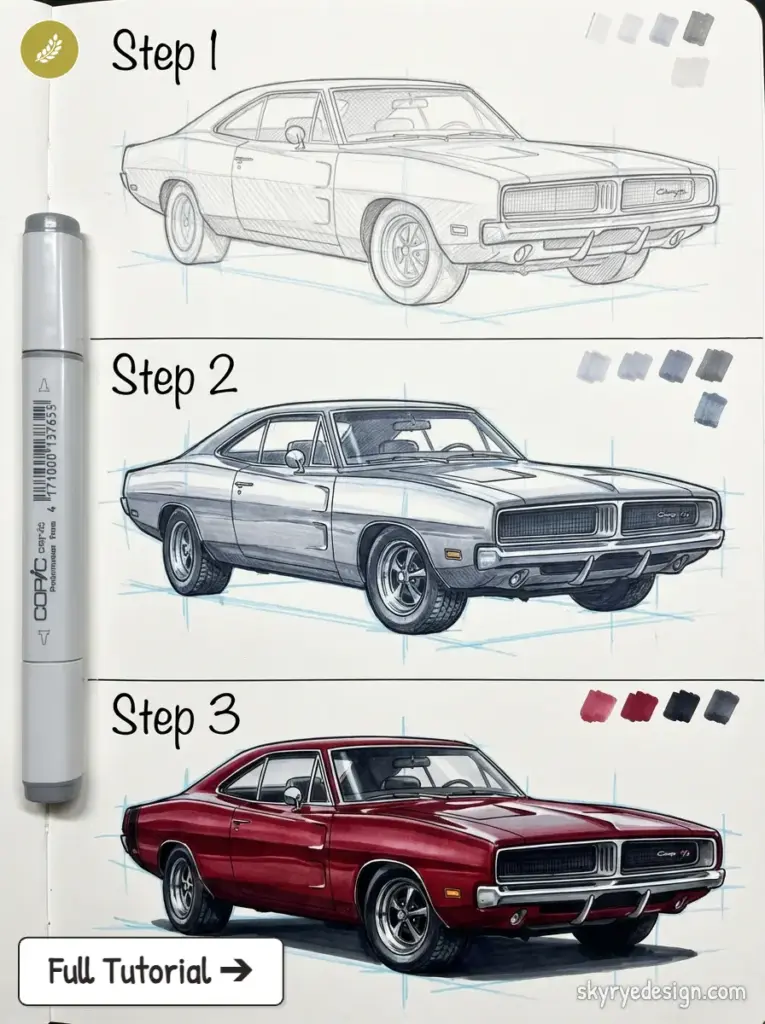
- Design Signature: A full-size fastback with hidden headlights recessed into a full-width concave grille opening, a dramatic recessed rear window, and flying buttress C-pillars that create a floating-roof effect. The Charger’s design language is about horizontal mass — it reads wider and lower than its dimensions actually warrant through a series of careful optical illusions built into the body surfacing.
- The Sketching Challenge: The hidden headlight grille in forced perspective. The concave depression into which the headlights recess is a complex form — curved inward on a surface that is already curved — and getting the perspective of that recession correct while maintaining the correct width-to-height ratio of the grille opening is technically demanding.
- What It Teaches You: Concave form depiction — how to draw a surface that goes away from you rather than toward you. Most sketching teaches convex forms (volumes that project); the Charger grille is an exercise in negative volume, which is a directly transferable skill to drawing air intakes and body sculpting on modern cars.
13. Chevrolet Camaro Z/28 (1969)
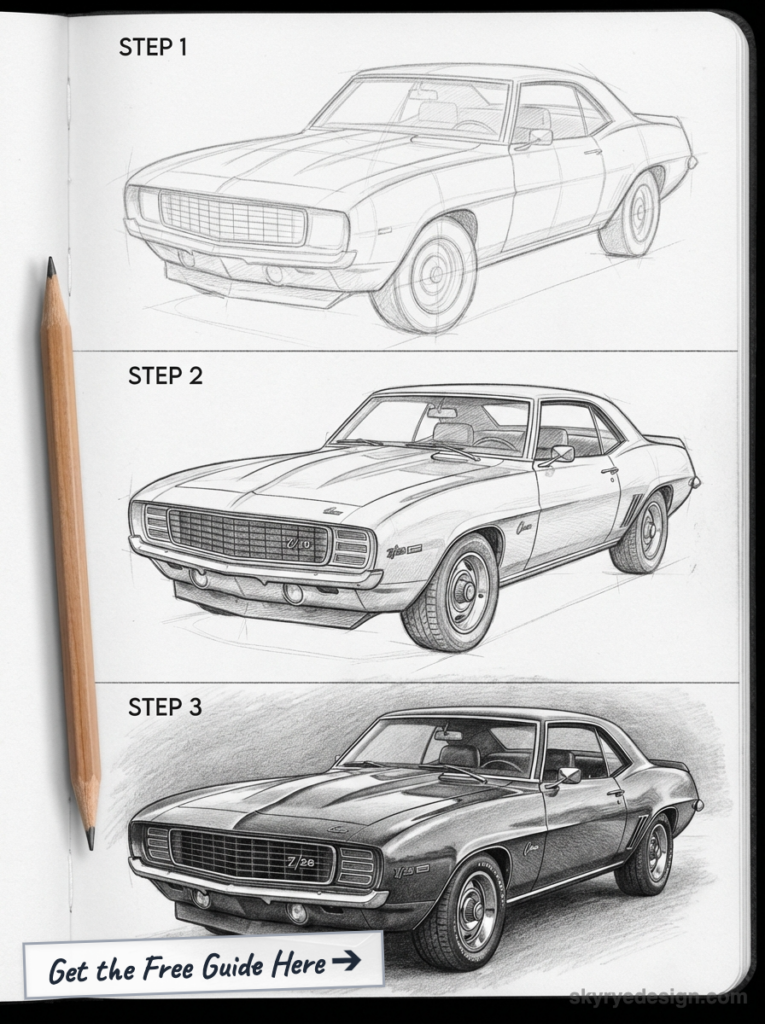
- Design Signature: A narrower, more aggressive interpretation of the pony car formula compared to the Mustang — lower, with a more pronounced shoulder line, a deeper front chin, and a more defined rear haunch. The side surface has a strong convex crown to the door that creates an almost nautical hull-like quality. The Z/28 strip graphics are also a masterclass in using graphic elements to reinforce proportion.
- The Sketching Challenge: The shoulder line and its relationship to the door surface crown. The Camaro’s shoulder line sits at an unusual height — midway between the beltline and the roofline — and the surface above and below it has different curvature character. Capturing this in a sketch requires you to simultaneously manage two different surface transitions.
- What It Teaches You: Feature line placement and its effect on perceived proportion. Where you place a shoulder line or feature crease dramatically changes how wide, low, or aggressive a car reads — the Camaro makes this lesson visible through its particularly deliberate and effective shoulder line position.
14. Pontiac Firebird Trans Am (1977)
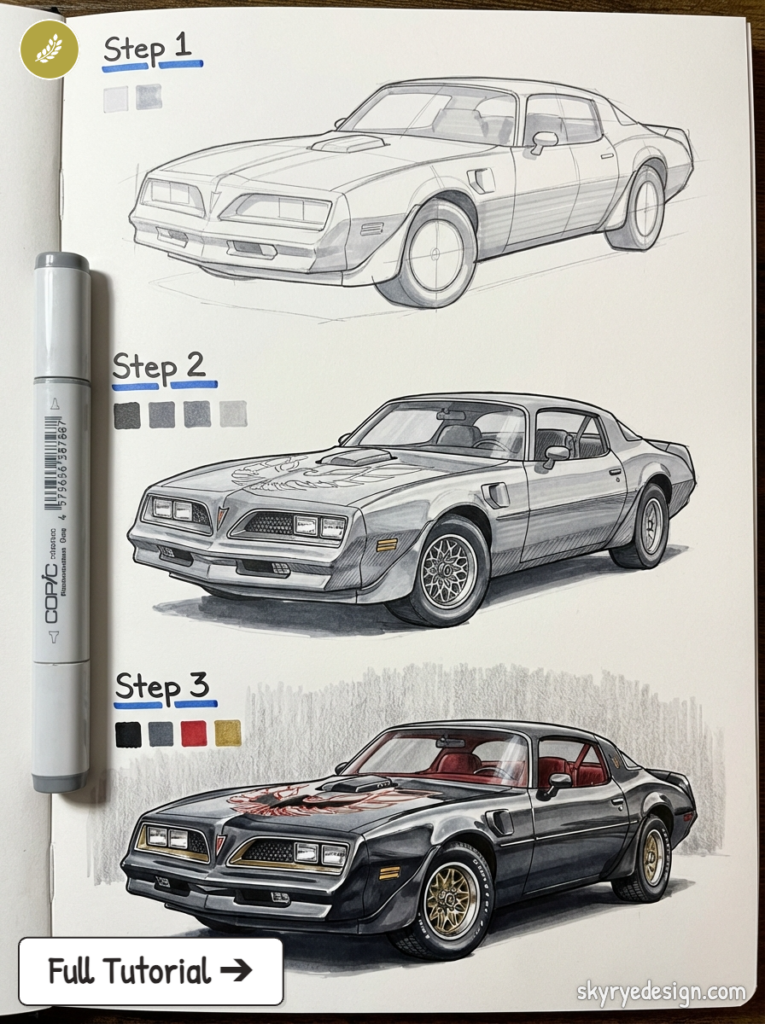
- Design Signature: The second-generation Firebird is pure American graphic design translated into a car body — the split twin-nostril hood, the shaker scoop, the aggressive front air dam, and the iconic Screaming Chicken hood decal (optional). The body itself has a smooth, relatively simple form; the design language is carried almost entirely by graphic and detail elements rather than surface complexity.
- The Sketching Challenge: The twin split-nostril hood from the front three-quarter view. The asymmetrical or symmetrical treatment of the two intake openings, their depth and the shaker scoop center mass, creates a complex perspective challenge when viewed from any angle other than dead-on. Students consistently misread the spatial relationship between the two nostrils.
- What It Teaches You: How graphic elements and details carry design language independent of body form. The Trans Am teaches you that a car can have a relatively simple body surface but project enormous visual aggression through its details — a lesson directly applicable to rendering sports car faces and grille designs.
15. Plymouth Barracuda ‘Cuda (1970)
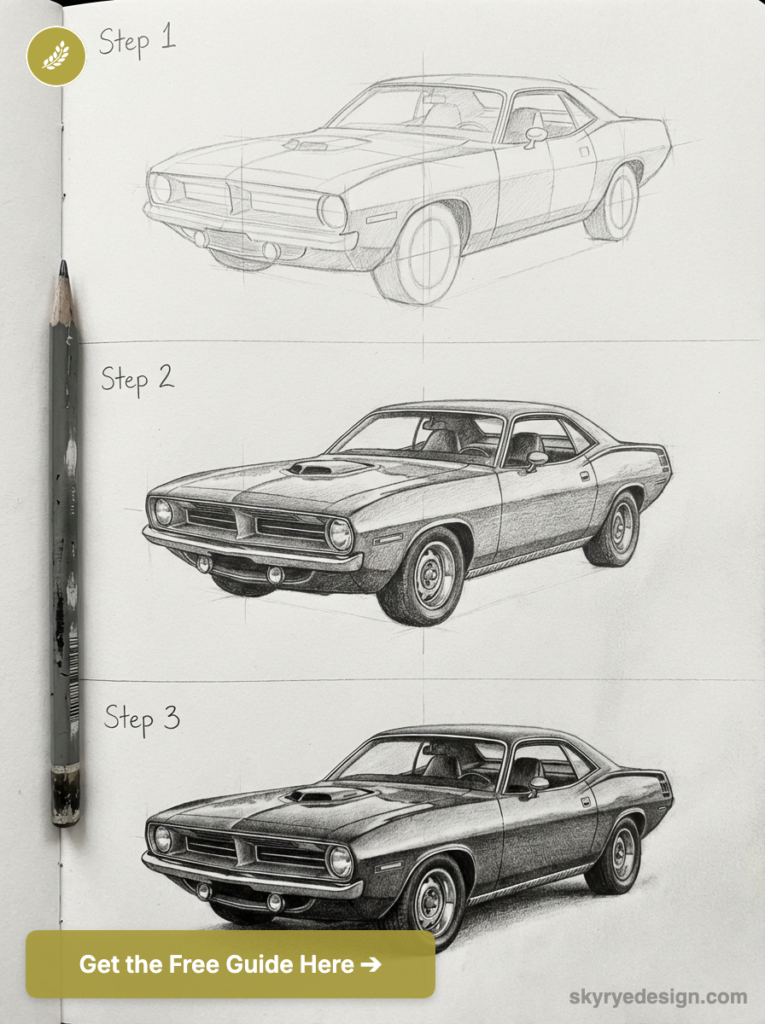
- Design Signature: The most extreme example of the pony car formula pushed to its limits — the ‘Cuda’s rear haunches are enormous relative to its body width, creating a hip-heavy proportion that was unprecedented at the time. The short rear deck, the deeply recessed rear glass, and the shaker hood scoop all contribute to a visual weight bias that’s almost 60/40 rear-heavy in its reading.
- The Sketching Challenge: The rear three-quarter view — the single most important and difficult angle for this car. The way the rear haunches swell out past the body, the depth of the rear glass recess, and the foreshortening of the long hood as it recedes all have to work simultaneously. This is one of the most complex rear three-quarter compositions in American automotive design.
- What It Teaches You: Visual weight distribution in a sketch — how to make a car read as front-heavy, rear-heavy, or balanced by controlling where you apply mass, darkness, and detail. The ‘Cuda is a master class in rear-biased visual weight, which is a concept directly applicable to modern supercar proportion work.
Category 4: Modern Aerodynamics — Parametric Surfaces and Active Design (1990–Present)
Contemporary high-performance sports cars are designed by software as much as by hand — parametric surface modeling, CFD analysis, and structural optimization algorithms generate forms that no designer could fully envision from a sketch alone. But that doesn’t mean they can’t be studied through sketching.
It means the sketching challenge changes: instead of reading organic surface tension or precise geometry, you’re reading surface transitions, light signatures, and the way aerodynamic function generates form. These five cars are the current advanced curriculum.
16. McLaren F1 (1992)
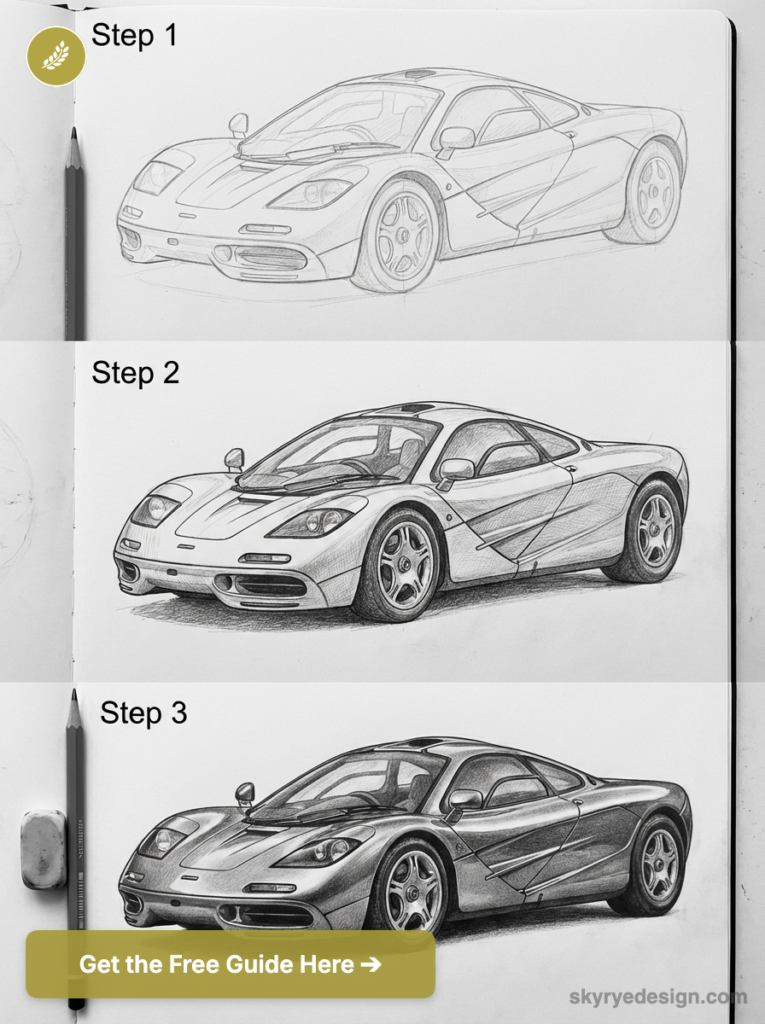
- Design Signature: Gordon Murray and Peter Stevens produced a car with almost no unnecessary surfacing — every curve, every intake, every duct serves a function that then becomes form. The F1’s body reads as minimalist, but the complexity is in the transitions: how the undercar venturi tunnels create the body edge profile, how the central driving position dictates the cockpit’s unusual symmetrical width. It’s engineering legibility as aesthetic.
- The Sketching Challenge: The front three-quarter view, specifically the relationship between the low nose, the swept-back headlight pods, and the way the body surface flows from nose to door. The F1’s front end transitions involve multiple surface changes at close proximity, and students who try to detail these before establishing the overall form end up with a crowded, confusing sketch.
- What It Teaches You: Reading aerodynamic intent in body form — understanding that a surface is not just a visual element but a functional one. This shifts how you approach the sketch from ‘making it look cool’ to ‘understanding why every line is where it is,’ which immediately improves the coherence of your own original designs.
17. Porsche 911 GT3 (992 Generation, 2021)
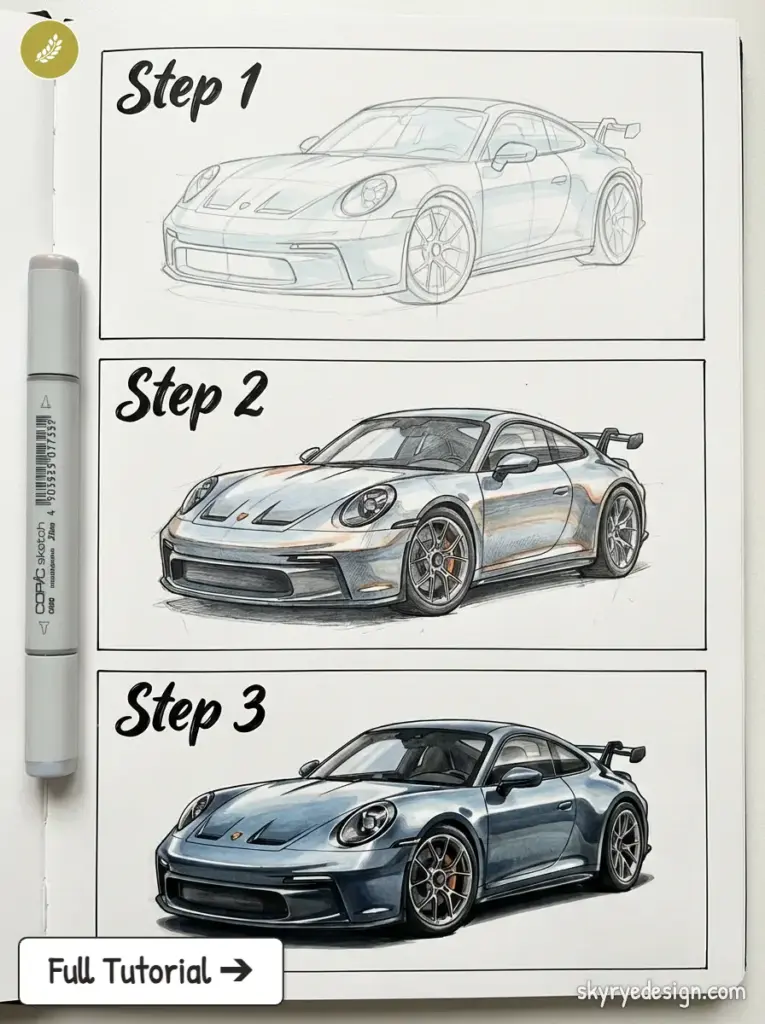
- Design Signature: Seven decades of continuous evolution on a single silhouette — the 992 GT3 is a master class in what happens when a design language is iterated rather than replaced. The iconic rear-engine roofline, the flared rear haunches, the swan-neck rear wing, and the wide-body aero package all coexist with proportions established in 1963. The GT3 body manages to look both ancient and current simultaneously.
- The Sketching Challenge: The rear wing attachment and its relationship to the body surface. Porsche’s official 911 GT3 notes call out the rear wing with swan-neck connection as part of the car’s aerodynamic package, and that is exactly why it is so useful to draw. The wing appears to float above the engine lid, supported by mounts that create their own shadow lines and perspective problems. In three-quarter rear view, it is one of the most technically demanding elements in contemporary sports car sketching.
- What It Teaches You: How design heritage constrains and enables contemporary form. Sketching the 992 forces you to work within a proportion system established 60 years ago while incorporating modern aero and manufacturing language — which is exactly the design brief that professional automotive designers face when working on heritage brands.
18. Lamborghini Huracán (2014)
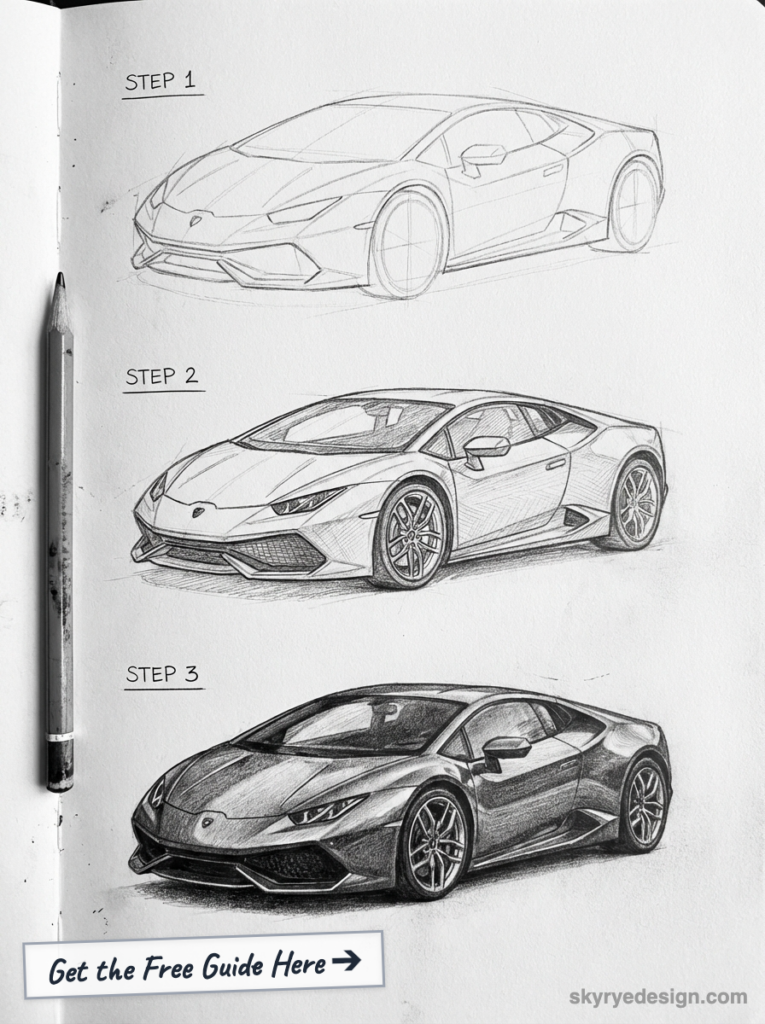
- Design Signature: A synthesis of the Countach’s wedge heritage with contemporary parametric surface modeling — the Huracán uses sharp crease lines and angular surfaces, but in compound-curved forms that the original wedge era couldn’t manufacture. The Y-shaped design motif runs through headlights, air intakes, and interior details. It’s the wedge translated into 21st-century manufacturing vocabulary.
- The Sketching Challenge: The Y-shaped headlight graphic in three-quarter perspective. The DRL and main beam elements form a Y that changes apparent angle dramatically as your viewing position changes — correctly depicting this while also establishing the nose intake below it and the wheel arch beside it is one of the more complex multi-element perspective challenges in modern car drawing.
- What It Teaches You: Graphic element perspective — how a distinctive graphic (a logo shape, a DRL pattern, a grille design) appears to change and distort as viewing angle changes, and how to depict this convincingly. This is a skill directly applicable to any product design that features strong graphic elements on a three-dimensional surface.
19. Ferrari LaFerrari (2013)
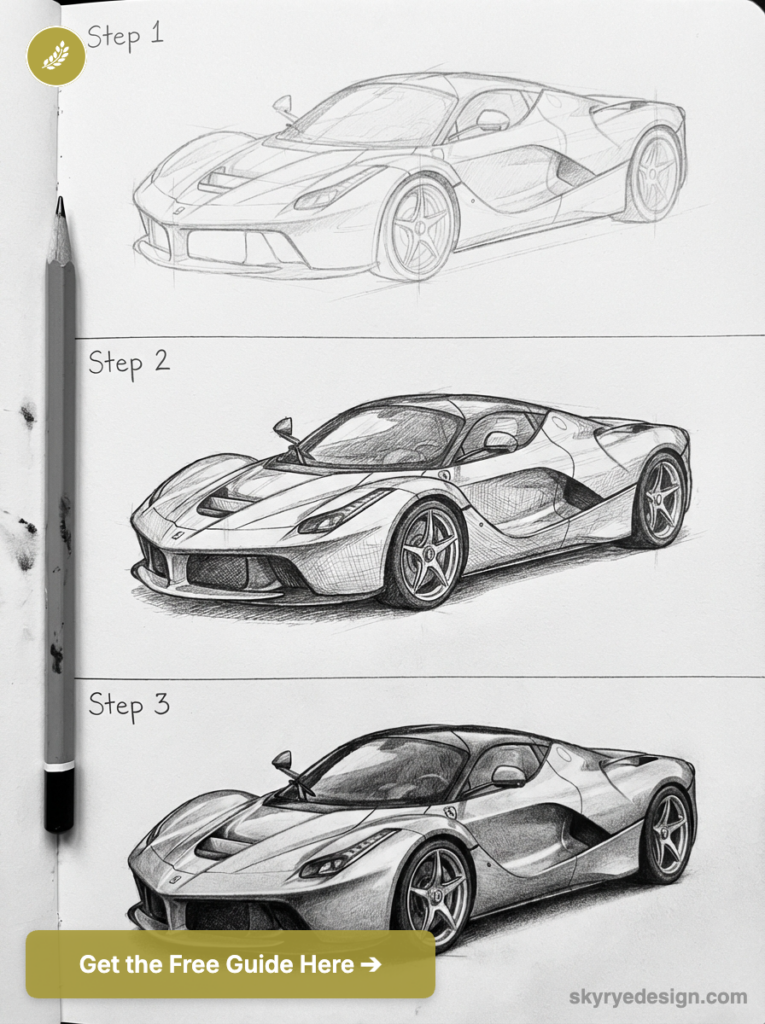
- Design Signature: Pininfarina’s synthesis of active aero, hybrid architecture, and Ferrari’s traditional surface language. The LaFerrari has no flat surfaces, and no purely decorative elements — the side strakes feed air to the rear diffuser, the sculpted hood channels air to the intakes, and the underbody is a structural aerodynamic element. But all of this functional complexity is wrapped in flowing Ferrari surface language rather than the angular aggression of Lamborghini.
- The Sketching Challenge: The side strake complex — the series of vertical blades and ducts behind the front wheel arch that manages airflow to the rear. In three-quarter side view, these overlapping elements create a perspective nightmare: each blade is at a slightly different depth, and the shadow and highlight relationships between them are genuinely complex. Most students either omit them (losing the car’s identity) or render them as a flat pattern (losing their three-dimensionality).
- What It Teaches You: Layered depth rendering — how to depict multiple parallel planes at slightly different depths in a sketch, creating the visual complexity of louvers, strakes, and grille openings that modern sports cars depend on for both function and visual richness.
20. Bugatti Chiron (2016)
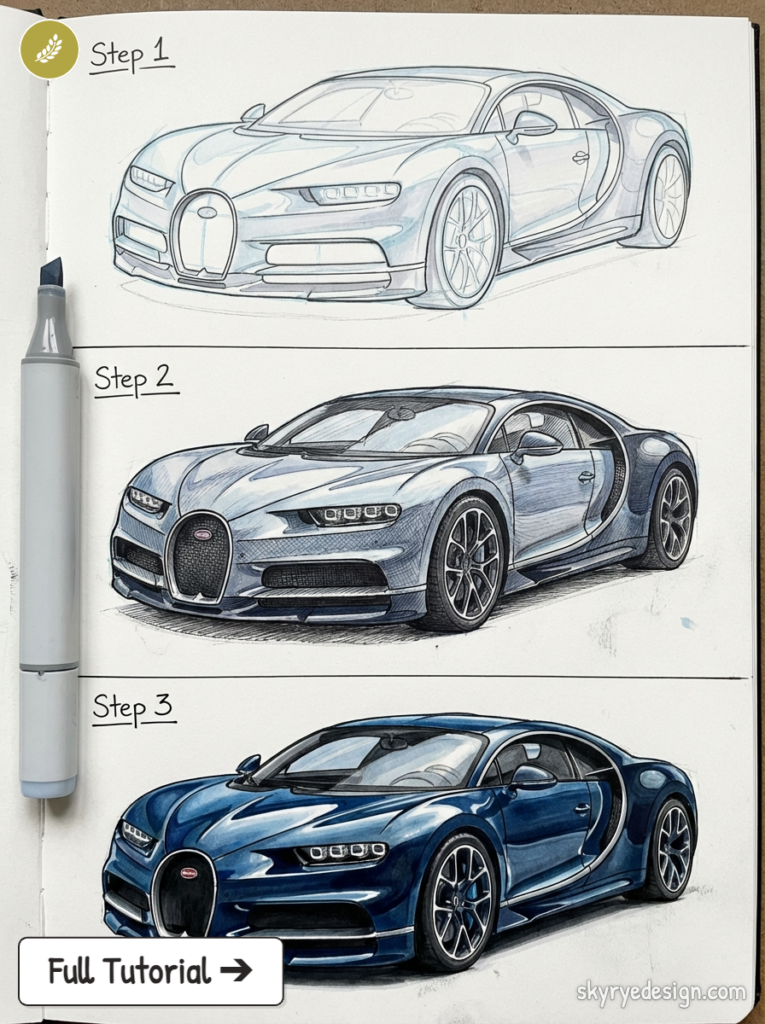
- Design Signature: The Chiron operates at a scale and proportion unlike any other sports car on this list — it’s a large car with a hypercar’s visual aggression, which creates unusual proportion challenges. The iconic C-shaped side intake, the horseshoe grille, and the two-tone body split (dark lower body, light upper) are the design’s primary visual organization tools. It’s a study in how graphic division manages visual mass.
- The Sketching Challenge: The C-line side intake in forced perspective. This is the Chiron’s defining feature — a large, complex intake opening that curves through three dimensions, with its edge forming the car’s primary surface break between upper and lower body. Getting the perspective of this curved opening correct while maintaining the intake’s apparent scale is the central technical challenge of sketching this car.
- What It Teaches You: Using graphic division to manage visual mass — how dividing a large body into two distinct tonal zones (the Chiron’s dark lower / light upper split) can reduce apparent size, add visual tension, and create hierarchy. This is one of the most practical and transferable lessons in this entire list, applicable to any large vehicle design.
Sports cars usually look best from a low three-quarter angle, so basic perspective drawing for car sketches is worth practicing before you chase reflections, vents, and wheel detail.
FAQ: Sketching Iconic Sports Cars
Q: What’s the best car to start with if I’m a complete beginner?
Start with the Lamborghini Countach or the Lotus Esprit S1. Both are built from ruled lines and flat surfaces — there’s no complex curvature to misread, so your errors are purely geometric and therefore easier to identify and correct. The Countach in particular is essentially a perspective exercise in disguise: get your horizon line, get your vanishing points, and the rest follows logic.
Q: What drawing tools should I use for automotive sketching?
For learning proportion and line quality: a 0.5mm mechanical pencil and smooth layout paper. No tools that auto-correct your line for you. For rendering: Copic markers (Cool Grey set plus a couple of accent colours) are the industry standard. Digitally, Procreate on an iPad Pro with a pressure-sensitive stylus replicates marker behaviour well. The tool matters less than the drawing — a great sketch in ballpoint beats a mediocre one in Photoshop every time.
Q: How long should I spend sketching each car before moving on?
Until you can sketch the car’s correct proportion silhouette from memory in under two minutes, from any angle. That’s the benchmark. Not photographic accuracy — proportional accuracy from memory. If you have to check your reference for the basic silhouette, you haven’t internalized the proportion logic yet. The design vocabulary of a car lives in its silhouette and its major surface transitions, not in its badge or its tail-light shape.
Q: Should I start with the side view or the three-quarter view?
Always start with the side view. The side view establishes all the fundamental proportion relationships — hood length to wheelbase, greenhouse height to body height, wheel size to overall height. Once you know a car’s side profile by heart, the three-quarter view is just a perspective projection of something you already understand. Students who start with the three-quarter view are solving two problems simultaneously (proportion and perspective) when they should solve them sequentially.
Q: Which single car on this list teaches the most transferable skills?
The Jaguar E-Type, by some distance. Mastering the E-Type’s long hood surface, its surface tension and tautness, and the way its volumes resolve at the tail gives you the vocabulary to read and sketch any car that prioritizes refined organic surfacing — which includes most premium and luxury cars being designed right now. The E-Type is not the flashiest car on this list. It’s the one that builds the deepest skills.
Q: How do I make my car sketches look less stiff and more dynamic?
Two techniques that work immediately: first, draw through the car — sketch all four wheels even when two are hidden, establish the full wheelbase line before drawing the body. This grounds the car to a surface and gives it weight. Second, use line weight variation deliberately — lightest lines for the surfaces receding from you, heaviest lines for the edges closest to you and the shadow edges underneath the car. Uniform line weight is the single most common reason automotive sketches look flat and stiff.
The Library You’re Building
Every car on this list is a problem statement disguised as a beautiful object. The Countach asks: how do you depict extreme geometry without compass or ruler? The E-Type asks: how do you draw surface tension in pencil? The Huracán asks: how do you place a graphic element correctly on a compound-curved surface in three-quarter perspective?
Work through these in order — wedge, then organic, then muscle, then modern — and you’re building a sketching vocabulary that covers a century of automotive design thinking. If you want a simpler warm-up before the full list, start with this easy car drawing guide and come back when the wheelbase and roofline feel automatic. By the time you’ve genuinely internalized all 20 of these, you won’t be copying cars anymore. You’ll be drawing from a vocabulary of your own.
That’s when the interesting work starts.
For a focused brand study after sports-car silhouettes, try the Mercedes-Benz drawing guide as a follow-up exercise.
Sports cars are easier to sketch when you understand their ancestors, so keep these classic automotive design references nearby for proportion checks.
For more vehicle drawing practice with helicopters, use the step-by-step helicopter guide to study aircraft proportions after you work through the sports-car silhouettes.
If you want to turn the supercar silhouettes into a focused practice session, use this Lamborghini car drawing guide next; it concentrates on wedge stance, wheel spacing, intakes, and the models that make Lamborghini sketches instantly readable.
Add one softer classic to the list with this Volkswagen Bug drawing exercise. It is a good antidote to aggressive sports-car shapes because the silhouette has to carry almost everything.
The same silhouette thinking carries into aviation, so keep these aircraft sketch ideas nearby when you want a break from sports-car forms.
- 38shares
- Facebook0
- Pinterest38
- Twitter0
- Reddit0