

A roofing contractor I worked with had been in business for fourteen years. He had a solid reputation, consistent referrals, and a truck that was booked three weeks out in summer. He also had a website that had not been updated since 2019 and a Google Business Profile with zero reviews that he had set up once and forgotten. When I searched his service area for the terms his customers were actually using, his business did not appear in the first three pages of results.
His main competitor — a company that had been in business for four years — was ranking first in the local pack and second organically for the same searches. When I looked at what that competitor was doing differently, it was not complicated: a complete Google Business Profile with 47 reviews, a website with dedicated service pages for each roofing type, and six locally-focused blog posts published over the previous year. Nothing technically sophisticated. Just consistent, deliberate optimisation that the fourteen-year veteran had never done.
That gap — between a strong business with no digital presence and a newer competitor who had done the basic work — is what roofing SEO services exist to close. This guide covers what roofing SEO actually involves, why each component matters, what realistic timelines and costs look like, and how to evaluate whether your current website is working as hard as your crew.
What Are Roofing SEO Services?
Roofing SEO services are digital marketing strategies designed specifically for roofing contractors. The goal is to improve a roofing website’s position in search engine results so that it appears when homeowners search for roofing services in your service area — not just once, but consistently and without paying for every click.
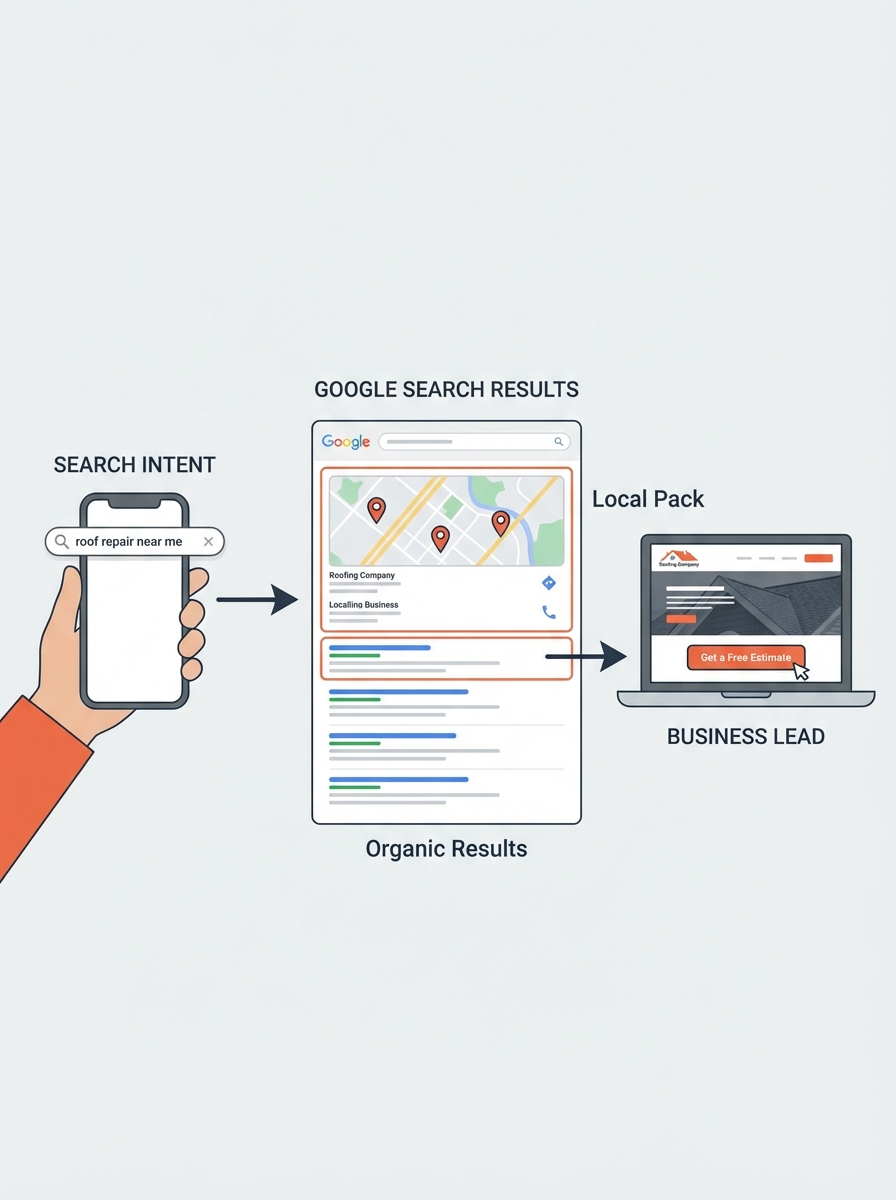
The distinction between SEO and paid advertising is worth being explicit about from the start. When you run Google Ads, you appear at the top of results while the budget is active and disappear the moment it stops. When your website ranks well organically through SEO, the visibility is not tied to a daily spend — it reflects the accumulated quality signals your site has built up over time: relevant content, a trustworthy backlink profile, a fast and mobile-friendly technical foundation, and a strong local presence. That accumulation is an asset that continues working when you are on a jobsite or asleep.
For roofing companies specifically, SEO operates in two overlapping environments. Organic search rankings are the traditional blue links below any ads or map results — earned by creating relevant content and building site authority. Local search rankings — the Google Maps local pack showing three businesses with reviews, photos, and contact details — are often more immediately valuable for local service businesses because they appear above organic results and because the searcher has already indicated location intent. Both matter, and they are optimised through related but distinct tactics.
✏ SEO note: The easiest way to audit your current roofing SEO baseline: open an incognito browser window and search the three terms your customers most commonly use, combined with your city name. Note where your business appears in the organic results and whether it appears in the local pack (the map with three businesses). If a competitor consistently outranks you on these terms, that is the gap your SEO work needs to close.
Why SEO Is Important for Roofing Companies
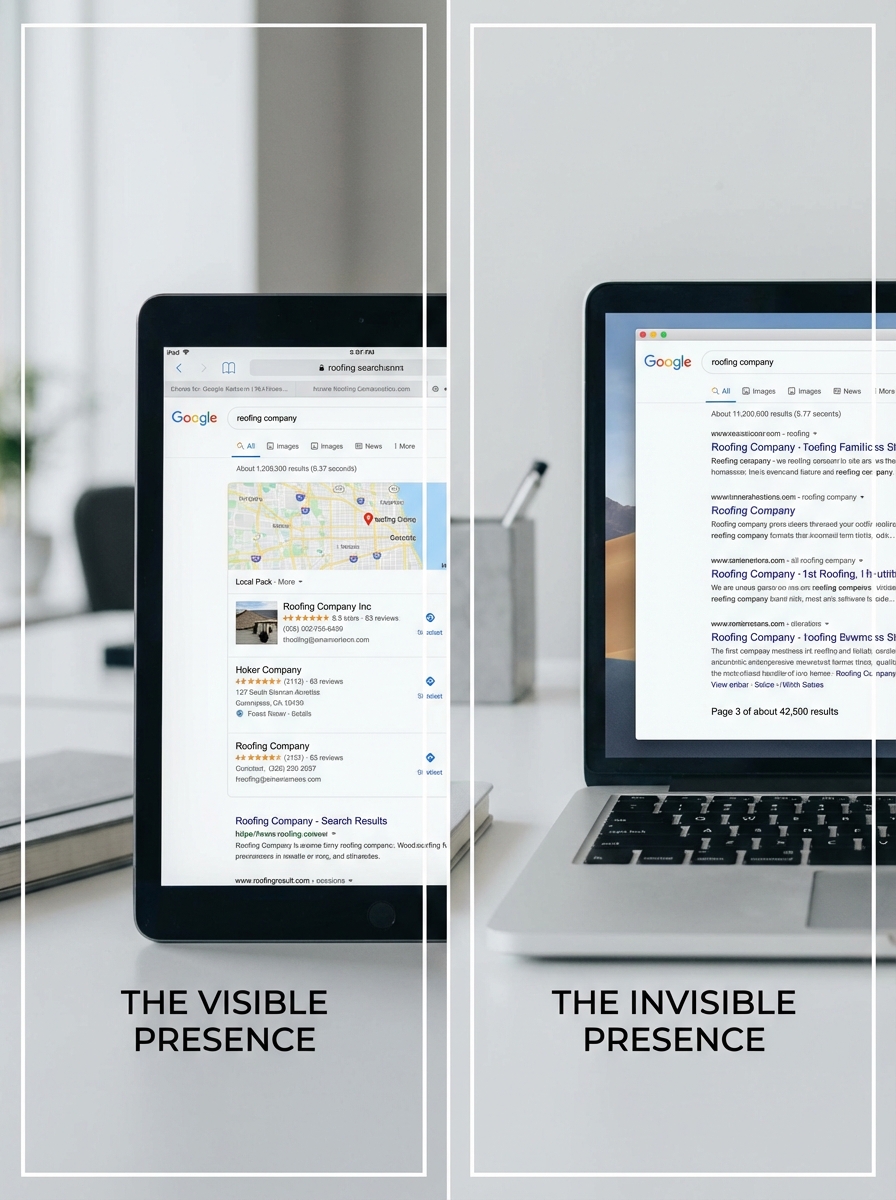
The roofing industry is among the most competitive local service categories in search. In any mid-size metro, there are dozens of contractors competing for the same search terms. Studies consistently show that approximately 75% of searchers never scroll past the first page of Google results, and the top three organic results capture over 50% of all clicks on a given search. If your website is not in that upper tier, the majority of potential customers who are actively searching for exactly what you offer will never see your business.
The Compound Effect of Long-Term Rankings
Unlike paid advertising, where the cost per lead remains roughly constant because you pay for every click, SEO produces a compounding return over time. A roofing website that ranks on the first page for 15-20 relevant local keywords generates leads continuously, and the cost of maintaining those rankings is significantly lower than the cost of acquiring equivalent traffic through Google Ads. Industry benchmarks suggest average cost-per-click for roofing keywords runs $15-$50 depending on market competitiveness — organic rankings produce the same traffic at zero marginal cost per click once established.
Trust and First Impression
There is a well-documented psychological effect in search behavior: users attribute higher credibility to businesses that appear at the top of search results. A top organic or local pack ranking functions as an implicit endorsement — the homeowner reasons, consciously or not, that if Google shows this business first, it must be reputable. Reviews visible in the local pack reinforce this: 47 five-star reviews next to your listing in the search results establishes trust before the homeowner has read a single word of your website.
Seasonal Demand and Storm Events
Roofing search demand is highly seasonal and event-driven. After a hailstorm or major wind event, search volume for emergency roofing, storm damage repair, and insurance claims help spikes dramatically — sometimes by 300-500% in the affected area within 24-48 hours. A roofing company with established first-page rankings for these terms captures that surge without spending anything additional. A company relying solely on paid advertising must rapidly increase ad spend and bid on newly competitive terms, often at dramatically higher cost-per-click during exactly the events that represent the highest revenue opportunity.
Key Elements of Roofing SEO Services
Effective roofing SEO is not a single tactic — it is a coordinated system of components that each address a different aspect of how search engines evaluate and rank a website. Understanding what each element does helps you evaluate whether your current SEO provider is doing the work, and where the biggest gaps are if you are starting from scratch.
Keyword Research and Optimisation
What it is: The process of identifying the specific search terms homeowners use when looking for roofing services in your area, then optimising your website content to match those terms
How it works: Keyword research tools analyse search volume, competition level, and searcher intent for hundreds of potential roofing terms. The most valuable targets are typically local service keywords (roof repair Austin TX), material-specific keywords (metal roofing contractor), and problem-based keywords (leaking roof emergency repair). These keywords are then integrated into page titles, headings, body content, meta descriptions, and image alt text
Why it matters: Search engines cannot guess what your business does — the keywords on your pages are the primary signal that tells Google which searches your website is relevant for. Without deliberate keyword optimisation, your website may rank for your business name but not for the service terms that generate new customer enquiries
Local SEO and Google Business Profile
What it is: The set of practices that improve a roofing company’s visibility in location-based searches, particularly the Google Maps local pack that appears at the top of local service searches
How it works: Local SEO involves optimising and actively managing your Google Business Profile (adding photos, responding to reviews, posting service updates, listing all services and service areas), building consistent business listings across local directories, earning local citations, and ensuring your website content references your specific service area cities and suburbs
Why it matters: For most roofing companies, the local pack — the map with three business listings at the top of search results — generates more calls and form fills than any other search result position. A homeowner searching for roof repair in your city sees your reviews, your phone number, and your photos before they visit any website. Local SEO is the fastest path to measurable lead generation for a roofing business
Website Technical Optimisation
What it is: Improvements to the underlying technical performance of a roofing website that affect how search engines crawl and index it, and how quickly it loads for visitors
How it works: Technical optimisation addresses: page speed (Google uses Core Web Vitals as ranking signals, and slow sites are penalised in rankings and lose visitors before they convert), mobile responsiveness (over 60% of roofing searches are made on mobile devices), site structure and internal linking, SSL security certificate, and crawlability — ensuring search engines can access and understand all relevant pages
Why it matters: A technically strong website provides the foundation that content and local SEO efforts build on. A site that loads slowly on mobile, has broken links, or has pages that search engines cannot crawl will underperform its content quality — technical problems cap the ceiling of what other SEO work can achieve
Content Marketing
What it is: The creation of high-quality pages and blog posts that answer questions homeowners have about roofing, targeted to search terms in the research and awareness phase of the buying journey
How it works: Service pages cover each specific roofing service in enough depth to be useful and to rank for service-specific keywords. Blog posts target informational queries: how long do asphalt shingles last, signs your roof needs replacing, how to file a roof insurance claim, metal roofing vs tile roofing. This content is researched for search demand, written at a quality level that builds trust with potential clients, and formatted to rank
Why it matters: Content marketing reaches homeowners before they are ready to call a contractor — during the research phase when they are gathering information. A roofing company that consistently appears in those research searches builds brand awareness and trust that translates to preference when the homeowner is ready to make a call. It also earns inbound links from relevant websites, which is one of the strongest signals for improving domain authority and overall rankings
✏ SEO note: The single highest-ROI local SEO action for most roofing companies that have not done it yet: request reviews from your last 20 satisfied customers. A personalised text message with a direct link to your Google Business Profile review page converts at 15-25% — meaning five to eight new reviews from 20 messages sent. Forty genuine five-star reviews on a Google Business Profile represent a local pack ranking advantage that takes competitors months to overcome.
What Roofing SEO Results Actually Look Like

One of the most common frustrations with SEO is that results are slow to appear and difficult to attribute directly to specific work. Setting accurate expectations for roofing SEO outcomes prevents both impatience and the premature abandonment of work that is already producing results.
Timeline: What to Expect and When
- Weeks 1-4: Technical fixes, Google Business Profile optimisation, and local citation building. Some local pack ranking movement may appear within this period. Organic rankings show minimal change.
- Months 2-3: Google begins recognising new and improved content. Long-tail keyword rankings start appearing. Local pack position stabilises or improves. First measurable increase in organic traffic for lower-competition terms.
- Months 4-6: Core service keyword rankings begin improving for moderate-competition terms. Review accumulation (if actively pursued) starts producing local pack advantages. Organic traffic increase measurable against baseline.
- Months 6-12: First-page rankings for primary service keywords in moderate markets. Compound traffic growth as multiple keywords contribute. Cost per lead from organic significantly lower than paid advertising equivalent.
How to Measure Whether SEO Is Working
- Google Search Console: shows which search terms are generating impressions and clicks, and how your average position is trending. Free, accurate, and directly from Google.
- Google Business Profile Insights: shows how many times your listing appeared in search and Maps, how many people called directly from the listing, and how many requested directions.
- Call tracking: a tracked phone number on your website (separate from your main business number) allows you to attribute inbound calls directly to website traffic.
- Lead form submissions: all contact form submissions should be tracked in Google Analytics with the referral source recorded, so you can see what percentage came from organic search.
Making the Investment Case for Roofing SEO
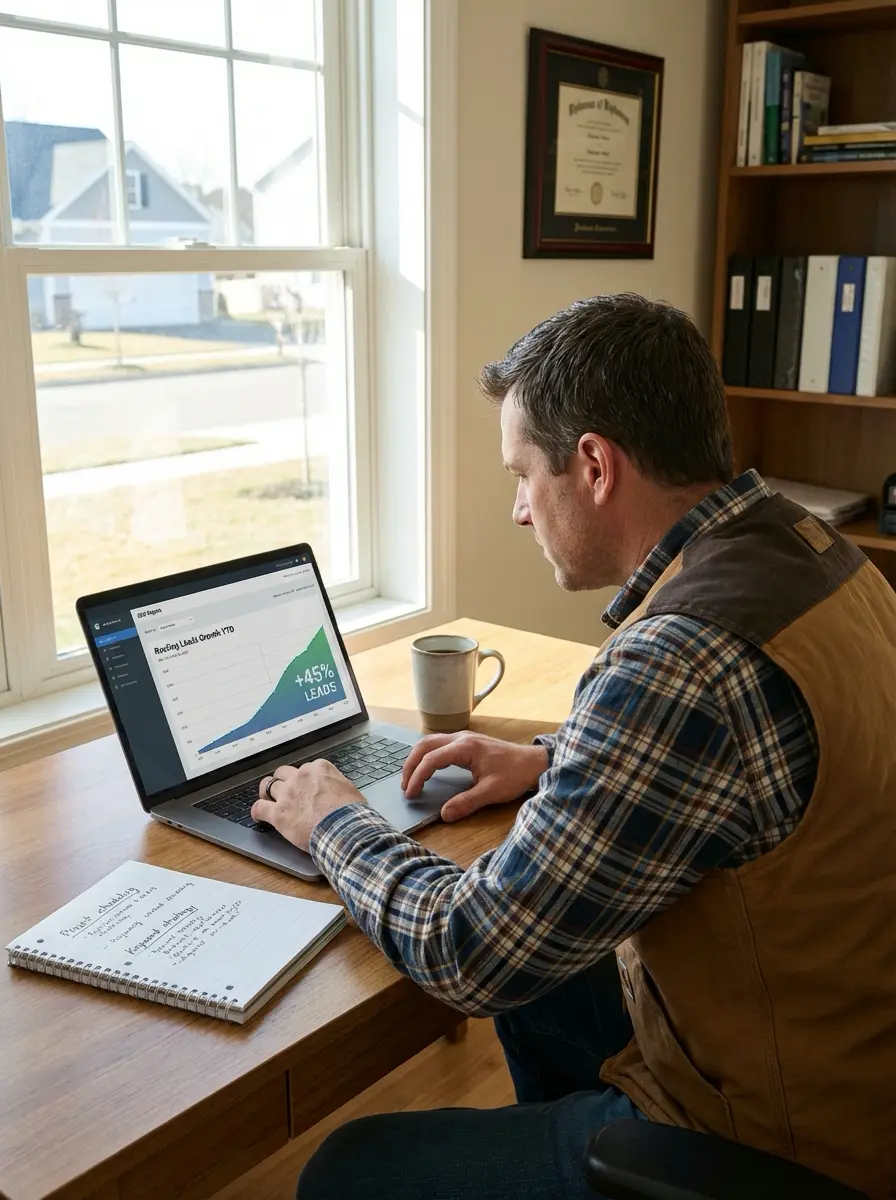
The fourteen-year contractor I mentioned at the start of this guide took six months to close the gap with his four-year competitor. Not completely — the competitor still had a lead on review count — but enough that he appeared in the local pack consistently for his three highest-value service terms, his organic rankings moved from page four to the bottom of page one, and his inbound enquiry volume from search increased measurably.
None of the work was sophisticated. Updated service pages with locally relevant content. A Google Business Profile that was actively managed with weekly photos and prompt review responses. Six blog posts targeting the questions his customers asked on every first call. A website that loaded in under two seconds on mobile. The gap between his previous digital presence and a competitive one was not technical complexity — it was consistency applied over time.
Roofing SEO services are not a marketing expense in the way that a billboard or a Google Ads campaign is an expense. They are an investment in an asset — a website that ranks and generates leads — that appreciates over time and produces leads at a cost-per-acquisition that drops as the asset matures. A roofing company that has established first-page rankings for its core service terms in its market has a competitive position that a competitor cannot buy overnight. That position is the goal of every roofing SEO campaign, and it is available to any contractor willing to do the consistent work to reach it.
FAQ: Roofing SEO Services
Q: How long does roofing SEO take to show results?
Local keyword improvements: 3-6 months in moderate markets, 6-12 months in competitive metros. Google Business Profile and local citation work can show movement in 4-8 weeks. Timeline depends on baseline site quality, market competitiveness, and consistency of SEO work applied.
Q: What keywords should a roofing company target?
Three categories: service-specific (roof repair + city name), material-specific (metal roofing contractor, asphalt shingles), and problem-based (leaking roof repair, storm damage). Long-tail local phrases convert at higher rates and rank faster than short generic terms — prioritise these before competing for single-word broad terms.
Q: What is local SEO for roofing companies?
Practices that improve visibility in the Google Maps local pack — the three-business block at the top of local search results showing reviews, photos, and contact info. Core components: complete Google Business Profile, consistent directory listings, local content on the website, and active review acquisition. The local pack generates more calls than any other search position for most roofing companies.
Q: How much do roofing SEO services cost?
$500-$1,500/month for single-area local SEO. $2,000-$5,000/month for multi-location or highly competitive markets. Cost per lead from organic typically drops well below paid advertising once rankings are established — organic traffic has no per-click cost once earned.
Q: Does a roofing company need a blog for SEO?
Not mandatory, but significantly advantageous. Blog posts capture informational searches during the homeowner research phase (how long do shingles last, signs of roof damage), build brand awareness before the customer is ready to call, and earn inbound links that improve domain authority — one of the strongest long-term ranking signals available.
- 0shares
- Facebook0
- Pinterest0
- Twitter0
- Reddit0