My first encounter with a great pinup tattoo was not in a tattoo studio. It was on a building site in Glasgow in 2004, on the forearm of a plasterer named Dougie who had spent twenty minutes explaining to me, with genuine expertise, why the Gil Elvgren painting on his arm was technically superior to the Vargas girls his colleague had on his bicep. ‘Elvgren understood anatomy,’ he said, not breaking rhythm with his trowel. ‘Vargas was more decorative. Beautiful, but decorative. Elvgren’s girls look like they could actually stand up.’
- What Is a Pinup Tattoo? The Definition
- The History of Pinup Art and How It Became Tattooed
- Five Pinup Tattoo Styles: Which Is Right for You
- The Anatomy of a Pinup Tattoo: Design Elements Worth Understanding
- Placement Guide: Where Pinup Tattoos Work Best
- How to Choose the Right Artist for a Pinup Tattoo
- How Pinup Tattoos Age and How to Keep Them Looking Right
- FAQ: Pinup Tattoos
I thought about that conversation for years afterward, because Dougie was right in a way that took me a while to fully articulate. The pinup tattoo — at its best — is not simply a picture of an attractive person. It’s a figure study with a graphic design logic: a human form rendered in a specific illustrative tradition, with bold outlines, saturated colour, stylised shading, and a carefully composed pose that communicates personality and narrative simultaneously. It’s one of the most technically demanding subjects in traditional tattooing, and one of the most consistently popular across eight decades of modern tattoo culture.
This guide covers everything worth knowing before you get one: what a pinup tattoo actually is and where it comes from, the five main style variations and what distinguishes them from each other, how placement affects both the design and how it ages, what to look for when choosing an artist, and the specific questions that will make your consultation more productive. Whether you’re certain you want a pinup tattoo or still figuring out whether it’s the right choice, the detail here is specific enough to be useful.
What Is a Pinup Tattoo? The Definition
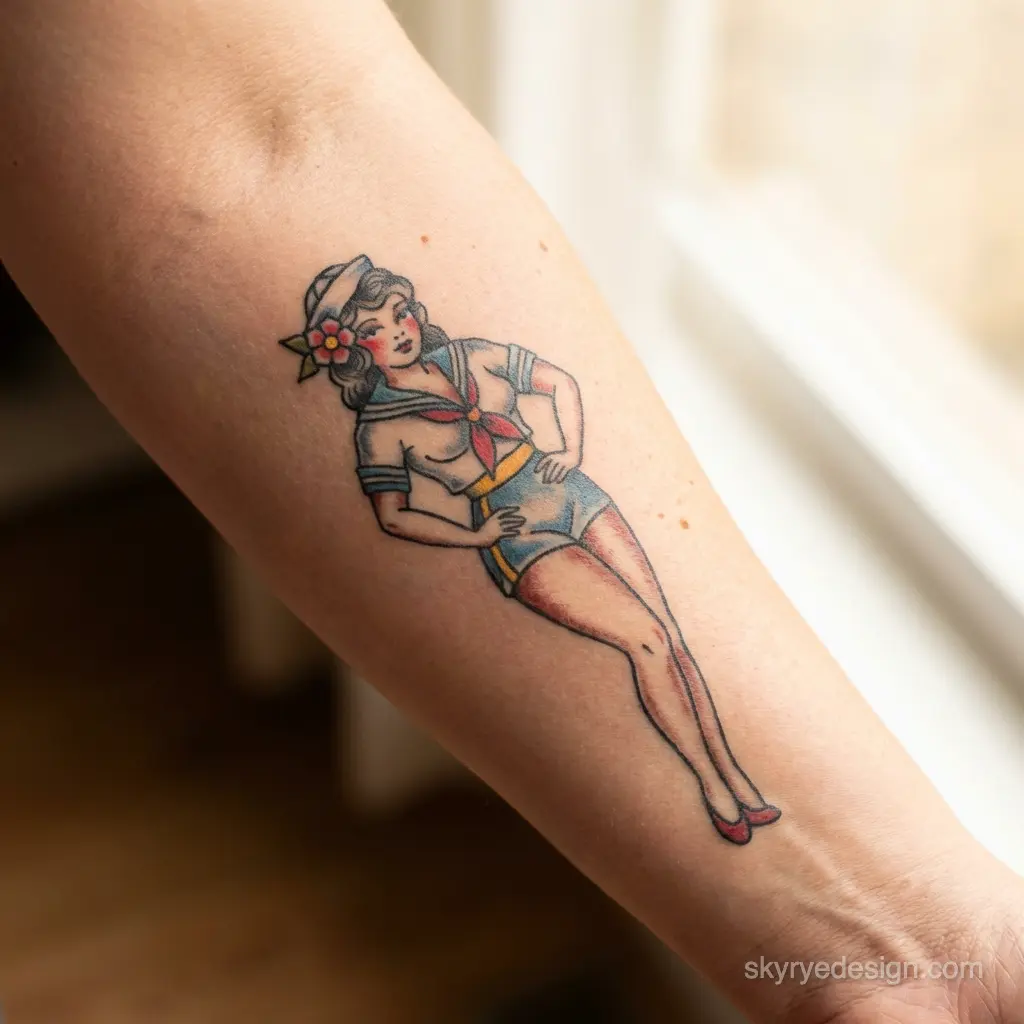
A pinup tattoo is a figure-based tattoo depicting a stylised person — historically female, increasingly gender-diverse — in a posed, confident, and aesthetically idealised way, drawn in the graphic style of mid-20th century commercial illustration. The term ‘pinup’ derives from the practice of pinning printed photographs and illustrations to walls — the images were designed to be displayed, which shaped their compositional logic: clear subject, legible from a distance, immediately attractive, with enough personality to reward closer examination.
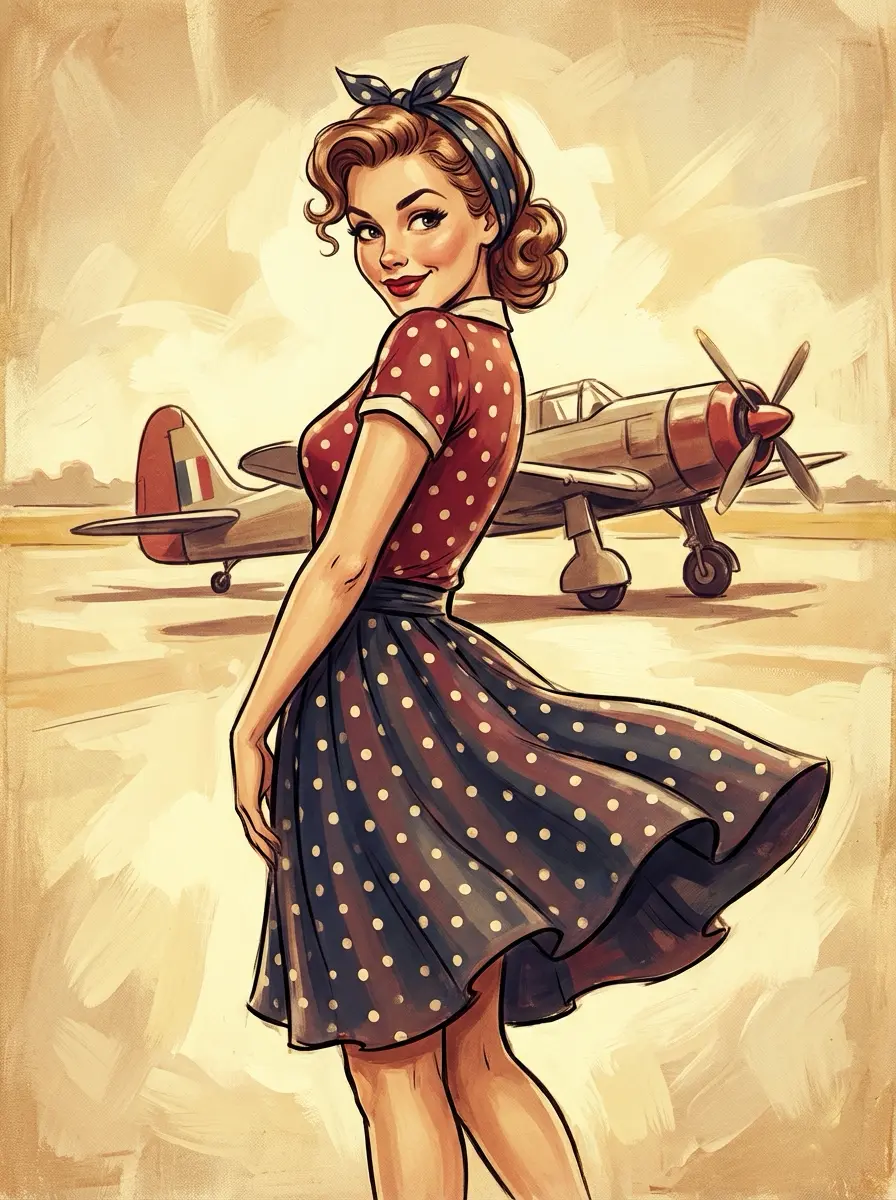
What defines a pinup tattoo as a distinct category is not just the subject matter but the specific graphic language used to depict it. Bold, confident outlines define the silhouette. Colour is applied in relatively flat, saturated areas rather than complex photorealistic gradients. Shading is stylised — suggesting form and volume without attempting to replicate the full tonal range of a photograph. Proportions are idealized but internally consistent — longer legs, smaller waists, larger eyes, but all in deliberate graphic relationship to each other rather than anatomically distorted.
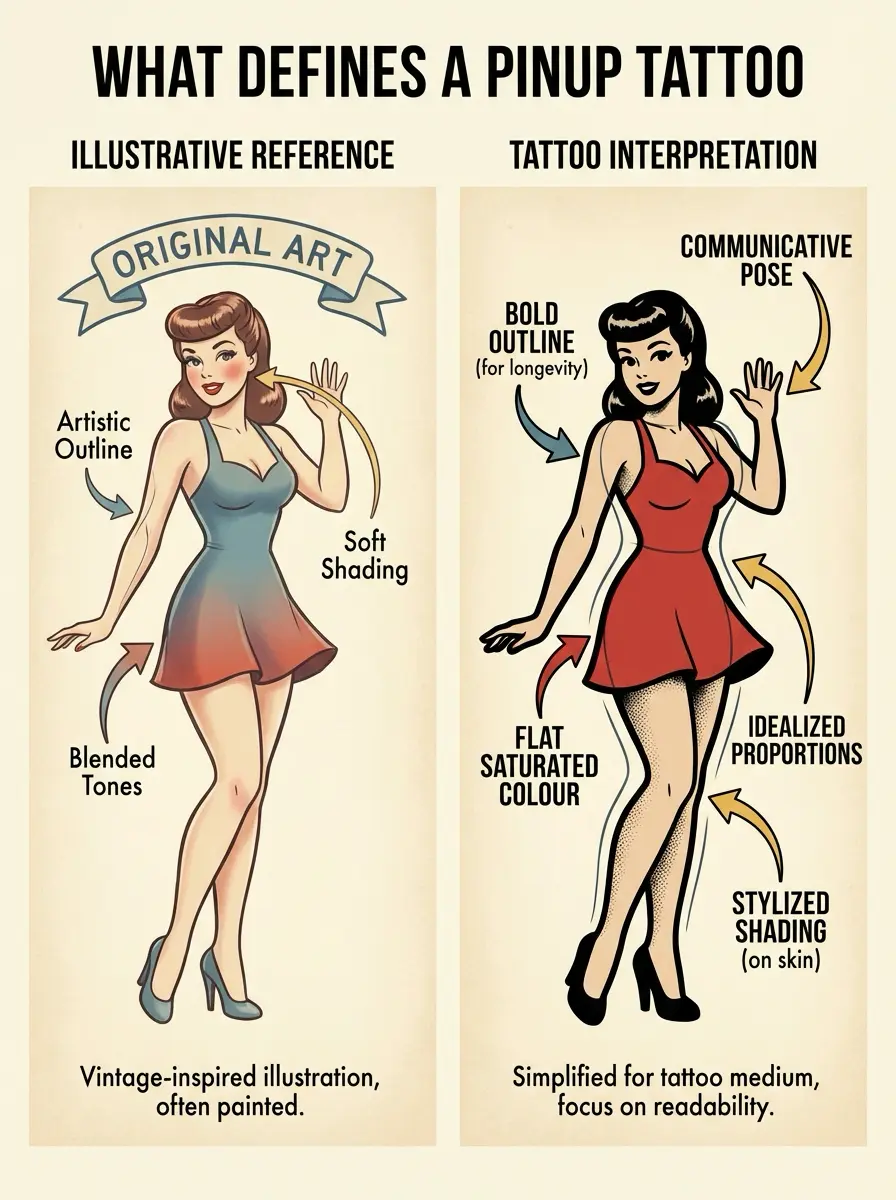
The pose is the pinup’s primary means of communication. Unlike a portrait, which captures a specific person’s likeness, a pinup communicates character through body language: a glance over the shoulder, a skirt caught by wind, a hand adjusting a stocking, a playful expression. These poses are drawn from the tradition of commercial illustration rather than fine art figure drawing, which gives them their particular quality of confident accessibility — approachable rather than aloof, vivid rather than subtle.
The History of Pinup Art and How It Became Tattooed
The Golden Age of Pinup Illustration: 1940s–1960s
The pinup as a cultural form reached its peak during the Second World War, when printed illustrations of idealised women became ubiquitous in American military culture — on aircraft nose art, in magazines like Esquire, on calendar posters, and in the pin-up photographs soldiers carried. The artists who defined the visual language of this era were working commercial illustrators, and their work had specific graphic qualities designed for print reproduction: strong outlines that survived the printing process, limited colour palettes that could be accurately reproduced, and compositions that read clearly at small scale
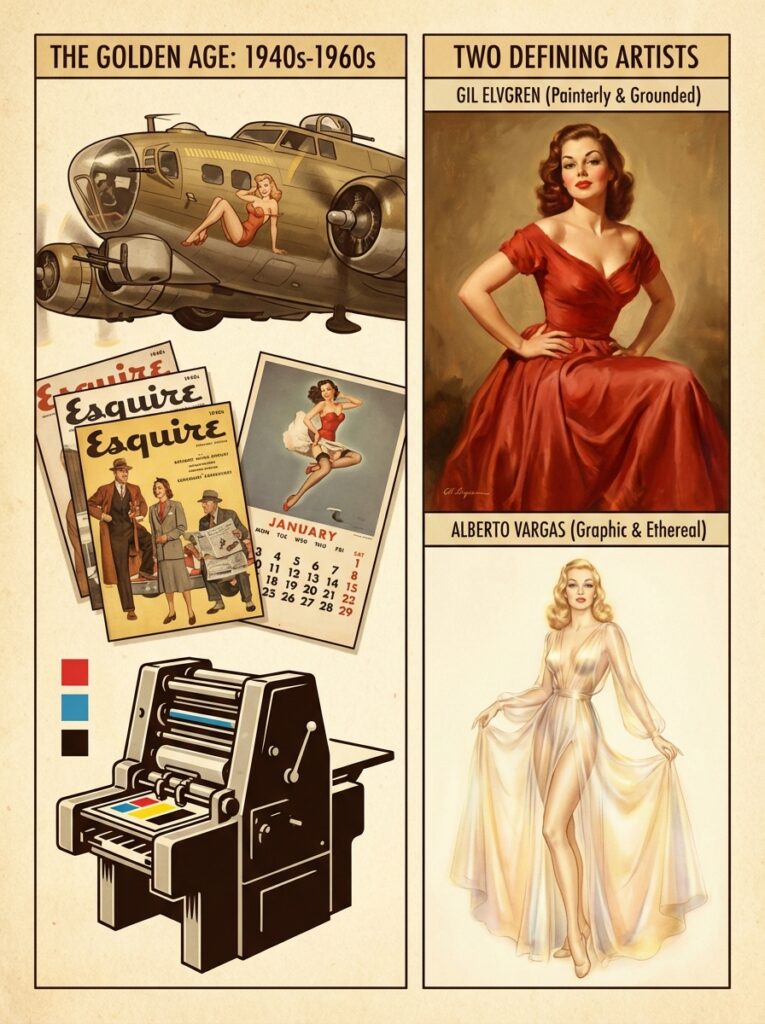
Two artists above all others defined what a pinup looked like. Gil Elvgren (1914-1980) produced over 500 oil paintings for calendar publication over four decades, notable for their technical sophistication — Elvgren trained in fine art, and his understanding of anatomy, lighting, and fabric behaviour gave his figures a quality of physical presence that distinguished them from lesser illustrators. His figures look like they have weight and warmth. Alberto Vargas (1896-1982) worked primarily in airbrush and watercolour, developing a signature style of elongated, luminous figures that became synonymous with Esquire magazine’s ‘Varga Girls’ in the 1940s. Where Elvgren was painterly and grounded, Vargas was graphic and ethereal — the contrast Dougie identified on that Glasgow building site.
From Illustration to Skin: The Tattoo Tradition
Pinup figures were entering the tattoo tradition at roughly the same time they were defining visual culture more broadly. Sailor Jerry Collins (Norman Collins, 1911-1973) — the most influential American traditional tattoo artist of the 20th century — incorporated pinup figures into his flash sheets alongside anchors, eagles, and ships. His pinups drew from the same illustrative tradition as Elvgren and Vargas but adapted the forms to the specific constraints of tattooing: bolder outlines to survive skin aging, simpler colour palettes manageable with the limited pigments of the era, and more graphic compositions that read clearly at small scale on the body
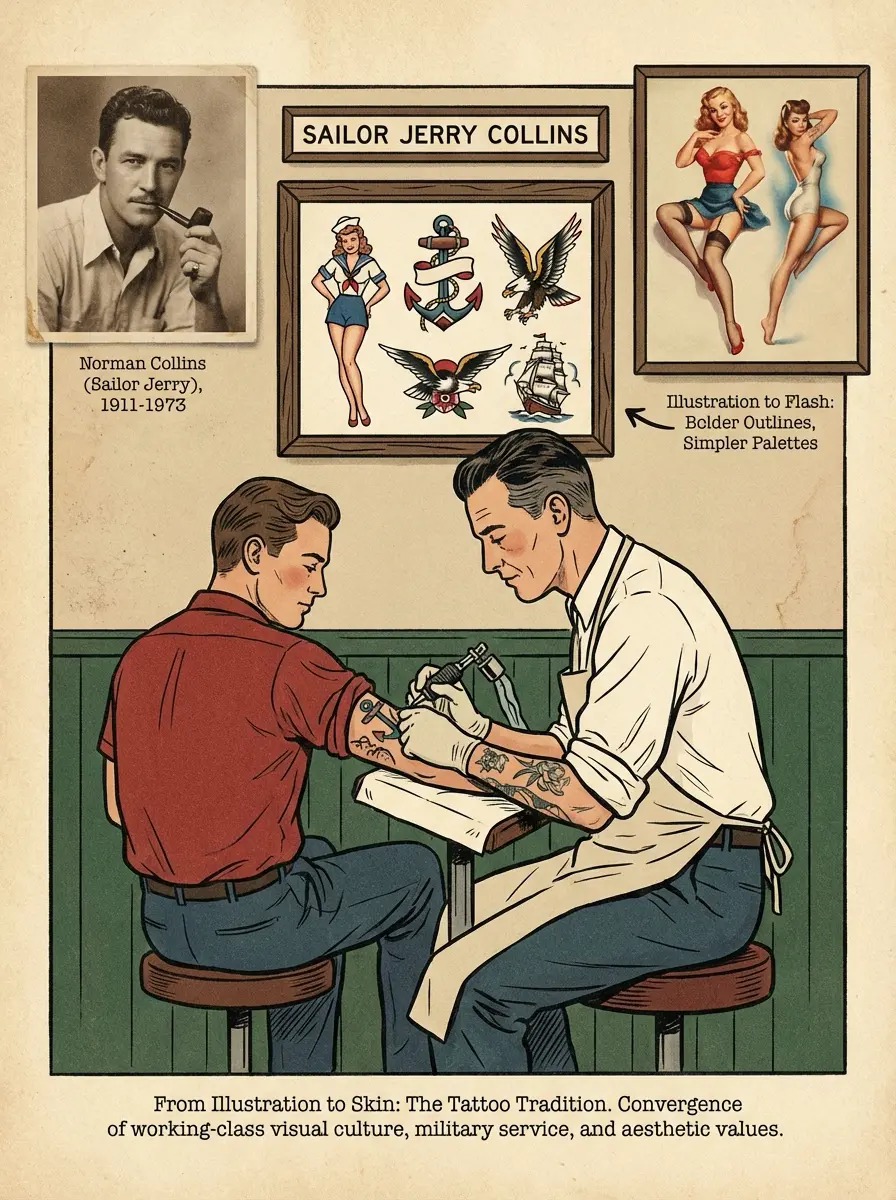
The convergence of pinup illustration and tattooing was not coincidental — both were forms of working-class visual culture associated with military service, masculinity, and a particular relationship with the body as a surface for self-expression. The pinup tattoo was, in its original context, a statement of aesthetic values as much as personal identity: it demonstrated that its wearer could distinguish a well-drawn figure from a poor one, that beauty and craft were worth permanent commemoration.
The Contemporary Revival
Pinup tattoos have remained continuously popular since the 1940s, but they’ve undergone significant evolution since the resurgence of traditional tattooing in the 2000s.
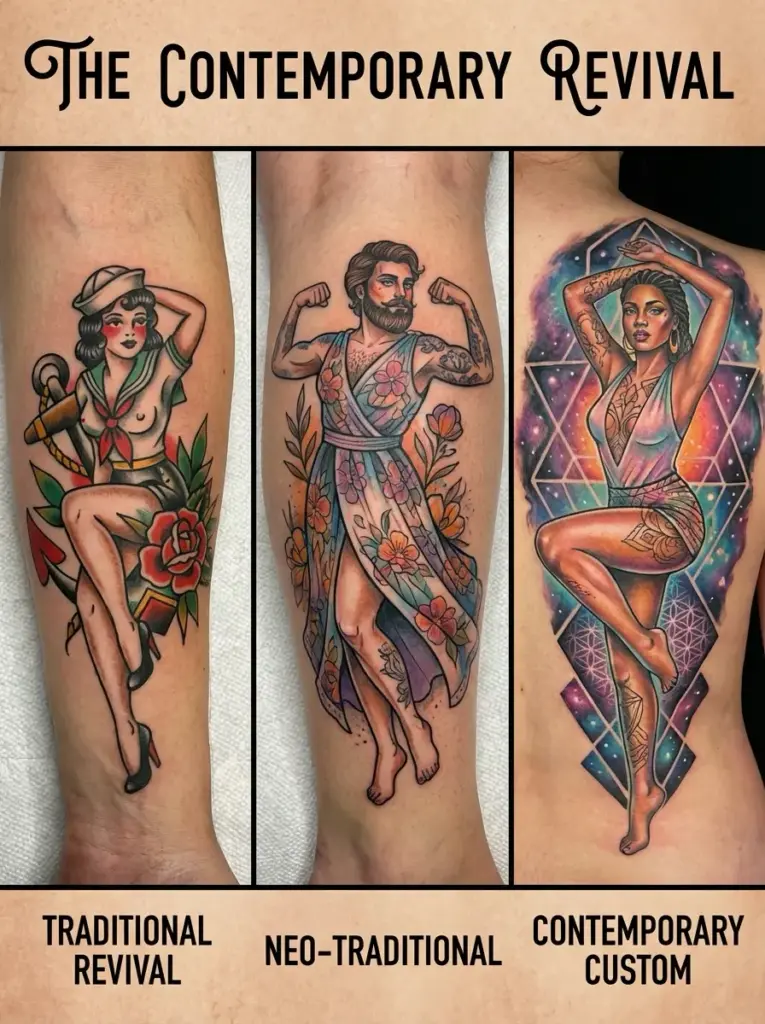
Contemporary pinup tattoos range from faithful recreations of the Sailor Jerry flash tradition to neo-traditional interpretations with expanded colour palettes and refined linework to fully customised original compositions that incorporate the pinup visual language into entirely contemporary imagery. The subject matter has also diversified: pinup tattoos depicting gender-nonconforming figures, men in pinup poses, and culturally diverse figures have become increasingly common, reflecting both broader social shifts and a recognition that the pinup’s graphic language is a style, not a demographic prescription.
Five Pinup Tattoo Styles: Which Is Right for You
Traditional American (Old School)
Era: 1930s–1960s original / continuously produced since
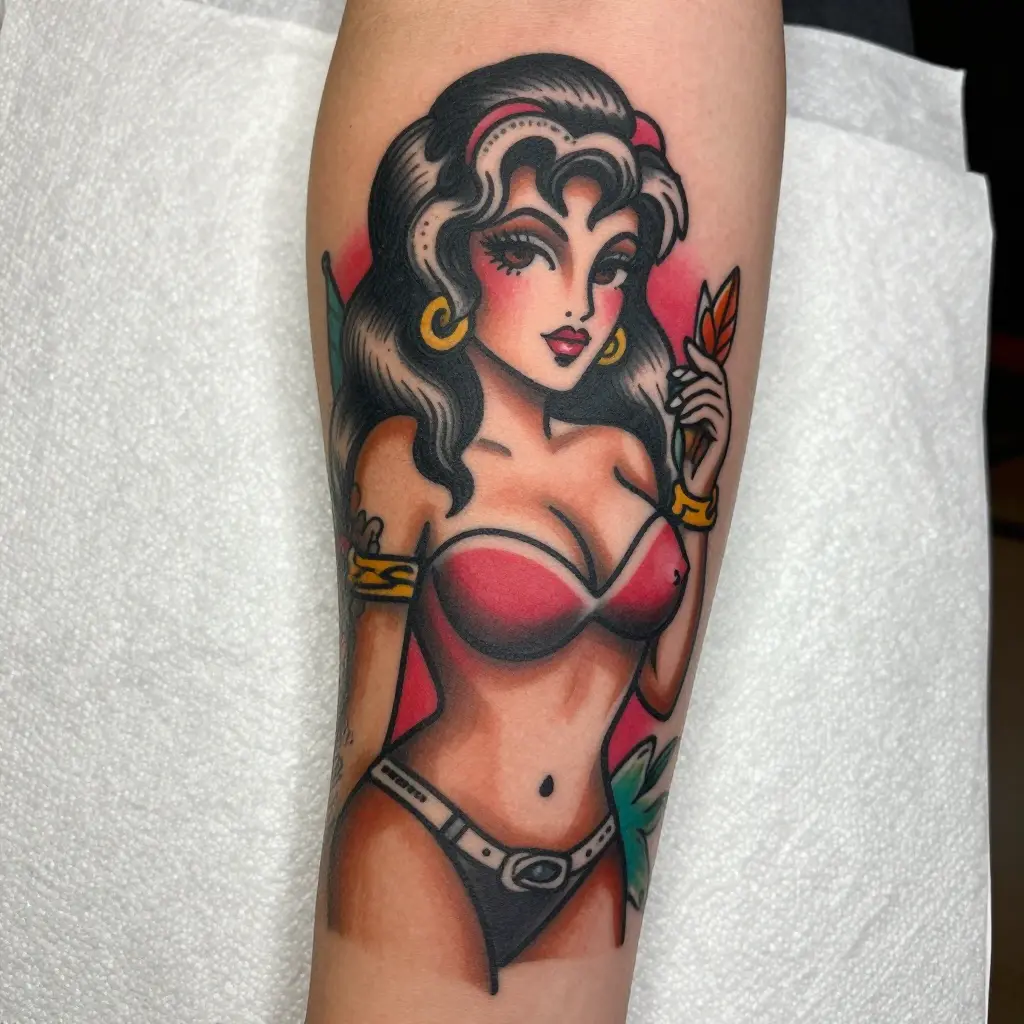
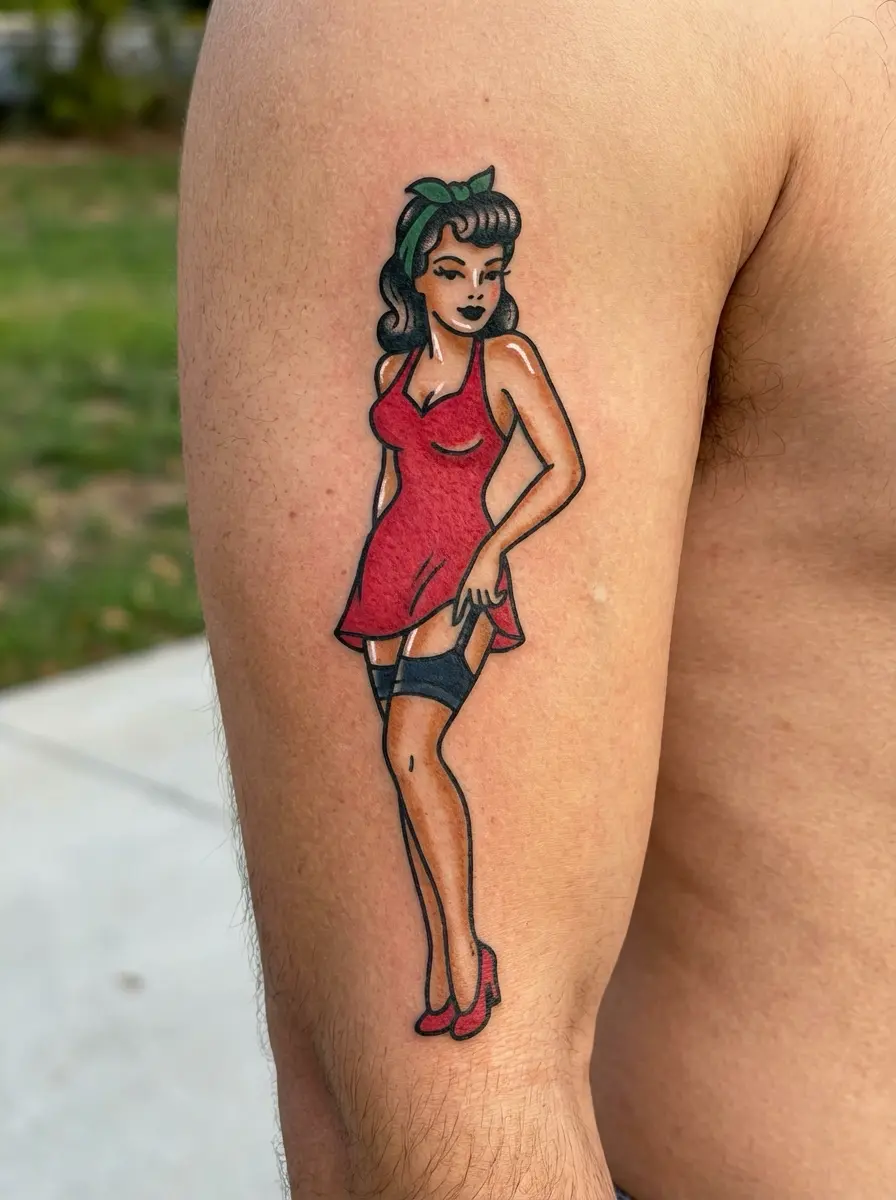
Key elements: Bold black outlines (minimum 1mm, often 2-3mm), limited palette (red, black, green, yellow, skin tone), flat colour fills, minimal background, strong silhouette, simple costume
Colour palette: Red, black, muted yellow, forest green, navy — the classic Sailor Jerry palette. Warm skin tones. No gradients or complex colour mixing.
Best placement: Upper arm, forearm, calf, thigh — traditional placements where bold designs have been proven to hold for decades
Reference artist: Sailor Jerry Collins, Mike Malone — the originators of the American traditional pinup canon
Varga / Airbrush Style
Era: 1940s Esquire era / revived in neo-traditional and illustrative tattooing
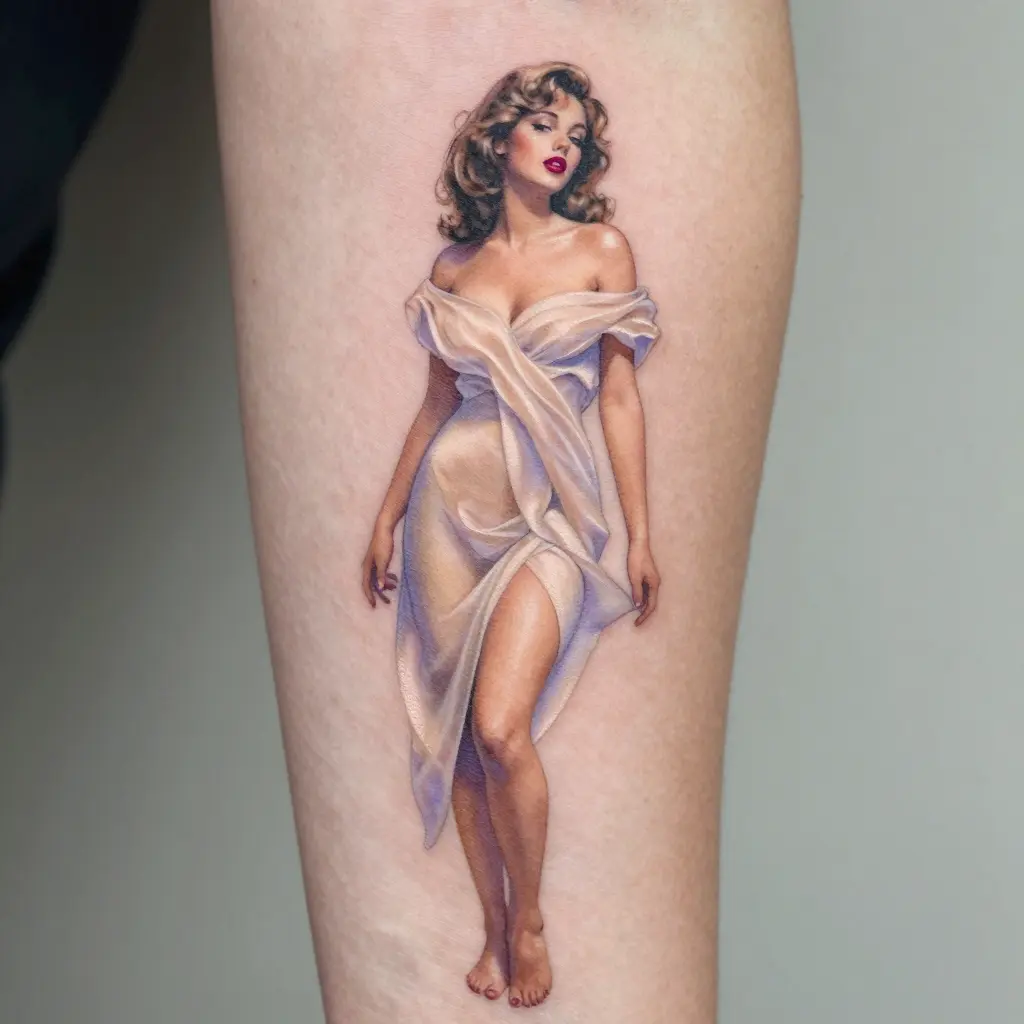
Key elements: Softer, more luminous skin rendering, elongated proportions, airbrushed-look colour transitions, lighter linework than traditional American, more emphasis on diaphanous clothing and implied form
Colour palette: Soft pinks, lavenders, warm skin tones, champagne and ivory, occasional vivid accent colour (a red lip, a blue ribbon). More pastel than traditional American.
Best placement: Thigh, ribcage, back — placements where the softer rendering can be appreciated at scale. Not ideal for small formats where the subtlety is lost.
Reference artist: Alberto Vargas (original), contemporary illustrative tattoo artists working in airbrush-inspired colour work
Rockabilly / 1950s Revival
Era: 1950s American cultural moment / continuously popular in rockabilly subculture
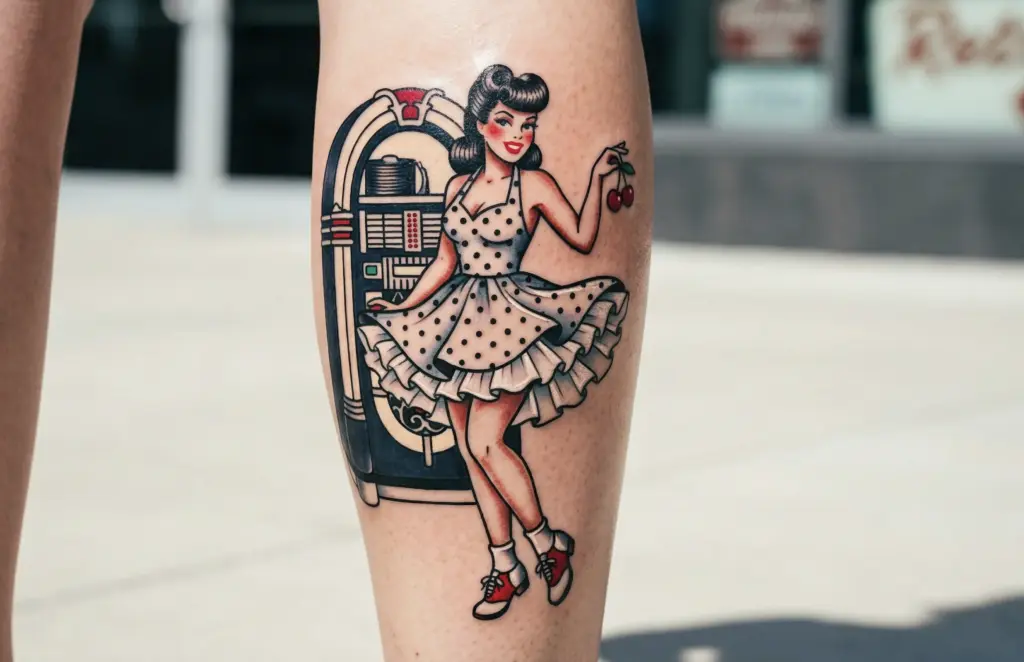
Key elements: Victory rolls, pedal pushers, polka dots, saddle shoes, classic cars, cherries and dice as props, cherry red lip, exuberant expression, kinetic poses
Colour palette: Cherry red, navy, cream, polka dot patterns, pastel pink. The specific colour language of 1950s American commercial design.
Best placement: Thigh, upper arm, calf — the primary placements for the subculture’s aesthetic. Often displayed intentionally rather than concealed.
Reference artist: Artists specialising in rockabilly and vintage Americana aesthetics — look for portfolios heavy with cherries, swallows, and classic cars alongside the figure work
Neo-Traditional Pinup
Era: 2000s–present, the dominant contemporary form
Key elements: Refined linework (varied weight, not uniformly bold), expanded colour palette, more complex background elements, greater anatomical accuracy than traditional American, decorative framing elements (roses, art nouveau borders), contemporary or historical costume
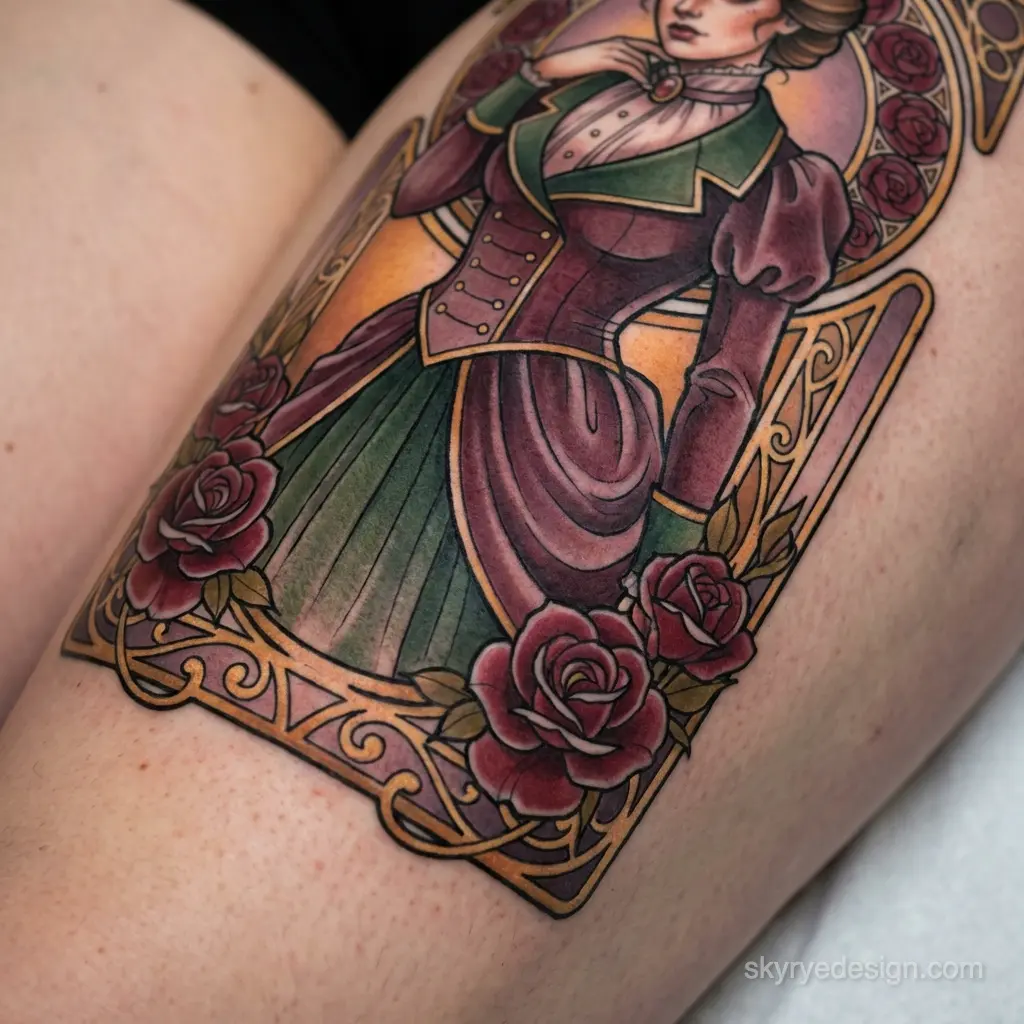
Colour palette: Expanded beyond the traditional palette — deep jewel tones, complex skin tone gradients, botanical greens and purples, metallic accents. More saturated than Varga, more complex than traditional American.
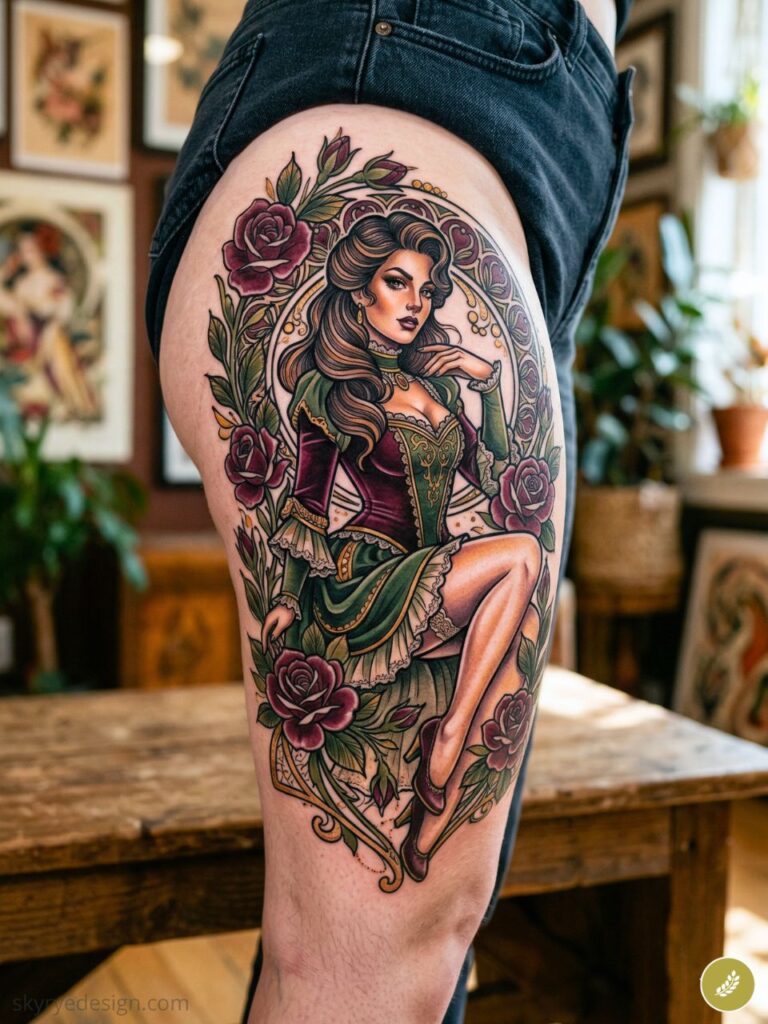
Best placement: Thigh, back, upper arm, full sleeve — the neo-traditional style scales well to large formats where the detail can be appreciated
Reference artist: Jenna Kerr, Hannah Flowers — neo-traditional artists known for strong figurative work with expanded colour palettes
Contemporary Illustrative
Era: 2010s–present, the current frontier
Key elements: Fine linework, watercolour-influenced colour, portrait-level facial detail, dynamic compositions, genre-mixing (pinup figures in fantasy, sci-fi, or historical settings), strong narrative element
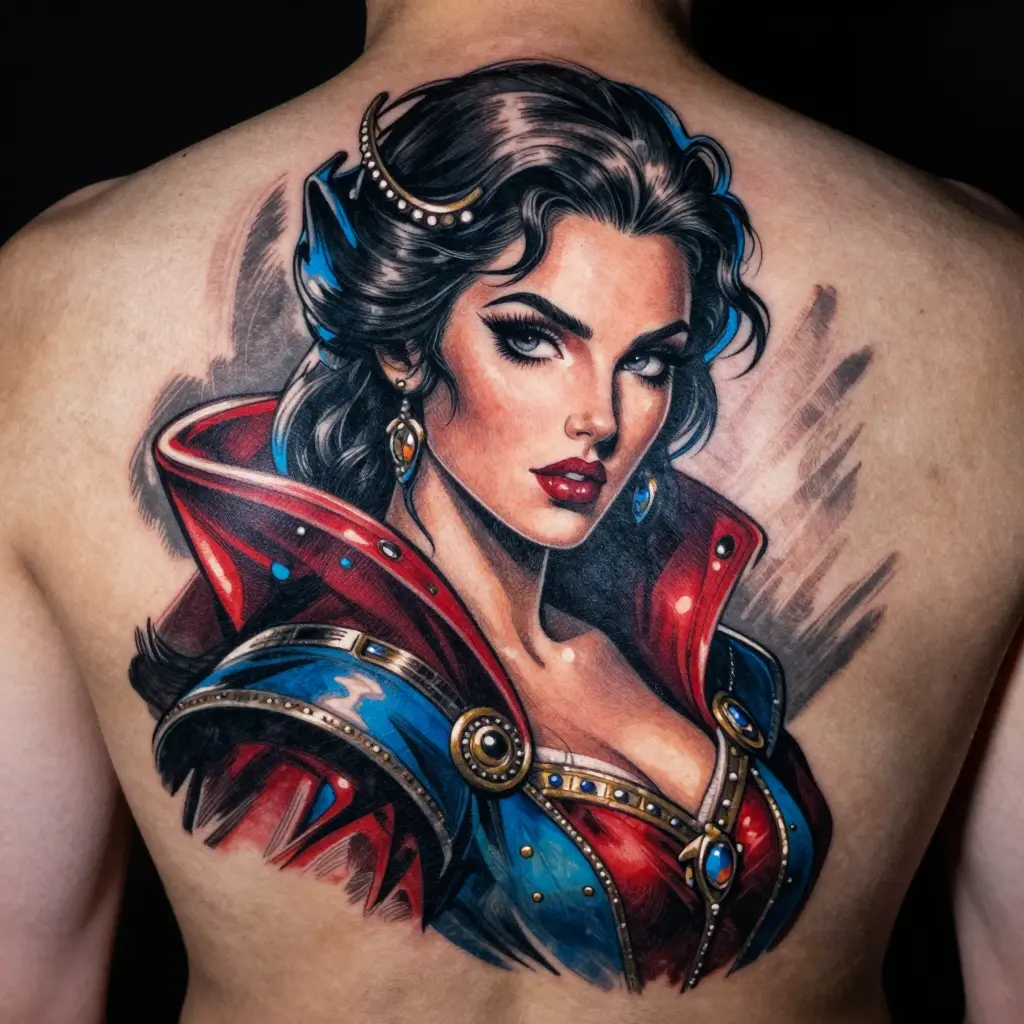
Colour palette: Variable — often based on a specific colour story rather than a formula. Deep blacks for contrast, selective colour emphasis, white highlight work.
Best placement: Thigh, back, chest — requires significant skin real estate for the detail level. Not suitable for small formats.
Reference artist: Research current portfolio work — illustrative pinup is highly artist-specific and varies enormously in execution quality
✏ Artist note: The single most important decision in a pinup tattoo is style selection before artist selection — not the reverse. If you want a traditional American pinup, book an artist with a strong traditional American portfolio. If you want a neo-traditional, book a neo-traditional specialist. An artist known for watercolour work who ‘can also do traditional’ will produce a different result than one whose entire practice is traditional American. The style should drive the artist choice, not the artist’s availability or proximity.
The Anatomy of a Pinup Tattoo: Design Elements Worth Understanding
The Pose: Where Character Lives
The pose is the most important design decision in a pinup tattoo, and the one most worth thinking about carefully before the consultation. A pose communicates: the figure’s relationship to the viewer (direct eye contact vs. looking away, aware vs. caught unawares), the emotional register of the piece (playful, confident, glamorous, melancholy), and the narrative context of the image (what is happening, or what just happened, or what is about to). The most successful pinup poses have an implied story — you can read the image and sense that something preceded it or will follow it. This narrative quality is what gives a great pinup tattoo its lasting interest as a permanent image.
Props and Costume: The Detail That Personalises
Costume and props are the pinup’s primary means of personalisation and period signalling. A 1940s pinup typically features: victory roll or wave hairstyle, high-waisted skirt or swimwear, strappy heels, red lipstick, simple jewellery. A 1950s rockabilly pinup: poodle skirt or capri pants, saddle shoes, petticoat, polka dots. A contemporary neo-traditional pinup can incorporate virtually any costume or prop that serves the design — including cultural references, occupational details, or personal objects that make the tattoo specifically meaningful to its wearer rather than generically ‘pinup.’
Backgrounds and Setting
Pinup tattoos can be designed with or without background elements. A figure-only design on a clean skin background is the most traditional approach and often the most graphic — the figure reads as a printed image rather than a scene. Background elements (clouds and sky, interior settings, outdoor environments, abstract decorative frames) add context and visual complexity but also add time, cost, and design demands on the artist. The background should support the figure, not compete with it — the most common background mistake is choosing one that creates visual competition with the face and pose, which are the primary focus of the design.
Scale and Its Relationship to Detail
Scale determines what detail level is achievable. A pinup figure at 8cm tall cannot carry the facial detail or costume intricacy of one at 20cm. This is one of the most frequent mismatches between what clients bring to consultations (small reference images they’ve seen online) and what is achievable at a given placement size. Discuss scale with your artist specifically — ask them what minimum size the design requires to achieve the detail level shown in your references, and let that inform your placement decision rather than the reverse.
Placement Guide: Where Pinup Tattoos Work Best
Thigh: The Classic Choice
The outer thigh is the single most popular placement for pinup tattoos, and for good reason.
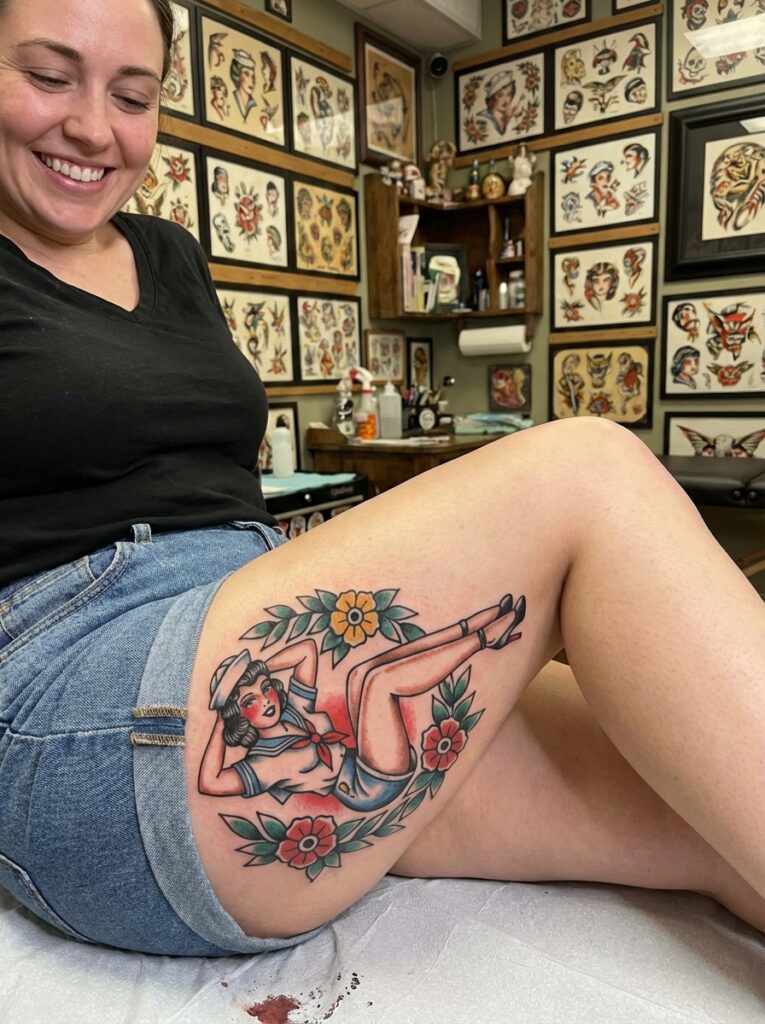
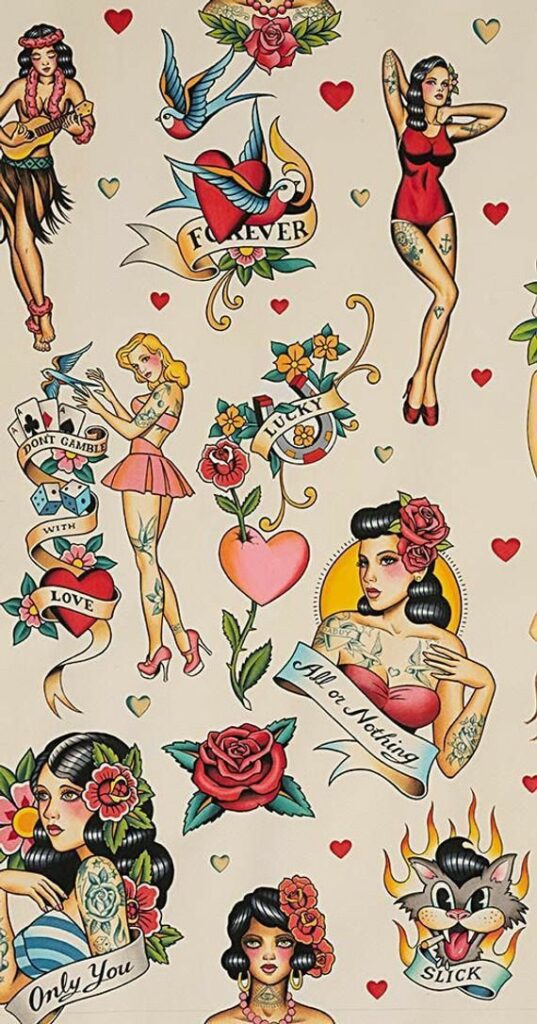
It offers the largest relatively flat skin surface on the body — enough space for a full figure with surrounding composition elements, without the significant curvature that distorts figure proportions on rounder surfaces. The thigh also has the advantage of being displayable or concealable depending on clothing choice, which matters for wearers who work in professional contexts. Pain level: moderate. The outer thigh is one of the more comfortable tattoo placements; the inner thigh significantly less so.
Upper Arm and Forearm
Upper arm placements suit medium-scale pinup figures — a figure from approximately 12-18cm tall fits well on the outer upper arm without requiring distortion for the curved surface.
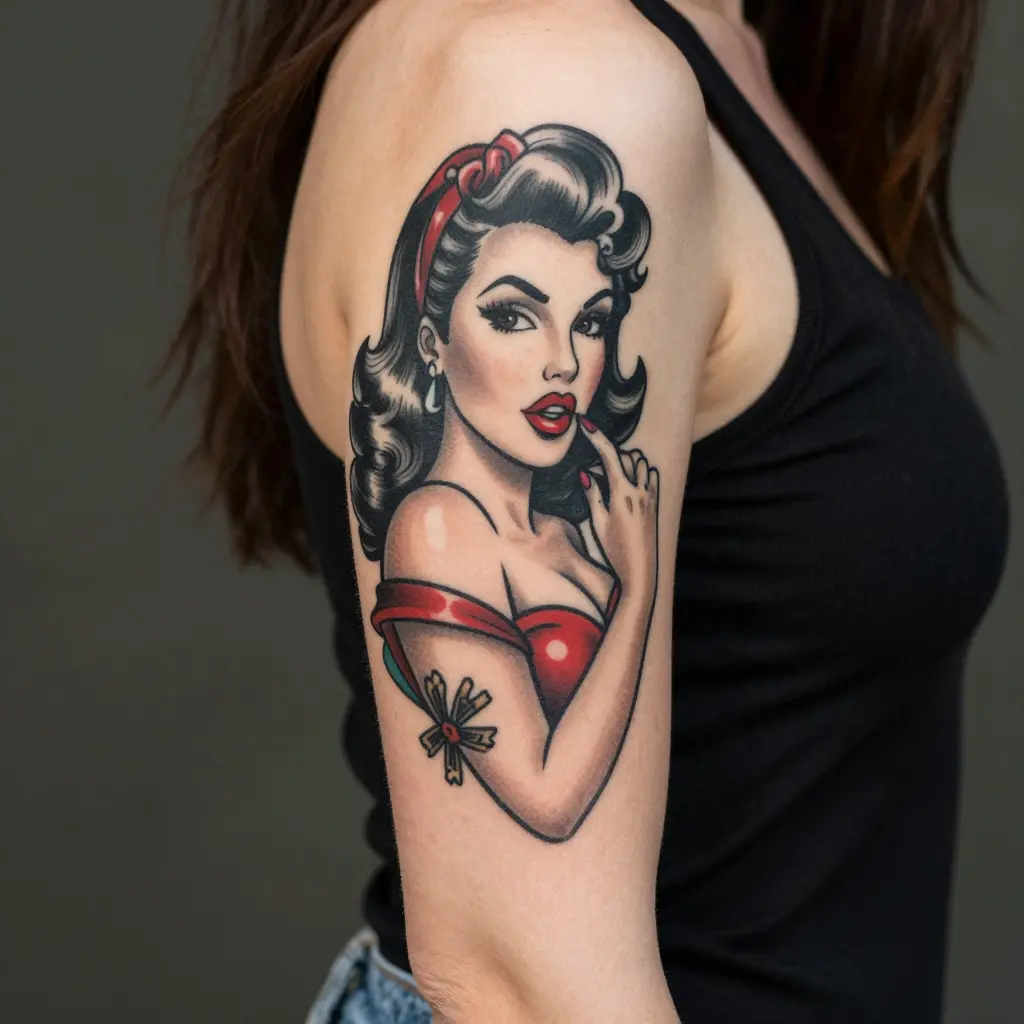
The forearm accommodates slightly smaller figures. Both placements have good visibility when the wearer chooses to display the tattoo and reasonable concealment with long sleeves. Sun exposure on the forearm is the primary aging consideration — colour on a forearm fades faster than on most body placements. Consistent SPF application significantly mitigates this.
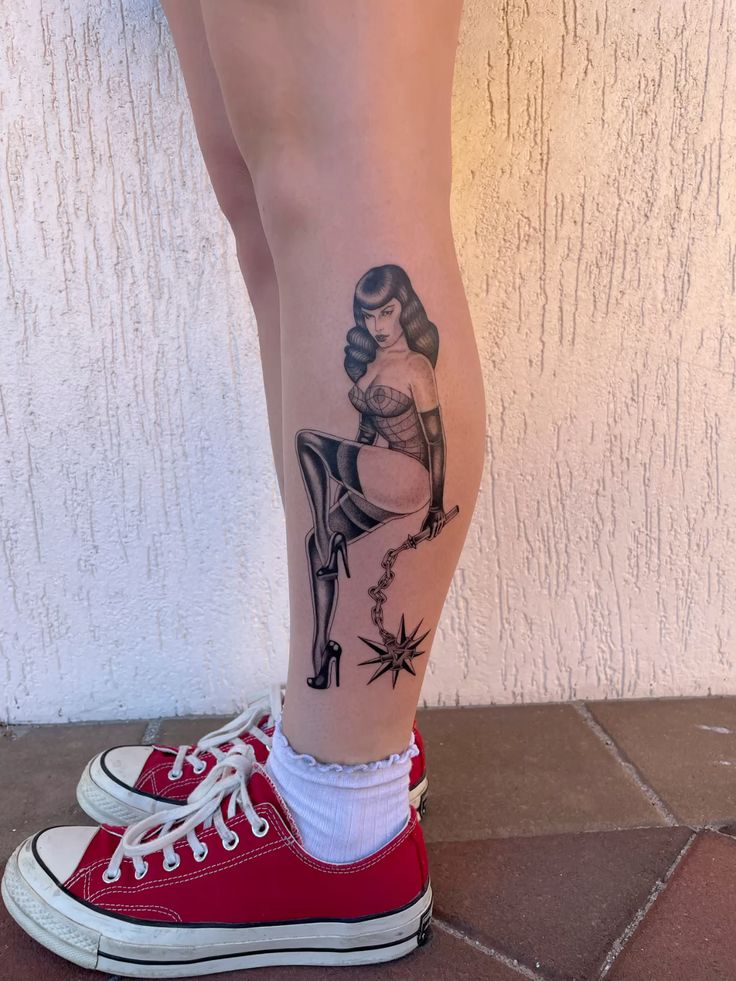
Calf
The calf is an excellent placement for vertically oriented pinup compositions — a standing figure with hair up reads particularly well on the vertical calf surface.
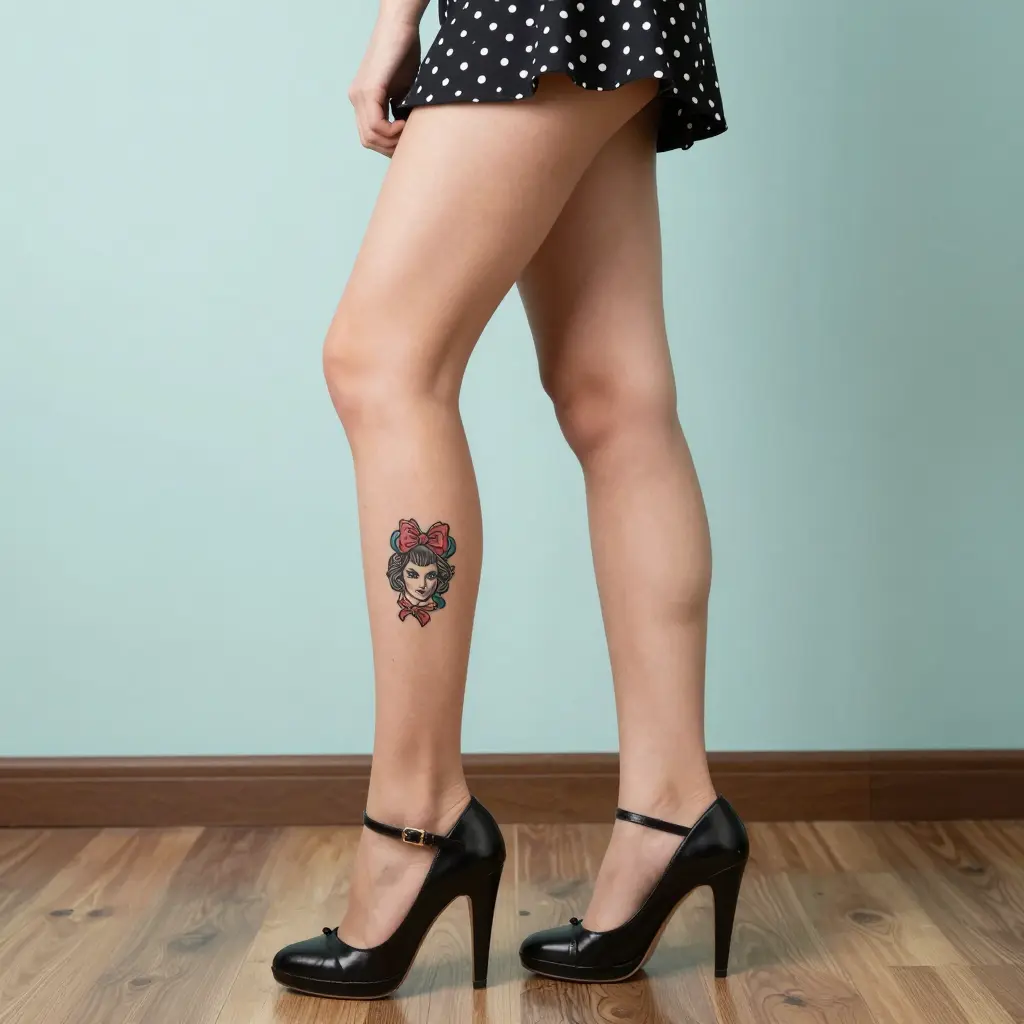
The calf muscle creates a natural contour that can enhance or distort the figure depending on the pose; a standing or slightly turned figure works better than a strongly lateral pose that reads differently from the front than from the side. Pain level: moderate, higher toward the shin and ankle.
Back and Chest
The back provides the largest canvas available in tattooing — sufficient for a full-scale pinup composition with elaborate background, multiple figures, or a full scene rather than a portrait composition.
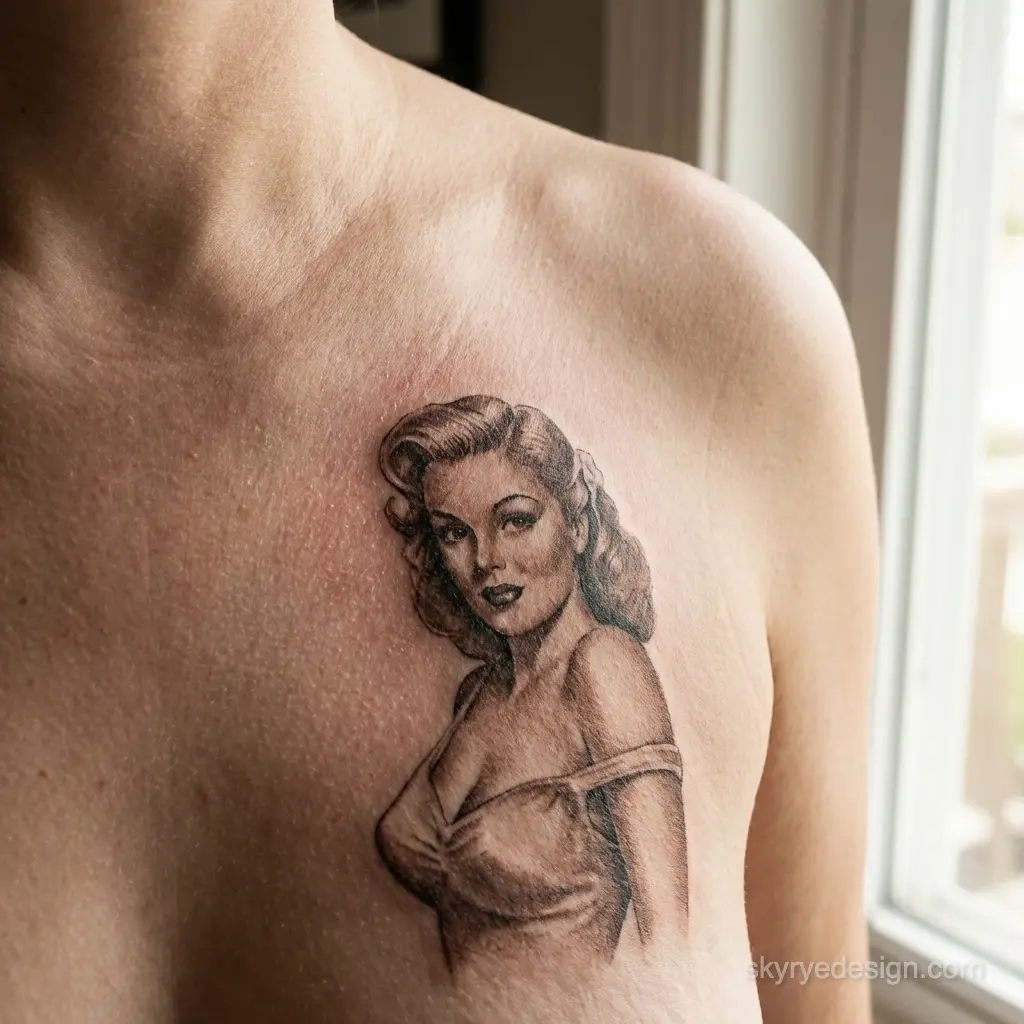
A full back pinup is a significant commitment in both time and cost (typically 20-40+ hours) and requires planning a composition specifically for the shape of the back. The chest — particularly the upper chest including the décolletage area — is a popular placement for smaller pinup figures, framed between the collar bones. This placement is visible with lower necklines and has a strong tradition in vintage tattoo culture.
✏ Artist note: Before fixing on a placement, ask your chosen artist to sketch the figure at the proposed size on paper and hold it against the placement. This simple exercise reveals two things that digital mockups often obscure: the actual scale of the figure relative to the body part, and whether the proportions of the design work at that size. Many consultations change their placement decision after this test because the initial choice was based on a digital reference that looked very different at real scale on skin.
How to Choose the Right Artist for a Pinup Tattoo
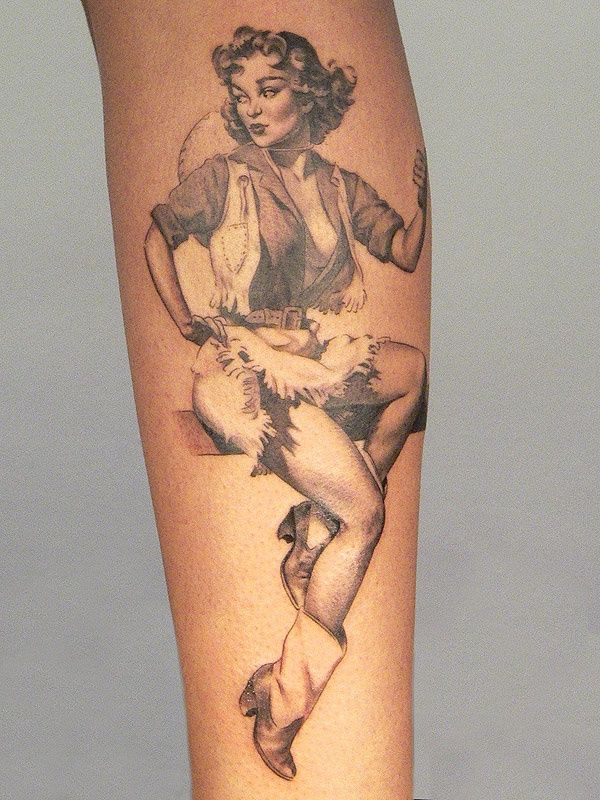
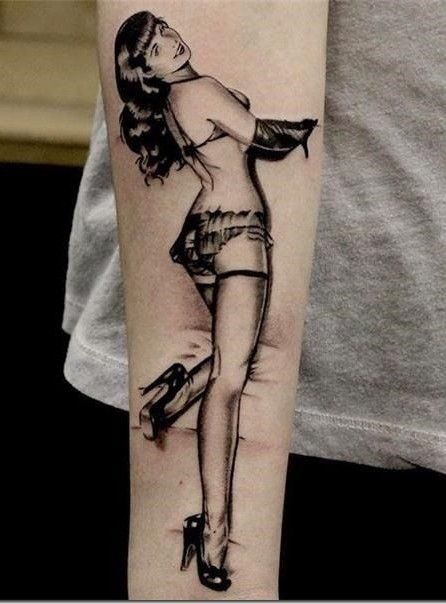
Pinup tattoos are among the most technically demanding subjects in tattooing. They require: the ability to draw the human figure convincingly in the relevant illustrative tradition; the technical skill to execute clean, consistent linework at the required weight; the colour knowledge to mix and apply skin tones, fabric colours, and background elements in the correct sequence; and enough compositional experience to design a figure that works on a three-dimensional curved surface rather than a flat page.
What to Look for in a Portfolio
- Facial quality is the first test. Look at the faces in the artist’s existing pinup work. Eyes, lips, and facial structure are the hardest elements to execute and the most obvious when they’re wrong. An artist who produces convincing faces in their portfolio can be trusted with yours. An artist whose faces look flat, inconsistent, or anatomically off will produce the same in your tattoo.
- Line consistency. Zoom into the linework in portfolio images. Are the lines clean and confident, or do they wobble and vary unevenly in weight? Clean linework requires both technical skill and a steady hand, and it’s visible in every healed tattoo photograph.
- Healed work over fresh. Fresh tattoo photographs show the work at its most flattering. Healed work — photographed 4-6 weeks after completion — shows how the colour holds, whether the lines stay crisp, and whether the overall design maintains its integrity after the skin has settled. Always look for healed examples from your prospective artist.
- Style match, not just subject match. An artist who has tattooed figures before is not necessarily the right artist for a pinup. Look for portfolio work that matches the specific style you want — traditional American, neo-traditional, illustrative — not just any figure-based tattooing.
The Consultation: Questions Worth Asking
- Can I see healed examples of figure tattoos you’ve done, specifically pinup or illustrative styles?
- What size would you recommend for the level of detail in these reference images at my proposed placement?
- Do you draw the design custom for each client, or do you adapt existing flash? (Both are valid, but you should know which applies.)
- What is your approach to skin tone mixing for [your skin tone] — can I see examples of similar skin tones in your healed work?
- How many sessions would you expect this design to require, and what does that mean for the total timeline?
How Pinup Tattoos Age and How to Keep Them Looking Right
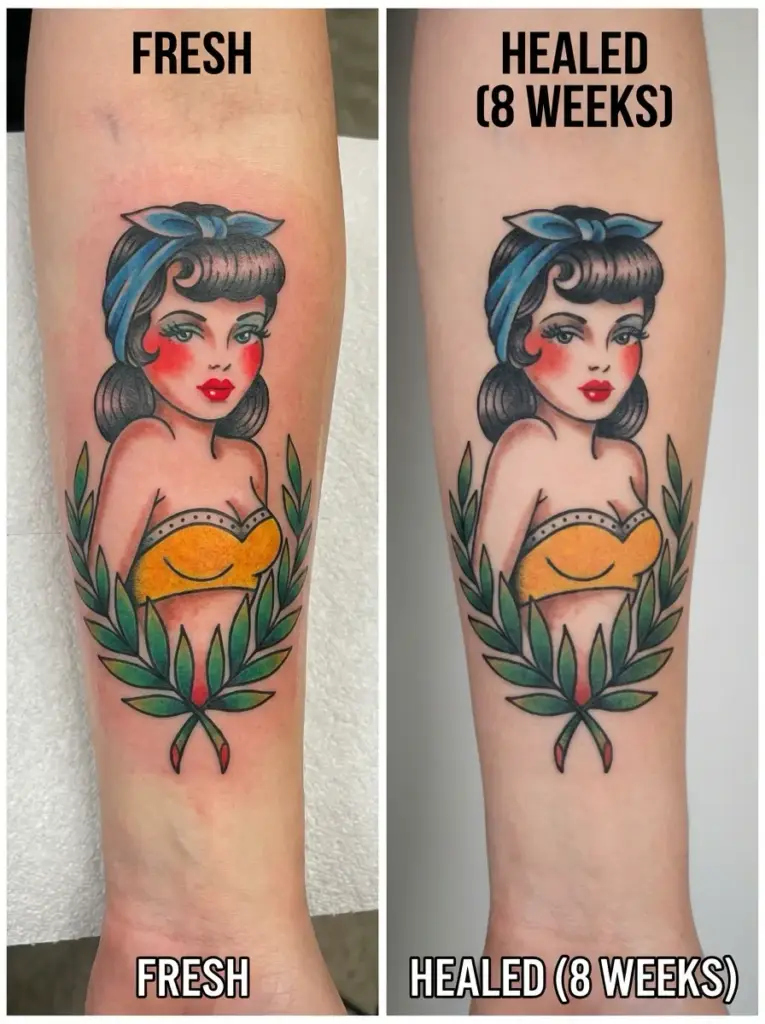
The aging behaviour of a pinup tattoo depends significantly on the style. Traditional American pinups with bold outlines and limited palettes age the best — the thick outlines hold their definition for decades, and the flat saturated colour areas maintain legibility longer than complex blended gradients. The Sailor Jerry flash tradition was specifically designed for longevity: bold, simple, designed to remain readable as skin changes over a lifetime.
Neo-traditional and illustrative pinups with fine linework and complex colour gradients age less predictably. Fine lines spread and blur as skin ages and relaxes; complex gradient work can lose its tonal separation, making the image appear muddy rather than detailed. This doesn’t mean these styles are wrong choices — only that they benefit more from good placement (protected from sun and friction) and consistent SPF care than traditional styles do.
Aftercare Specific to Colour Work
- SPF 50 on all exposed placements, every day. UV exposure is the primary cause of colour fading in tattoos. A forearm pinup without sun protection will fade measurably within 5 years. The same design with consistent SPF will retain most of its colour saturation at 10 years.
- Moisturise consistently. Well-hydrated skin holds colour better and shows tattoo detail more clearly than dry skin. A simple unscented moisturiser applied daily extends the visual quality of colour work significantly over time.
- Touch-ups are normal, not a sign of failure. Complex colour work, particularly in faces and skin tone areas, often benefits from a touch-up session 6-12 months after the original work has healed. Discuss this with your artist at the consultation so it’s factored into your timeline and budget.
FAQ: Pinup Tattoos
Q: What is a pinup tattoo?
A pinup tattoo is a figure-based tattoo depicting a stylised person in a posed, confident, and aesthetically idealised way, drawn in the graphic style of mid-20th century commercial illustration. The defining characteristics are bold outlines, saturated colour, stylised shading, idealised proportions, and a communicative pose that conveys personality and narrative. The style originates in the pin-up illustration tradition most associated with Gil Elvgren and Alberto Vargas.
Q: How long does a pinup tattoo take?
A small figure without complex background typically takes 3-5 hours. A medium full-colour pinup with simple background takes 6-8 hours. A large-scale piece with elaborate background and fine costume detail can take 10-15+ hours across multiple sessions. Colour packing and facial detail are the most time-consuming elements.
Q: What are the best placements for a pinup tattoo?
The outer thigh is the most popular and technically ideal placement — large, relatively flat, sufficient space for a full figure and composition. Upper arm and forearm work for medium-scale figures. Calf suits vertical compositions. Back and chest provide the largest canvas for complex pieces. Avoid highly curved areas (inside the knee, inside the elbow) for faces and fine detail.
Q: Do pinup tattoos age well?
Traditional American pinup tattoos with bold outlines and limited palettes age best — bold black outlines hold definition longer than fine lines, which spread with skin aging. Saturated flat colour areas maintain legibility longer than complex gradients. Regular SPF 50 on exposed placements is the single most effective measure for preserving colour quality over time.
Q: What should I bring to my pinup tattoo consultation?
Reference images showing the specific style you want; reference images for pose, costume, and props; examples of that artist’s previous pinup work you want to emulate; and any personal elements to incorporate. Visual references are significantly more useful than written descriptions — bring images, not words.
- 5shares
- Facebook0
- Pinterest5
- Twitter0
- Reddit0