A fit-out I was brought in to consult on six years ago cost the client around $320,000. Eighteen months after completion, they restructured two departments and shifted to activity-based working. The furniture couldn’t move. The partition walls were bolted to the slab. The entire investment had become a constraint — and they were looking at a second six-figure spend to undo what the first one built.
That project is why I have very specific views on fixed commercial infrastructure. The most expensive mistake in commercial interior architecture isn’t a wrong aesthetic decision. It’s designed for one version of the business, at one point in time, with no mechanism for change.
- Why Fixed Layouts Stopped Working
- Modular Workstation Systems: What's Actually Changed
- Activity-Based Zones: Designing for What People Actually Do
- Biophilic Design: From Mood Board to Structural Principle
- Technology Integration: The Invisible Infrastructure Principle
- Modularity as Sustainability Strategy
- Three Decisions That Undermine Modular Investments
- Designing for the Business You'll Be in Three Years
- FAQ: Modular Office Systems
The shift toward modular office systems is the industry’s structural answer to that problem. Not a furniture trend — a rethinking of how the built environment relates to organisational change. This article covers where that shift stands in 2025–2026: the design principles behind it, the technology driving it, and the decisions that separate implementations that work from ones that look good on a floor plan but fail in daily use.
Why Fixed Layouts Stopped Working
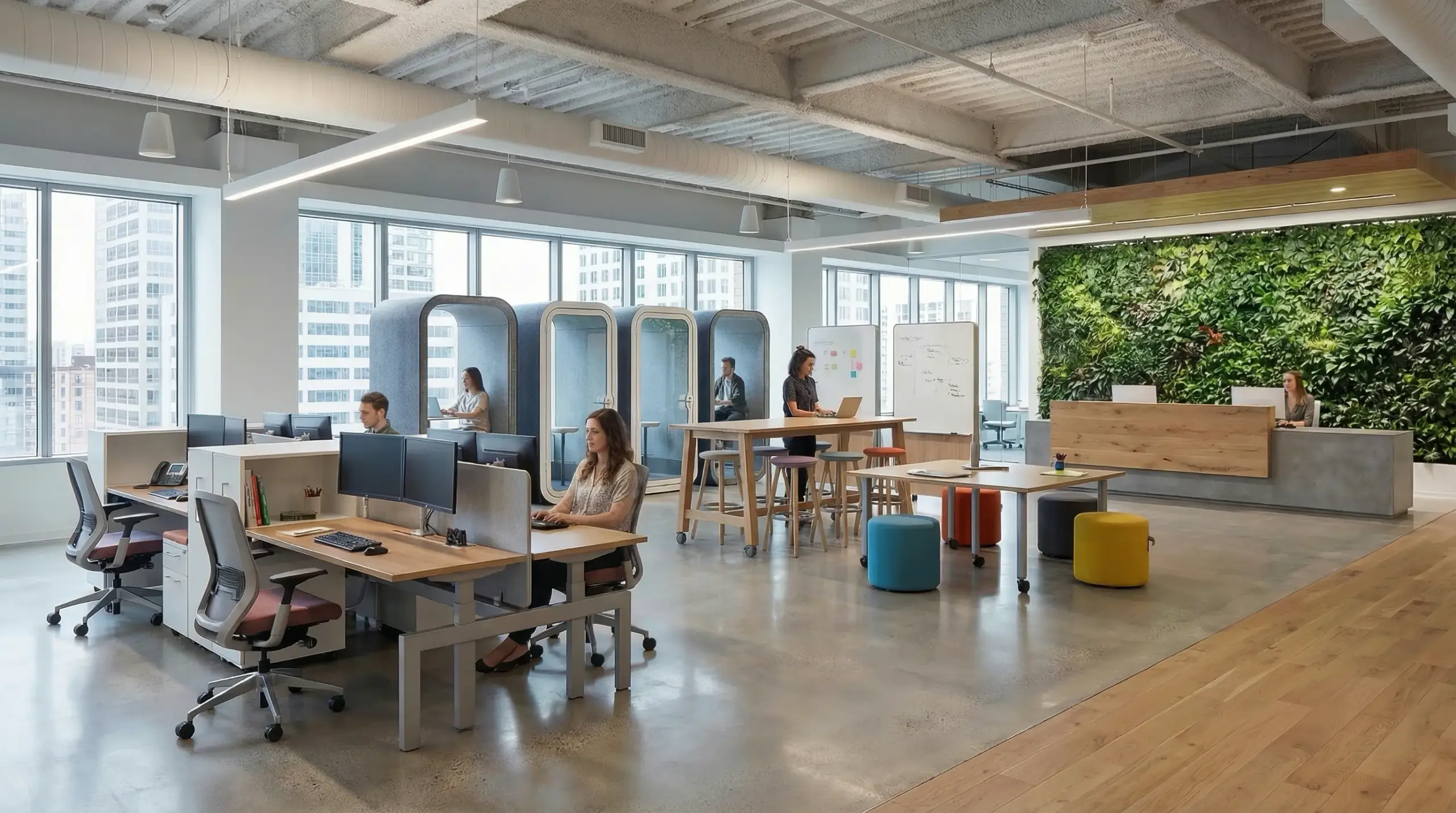
The open-plan office was, at its core, a cost-reduction strategy dressed as a design philosophy. Strip out the partitions, increase density, and lower the per-head footprint. What it produced was an environment that served no single work mode well — too noisy for focused work, too exposed for confidential conversations, too uniform to accommodate the genuinely different ways people think and produce across a single working day.
The response — accelerating sharply after 2020 — wasn’t cosmetic. It was architectural. The defining shift: spatial divisions, furniture systems, and infrastructure should be reconfigurable rather than fixed. The organisation that can change its floor plan in a weekend without a contractor is fundamentally more resilient than one that needs three months and a capital project approval to reorganise a team.
Gensler’s 2025 Global Workplace Survey documented this with data. Organisations reporting the highest workplace effectiveness scores consistently offer meaningful choice in where and how people work — not the ones with the most open plan or the newest furniture. Choice requires variety. Variety requires different settings. Different settings require either a very large building or one whose components can be rearranged.
According to Jones Lang LaSalle’s Q1 2025 report, total U.S. office inventory stands at approximately 4.8 billion square feet. The challenge isn’t square footage — it’s activating that space in ways that match how organisations actually function today, not how they functioned when the space was originally designed.

Modular Workstation Systems: What’s Actually Changed
The modern office workstation has evolved from a standalone piece of furniture into a configurable unit within a larger system. That distinction matters more than it sounds. A workstation designed as a standalone object can be moved. A workstation designed as a system component can be reconfigured — meaning work surfaces, screens, storage, and power infrastructure can be separated and recombined in different arrangements without modifying any individual piece.
Interchangeable Component Logic
The best modular workstation systems are built around a simple principle: no component should depend on another to function. A four-person cluster ungrouped becomes four individual stations. Two L-shaped surfaces flipped and joined become a collaborative double bench. The geometry of each component is part of the design intent — it determines what combinations are possible without any modification at all.
This is what separates genuine modularity from furniture that can technically be moved but was never designed to be. The test is straightforward: can the facilities team change the layout on a Friday afternoon without specialist tools or structural intervention?
Integrated Power and Connectivity
Fixed perimeter power trunking and floor boxes are the infrastructure decision that most reliably undermines reconfiguration capability. Workstation systems designed for genuine modularity carry their own power — integrated cable management within the worksurface structure, accessible pop-up modules, and wireless charging built into specific surface zones.
The practical result: relocating a workstation cluster is a half-day project rather than a building works project. Organisations that previously repurposed space every three to five years can now respond to structural change in weeks.
Acoustic Performance Built In
Acoustic quality has emerged as the primary performance metric in contemporary commercial design — consistently the top workplace complaint in 2026 research. The significant shift is that acoustic function is now built into the workstation system itself. Height-adjustable screens with acoustic backing, timber slat panels integrated into cluster dividers, and felt-finished worksurface returns do double duty: spatial definition and sound absorption in the same element.
For businesses specifying workstation systems that genuinely deliver on these principles, Urban 411 Office Furniture builds their collections around this component logic — adaptability, acoustic integration, and natural material specification are structural to the product rather than optional upgrades.

Activity-Based Zones: Designing for What People Actually Do
The most consequential change in commercial interior design in 2025–2026 is the abandonment of person-to-desk ratios as the primary spatial planning metric. Forward-thinking organisations now plan space around work modes — the categories of activity that happen throughout the working day — rather than headcount.
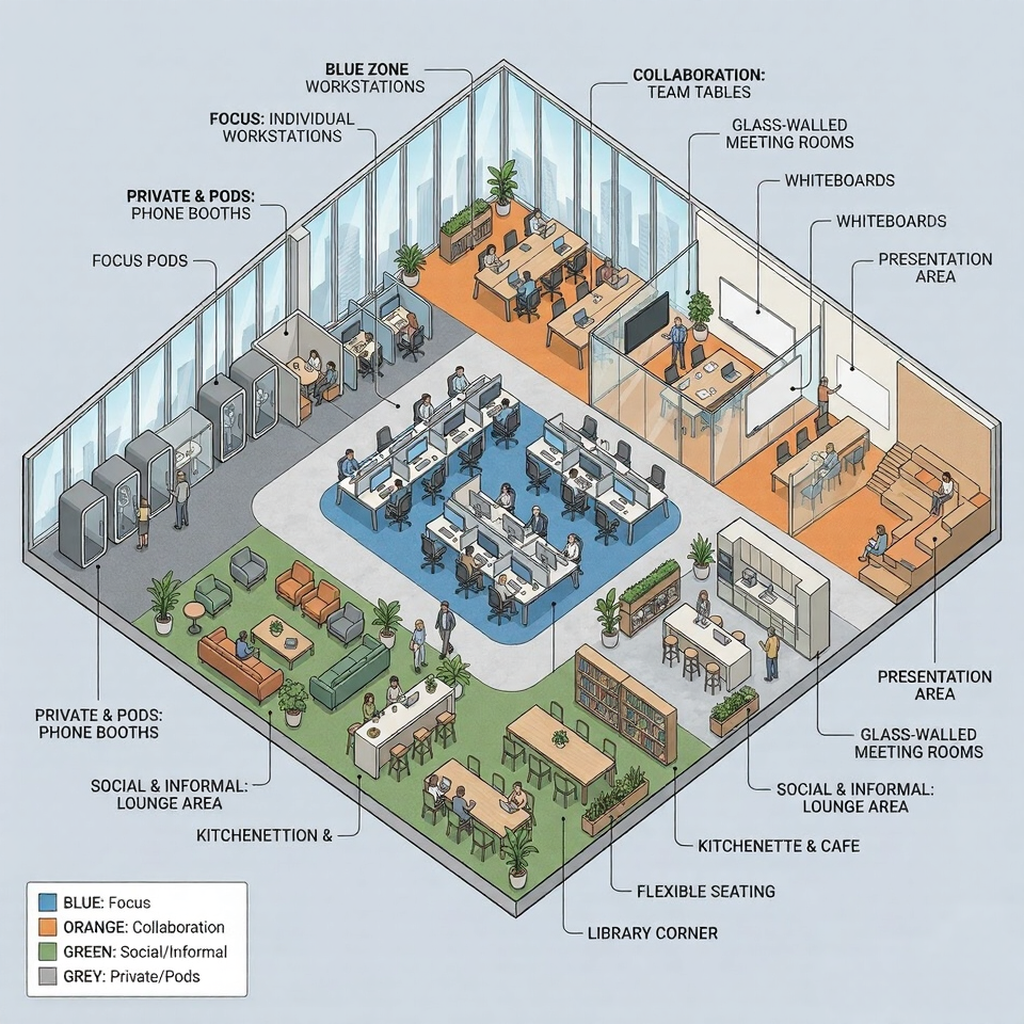
A well-designed zone architecture addresses four distinct modes:
- Focused individual work — Low-stimulation, defined-boundary settings: acoustic pods, semi-enclosed booths, or screened workstations. Cool colour temperatures around 4000K support sustained attention. Occupancy sensors keep these spaces available rather than colonised as permanent desks.
- Collaborative teamwork — Reconfigurable furniture serving two people or twelve. Mobile tables, stackable seating, writable surfaces, and integrated screen-sharing. The furniture mobility is architectural — it lets a space function as a stand-up briefing at 9 am and a full workshop at 2 pm.
- Informal social and creative — The ‘third space’ category. Lounge seating, casual tables, poseur-height units, coffee counter adjacencies. In 2026, these spaces will be the primary reason hybrid workers choose to come in. Workplace strategists now describe this design approach as ‘workspitality’ — borrowing hospitality cues to make offices people want to be in, not just have to be in.
- Private and confidential — Acoustic pods, phone booths, enclosed meeting rooms. The modular pod market has matured significantly — units are now integrated as semi-permanent architectural elements, repositioned as team structures evolve rather than treated as fixed installations.
Aflac’s 2025 workplace report found that nearly 3 in 4 U.S. workers report moderate to very high workplace stress. Sensory comfort — acoustic control, lighting quality, spatial predictability — is identified as one of the most reliable mechanisms for reducing that strain. Zone architecture is what makes sensory comfort available by design rather than by accident.

Biophilic Design: From Mood Board to Structural Principle
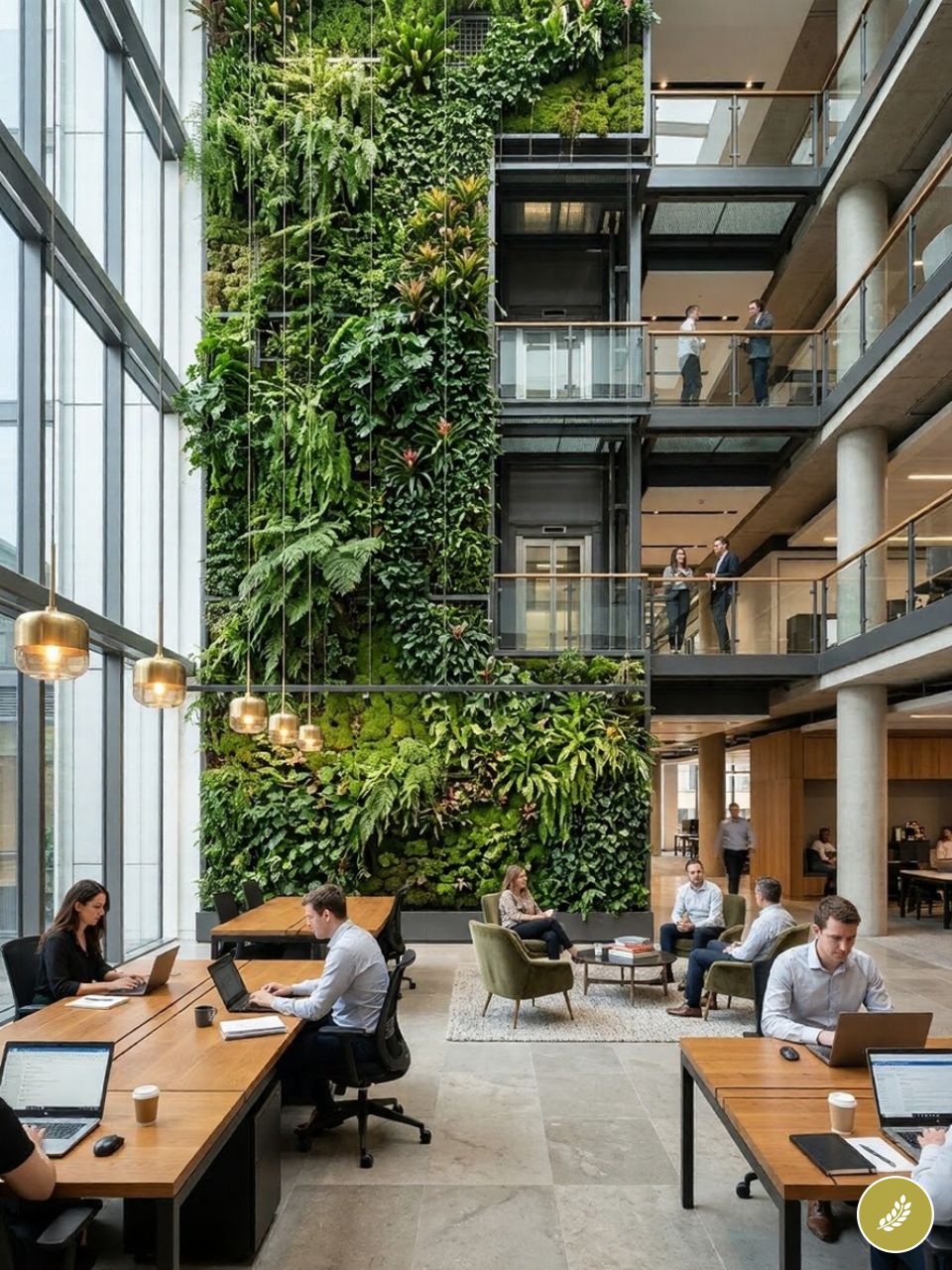
Biophilic design in commercial interiors has moved past the phase where it meant a plant shelf above the printer. In 2026, biophilic principles are embedded at the specification level — in material choices, spatial configuration, lighting design, and acoustic treatment — rather than applied as surface decoration after the structural decisions are already made.


The case is physiological. Human nervous systems evolved in environments with natural light variation, organic material surfaces, irregular forms, and ambient natural sound. The entirely artificial office environment produces a low-grade stress response that compounds across a working day. The workplace research on this is consistent.
Material Specification as Performance Decision
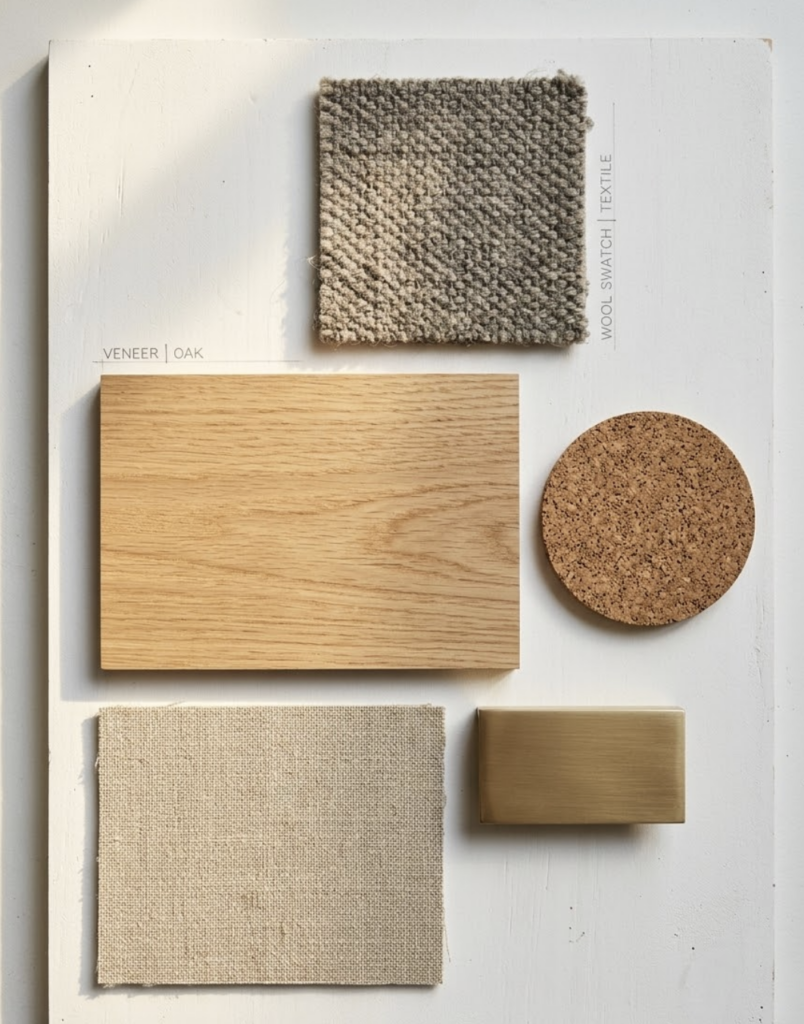
Timber, cork, stone, and wool surfaces in workstations and meeting furniture are sensory regulation tools, not decorative choices. The tactile variation between a timber worksurface and a fabric acoustic screen within the same workstation gives the nervous system the material variety it reads as ‘natural environment’ rather than ‘institutional space’.
Urban 411 Office Furniture‘s approach reflects this: natural material integration is treated as standard in their collections rather than a premium tier option. The business case — employee retention, wellbeing outcomes, reduced sick leave — is increasingly well-documented at the corporate level.
Lighting Architecture and Circadian Alignment
Access to natural light isn’t a luxury feature — it’s a productivity and health requirement. Circadian-aligned lighting systems (shifting from ~5000K morning activation through ~3000K afternoon settling) are increasingly standard in new commercial fit-outs. Material specification responds directly: high-gloss surfaces near glazing create glare problems. Matte-finished workstation surfaces and acoustic panels manage that glare while preserving the light penetration that makes a floor plate feel alive rather than institutional.
Acoustic Naturalness
Total silence is physiologically uncomfortable — as disruptive, in its way, as high noise. The target acoustic environment is ‘lively but not loud’: background sound between 45–50dB with reverberation under 0.6 seconds in open-plan areas. Timber slat panels, living green walls, and moss installations contribute to this through natural material absorption. Function and biophilic aesthetics converge in the same element.
Technology Integration: The Invisible Infrastructure Principle
The most effective technology integration in 2026 commercial interiors shares one quality: it disappears. Conspicuous technology — visible cable runs, obvious sensor housings — creates the visual complexity that undermines the calm environment the space is supposed to support. The best commercial fit-outs solve technology through the furniture and architectural framework, not by adding it to a completed space.
Embedded Power and Occupancy Intelligence
Wireless charging built into work surfaces is now standard in commercial-grade workstation systems. The more consequential development is predictive occupancy sensing — IoT sensors tracking usage patterns across the floor plate. The data informs future reconfiguration decisions with real evidence rather than assumptions.
An organisation that discovers through six months of sensor data that its focus pods run at 90% occupancy while collaboration hubs run at 30% has quantified evidence for a zone rebalancing that would otherwise require a full workplace audit. Modularity and data close the loop on each other.
Hybrid Work Infrastructure
With hybrid working firmly established, 28% of working adults in Great Britain were hybrid working between January and March 2025, a figure rising consistently. Every furniture decision must address technical equality between in-person and remote participants. Camera-height-optimised meeting furniture, acoustic treatment around video conferencing zones, and power infrastructure for hybrid peripheral devices are now baseline requirements, not premium considerations.

Modularity as Sustainability Strategy
The sustainability case for modular office systems is arguably the most compelling argument for the procurement decision — and it’s what gets capital projects approved in 2026. Any furniture component that can be reconfigured or refurbished rather than replaced reduces embodied carbon: the carbon cost of manufacturing and transporting new furniture, increasingly subject to regulatory and investor scrutiny in commercial real estate.
Hushoffice’s 2026 workplace design analysis identifies modularity and life-cycle thinking as the current growth areas in workplace sustainability. A modular workstation system serving three configurations over twelve years has significantly lower lifecycle carbon than three fixed systems replaced sequentially across the same period.
- Material specification: Specify FSC-certified timber, recycled content targets, and manufacturer take-back programmes. The most advanced commercial furniture suppliers now publish full Environmental Product Declarations (EPDs) — ask for them at the procurement stage.
- Demountable partitions: Aluminium-framed demountable wall systems are 100% recyclable at the end of life and reconfigurable between tenancies without generating construction waste. The embodied carbon comparison against conventional drywall is consistently favourable.
- Circular economy procurement: Several commercial furniture manufacturers now offer refurbishment and remanufacturing services — panels, work surfaces, and storage disassembled, refinished, and returned to service rather than landfilled.
Three Decisions That Undermine Modular Investments
1. Modular Furniture Without Flexible Power Infrastructure
The most common failure mode: furniture designed to move, but a power infrastructure that can’t follow it. A workstation cluster relocated to a new zone is useless if the nearest floor box is twelve metres away. Modular furniture investment requires parallel investment in flexible power — underfloor systems, modular power poles, or workstation-integrated solutions.
2. Zone Design Without Acoustic Boundaries
Activity-based zone design fails when boundaries are visual rather than acoustic. A ‘focus zone’ defined only by carpet change next to an open collaboration hub will never function as a focus zone. Acoustic differentiation — pod enclosures, screen heights, ceiling treatment changes at zone boundaries — is what makes zone strategy real rather than diagrammatic.

3. Physical Infrastructure Without Change Management
The furniture is only half the implementation. Organisations that invest in modular systems but assign permanent desks and prohibit reconfiguration without facilities approval have bought flexibility and chosen not to use it. A spatial governance model — who can reconfigure, what requires approval, and how zones are booked — must accompany the furniture strategy. Without it, the modular investment calcifies into a fixed layout within six months.
Designing for the Business You’ll Be in Three Years
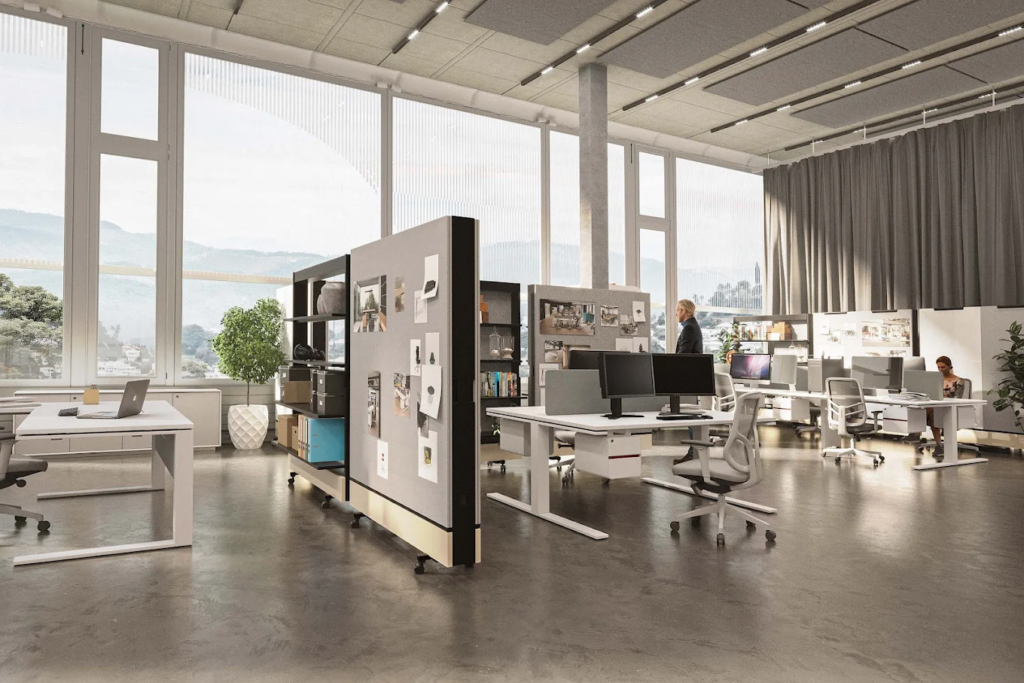


The question that should open every commercial interior architecture brief isn’t ‘what does our business look like today?’ It’s: ‘what range of configurations do we need to reach without a full refurbishment?’ That question changes every subsequent decision — workstation system selection, partition strategy, power routing, acoustic treatment.
It’s the question the best commercial furniture providers are built to answer. Urban 411 Office Furniture designs their collections around exactly this thinking — workstation systems that function as adaptable frameworks, not finished objects, evolving as the organisations using them evolve.
The clients who get the most value from commercial interior investment are the ones who buy systems rather than furniture. That distinction is the whole argument for modular architecture in commercial interiors — and the evidence has better supported it than it is right now.
FAQ: Modular Office Systems


Q: What are modular office systems?
Modular office systems are workstation and spatial division solutions whose components can be reconfigured without structural building work. Each component is designed to function within a larger system — layouts change, clusters ungroup, zones reposition as the organisation evolves. The result: a furniture investment that stays relevant across multiple configurations rather than becoming a constraint when the first configuration changes.
Q: How do modular office systems support hybrid working?
Hybrid working requires spatial variety compelling enough to justify the commute. Modular systems create that variety — focus zones, collaboration hubs, social spaces, acoustic pods — within a standard commercial floor plate. The modular design means those proportions adjust as hybrid patterns change across departments and seasons without any structural intervention.
Q: What is activity-based working, and why does it require modular furniture?
Activity-based working provides settings matched to different work modes rather than assigning fixed workstations per employee. Modular furniture is the physical enabler — it creates the variety of settings within a standard floor plate. It allows the balance between modes to shift as team structures and project types change. Fixed furniture with fixed purposes can’t support ABW. The spatial flexibility and the furniture flexibility are the same decision.
Q: How long does a modular office furniture investment last?
Quality modular commercial workstation systems have functional lifespans of 12–15 years with reconfiguration capability throughout. Fixed, non-modular systems typically require replacement at 6–8 years as organisational needs outgrow the spatial logic the furniture was designed around. The upfront cost differential is typically recovered within the first avoided refurbishment cycle.
Q: What role does biophilic design play in commercial interiors?
Biophilic design is a performance strategy, not an aesthetic preference. Evidence consistently links natural materials, daylight access, acoustic variation, and organic form to reduced stress, improved focus, and stronger employee retention. In 2025–2026, leading commercial architects specify biophilic principles at the structural level — in material selection, lighting architecture, and acoustic treatment — rather than as a decorative overlay applied after the fact.
- 9shares
- Facebook0
- Pinterest9
- Twitter0
- Reddit0