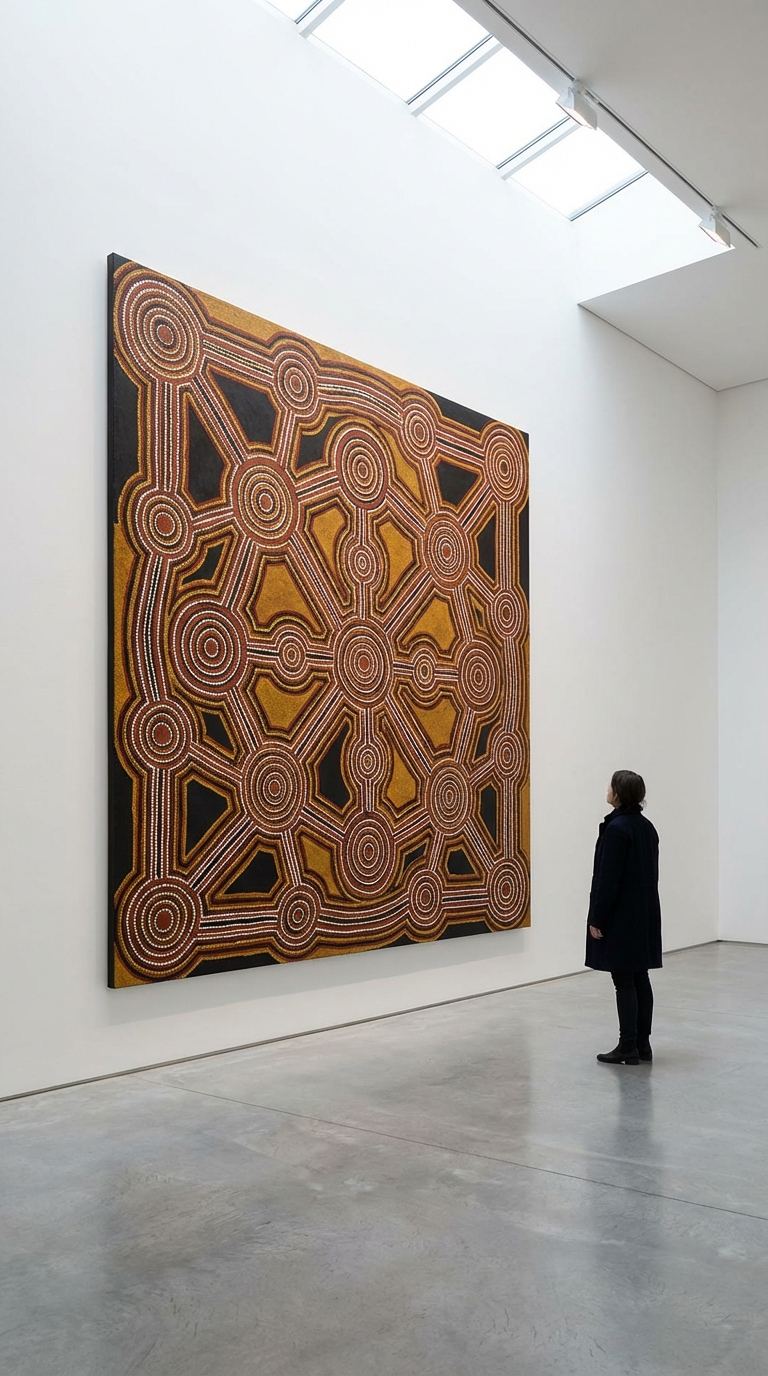
The first time I paid real attention to an Aboriginal painting — not a passing glance at a reproduction in a museum shop, but actual sustained looking — was in front of a large Clifford Possum Tjapaltjarri canvas at a Sydney gallery. It was a map. Not a decorative pattern, not an abstraction for its own sake, but a precise geographic record of Country: waterholes marked with concentric circles, Dreaming tracks connecting them, ancestor routes crossing the canvas the way roads cross a topographic chart. Once I understood what I was looking at, I could not stop seeing it.
- How Aboriginal Art Symbols Work: Context, Not Dictionary
- Regional Traditions: How Style Reflects Country and Culture
- How Aboriginal Art Reached the World: The 1971 Papunya Movement
- How to Look at an Aboriginal Work: A Practical Guide for Viewers
- Why This Tradition Belongs in Every Serious Art Education
- FAQ: Aboriginal Art
That shift in understanding — from pattern to meaning — is what this guide is for. Aboriginal art is the oldest continuous art tradition on Earth, with rock engravings in the Pilbara region of Western Australia estimated at 40,000 years old, and ochre pigment use documented at over 70,000 years. The works you encounter today in galleries and auction houses carry that deep continuity — the symbols, the compositions, and the stories encoded in them connect to ancestral knowledge systems that predate writing by tens of thousands of years. Knowing something about those systems transforms the viewing experience entirely.
This guide covers the visual language of Aboriginal art: what the symbols mean and why that meaning varies by context, the major regional traditions and how they differ visually and technically, the history of how contemporary Aboriginal art reached the international market, and what to look for when viewing or collecting a work.
The goal is not to provide a shortcut to meaning that belongs to specific communities — some knowledge in Aboriginal art is rightly held within communities and is not for outside audiences. The goal is to give you the contextual understanding that makes genuine engagement with the work possible.
How Aboriginal Art Symbols Work: Context, Not Dictionary
The most common mistake non-Indigenous viewers make when approaching Aboriginal art is looking for a fixed symbol dictionary — a key that translates each mark into a universal meaning. This approach fundamentally misunderstands how the visual language works. Symbols in Aboriginal art are context-dependent, not universally fixed.
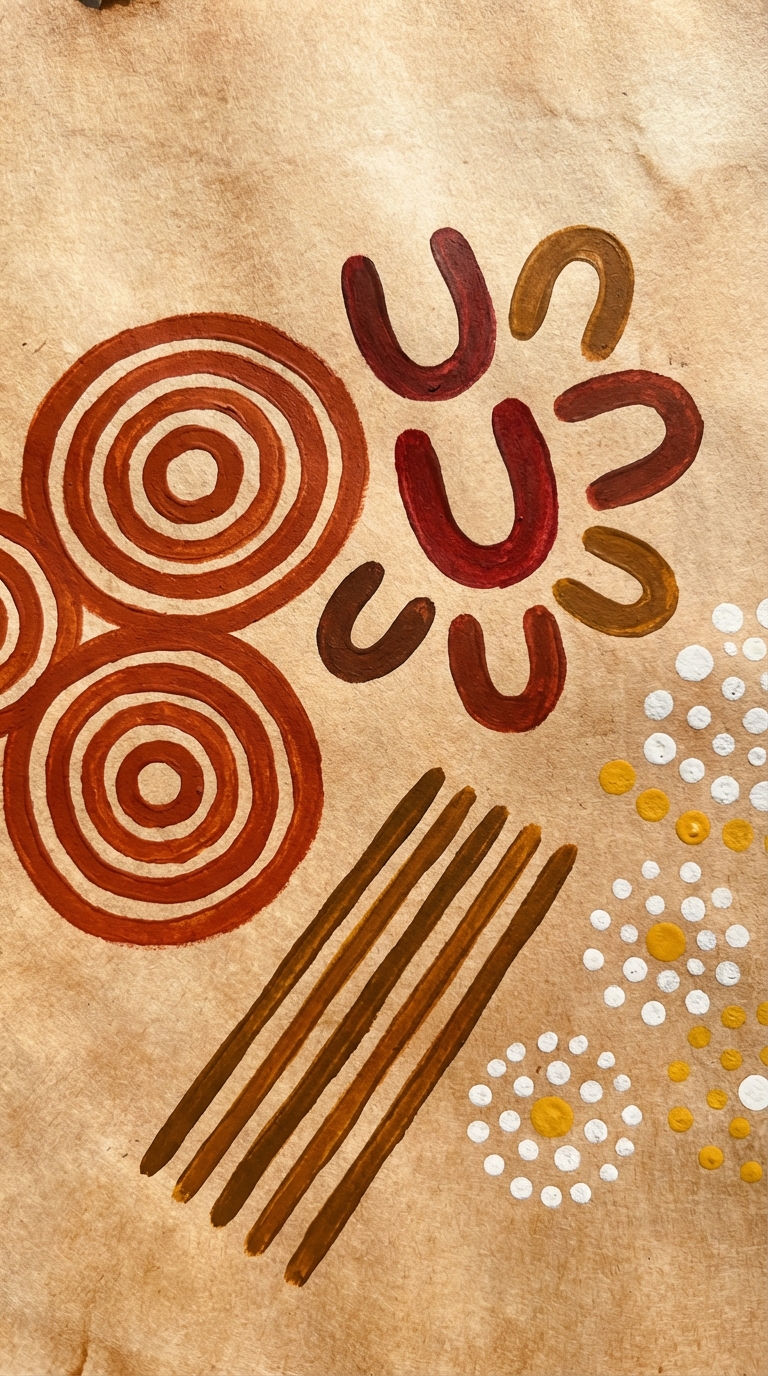
A concentric circle can represent a waterhole in one work, a campsite in another, a significant ceremony site in a third — and the same artist may use the same symbol differently across different works depending on the story being told, the audience intended, and the protocols governing what knowledge can be shared in public.
Shared Symbols, Individual Voices
Many symbols are shared across communities and language groups — the concentric circle, the U-shape representing a seated figure, the straight line for a path or river, the meandering line for a waterway. But shared symbols are not standardised symbols. They function more like shared grammatical structures than shared vocabulary — the same formal element is available to different artists, who use it to say different things in different compositional contexts. An artist from Yuendumu and an artist from Papunya may both use concentric circles, but the circles carry different story content, different geographic reference, and potentially different ceremonial associations.
The artist controls the layers of meaning in any given work. Some knowledge encoded in Aboriginal art is publicly available — the outer layer of meaning that can be shared with any viewer. Other layers of meaning are held within the community, within particular ceremony groups, or within family lines. A painting may communicate one story to a general audience while simultaneously encoding deeper knowledge for viewers with the appropriate cultural standing to receive it. This multi-layered communication is a deliberate feature of the tradition, not an accident of translation.
The Dreaming as Narrative Foundation
Most Aboriginal art symbol systems are grounded in the Dreaming — not a historical past or a mythological golden age, but an ongoing foundational reality that encompasses creation, law, kinship, land, and the relationships between all living things. Dreaming stories are not metaphors — they are accounts of actual events that shaped the Country and continue to govern correct behaviour within it. When an artist depicts a Dreaming story, they are not illustrating mythology; they are recording law and geography in visual form.
Understanding this reframes what a dot painting is. It is not decoration. It is a map, a legal document, a songline notation, and a ceremony record simultaneously — compressed into a visual language that can communicate across language boundaries while protecting ceremony-specific knowledge through selective revelation.
✏ Note: When viewing any Aboriginal work, prioritise the label information before forming any interpretation. The artist name, language group, community, and the title or story reference are not supplementary — they are essential. A work labelled ‘Tingari Cycle’ by a Pintupi artist from Kiwirrkurra carries entirely different cultural and geographic references from a work labelled ‘Country near Yuendumu.’ The same formal vocabulary, entirely different content.
Regional Traditions: How Style Reflects Country and Culture
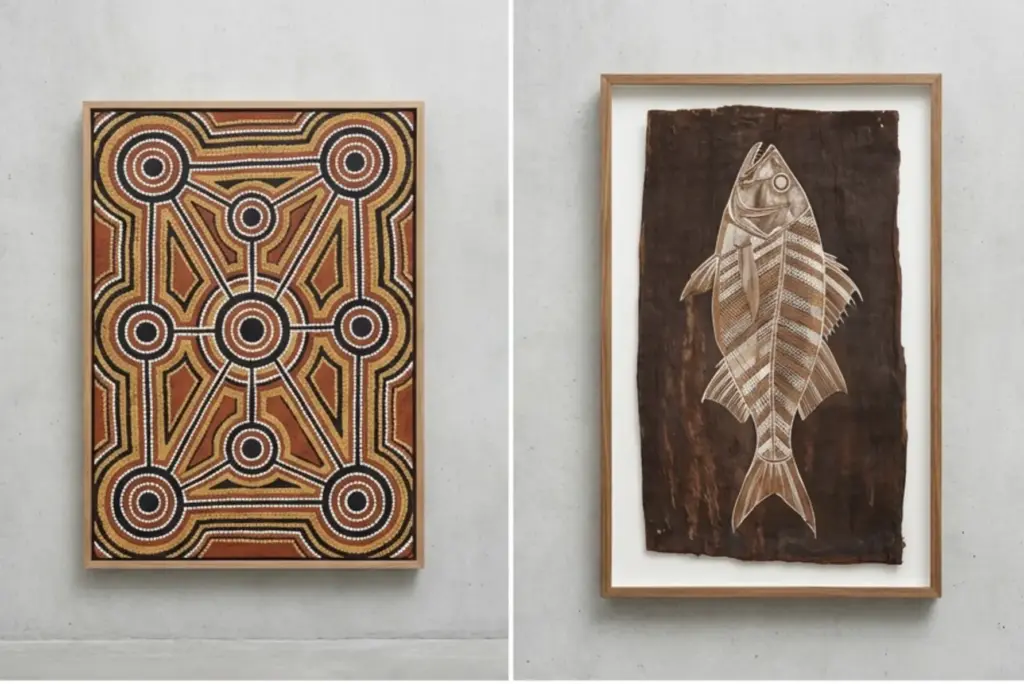
Aboriginal art is not a single style — it is a continent of styles, each rooted in the specific Country, language group, and ceremonial traditions of the community that produced it. The geographic and cultural diversity of Aboriginal Australia (over 500 distinct language groups at the time of European arrival) is directly reflected in the visual diversity of its art traditions. Understanding the major regional styles gives you a practical framework for situating any work you encounter.
Western Desert — Dot Painting Tradition
Language group: Luritja, Aranda, Pintupi, Warlpiri (Central Australia)
Key symbols: Concentric circles (waterholes, campsites, sites of significance), straight and curved lines (Dreaming tracks, paths between Country), U-shapes (seated figures), animal tracks
Palette: Ochre red, black, white, and yellow — the traditional ground pigment colours — supplemented by acrylic colour after the 1970s. Many artists work in the original four-colour palette; others have expanded significantly.
Technique: Acrylic on canvas (contemporary), originally ochre on wood or sand. Dot infill (the characteristic stippling) was partly developed to obscure sacred design elements for public display while maintaining the underlying composition.
Arnhem Land — Bark Painting and Rarrk
Language group: Yolngu, Kunwinjku, and other Arnhem Land language groups (Northern Territory)
Key symbols: X-ray depictions of animals and human figures showing internal anatomy, Mimi spirit figures, animals of the Country (barramundi, kangaroo, crocodile), clan designs
Palette: Natural ochres on stringybark eucalyptus. The bark is harvested, flattened, and dried before painting. Earth tones dominate: red, yellow, white, and black ochre on the bark ground.
Technique: Rarrk — the precise crosshatch pattern specific to each clan — is the defining technical element. Rarrk patterns identify clan affiliations and encode sacred knowledge. Fine parallel lines applied with a brush made from a single human hair characterise the finest examples.
Kimberley — Wandjina and Gwion Gwion
Language group: Ngarinyin, Worrorra, Wunambal (Western Australia Kimberley region)
Key symbols: Wandjina figures: large, round-headed spirit beings with white faces, enormous eyes, and no mouths, encircled by halo-like headdresses representing clouds and rain. Gwion Gwion (Bradshaw) figures: older, more dynamic, elongated human figures in movement.
Palette: Traditionally white ochre, red and yellow ochre, and black on rock surfaces. Contemporary Kimberley artists on canvas maintain this palette.
Technique: Wandjina paintings were traditionally repainted to renew their power and connection to rain and fertility. The repainting practice means that rock art sites carry accumulated layers of cultural intention across generations.
Southeast — Fibre Arts and Carving
Language group: Koorie peoples (Victoria, New South Wales), Noongar (Western Australia)
Key symbols: Geometric designs in weaving and basket work, possum-skin cloaks with incised clan designs, carved wooden forms. Symbols are carried in three-dimensional craft traditions as much as painting.
Palette: Natural fibres, possum skin, ochre for incised designs. Contemporary southeast Aboriginal artists work across media including printmaking, textile, and digital.
Technique: The southeast tradition was heavily disrupted by early colonial settlement and continues a process of revival and reconnection. Cloak designs encode clan knowledge that survived through family oral transmission even when the physical practice was interrupted.
How Aboriginal Art Reached the World: The 1971 Papunya Movement
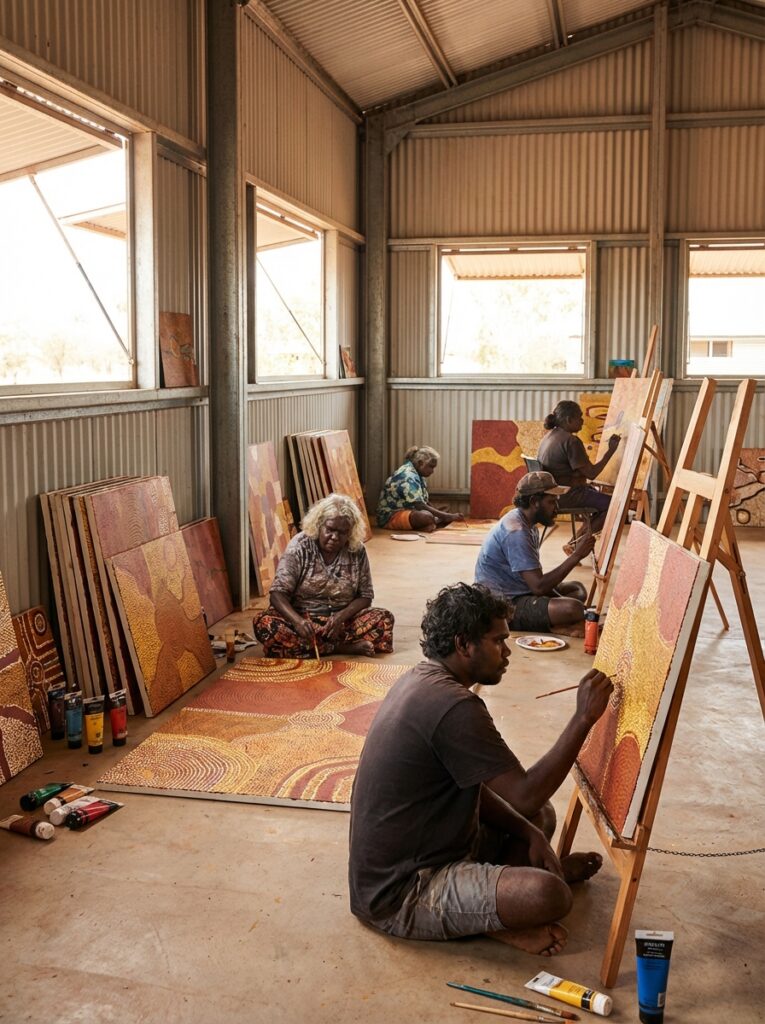
The contemporary Aboriginal art market as it exists today — international auction results, gallery representation in New York, London, and Paris, museum acquisitions in major institutions — traces directly to a specific moment: Geoffrey Bardon’s school wall at Papunya in 1971. Bardon, a non-Indigenous art teacher working at the settlement west of Alice Springs, encouraged Luritja and Aranda elders to paint Dreaming stories on a school wall. The elders agreed, and what began as a mural became the Papunya Tula Artists cooperative — the founding institution of the Western Desert art movement.
The founding artists — including Kaapa Mbitjana Tjampitjinpa, Clifford Possum Tjapaltjarri, and Tim Leura Tjapaltjarri — worked first on boards and later on canvas, using acrylic paint supplied by Bardon. The dot technique that became the movement’s signature was developed partly as a practical strategy: dots were used to fill in around sacred design elements, obscuring the ceremony-specific geometric forms at the composition’s centre while maintaining the overall visual logic of the work for public display. The adaptation was a deliberate cultural negotiation, not an aesthetic accident.
By the 1980s, Papunya Tula works were entering major auction houses and international collections. Clifford Possum’s large map paintings of Country — some exceeding three metres across — achieved prices that established Aboriginal art as a significant category in the international fine art market. The Papunya Tula model inspired the establishment of community-controlled art centres across remote Australia, creating the network that today represents hundreds of artists from dozens of language groups and ensures that artists receive direct payment for their work.
✏ Note: Community-owned art centres — Papunya Tula Artists, Buku-Larrnggay Mulka Centre in Yirrkala, Warmun Art Centre in the Kimberley, APY Art Centre Collective in the Anangu Pitjantjatjara Yankunytjatjara Lands — are the most ethically reliable source for collecting Aboriginal art. Purchasing through these centres ensures direct artist payment, accurate provenance documentation, and genuine community connection to the work. The National Association for the Visual Arts (NAVA) Code of Practice and the Australian Indigenous Art Trade Association (AITA) provide frameworks for ethical collecting.
How to Look at an Aboriginal Work: A Practical Guide for Viewers
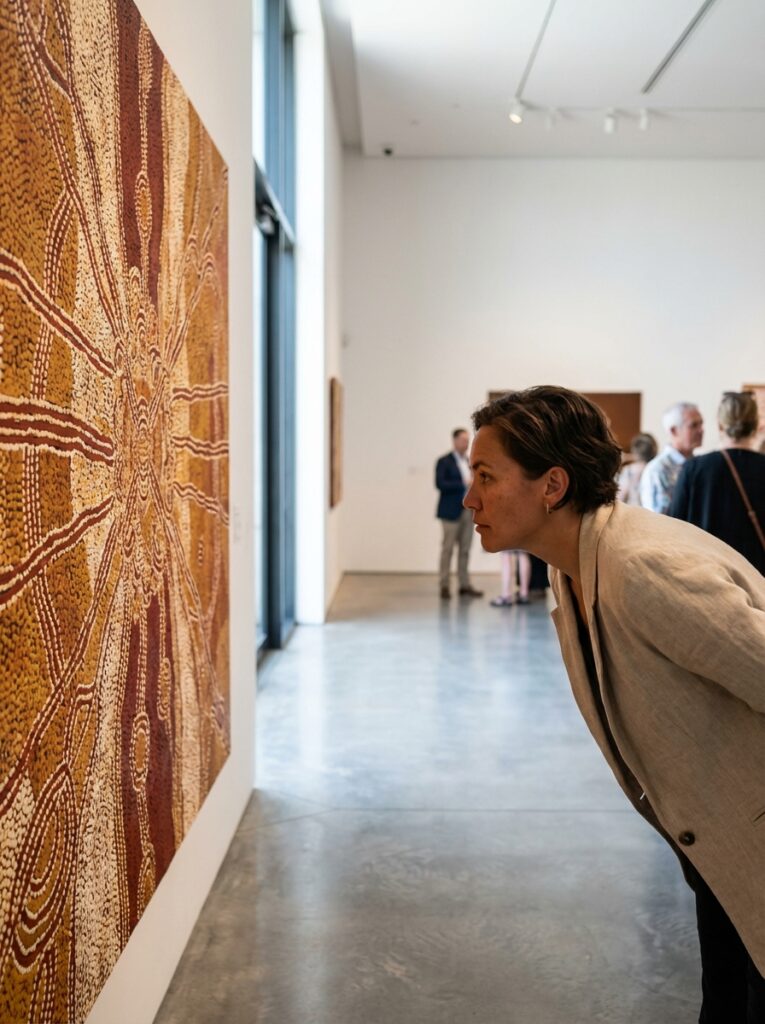
The most rewarding approach to Aboriginal art is patient looking combined with informed context. The visual complexity of many works rewards sustained attention in a way that can be missed on a quick walk-through.
Start with the Label
The artist name, language group, community, and story title are not supplementary information — they are the primary context without which the work cannot be correctly situated. A work by Emily Kame Kngwarreye from Utopia carries different cultural authority, different visual tradition, and different story content from a work by a Yolngu artist from Yirrkala — even if both are technically classified as Australian Aboriginal art. Read the label before looking at the work, not after.
Look for Compositional Logic
Most Aboriginal works have a compositional logic that reflects the geographic or narrative structure of the story being depicted. In Western Desert works, look for the network logic: how do the concentric circles connect to each other? The lines between them are not decorative — they are the routes between significant places, the Dreaming tracks that an ancestor travelled. Following those routes across the canvas is following the story through the Country.
Consider the Scale
Large-scale Aboriginal works — particularly the map paintings of Clifford Possum or the expansive Country paintings of Emily Kame Kngwarreye — reward physical proximity and distance alternately. At a distance, the overall compositional structure and the relationship between major elements is visible. Close up, the individual mark-making — the precise dotting, the fine rarrk lines, the layering of colour — reveals the technical discipline and time investment that the work represents. Most major Aboriginal works require at least five minutes of sustained attention at varying distances to begin to understand.
Why This Tradition Belongs in Every Serious Art Education
The symbols at the heart of Aboriginal art are not decorative motifs — they are a visual language developed over tens of thousands of years to encode geography, law, kinship, and story simultaneously. Understanding even a fraction of how that language works changes what you see when you look at the work. What read as pattern becomes place. What read as abstraction becomes record. What read as decoration becomes law.
For designers, illustrators, and artists, Aboriginal traditions offer one of the most sophisticated examples of how visual language can carry multiple simultaneous layers of meaning — functional, geographic, spiritual, and aesthetic at once. The dot painting tradition specifically is a masterclass in how a restricted formal vocabulary (a limited set of symbols, a constrained palette) can generate unlimited compositional complexity when the underlying knowledge system is deep enough to generate variation.
The international appetite for Aboriginal art in galleries and auction houses reflects a genuine recognition of this quality. What those markets sometimes flatten into aesthetic category is, in its full context, one of humanity’s most extraordinary ongoing creative traditions — alive, evolving, and still speaking in the language of Country that it has carried for longer than any other art tradition on Earth.
FAQ: Aboriginal Art
Q: What do the symbols in Aboriginal art mean?
Symbols are context-dependent — their meaning is determined by the artist, language group, Country depicted, and intended audience. Common symbols include concentric circles (waterholes, campsites, or significant sites), U-shapes (seated figures), straight and curved lines (paths or Dreaming tracks), and dotting patterns (ground cover, rain, or stars). The same symbol can mean different things in different works by the same artist. Some layers of meaning are deliberately held within the community and not shared with general audiences.
Q: What is the difference between Western Desert and Arnhem Land art?
Western Desert art (Papunya, Yuendumu, Alice Springs) is characterised by the dot painting style developed from 1971, using concentric circles and connecting lines on acrylic canvas. Arnhem Land art uses X-ray painting and rarrk crosshatch patterns specific to each clan, traditionally in ochre on stringybark bark. The visual languages, subject matter, and cultural references are distinct — both are major traditions within a much wider continent of regional styles.
Q: When did Aboriginal dot painting begin?
The modern dot painting movement began in 1971 at Papunya, west of Alice Springs, when art teacher Geoffrey Bardon encouraged Luritja and Aranda elders to paint Dreaming stories on a school wall. Key founding artists included Kaapa Mbitjana Tjampitjinpa and Clifford Possum Tjapaltjarri. Dots were introduced partly to obscure sacred design elements not intended for public viewing.
Q: How can I tell if an Aboriginal artwork is authentic?
Authentic works should include clear provenance: artist name, language group, community of origin, and the story or Country depicted. Purchase through community-owned art centres (Papunya Tula Artists, Buku-Larrnggay Mulka, Warmun Art Centre) or galleries complying with the NAVA Code of Practice and AITA guidelines. These sources ensure direct artist payment and genuine cultural connection.
- 1share
- Facebook0
- Pinterest1
- Twitter0
- Reddit0