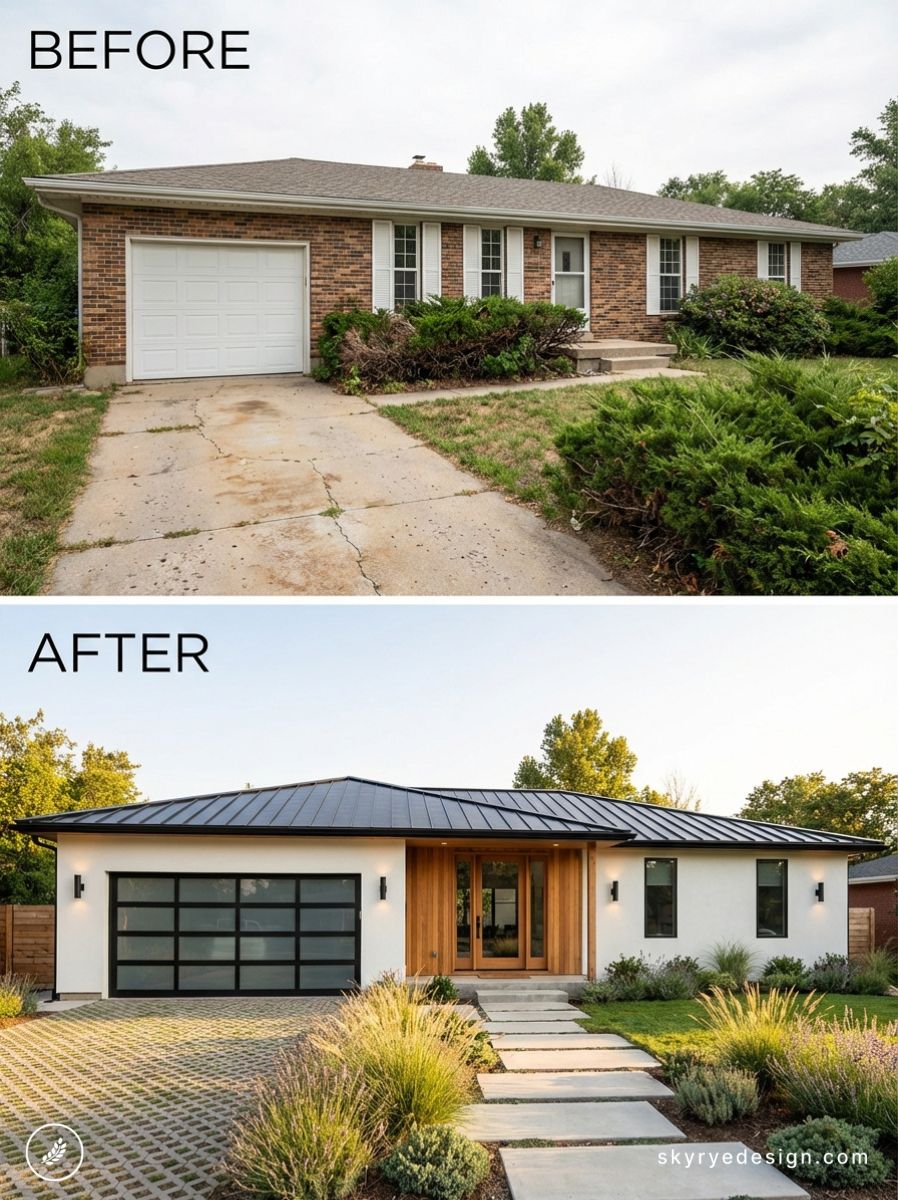
The house in the reference image at the top of this article is a perfect illustration of a specific renovation phenomenon: the same structure, the same footprint, the same street — and a completely different building. The before shows a 1970s brick ranch with a white garage door, shuttered windows, and foundation plantings that have been there since the Reagan administration. The after shows a contemporary home with a standing-seam black metal roof, white render, timber cladding at the entry, glass garage panels, and a concrete stepstone path through deliberately planted ornamental grasses.
- 01. Reclad the Exterior: The Single Biggest Visual Change
- 02. Replace the Garage Door: The Highest-ROI Single Change
- 03. Redesign the Entry: Door, Path, and Lighting Together
- 04. Update the Roof: The Canopy That Changes Everything
- 05. Transform the Kitchen Without Moving Anything
- 06. The Primary Bathroom: Fixtures and Tile That Change the Room
- 07. Replace the Windows: Light, Noise, and the Facade Together
- 08. Redesign the Front Garden: The Cheapest High-Impact Renovation
- 09. Repaint Interior Walls and Trim: The Fastest Transformation
- 10. Update the Lighting: The Detail That Changes How Everything Else Reads
- FAQ: Home Renovation Ideas
Not a single wall moved. The floor area is identical. The transformation is entirely surface — material selection, finish colour, fixture replacement, and landscaping — and yet the before and after look like two houses from different decades, built by different architects, selling at different price points. This is the promise of renovation done well: the structure stays, everything else changes.
The ten ideas in this guide are ordered by visible impact per dollar spent — starting with the exterior changes that transform a property’s first impression, moving through the interior updates that shift daily experience, and ending with the detail-level changes that are often overlooked but consistently make the difference between a renovation that looks finished and one that feels almost there. Each section includes specific costs, specific products worth considering, and the design logic that makes the change work.
01. Reclad the Exterior: The Single Biggest Visual Change
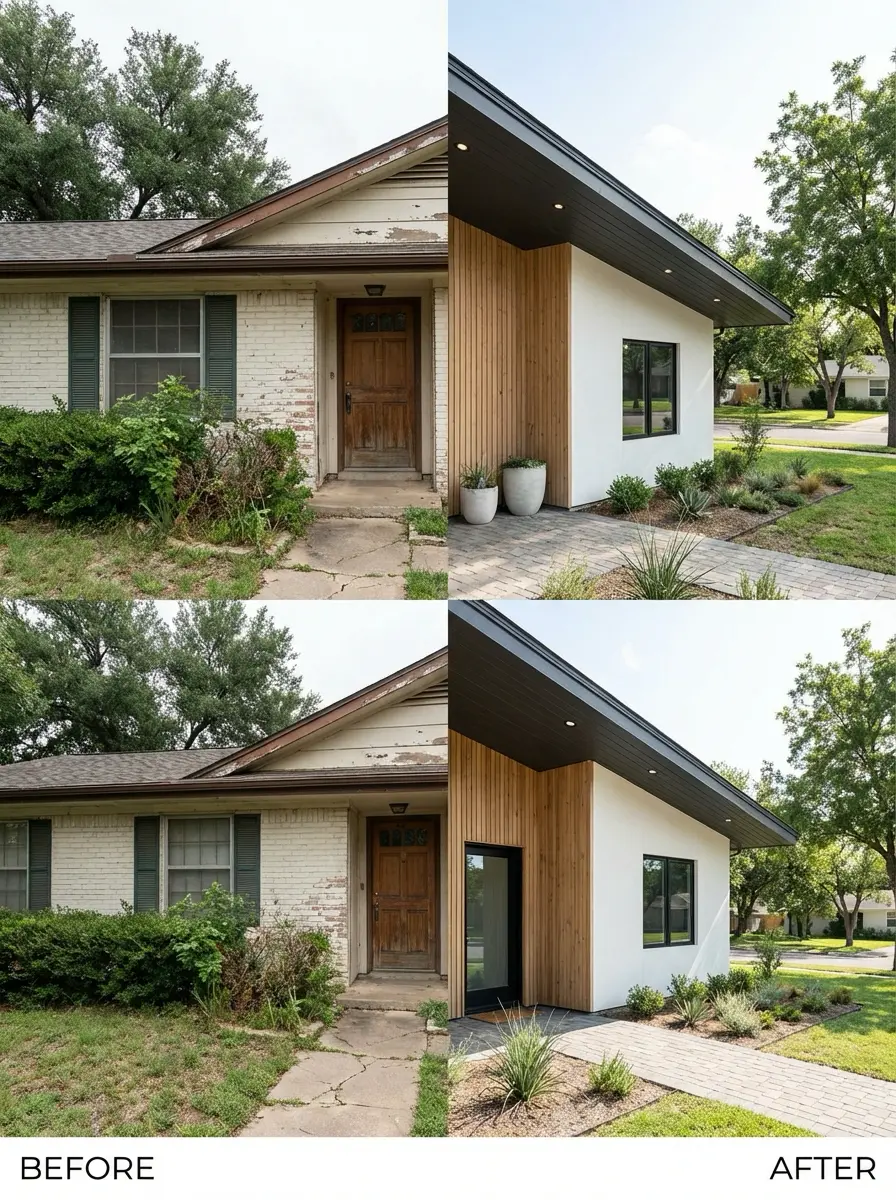
The facade material is the single most powerful change available in exterior renovation — more impactful than landscaping, more lasting than paint, and more transformative than any other intervention of equivalent cost. The before-and-after in the reference image makes this point clearly: the brick didn’t change, but the render over it and the timber cladding at the entry turned a 1970s ranch into something that could appear in an architecture magazine.
The most effective contemporary facade combination — the one appearing in the majority of high-impact renovation before-and-afters — is white or light grey mineral render on the primary wall surfaces, with a vertical timber cladding accent at the entry or on a specific wall plane. The render provides the clean, contemporary base. The timber introduces warmth and material complexity that prevents the all-render look from feeling cold or clinical. Together they create the contrast that makes a facade read as designed rather than defaulted.
Cost range: render over existing brick or cladding is $40-$80 per square metre installed depending on substrate condition and render type (acrylic render is less expensive and more flexible; mineral render is more durable and more vapour-permeable). Timber cladding for an accent panel at the entry — typically 6-10 square metres — adds $2,000-$5,000. The total for a typical ranch-style exterior is $15,000-$35,000 depending on size and condition. Return: consistently among the highest ROI exterior renovations available.
✏ Design note: The render colour matters more than most homeowners expect. Pure white reads as stark and shows every imperfection in direct sunlight. A warm white (Dulux Antique White USA or Taubmans Classic Cream) or a warm light grey (Dulux Tranquil Retreat or similar) photographs better, ages more gracefully, and creates a warmer relationship with the timber cladding accent. Sample the render colour at 300mm square on the actual wall and observe it at different times of day before committing.
02. Replace the Garage Door: The Highest-ROI Single Change
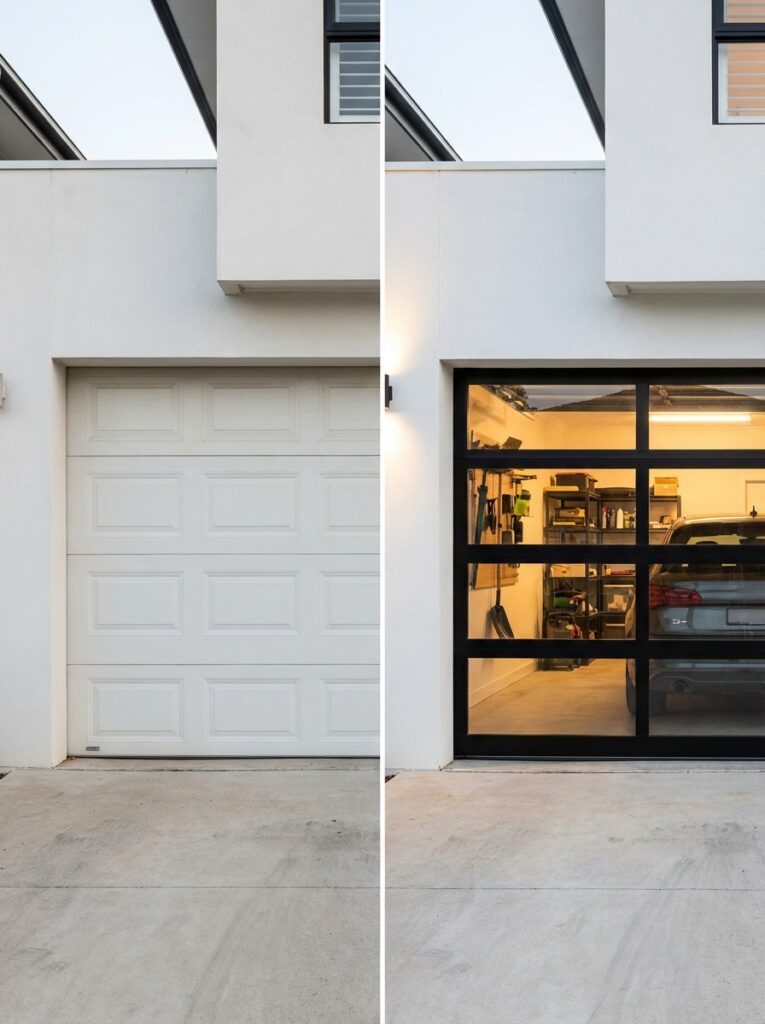
Remodeling Magazine’s 2025 Cost vs. Value report ranks garage door replacement as one of the highest-ROI renovation projects available — consistently returning over 190% of its cost in added home value. This is counterintuitive until you see a before-and-after: the garage door typically occupies 30-40% of the visible front facade on a single-storey home. A dated white raised-panel door is one of the most ageing elements of any 20th-century house. A contemporary glass-panel door is one of the most transformative single changes possible.
The reference image illustrates this precisely. The before has a plain white door that reads as default and institutional. The after has a full-view glass-panel door in black aluminium — the glass panels allow the interior garage lighting to glow through in evening light, the black frame ties to the black window frames, and the contemporary design adds an architectural quality to the facade that the render and cladding work reinforces.
Cost range: a standard steel raised-panel replacement door runs $800-$1,500 installed. A contemporary full-view glass-panel door in aluminium — equivalent to what’s in the reference — runs $3,500-$8,000 installed depending on size and specification. Black powder-coated aluminium frames with clear or frosted tempered glass panels are the current standard for this look. Motor and smart opener included in most installations.
03. Redesign the Entry: Door, Path, and Lighting Together
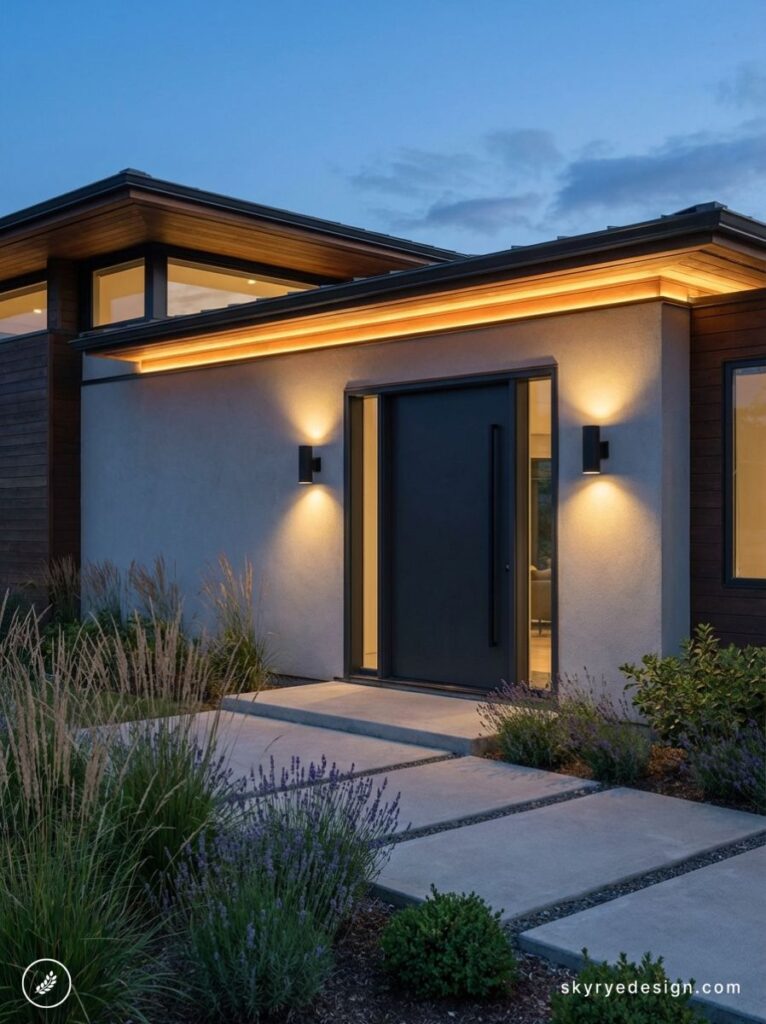
The entry is the moment of first contact — the point where the first impression of the renovation either holds or fails. A strong exterior facade transformation that leads to an unchanged 1990s panel door with a brass handle reads as unfinished. The entry door, the path that leads to it, and the lighting that frames it are a single design system and should be addressed together.
The contemporary entry formula that works: a solid-core door in a dark neutral — charcoal, black, or deep navy — with a clean frame and a single long lever handle or concealed hardware. Paired with this: two wall-mounted cylinder sconces in matching dark metal, positioned at door height on each side of the entry. Below: a concrete stepstone path (square or rectangular poured-concrete stepping stones, 600mm-800mm square, set into fine gravel or ornamental grass planting) replacing the standard concrete ribbon path.
The path redesign is the element most often skipped and most consistently noticeable in its absence. A concrete ribbon path that runs straight from the driveway to the door reads as utilitarian. Concrete stepstones through planting reads as intentional landscape design, transforming the approach sequence and making the entry zone feel like a designed space rather than a function. Cost: concrete stepstone path, $80-$150 per stone installed. Six stones = $500-$900 — a fraction of the visual impact.
✏ Design note: The lighting choice matters most at night, but needs to work in daylight too. Cylinder sconces in black or dark bronze read well in daylight as architectural details — they have presence without competing with the door. At night they cast a warm pool of light that frames the entry. Specify LED warm white (2700K-3000K) bulbs — cooler temperatures (4000K+) make the entry feel harsh and institutional at night, which undermines everything the daylight renovation achieved.
04. Update the Roof: The Canopy That Changes Everything
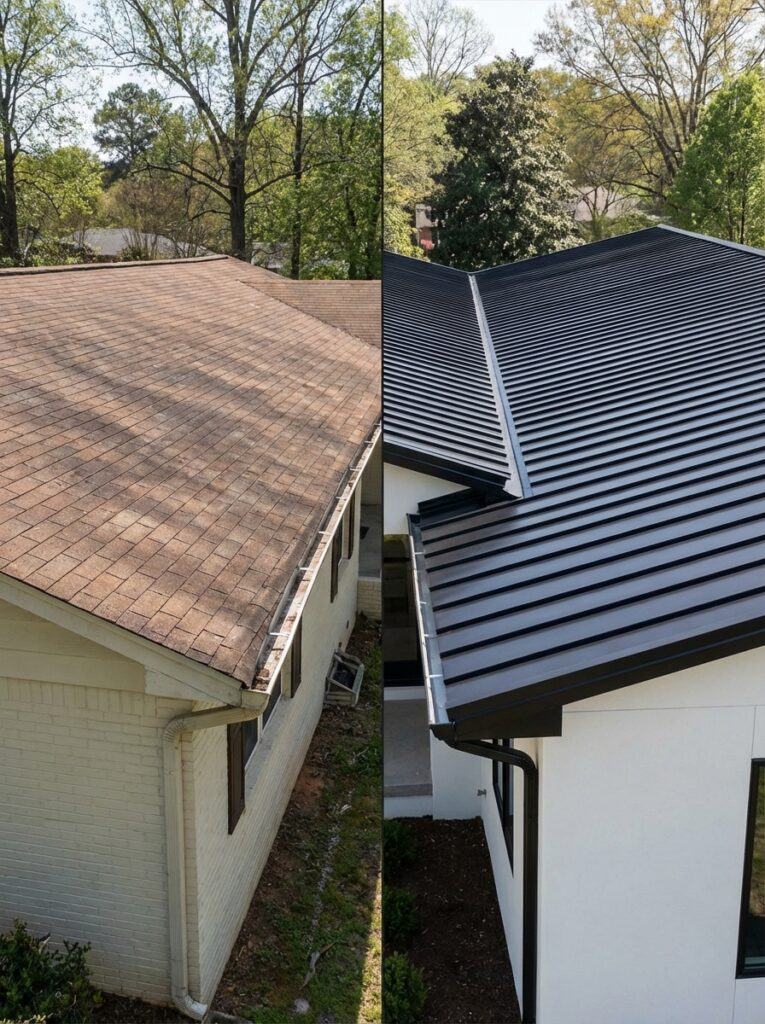
A roof replacement is rarely a design choice — it’s typically a maintenance decision. But the material you replace it with is entirely a design choice, and the reference image demonstrates why it matters. The before has brown asphalt shingles — the default choice, the cheapest option, the most common roof on mid-century American and Australian suburban housing. The after has a standing-seam black metal roof. The change in profile and colour is dramatic enough that the house reads as a different building even before accounting for the facade or garage door changes.
Standing-seam metal roofing — steel or aluminium panels with raised seams running vertically or horizontally — costs approximately twice as much as high-quality asphalt shingles but lasts 50+ years versus 20-25, requires almost no maintenance, and delivers a visual quality that no other roofing material achieves. The black colour specifically works against white or light render facades by creating a strong horizontal plane that defines the top of the building and grounds it visually.
Cost: standing-seam metal roofing runs $15-$30 per square foot installed, compared to $4-$8 for architectural asphalt shingles. On a 2,000 square foot ranch-style roof the difference is $22,000-$44,000 versus $8,000-$16,000. For a planned renovation where the existing roof needs replacement anyway, the metal upgrade represents the best long-term value and the most significant design improvement available.
05. Transform the Kitchen Without Moving Anything
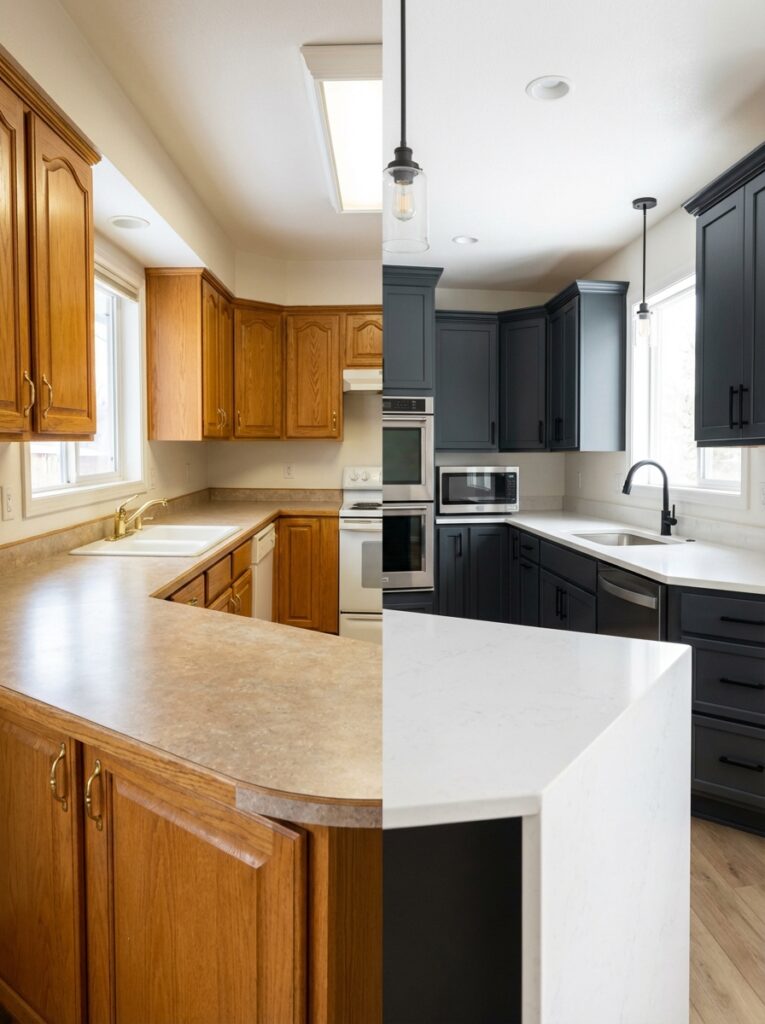
The most common kitchen renovation mistake is treating it as an all-or-nothing project: either a full gut renovation with new cabinetry, new plumbing layout, and new everything — which costs $40,000-$100,000 — or doing nothing because the full renovation isn’t in the budget. The middle ground is where the best value lives: keeping the cabinet boxes and the plumbing layout while changing the surfaces, hardware, and fixtures.
The three changes that transform a kitchen’s visual quality most effectively, in order of impact: (1) Replace the countertops — quartz is the current standard for its combination of appearance, durability, and maintenance-free surface ($4,000-$12,000 depending on size and stone selection). (2) Replace the cabinet hardware — bar pulls in matte black, brushed brass, or brushed nickel cost $5-$30 per handle; a kitchen with 30 handles updates completely for $150-$900. (3) Paint the cabinet fronts — not the boxes, just the doors and drawer fronts — in a deep neutral (charcoal, navy, or forest green for lowers; white or light grey for uppers). Professional cabinet painting runs $1,500-$4,000 and the result is unrecognisable from the before.
The kitchen faucet is the most frequently touched fixture in the kitchen and the one that dates the space most visibly when it’s wrong. Replacing a dated single-lever chrome faucet with a matte black or brushed stainless pull-down sprayer costs $200-$600 for the fixture and $150-$300 for installation. The fixture choices at suppliers like Ferguson Home consolidate faucets, sinks, and lighting options in one place, which makes it significantly easier to confirm that the finishes coordinate before purchasing any of them separately.
06. The Primary Bathroom: Fixtures and Tile That Change the Room
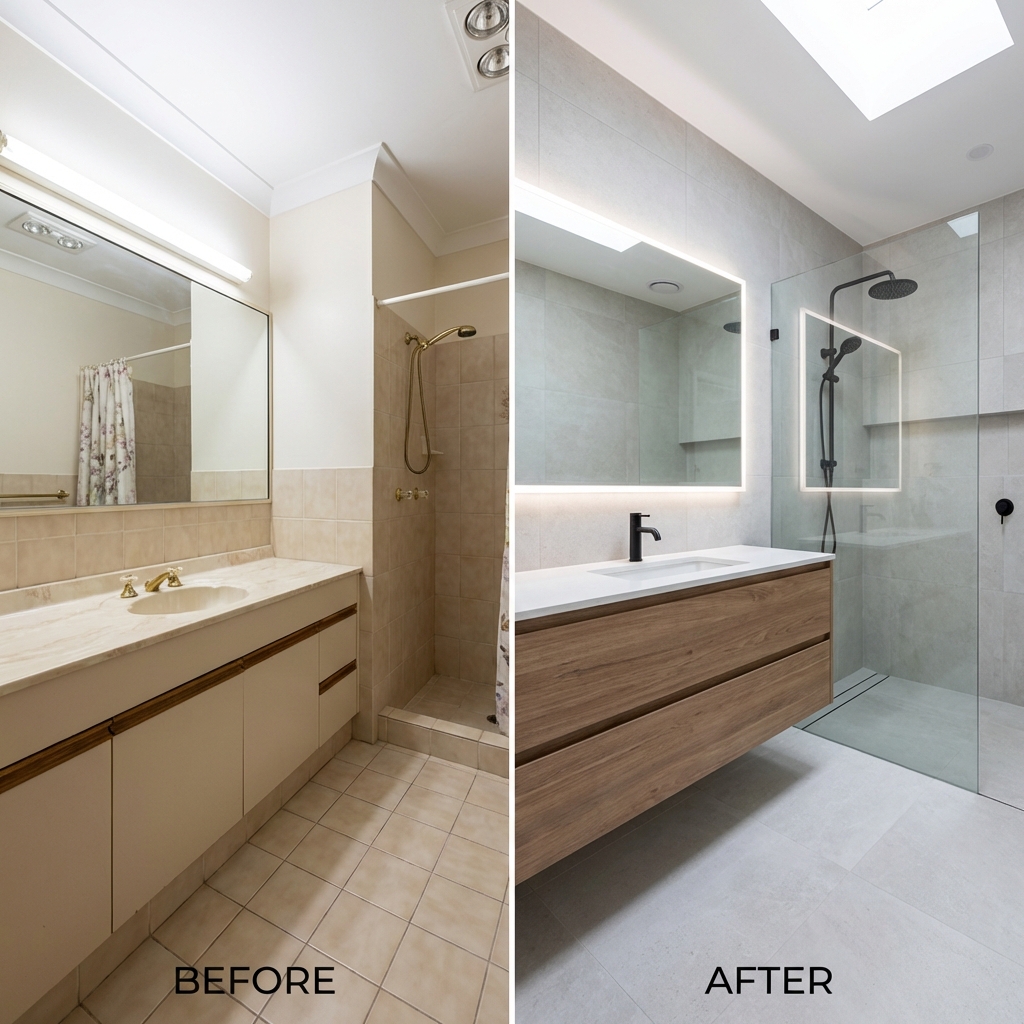
The primary bathroom is used multiple times every day — which makes its quality of experience more directly felt than almost any other room in the house. A dated bathroom isn’t just a visual problem; it’s a daily quality-of-life problem. The renovation doesn’t need to be structural to be transformative. The same footprint, the same plumbing layout, and the same room dimensions can produce a completely different experience with surface changes.
The changes that deliver the most impact: replacing the vanity (a floating timber-look or white lacquer vanity with an integrated sink costs $600-$2,500 and reads immediately as contemporary), updating the tapware (replacing all fixtures — tapware, shower fittings, towel rails, toilet roll holder — in a matching matte black or brushed nickel finish runs $800-$2,000 and creates the coordinated finish quality that makes a bathroom feel designed), and retiling the shower (large-format porcelain tile in the shower enclosure, $3,000-$8,000, eliminates the grout-heavy dated small-tile look that ages more than any other bathroom element).
The frameless glass shower screen is the single architectural change that most consistently transforms a bathroom. Removing a shower curtain or a framed glass screen and replacing it with a frameless 10mm glass panel opens the visual space of the bathroom significantly — the shower reads as part of the room rather than a separate zone, and the frameless detail communicates quality in a way that the framed alternative cannot match. Cost: $600-$1,500 for a standard single-panel frameless screen installed.
07. Replace the Windows: Light, Noise, and the Facade Together
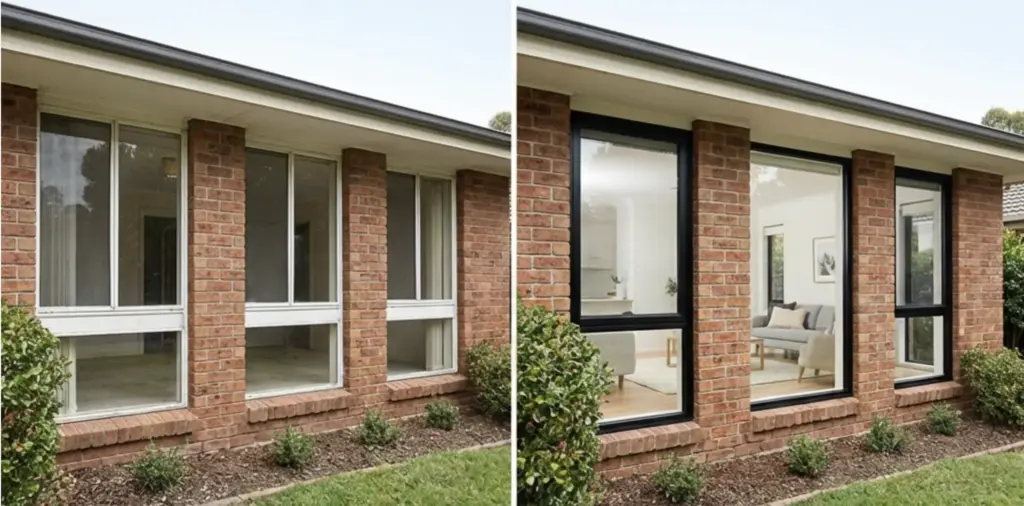
Window replacement sits at the intersection of performance and aesthetics — it improves energy efficiency, reduces noise transmission, and transforms the visual quality of the facade simultaneously. The black powder-coated aluminium window frames in the reference image’s after photo are doing as much work as the render and the roof in changing the building’s character. The same opening, the same size, a different frame colour and profile — and the house reads as contemporary.
The current standard for contemporary residential window replacement: double-glazed units with slim aluminium frames in black or dark charcoal — frame profiles as thin as 50-60mm are achievable with thermally broken aluminium, giving a near-frameless appearance that maximises the glass area visible from both inside and outside. The double glazing improves thermal performance significantly over single-pane units (reducing heat loss by approximately 50%) and reduces exterior noise transmission by 25-35dB depending on glass specification.
Cost: aluminium double-glazed replacement windows run $800-$2,000 per window installed depending on size and specification. A typical ranch-style house with eight to twelve windows costs $8,000-$24,000 for a complete replacement — a significant investment that’s most justified when the existing windows are single-pane, draughty, or visually incompatible with the renovation direction being taken elsewhere.
✏ Design note: The window frame colour is a facade decision, not a window decision. Before specifying black frames, hold a black painted sample against the facade and assess it with the door colour and any cladding material. Black frames work best against white or very light facades — against brick, they can read as too heavy. Dark charcoal or anthracite grey is often a better choice than pure black for brick facades, as it reads as strong without the high-contrast starkness of true black against warm masonry.
08. Redesign the Front Garden: The Cheapest High-Impact Renovation
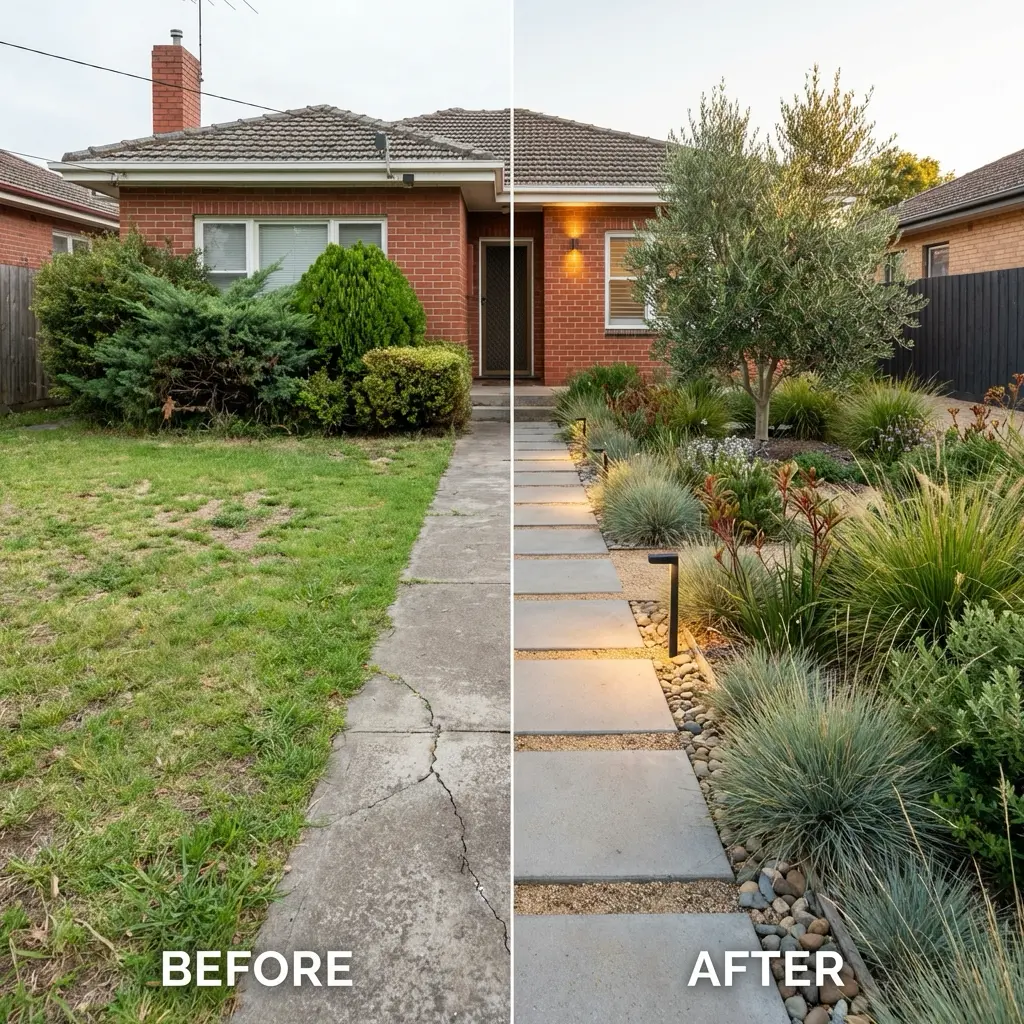
The front garden in the reference after photo does more work than any single renovation idea in this list. The concrete stepstone path through ornamental grasses and the removal of the standard lawn transforms the approach to the house from generic suburban to deliberately designed. This change is also among the cheapest available: removing the lawn, installing the gravel base, placing the concrete stepstones, and planting the ornamental grasses can be done for $3,000-$8,000 — less than a bathroom faucet replacement in some renovation budgets.
The contemporary front garden formula that reads as designed: no lawn (or a significantly reduced lawn), ornamental grasses as the primary ground cover (Festuca glauca, Lomandra longifolia, or Pennisetum setaceum — drought-tolerant, low-maintenance, and visually distinctive in every season), one or two specimen plants with strong structure (ornamental olive, Japanese maple, or architectural Agave for warmer climates), and concrete or stone stepstones rather than a concrete ribbon path.
Low-voltage LED pathway lighting along the stepstones is the addition that completes the design and makes the front garden as effective at night as it is in daylight. Staked pathway lights at 500-600mm intervals, $30-$80 per light, transform the approach sequence after dark and add a safety element that increases the practical value of the landscape redesign.
09. Repaint Interior Walls and Trim: The Fastest Transformation
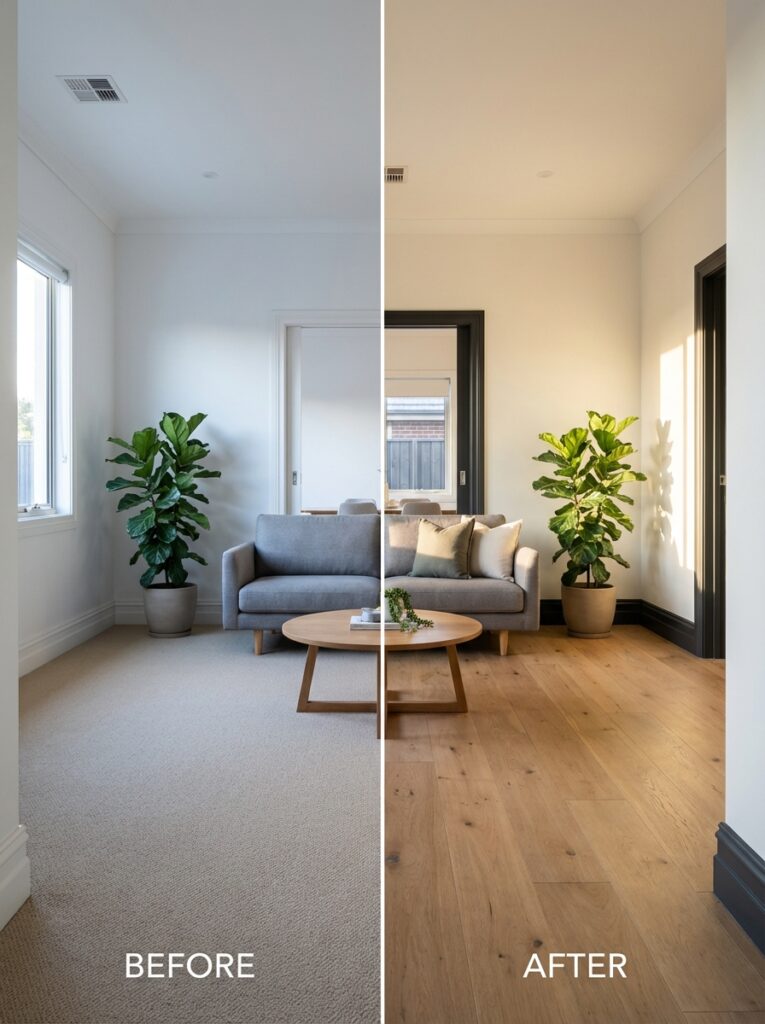
Paint is the most frequently underestimated renovation tool. Not because the colour itself is transformative — though colour matters — but because the decision about which surfaces to paint which colour is a design decision that most homeowners treat as a default. Builder-grade white on walls and white on trim reads as unfinished and impermanent. Deliberately specified colours — a warm white wall with a deep charcoal or black skirting board and door frame — read as intentional design choices that elevate the entire room without changing a single other element.
The specific approach that’s appeared consistently in interior renovation before-and-afters over the past three years: warm white or warm grey on the main wall surfaces, with the skirting boards, architraves, and door frames painted in a deep neutral — charcoal, black, or dark navy. This ‘dark trim’ approach visually grounds the room, makes the ceiling height feel more generous, and creates a frame around every opening that reads as architectural detail. The cost: professional interior painting of a standard living room, $800-$2,000 depending on size and condition.
The ceiling colour matters more than most guidance acknowledges. A standard white ceiling reads as the default it is. A ceiling painted in the same colour as the walls — particularly effective in smaller rooms — removes the visual interruption at the cornice line and makes the room feel larger and more deliberately considered. A ceiling painted 10-15% lighter than the wall colour achieves a similar effect with slightly more visual lightness. These are decisions that cost nothing extra but require someone to make them — which is why they so often default to standard white.
10. Update the Lighting: The Detail That Changes How Everything Else Reads
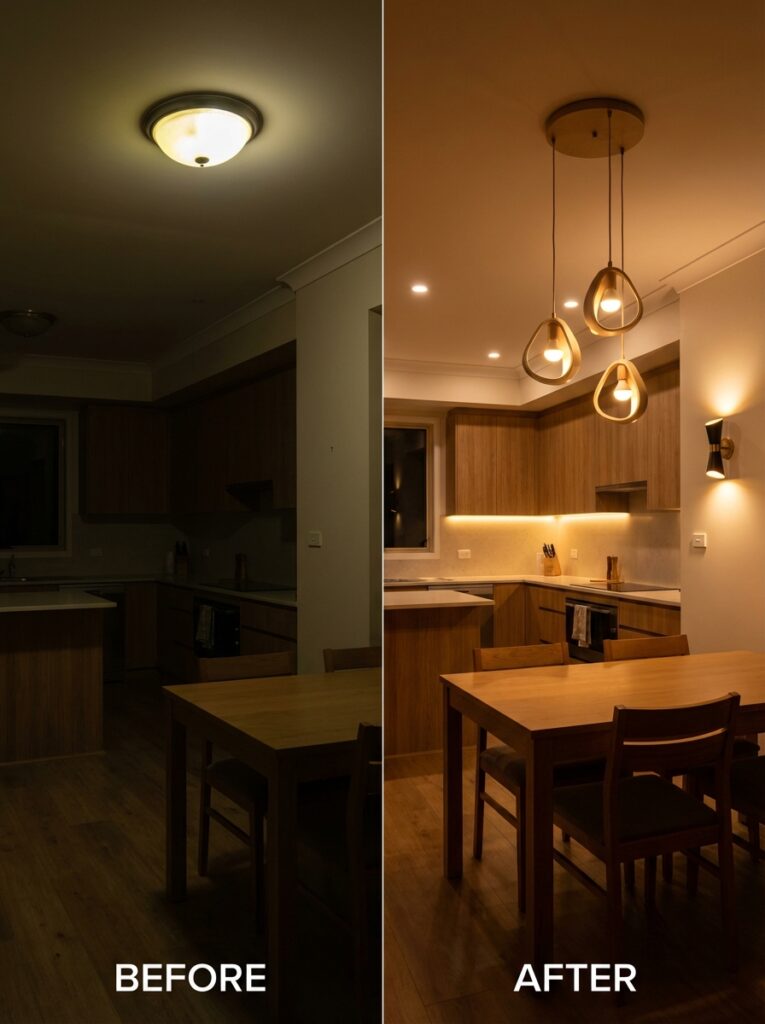
Lighting is the renovation idea most consistently added last and specified least carefully — which is particularly unfortunate because it affects the appearance of every other renovation decision made in the room. A beautifully renovated kitchen with flat, institutional ceiling lighting looks worse than a mediocre kitchen with well-designed layered light. The fixtures, the colour temperature, the layering of ambient, task, and accent light — these decisions determine how the space is experienced after dark, which is when most people actually live in it.
The contemporary residential lighting formula: recessed LED downlights for ambient illumination (warm white, 2700K-3000K, positioned to avoid shadows on working surfaces), a statement pendant or chandelier over the dining table or kitchen island (the primary architectural fixture, specified for design quality rather than function alone), under-cabinet LED strip lighting in the kitchen (the most functional addition — it eliminates the shadow cast by upper cabinets and makes the countertop work surface genuinely usable), and wall sconces in corridors and bedrooms (replacing floor-standing or table lamps with wall-mounted fixtures frees floor and surface space while maintaining the warm, low-level light quality of those sources).
When coordinating fixtures across rooms — pendant, sconces, downlight trims, bathroom tapware, kitchen faucet — the finish consistency is the detail that separates a renovation that looks considered from one that looks assembled. Spending time at a showroom that consolidates these decisions — like browsing options at visit Ferguson Home or similar fixture showrooms where pendants, sconces, faucets, and bathroom hardware are presented together — reveals coordination possibilities and incompatibilities before purchase rather than after installation.
✏ Design note: Specify lighting colour temperature before purchasing a single fixture. 2700K (warm white) is the standard for residential living, dining, and bedroom spaces — it reads as warm and domestic. 3000K is appropriate for kitchen task areas and bathrooms where clarity is a priority. 4000K+ (cool white) is institutional and should be avoided in residential interiors. All fixtures in a connected room should be the same colour temperature — mixing 2700K and 3000K within the same space creates visible colour casts that undermine the quality of both.
FAQ: Home Renovation Ideas
Q: What is the highest ROI home renovation?
Exterior upgrades deliver the highest return consistently. Garage door replacement returns over 190% of cost according to the 2025 Cost vs. Value report. Facade material updates — render over brick, timber cladding accents, new entry door — also rank highly. These changes transform the first impression of a property for a fraction of interior renovation costs and consistently add more appraised value than their investment.
Q: How much does a kitchen renovation cost?
A mid-range kitchen renovation (new cabinetry, countertops, appliances, no structural changes) costs $25,000-$60,000. The most cost-effective kitchen updates: replacing cabinet fronts ($3,000-$8,000), upgrading countertops to quartz ($4,000-$12,000), and replacing the faucet and sink ($700-$2,300). These three changes transform the visual quality at roughly 20% of a full renovation cost.
Q: What home renovations add the most value?
In order of ROI: exterior facade and landscaping, kitchen countertop and hardware update, bathroom fixtures update, garage door replacement, and window replacement. Prioritise visible, surface-level updates before structural ones — they deliver the most value per dollar and can be done in phases without disrupting the whole house.
Q: How do you plan a home renovation on a budget?
List every change, categorise as must/should/could. Fund the must list first. Prioritise by ROI — paint and hardware replacement are highest-ROI DIY tasks. Budget a 10-15% contingency for hidden problems. Do your own painting and hardware; hire professionals for plumbing, electrical, and structural work.
If the renovation is meant to change how the whole house feels, start with these home value kitchen remodel ideas and then compare the kitchen spend with larger home updates.
Q: What is the most important room to renovate first?
For high-yield room transformations, check out our guide to planning a budget-friendly bathroom remodel without losing quality.
Before breaking ground on structural extensions, explore how 3D printing in architecture can help you pre-visualize scale and proportions.
The exterior first if the goal is value or sale preparation — it’s the first impression that determines perceived quality. The kitchen first if the goal is daily liveability — it’s used multiple times every day and connected to the main living area. The primary bathroom second for liveability — a new vanity, fixtures, and updated tile deliver significant experience improvement at moderate cost.
When a renovation changes the garage approach, parking layout, or front elevation, the driveway budget should be checked early. Here is how to estimate the cost to pave a driveway before the exterior plan is locked.
- 368shares
- Facebook0
- Pinterest368
- Twitter0
- Reddit0