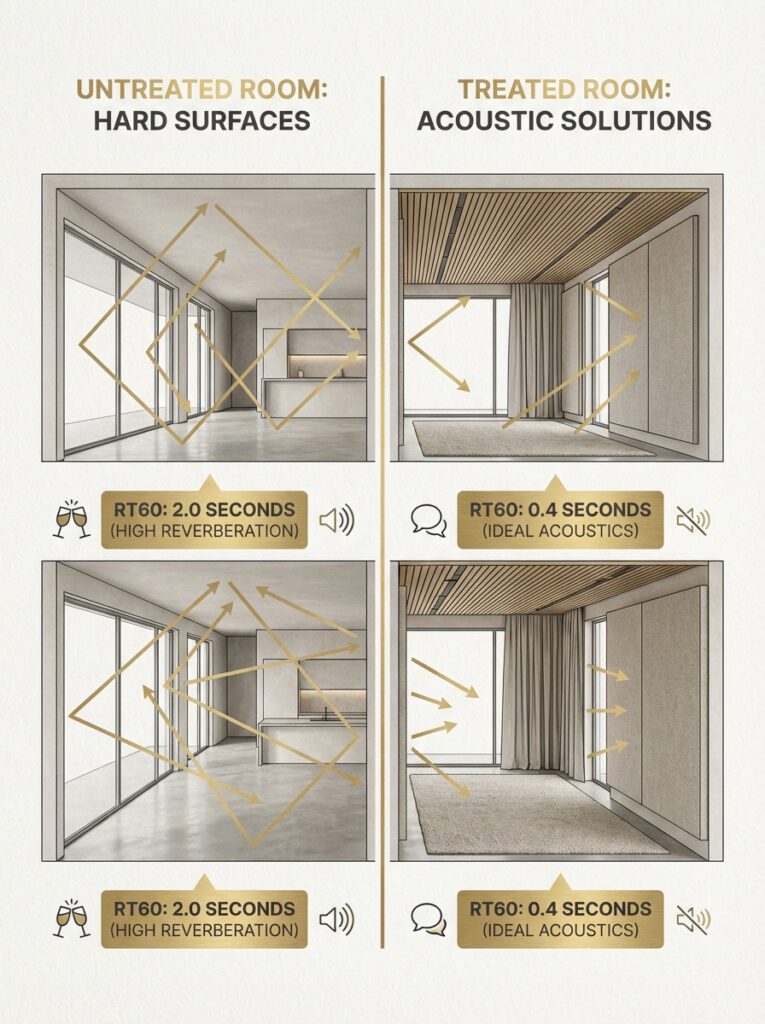
The first apartment I lived in with polished concrete floors and an open kitchen had a reverb time I could measure with a slow handclap. One sharp clap and the sound bounced between the kitchen splashback, the glass sliding door, and the plasterboard ceiling for just over two seconds before it died. Two seconds doesn’t sound like much until you understand that a well-designed living room has a reverb time closer to 0.4 seconds. I was living in something acoustically closer to an empty swimming pool than a home.
Acoustic comfort matters in resort villas too, especially when open interiors meet wind, water, and hard surfaces; the private island design guide covers that larger site logic.
The problem wasn’t that it was loud — nobody was making excessive noise. The problem was that every noise was loud. The refrigerator compressor at 2am. The neighbour’s footsteps one floor above, transmitted through the concrete slab with almost no attenuation. Conversations at normal volume that felt like they were happening in the same chair regardless of where in the apartment you were. The space looked exactly as good as the architect intended. It performed acoustically like nobody had thought about it at all — which, in 2008, they probably hadn’t.
The acoustic quality of a home is as much a design decision as its visual quality — and like visual design, it’s far cheaper and more effective to address during the design and construction phase than to fix afterward. This guide covers what causes the acoustic problems that are endemic to contemporary minimalist architecture, and the specific structural strategies that solve them without touching the aesthetic.
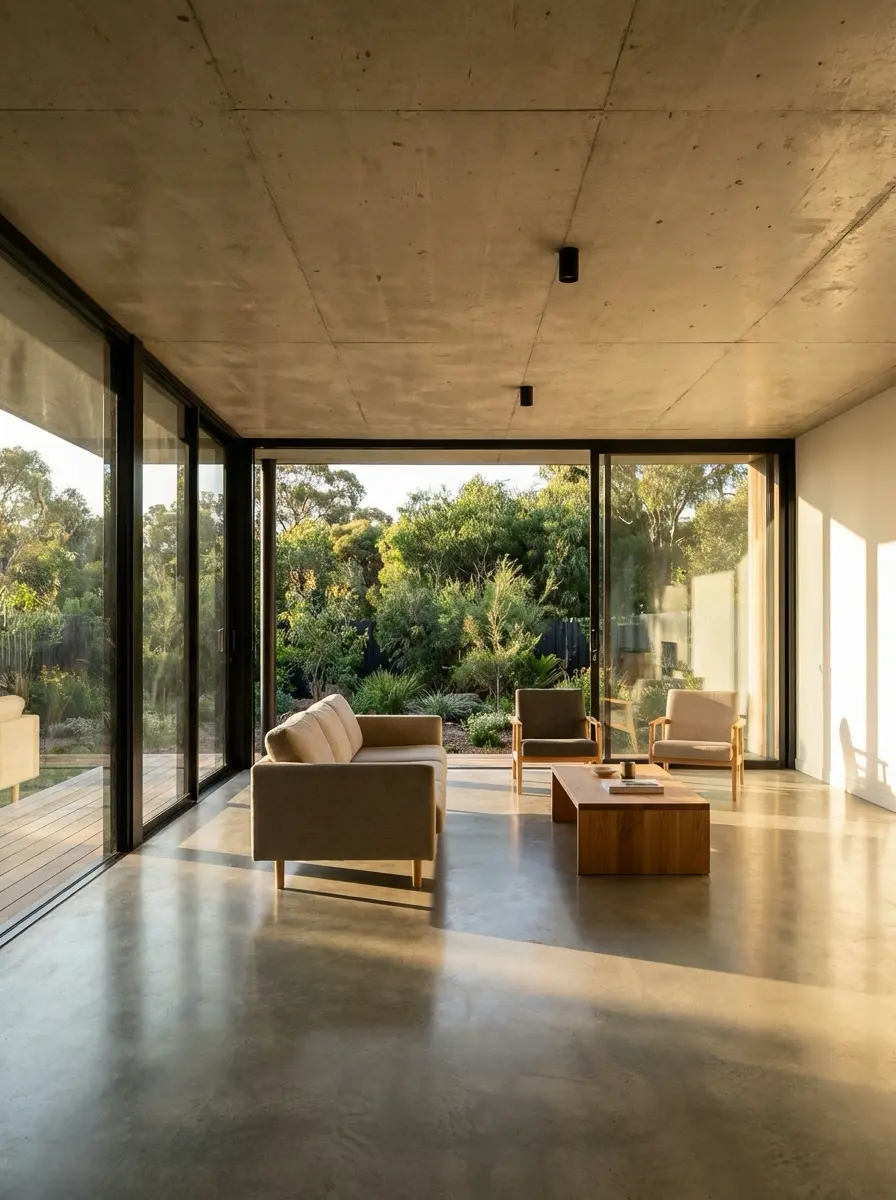
All of the techniques described here are invisible in the finished building. The surface looks identical. The space sounds completely different.
Why Modern Architecture Creates an Acoustic Problem
The visual language of contemporary residential architecture — open plans, hard surfaces, generous glazing, minimal furnishings — is also a description of the worst possible acoustic environment. Every design decision that makes a modern home look the way it looks makes it sound the way it sounds: reflective, reverberant, and incapable of containing noise within zones.
Hard Surfaces and Reverberation Time
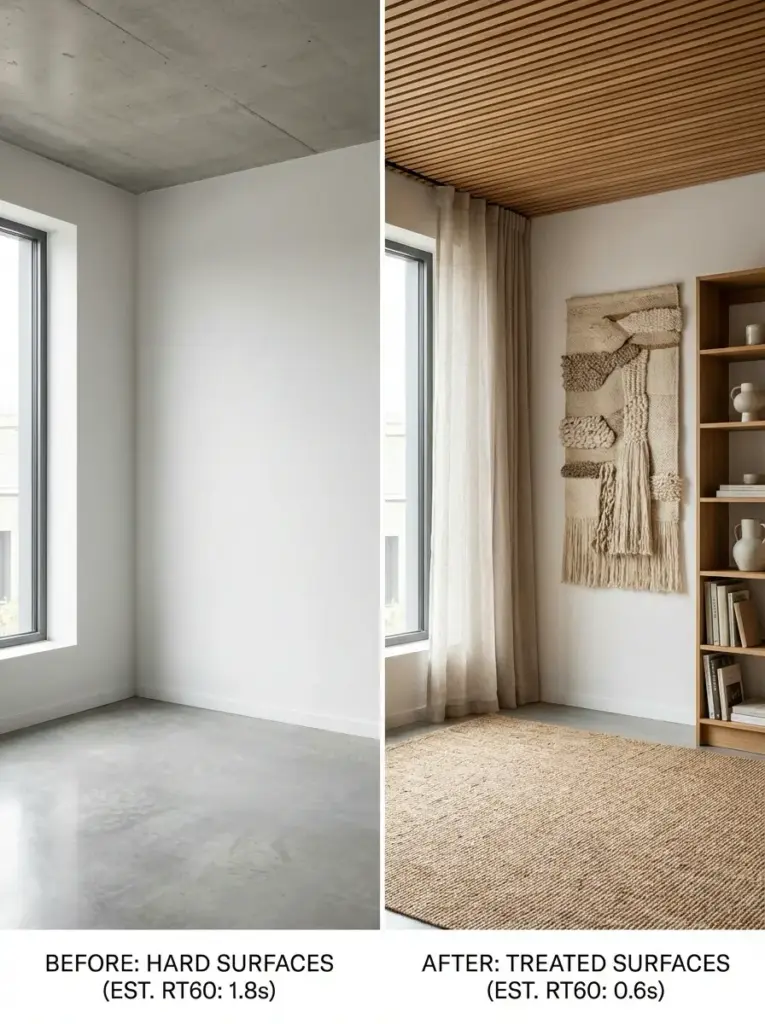
Sound behaves differently on different surfaces. Soft, porous materials — carpet, upholstered furniture, heavy curtains, timber with a rough surface — absorb sound energy, converting it to heat through friction in the material fibres. Hard, non-porous materials — polished concrete, glass, glazed tile, smooth plaster — reflect almost all sound energy back into the room. Reverberation time (RT60) measures how long it takes for a sound to decay by 60 decibels after the source stops. For comfortable speech intelligibility in a living room, the target RT60 is approximately 0.3-0.5 seconds. A room with all-hard surfaces — concrete floor, glass wall, plaster ceiling — can easily reach 1.5-2.5 seconds. In that environment, every sound you make is still audible half a second to two seconds after you’ve made it, layering on top of the next sound in an overlapping wash.
Open Plans and Sound Travel
Segmented rooms contain sound. A conversation in the kitchen stays in the kitchen because the walls interrupt and absorb the sound before it reaches the living room. Remove those walls and the kitchen conversation is now ambient noise for the entire ground floor. An open-plan layout is acoustically equivalent to one very large room — and large rooms have worse acoustic performance than small ones, because the same sound energy has more reflective surfaces to bounce between before it dissipates. The open plan’s visual quality — spaciousness, flow, connection — is purchased at a direct acoustic cost.
The health implications of this are not trivial. Environmental noise pollution — which includes the chronic low-level noise of a reverberant interior as much as traffic or industrial sources — is linked by the US EPA and the WHO to elevated cortisol levels, disrupted sleep, reduced concentration, and measurable cardiovascular effects with prolonged exposure. The research doesn’t distinguish between outdoor noise sources and indoor acoustic environments: a home that is chronically noisy to inhabit produces the same physiological stress response as external noise sources. Acoustic design is a health decision as much as an aesthetic one.
The Minimalist Trap
The conventional acoustic remediation for a reverberant room is soft furnishings: rugs, upholstered sofas, curtains, bookshelves filled with books. These work — fabric and paper absorb sound effectively — but they directly contradict the visual language of minimalism. A minimally furnished room with hard surfaces is a deliberately high-RT60 environment. The architect designing such a space has two options: accept the acoustic consequences and furnish accordingly, or address the acoustic performance in the structure itself — in ways that are entirely invisible in the finished building. The second option is the one this guide covers.
✏ Design note: When evaluating a modern home or apartment before purchase or rental, bring a set of car keys and drop them on the hard floor in the centre of the main living area. Count how long the impact sound takes to become inaudible. Under 0.5 seconds: good acoustic performance. 0.5-1.0 seconds: moderate — manageable with soft furnishings. Over 1.0 second: serious acoustic problem that will be pervasive in daily life. This test costs nothing and takes three seconds. It reveals more about acoustic performance than any amount of visual inspection.
Structural Acoustic Design: The Invisible Interventions
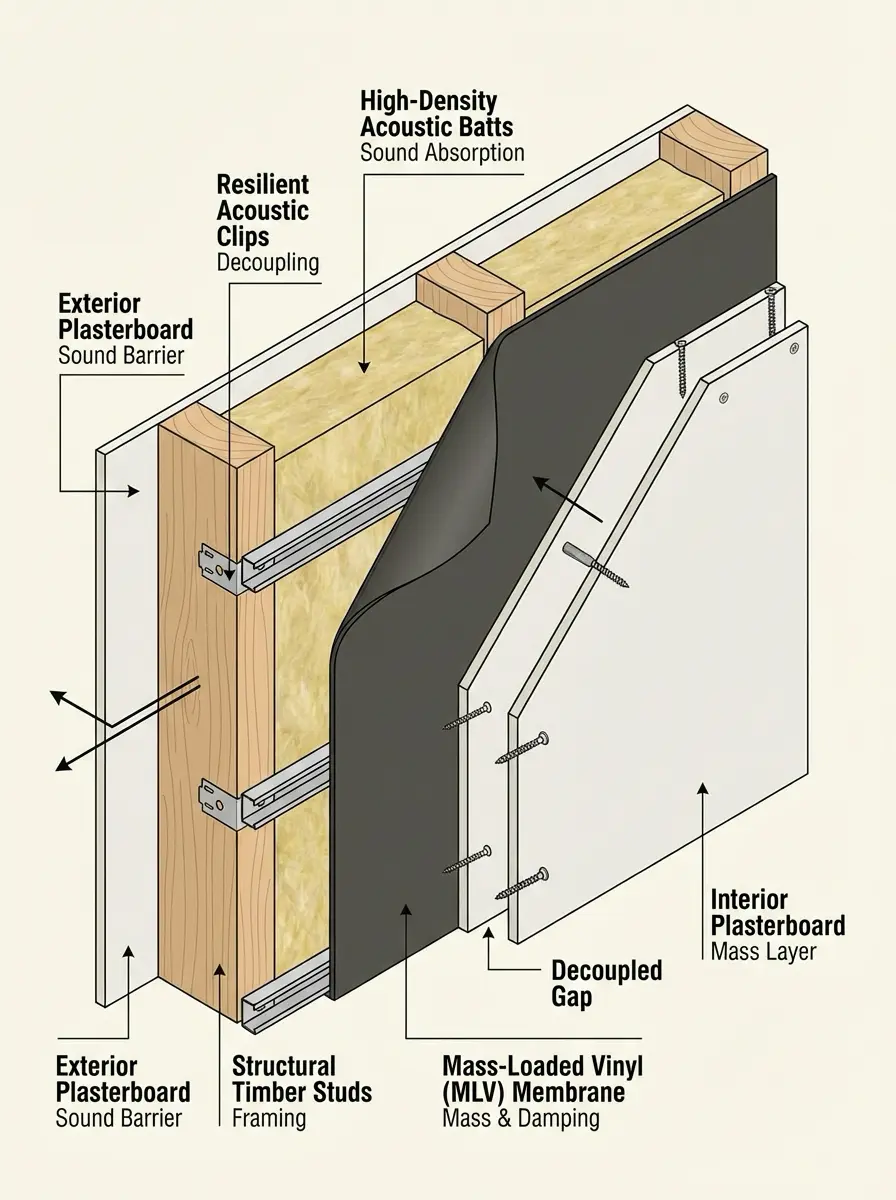
The most effective acoustic design is entirely invisible. It happens in the construction phase — in wall cavities, floor assemblies, and ceiling builds — and leaves no evidence on the finished surface. A wall with acoustic decoupling, high-density batts, and mass-loaded vinyl looks identical to a standard plasterboard wall. It performs at a completely different level.
Structural Decoupling: Breaking the Vibration Path
Sound travels through structures as vibration. When a sound wave strikes a wall surface, it generates vibration in that surface, which travels through the structure and radiates as sound on the other side. Structural decoupling interrupts this vibration path by preventing rigid contact between the surfaces on each side of the wall assembly.
The primary tool is the resilient acoustic clip — a rubber-and-steel mounting point that holds the interior plasterboard at a slight distance from the structural framing, with the rubber element absorbing and dissipating vibration before it reaches the plasterboard. A standard single-skin plasterboard wall achieves an STC (Sound Transmission Class) rating of approximately 33-38. The same wall with resilient clips, acoustic batts in the cavity, and double-layer plasterboard on one side achieves STC 50-58 — the difference between hearing a normal conversation clearly through the wall and hearing only the faint impression that someone is speaking. This performance improvement is entirely hidden; the wall looks identical from both sides.
Mass-Loaded Vinyl and Acoustic Batts
Mass-loaded vinyl (MLV) is a dense, flexible membrane — typically 1-2kg per square metre — installed within floor and ceiling assemblies between structural elements and finished surfaces. Its density interrupts the transmission of airborne sound, and its flexibility decouples it from the structure to reduce impact sound transmission. MLV is particularly effective in floor assemblies in multi-storey homes, where impact noise (footsteps, dropped objects) is transmitted through the structural slab. Installed between the slab and the finished floor surface — beneath engineered timber, beneath a concrete screed, or beneath a floating floor — it can reduce impact sound levels by 20-30dB.
Acoustic batts — high-density mineral wool or glass fibre insulation installed in wall and ceiling cavities — absorb airborne sound within the cavity, reducing the sound energy available to excite the opposite surface. The density matters: standard thermal insulation batts at 10-14kg/m³ provide limited acoustic performance; acoustic-grade batts at 40-60kg/m³ provide significantly better absorption. The visual and installation difference is zero — both look like insulation in the cavity. The acoustic performance difference is substantial.
Solid-Core Doors and Acoustic Seals
A hollow-core interior door has an STC rating of approximately 20-25 — it provides almost no acoustic separation. A solid-core door of the same dimensions achieves STC 28-34, and a properly specified acoustic door with perimeter seals achieves STC 35-45. In an open-plan home where acoustic zones are defined by doors rather than walls, the door specification determines the acoustic separation between zones. Pairing a solid-core door with perimeter acoustic seals (brush seals on the sides and head, an automatic drop seal at the bottom that lowers when the door closes) transforms a domestic interior door into a functional acoustic boundary.
For homeowners interested in residential soundproofing, the door and seal combination offers the highest acoustic return for investment of any single intervention — particularly for bedrooms, home offices, and any space where acoustic separation from the open-plan living area is required. A well-specified acoustic door costs approximately $800-1,500 installed, achieves meaningful acoustic separation, and is visually indistinguishable from a standard interior door.
✏ Design note: The weakest acoustic element in any wall assembly is typically not the wall itself but the electrical outlets and light switches. A standard back-to-back outlet installation creates a direct acoustic path through the wall — the cavity behind each outlet communicates between the two sides of the wall assembly. Offsetting outlet positions by at least one stud bay eliminates this path. Adding acoustic putty pads behind outlet boxes seals the air path around the fitting. These are two-minute interventions during construction that have no visible effect but meaningfully improve wall acoustic performance.
Acoustic Glazing: Keeping the View, Losing the Noise
Expansive glazing is the defining visual element of contemporary Australian residential architecture. It’s also the element most resistant to acoustic treatment — you can’t fill a window with insulation. The acoustic performance of standard glass is poor: a single 6mm pane achieves Rw (weighted sound reduction index) of approximately 30dB, which provides meaningful attenuation of high-frequency traffic noise but almost no attenuation of low-frequency urban rumble. The specific challenge of glazing is that visual transparency and acoustic performance work in opposition: the thicker and more complex the glass assembly, the better the acoustic performance and the more expensive, heavier, and thermally complex the window becomes.
The range of acoustic glazing solutions available to contemporary residential designers covers most performance requirements without visible compromise. The choice between them depends on the noise source (frequency profile of the external noise), the required performance level, and the existing window system.
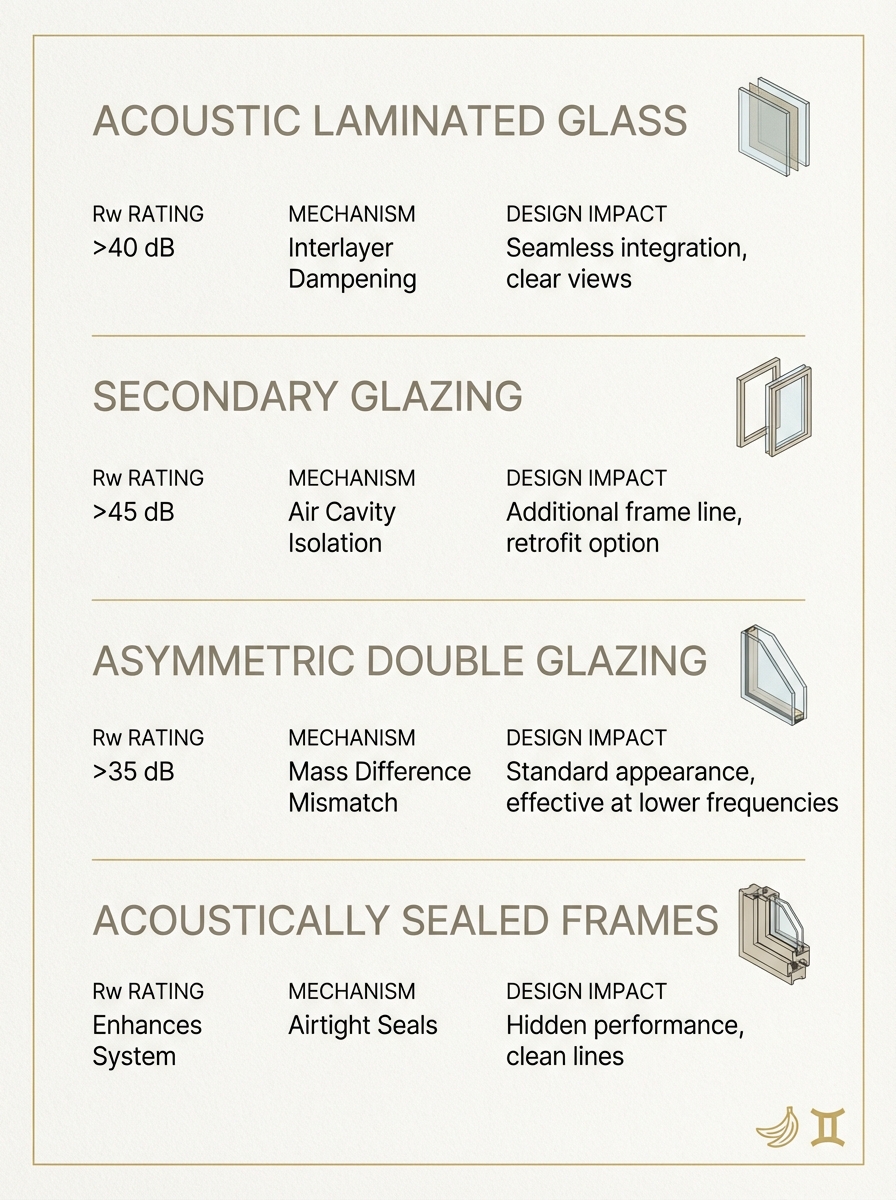
Well-designed simple home design ideas for new builds include specifying the glazing system at design development stage — before the window frames are ordered — because retrofitting acoustic glazing to an existing frame is significantly less effective than selecting the correct system from the beginning. The frame seal is as important as the glass specification: the best acoustic glass in a poorly sealed frame loses most of its performance at the air leakage paths around the perimeter.
Acoustic Laminated Glass
How it works: A polyvinyl butyral (PVB) interlayer bonded between two glass panes damps vibration across the glass surface. The PVB layer converts sound vibration energy to heat through internal friction, reducing the amount of energy transmitted to the interior.
Performance range: Rw 35-42dB depending on glass thickness combination. Most effective at mid and high frequencies (above 500Hz). Less effective at low-frequency traffic rumble below 250Hz.
Design impact: Visually identical to standard glass — the PVB interlayer is optically clear. Can be specified as a direct replacement for standard glass in most window systems without frame modification. The standard specification for new residential builds near moderate traffic noise sources.
Secondary Glazing
How it works: An independent inner window installed behind the primary window, creating a trapped air gap of typically 100-200mm. The large air gap is the primary acoustic mechanism — it decouples the two glass surfaces and provides exceptional attenuation of low-frequency sound that laminated glass cannot address.
Performance range: Rw 45-55dB for the combined assembly. The most effective solution for low-frequency urban noise (traffic, rail, mechanical plant). The air gap depth is critical — below 50mm the performance drops significantly.
Design impact: Adds an inner window reveal — visible but often integrated as an architectural element. The inner window can be openable independently of the outer window for ventilation. A practical solution for heritage buildings where the primary window cannot be replaced.
Asymmetric Double Glazing
How it works: Two glass panes of different thicknesses (e.g. 6mm outer + 10mm inner, or 6mm + 8mm) separated by a gas-filled cavity. Different thicknesses have different resonant frequencies, so the assembly attenuates a broader frequency range than symmetric double glazing where both panes resonate at the same frequency.
Performance range: Rw 38-48dB. Better low-frequency performance than symmetric double glazing of equivalent total glass weight. The thickness asymmetry is the performance differentiator — specify the thickness combination based on the dominant noise frequency from the external source.
Design impact: Visually identical to standard double glazing. Specified at the manufacturing stage — the thickness combination cannot be changed after the unit is made. Most effective when the external noise source has a defined frequency profile (e.g. rail noise with dominant 125Hz component).
Acoustically Sealed Frames
How it works: Acoustic performance of any glazing system is limited by the weakest path — typically air leakage at the frame perimeter. High-performance weather seals (multiple-contact brush or compression seals), thermally broken frames with acoustic gaskets, and sealant-applied perimeter treatments eliminate air leakage paths that bypass the glass performance entirely.
Performance range: Frame sealing can add 5-10dB to overall assembly performance at no cost to the glass specification. A poorly sealed frame with excellent glass typically underperforms a well-sealed frame with moderate glass.
Design impact: Invisible from the interior — seals are within the frame system. Should be specified for any acoustic glazing installation. A standard double-glazed unit in a well-sealed thermally broken frame often outperforms acoustic laminated glass in a poorly sealed standard frame.
Designing Acoustics Into the Architecture — Not Onto It
The distinction between acoustic design and acoustic treatment is critical. Acoustic treatment is what happens when acoustic problems are addressed after the building is complete: panels applied to walls, baffles suspended from ceilings, rugs added to floors. These interventions work, but they work against the aesthetic intent of contemporary minimalism, and they cost significantly more per unit of performance than structural acoustic design decisions made during the construction phase.
The Zone Strategy: Quiet by Design
Open-plan architecture doesn’t have to be acoustically uniform. A well-designed open-plan home uses spatial zoning — changes in ceiling height, changes in floor level, strategically placed mass elements, and changes in material palette — to create acoustic zones within the open plan without introducing walls. A sunken living area with a lower ceiling height has a smaller acoustic volume and a shorter reverberation time than the adjacent kitchen with high ceilings. A partial wall that doesn’t reach the ceiling contains enough of the sound path to meaningfully reduce the level of kitchen noise audible in the living area while maintaining visual connection and airflow.
Material Choices That Do Double Duty
Some material choices achieve both visual and acoustic goals simultaneously. Timber-lined ceilings — popular in contemporary Australian residential architecture for their warmth and character — scatter and partially absorb sound more effectively than smooth plaster, improving RT60 without any visible acoustic treatment. Bookshelves filled with books are one of the most effective acoustic diffusers available (irregular surfaces scatter sound in multiple directions rather than reflecting it coherently) and are a completely natural residential furnishing. A large, dense textile artwork on a wall is both a design element and a meaningful absorber. Acoustic design in a residential context is often about choosing between two material options that achieve the same visual result but different acoustic ones — and specifying the acoustically better option.
Acoustic Comfort as Spatial Luxury
The quietest rooms in the most expensive houses are quiet not because they’re expensively furnished but because they were designed acoustically from the first drawing. Sound level is the invisible quality metric of residential design — it’s not photographed, it’s not visible in the finished images, but it determines whether the home is genuinely comfortable to inhabit over years and decades. A visually stunning home that is acoustically uncomfortable is a home you eventually stop enjoying spending time in.
The premium end of the residential market has understood this for years: acoustic comfort has become a specification item in luxury residential briefs in the same way that thermal comfort and air quality have.
The structural interventions that deliver acoustic comfort — decoupled wall assemblies, mass-loaded vinyl in floor builds, acoustic glazing systems, solid-core doors with perimeter seals — add a modest percentage to the relevant construction costs and produce a result that is entirely invisible in the finished building. The space looks identical. The quality of daily life in it is fundamentally different.
✏ Design note: For homeowners considering a renovation that includes any structural work — a kitchen extension, a floor replacement, a window upgrade — the most cost-effective moment to address acoustic performance is during that work, not as a separate project afterward. Adding resilient clips and acoustic batts to a wall being re-lined costs almost nothing additional once the wall is already open. Adding mass-loaded vinyl to a floor being replaced is straightforward when the existing floor is already removed. The marginal cost of the acoustic specification is a fraction of the retrofit cost of doing it separately.
The Architecture of Silence
A well-designed quiet home is quiet in the way that good structural engineering is invisible — you don’t notice it because it’s working. You notice its absence when you spend time in a home where acoustic design was not considered, where the reverb time makes conversation exhausting and the slab transmits every footstep from the floor above.
The acoustic strategies covered here — structural decoupling, mass-loaded vinyl, acoustic batts, solid-core doors, acoustic glazing — are not specialist interventions reserved for recording studios or concert halls. They are standard residential construction techniques, available to any builder, specifiable in any architectural brief, and entirely compatible with the visual language of contemporary minimalism. They leave no trace on the finished surface. The walls are smooth, the glazing is clear, the floors are polished. The space sounds completely different.
The goal is a home that meets every visual standard you’ve set for it and exceeds every acoustic standard you didn’t know to set. A home where the refrigerator compressor is the loudest sound at 2am. Where a conversation in the kitchen stays in the kitchen. Where the reverberation time is measured in tenths of a second rather than whole seconds. That’s not an unreachable standard. It’s a structural decision, made during the design phase, that costs a fraction of what it costs to pursue after the walls are closed.
FAQ: Acoustic Design in Modern Homes
Q: Why do open-plan homes have poor acoustics?
Open-plan layouts remove the walls that naturally absorb and interrupt sound travel. Without room divisions, sound reflects between hard surfaces — concrete, glass, plaster — across the entire floor area. Reverberation time can reach 1.5-2.5 seconds in an all-hard-surface open plan, compared to the 0.3-0.5 second target for comfortable living spaces. Every noise becomes ambient noise for the whole floor.
Q: What is structural decoupling?
Structural decoupling prevents rigid contact between the two surfaces of a wall assembly, interrupting the vibration path that transmits sound. Resilient acoustic clips hold interior plasterboard away from the framing structure, absorbing vibration before it reaches the finished surface. A standard wall achieves STC 33-38; a decoupled assembly with acoustic batts achieves STC 50-58 — the difference between clearly hearing a conversation through a wall and hearing only its faint impression.
Q: What is the best acoustic glazing for a modern home?
Acoustic laminated glass (PVB interlayer between panes, Rw 35-42dB) is the standard for new builds near moderate traffic noise. Secondary glazing (independent inner window with large air gap, Rw 45-55dB) provides the highest performance for low-frequency urban rumble. Both require properly sealed frames — frame air leakage reduces performance by 5-10dB regardless of glass specification.
Q: Does acoustic treatment have to be visible?
No — structural acoustic design is entirely invisible. Decoupled walls, acoustic batts, mass-loaded vinyl in floor assemblies, and acoustic glazing all operate behind finished surfaces. Visible acoustic panels are a remediation approach for problems not addressed during construction. A home designed acoustically from the beginning requires no visible treatment — the performance is built into the structure.
Q: How much does residential acoustic design add to construction cost?
Acoustic upgrades during construction typically add 3-8% to the relevant construction elements (walls, floors, glazing) — not the total build cost. Retrofitting the same performance after construction costs 3-5 times more per element. The economic case for structural acoustic design during construction is clear: the upgrade cost is small, the retrofit cost is disproportionately large.
Acoustic comfort and visual comfort often meet on the same surfaces. The guide to textured wall finishes and wallpaper is useful when a room needs warmth and depth without adding clutter.
- 62shares
- Facebook0
- Pinterest62
- Twitter0
- Reddit0