Couple bedroom ideas work best when the room feels shared, not staged. A married couple bedroom has to hold two routines, two comfort levels, two visual tastes, and one clear mood at the end of the day. That is why the best decor choices usually start with lighting, bedding, storage, and one personal focal point.
We spent three years sleeping in a bedroom that looked like a hotel room: neutral, inoffensive, and completely forgettable. The shift happened when we replaced the generic landscape print above the bed with something we actually cared about. One intentional decor choice changed the room faster than another set of matching pillows ever could.
- Couple bedroom ideas that make the room feel shared
- 1. Start married couple bedroom decor with one statement piece
- 2. Use layered lighting for a romantic bedroom
- 3. Choose couple bedroom colors that work for two people
- 4. Choose bedding both people actually like
- 5. Add personal wall decor without visual clutter
- 6. Add natural texture to soften the bedroom
- 7. Give each person a useful nightstand zone
- 8. Use scent as a subtle romantic bedroom detail
- 9. Design the bedroom for mornings too
- 10. Keep editing the room as the relationship changes
- Recommended brands and budget guide
- More bedroom and interior design ideas
- Couple bedroom ideas FAQ
- Q: What is the most important element in couple bedroom ideas?
- Q: How do we decorate a bedroom when we have completely different tastes?
- Q: How much should a couple spend on bedroom decor ideas?
- Q: Where should couple artwork be placed in a bedroom?
- Q: What bedroom colors work best for couples in 2026?
- Q: What are good small bedroom ideas for couples?
- Q: How do you make a couple bedroom feel romantic without looking cheesy?
- Final take on couple bedroom ideas
That is the part many bedroom decor guides miss. Bedroom decor ideas for couples are not about copying a showroom or buying the same nightstands. They are about making a room that supports connection and rest without erasing either person’s taste.
Couple bedroom ideas that make the room feel shared
Start with a simple decision order: choose the mood, fix the lighting, agree on bedding, then add art and personal details. If the bedroom is small, solve storage before adding decor. If the room feels cold, add warm light, texture, and one natural material before buying more accessories. These 10 married couple bedroom decor ideas range from $20 weekend edits to bigger investments, but the goal is the same: meaning over matching.
| Bedroom issue | Best decor move | Why it helps couples |
| The room feels generic | One large personal art piece | Creates a shared focal point without cluttering the wall. |
| The room feels tense at night | Layered warm lighting | Lets each person read, relax, or sleep without one harsh overhead light. |
| Tastes clash | 60/30/10 color palette | Gives both people a visible say without making the palette chaotic. |
| The room is small | Matched storage zones and edited nightstands | Keeps daily routines from turning into visual noise. |
1. Start married couple bedroom decor with one statement piece
Most couples start with a gallery wall — 12 frames, three sizes, arranged on a Sunday afternoon. Three months later, it’s overwhelming, and nobody knows what to look at.
A better approach: one large, intentional piece above the bed that does all the work.
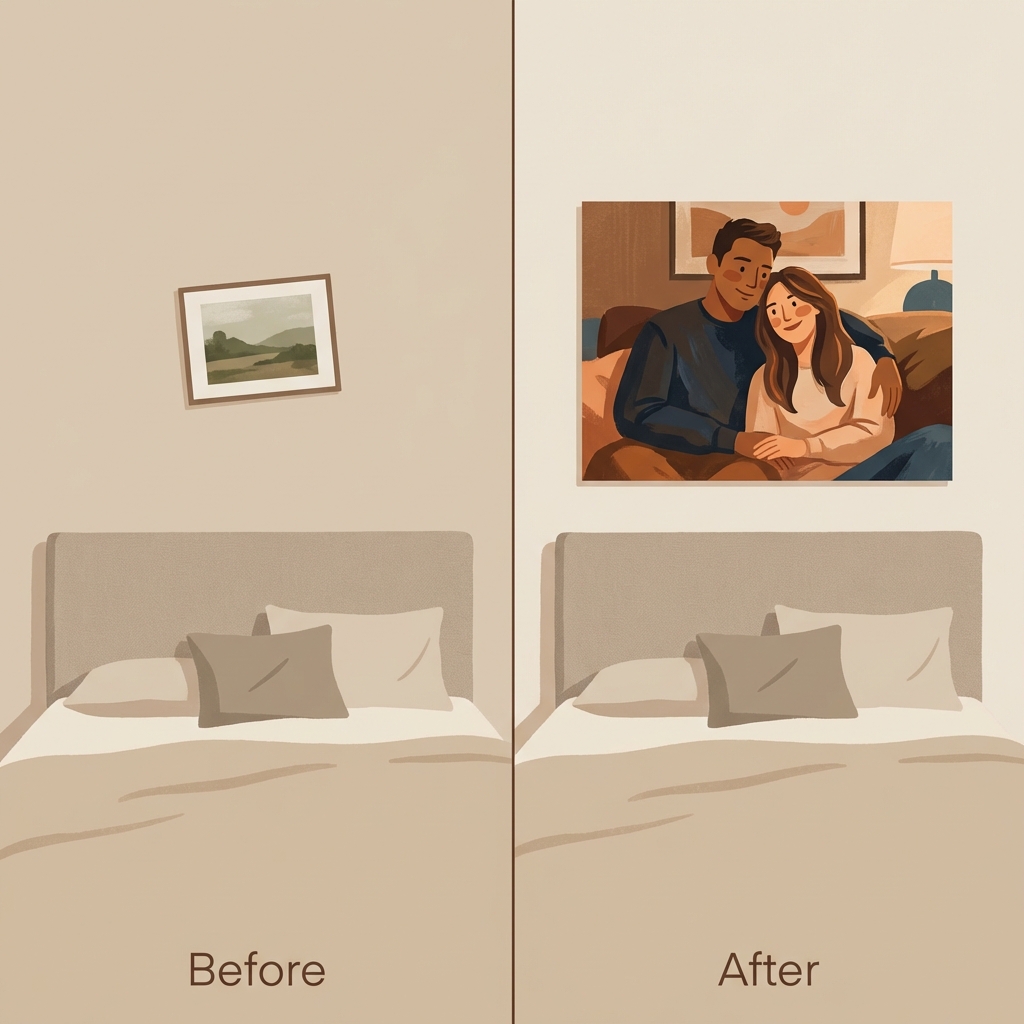
Custom couple portraits have become the dominant choice here in 2026, and for good reason. If you want something truly personal — not a print anyone could buy — a wedding couple painting made from your own photo is the option that holds up over time. It’s the kind of piece that doesn’t get swapped out in the next redesign. For something immediate off the shelf, Desenio (~$30–$80 for large format prints) offers curated couple-themed art. For photo-to-print quality, Fracture ($45–$150) prints directly onto glass with a clean, frameless finish — no matte, no border, just the image.
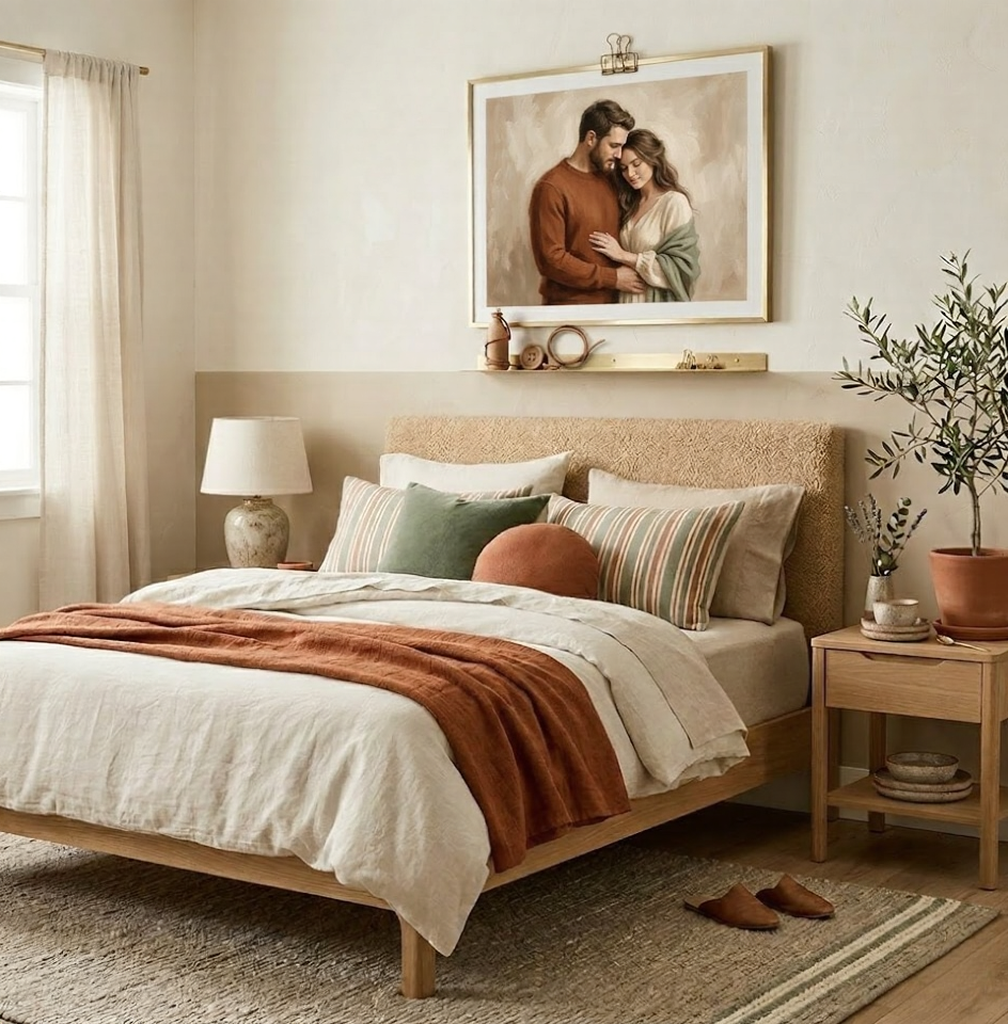
The rule for sizing: the art should span roughly two-thirds the width of your headboard. Anything smaller looks timid. Anything larger overwhelms the wall.
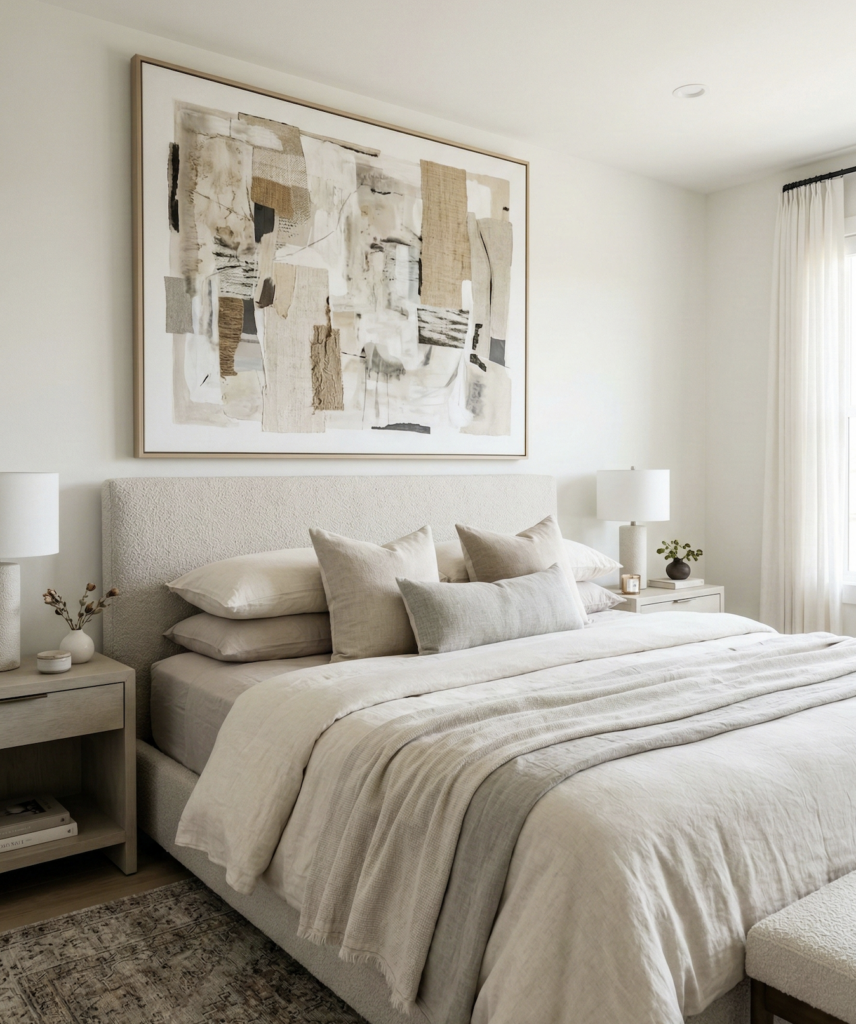
2. Use layered lighting for a romantic bedroom
The single overhead fixture is the fastest way to make a bedroom feel like an office. Couple bedrooms need light that shifts with mood — and that means three distinct layers.
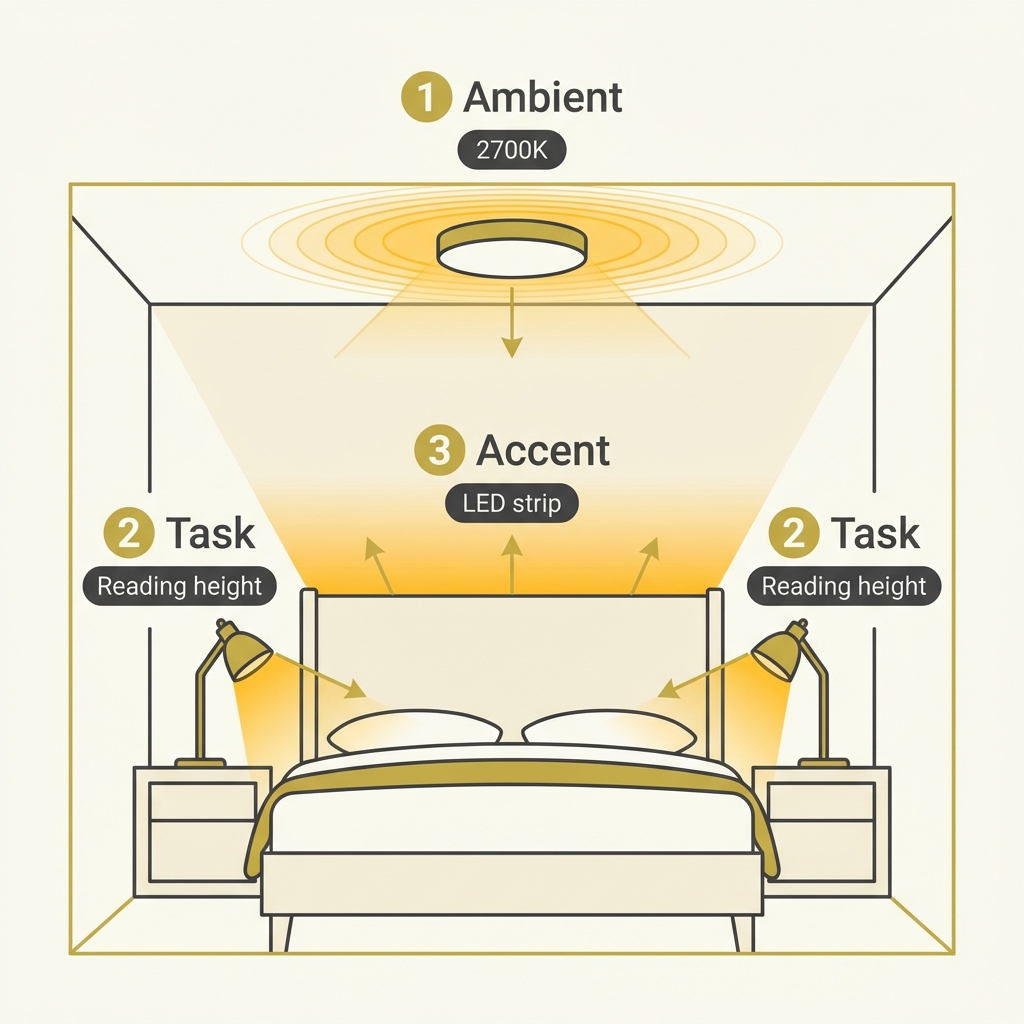
Ambient (general room light): a dimmable ceiling fixture or recessed lighting on a dimmer switch. This is your baseline — keep it warm, 2700K or lower.
Task (reading, getting ready): bedside lamps at shoulder height when seated. Matching lamps on both sides creates symmetry, but mismatched pairs in the same tone can feel more personal. IKEA’s RANARP series (~$40 each) is a consistently reliable option at a reasonable price point.
Accent (mood): LED strip lighting behind a headboard or under a floating shelf. This is what makes a room look like a bedroom and not a guest room. Warm white or amber, never cool blue in a space meant for relaxation.
The full setup costs $80–$200, depending on what you already have. The difference in atmosphere is immediate.
3. Choose couple bedroom colors that work for two people
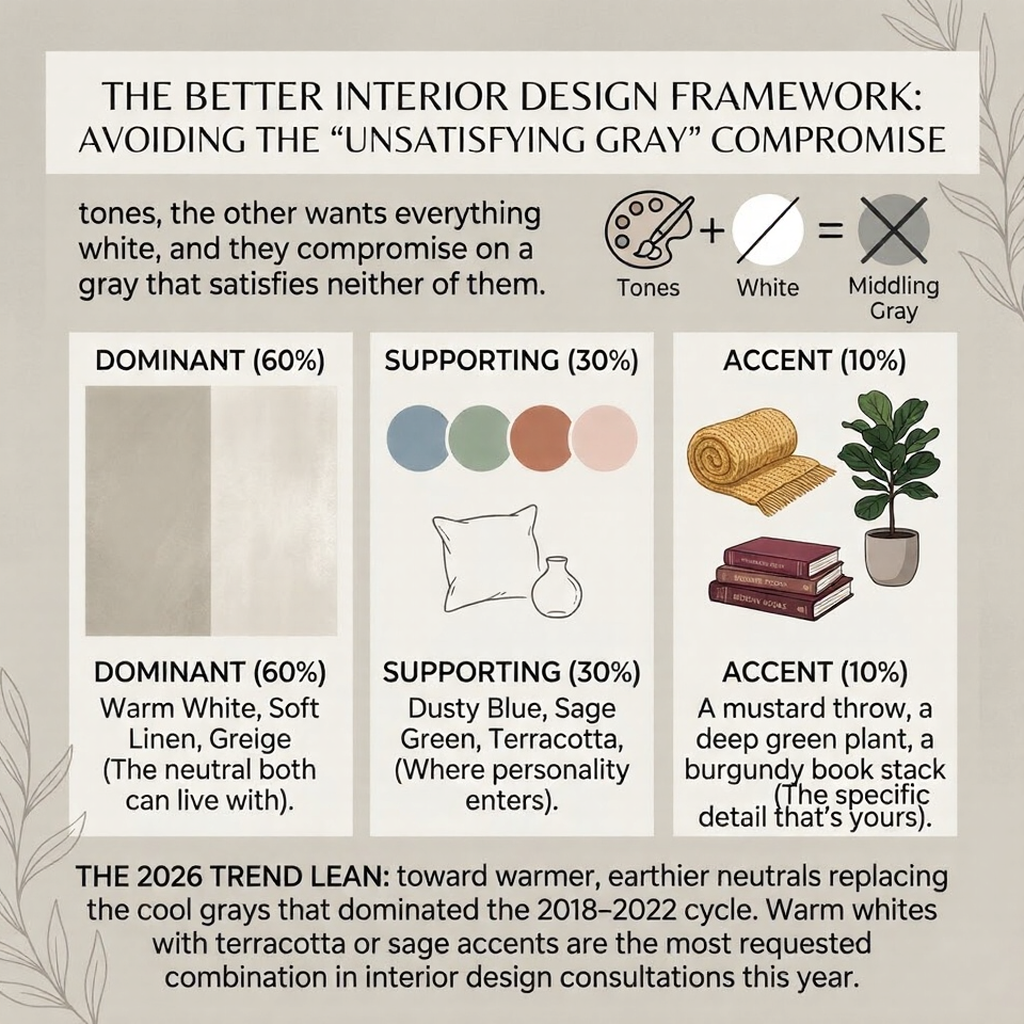
Here’s where most couple bedrooms go wrong: one person loves deep jewel tones, the other wants everything white, and they compromise on a gray that satisfies neither of them.
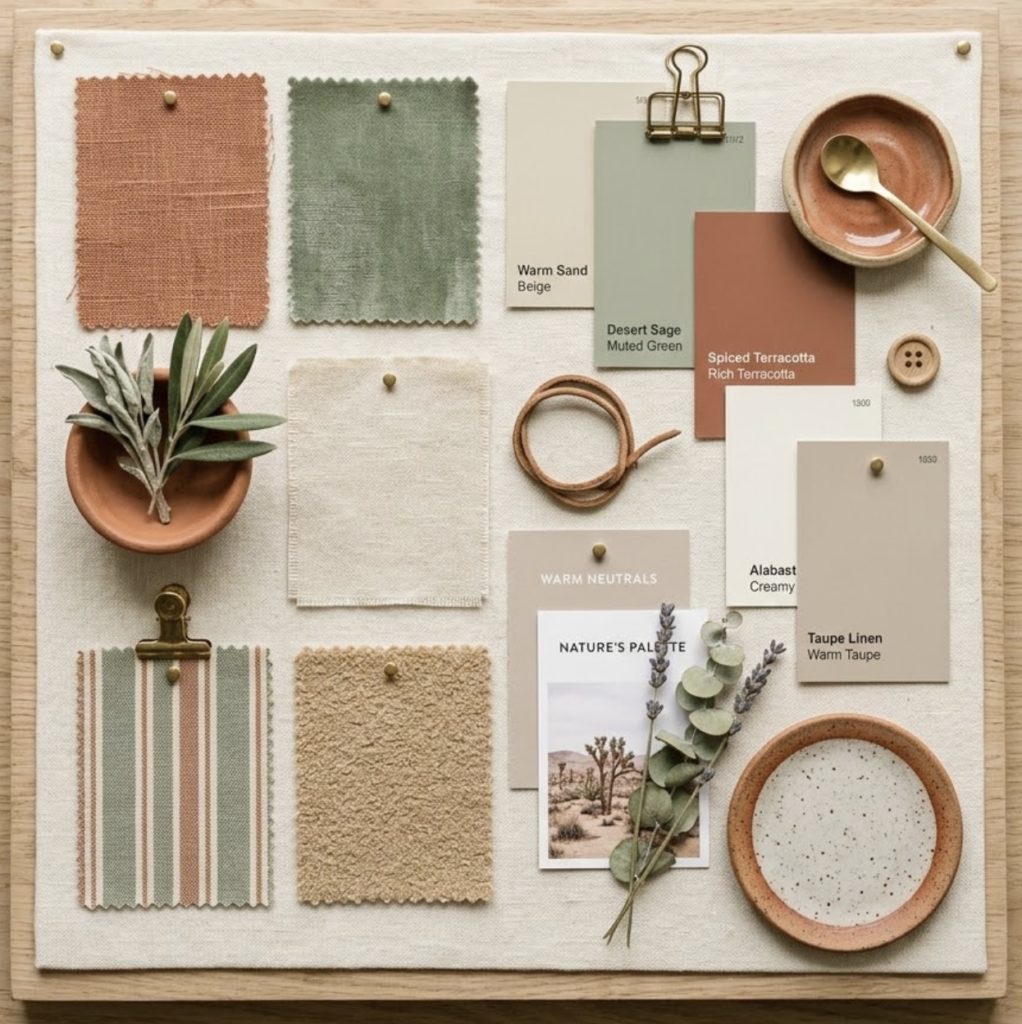
The better framework is dominant + supporting + accent:
- Dominant (60% of the room): a neutral both people can live with — warm white, soft linen, greige
- Supporting (30%): where personality enters — dusty blue, sage green, terracotta, blush
- Accent (10%): the specific detail that’s yours — a mustard throw, a deep green plant, a burgundy book stack on the nightstand
The 2026 lean is toward warmer, earthier neutrals replacing the cool grays that dominated the 2018–2022 cycle. Warm whites with terracotta or sage accents are the most requested combination in interior design consultations this year.
4. Choose bedding both people actually like
Bedding is the most-touched surface in the room. It’s also the thing couples disagree about most — thread count vs. weight, cool vs. warm, minimal vs. layered.
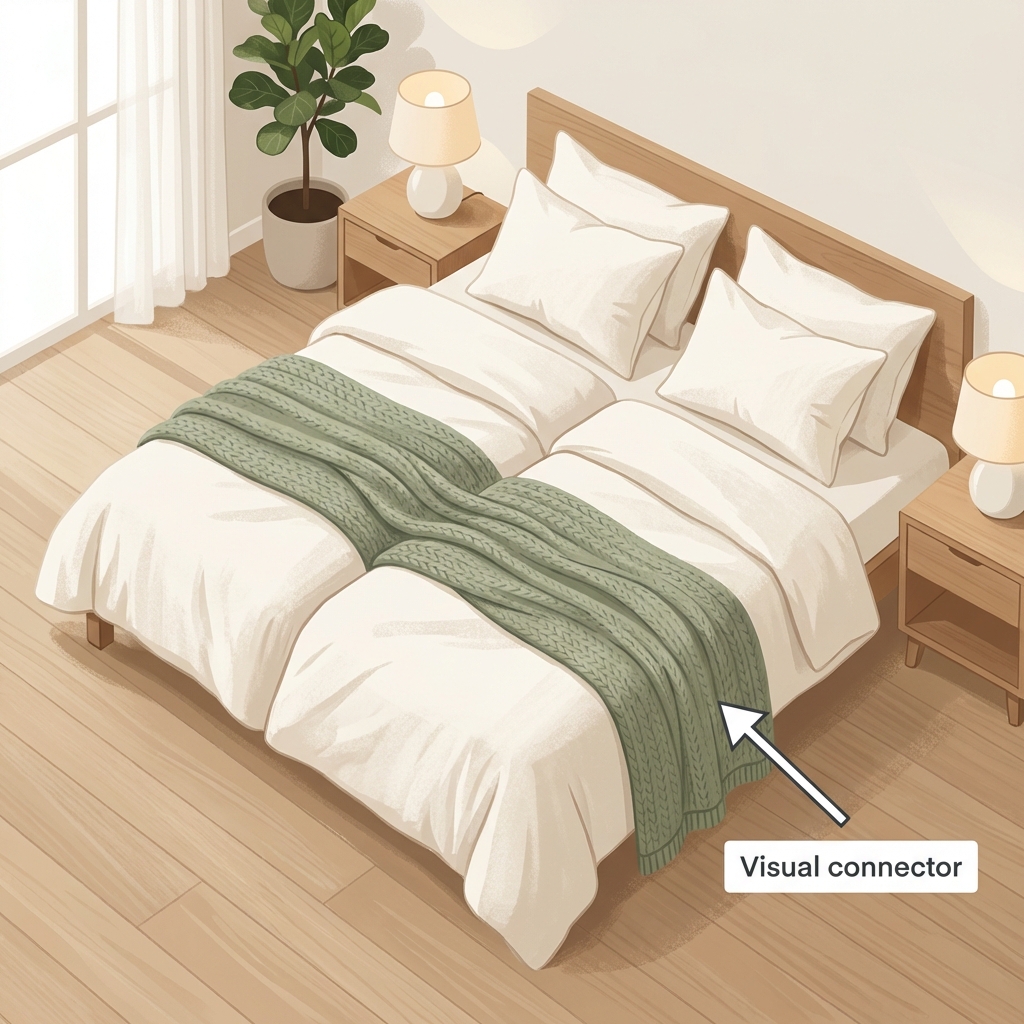
A practical solution that works for genuinely different preferences: separate duvets, shared bed. This is standard across Scandinavia and increasingly common elsewhere. Two twin duvets on a king bed means each person regulates their own temperature without negotiation. Visually, it reads as one layered bed if you add a decorative throw across the center.
For quality at a reasonable price point, Brooklinen’s Classic Core Sheet Set (~$109 for queen) consistently outperforms what you’d find in home goods stores at twice the price. Parachute’s Cloud Cotton Duvet (~$149) is warm without being heavy — a good middle-ground option.
Cover both duvets in the same case color for visual unity. Add texture with a knit throw draped across the foot.
5. Add personal wall decor without visual clutter
If you do want a gallery wall, the secret is editing ruthlessly before you hang anything.
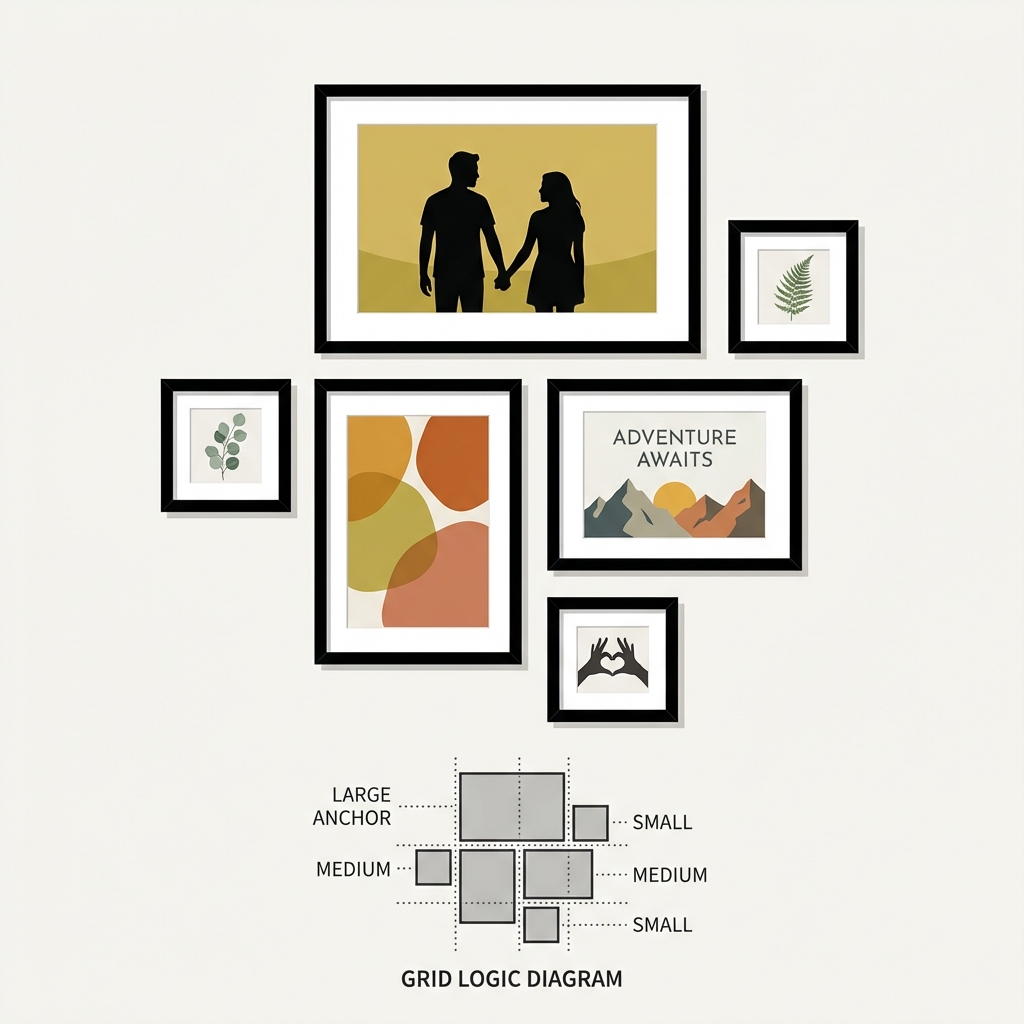
The mistake is including everything. The result that actually looks good includes 5–7 pieces maximum, all with intentional connection — not just “photos we like.”
A strong couple gallery wall structure:
- One larger anchor piece (the wedding photo, a meaningful travel print, custom art)
- Two medium frames at complementary angles
- Two or three smaller pieces that echo the palette
Use Canva (free) to mock up the arrangement digitally before putting a single nail in the wall. The Mixtiles app (~$17 per tile) offers peel-and-stick photo tiles that reposition without damaging paint — useful for testing placement before committing.
All frames in the same finish (all black, all natural wood, all brass) read as intentional. Mixed frames read as unfinished.
[Image: Styled gallery wall with 6 frames in matching black finish — mix of couple photos, travel prints, and one abstract art piece]
6. Add natural texture to soften the bedroom
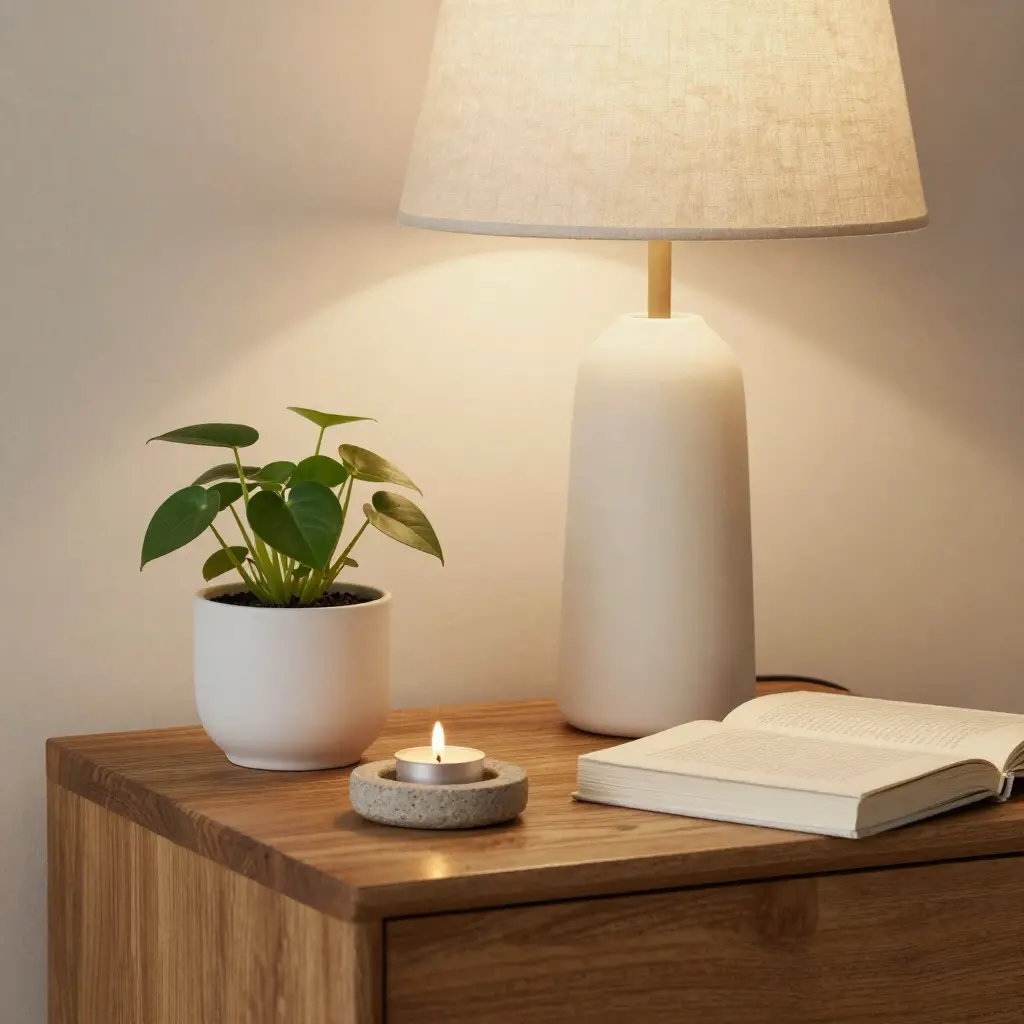
Organic materials do something synthetic ones can’t: they make a room feel alive without being loud about it.
For couples who don’t want the maintenance of real plants, Pilea peperomioides (the Chinese money plant, ~$12–$20 at most nurseries) is genuinely low-effort and visually distinct. Pothos is borderline unkillable and trails beautifully from a shelf or nightstand. One plant per side of the room creates balance without overdoing it.
For non-plant people: a wooden tray on the dresser, a rattan lampshade, a stone candle holder. The material matters more than the specific object. Natural textures break up the visual monotony of fabric and painted walls.
7. Give each person a useful nightstand zone
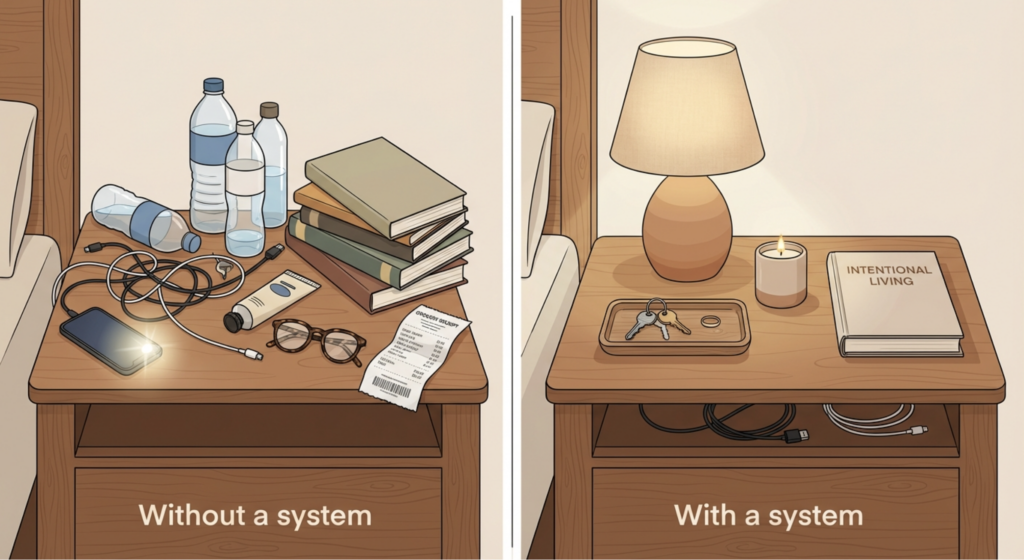
Nightstands are where bedroom decor collapses in most couple spaces — one person’s side becomes a pile of books, chargers, glasses, water bottles, and hand cream while the other stays pristine.
A functional nightstand setup that still looks good:
- One lamp (not a phone being used as a light)
- One tray or dish to contain the small objects
- One decorative element — a small plant, a candle, a single book
- Cables managed — a nightstand with a built-in USB port or a small cable management box
IKEA’s HEMNES nightstand (~$130) has been around for decades because it solves the problem: a drawer for the messy things, a surface for the intentional ones. West Elm’s Nightstand with USB (~$229) is the upgrade option if budget allows.
Matching nightstands create symmetry. Slightly different nightstands in the same finish or material family feel more personal — and are increasingly common in the spaces that actually photograph well.
8. Use scent as a subtle romantic bedroom detail
Scent is the most underused tool in bedroom design — and the one that most immediately changes how a space feels to be in.
A bedroom that smells is considered to feel more intentional than one that looks it.
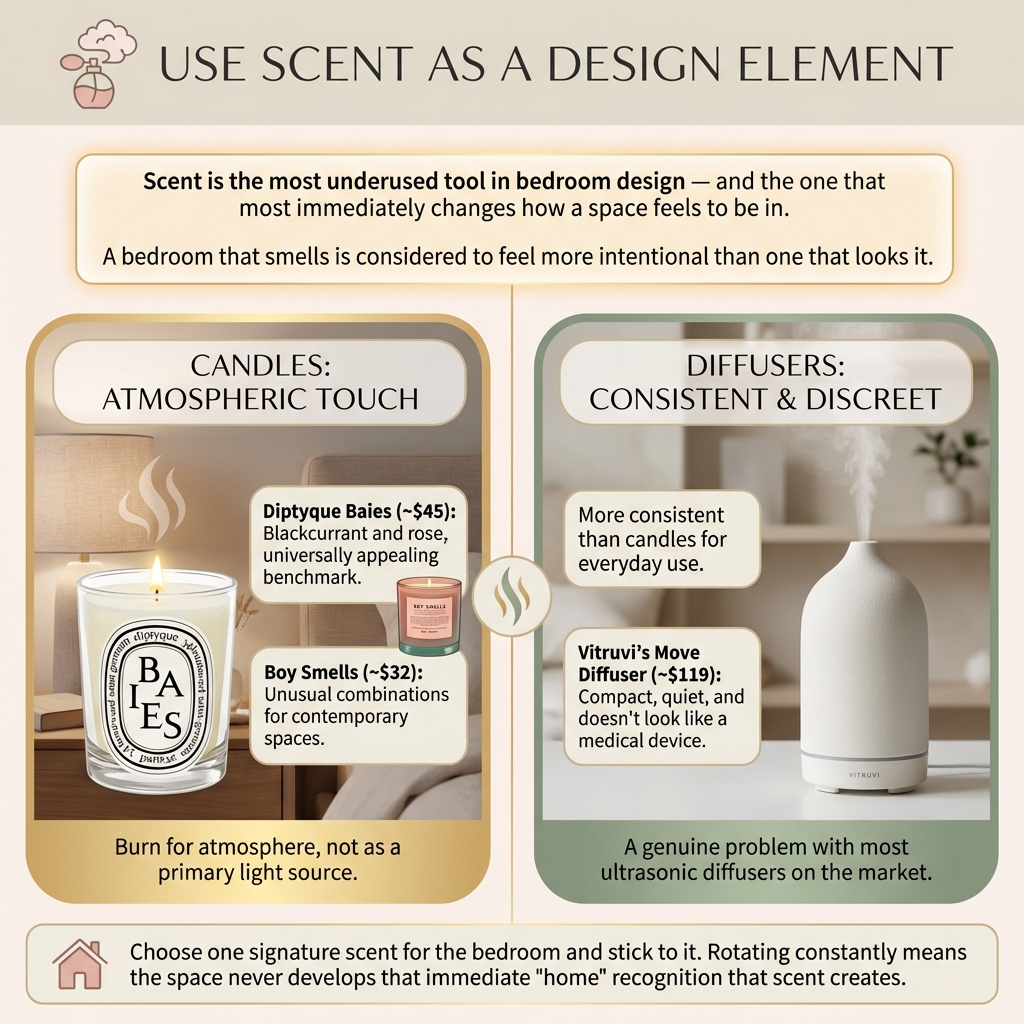
Two reliable approaches:
Candles: Diptyque Baies (~$45) is the benchmark — blackcurrant and rose, universally appealing. Boy Smells (~$32) offers more unusual combinations that work well in contemporary spaces. Burn for atmosphere, not as a primary light source.
Diffusers: more consistent than candles for everyday use. Vitruvi’s Move Diffuser (~$119) is compact, quiet, and doesn’t look like a medical device — a genuine problem with most ultrasonic diffusers on the market.
Choose one signature scent for the bedroom and stick to it. Rotating constantly means the space never develops that immediate “home” recognition that scent creates.
9. Design the bedroom for mornings too
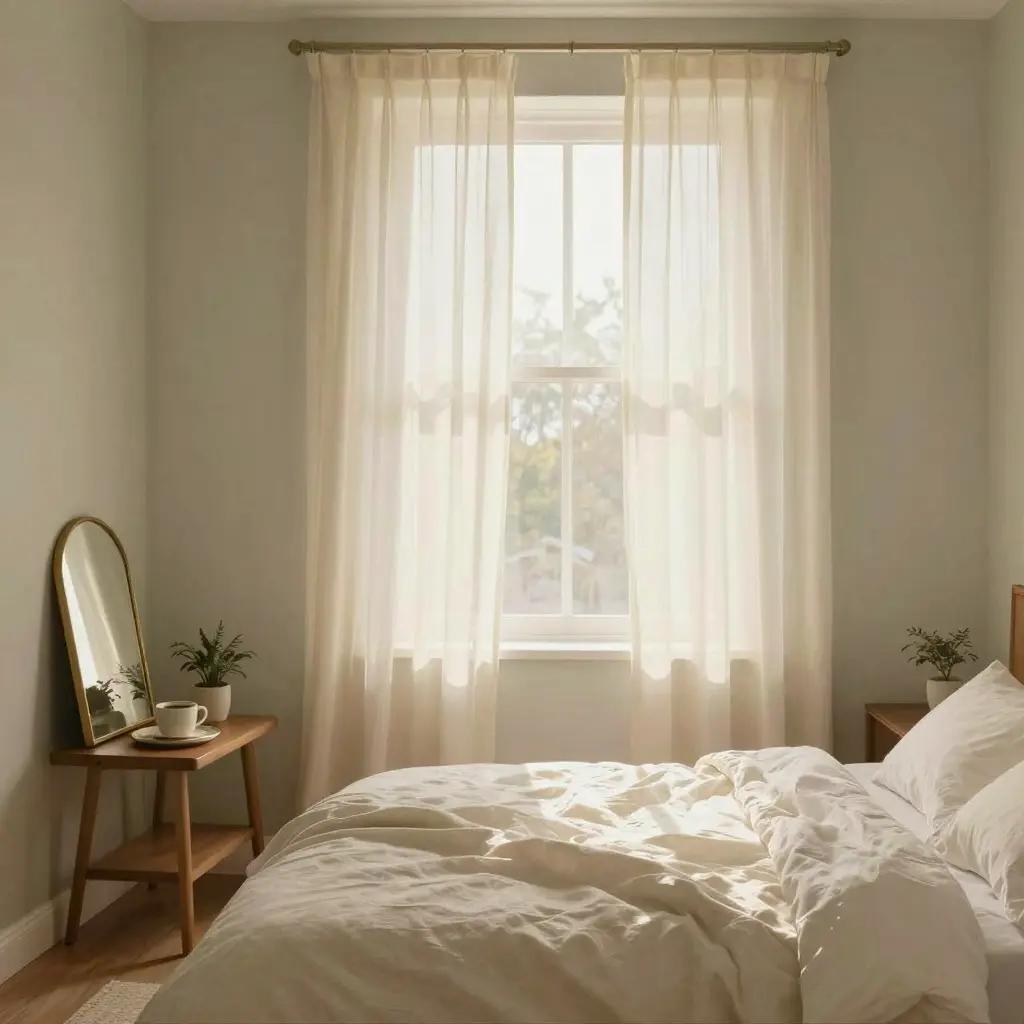
Most couple bedroom decor is designed for night — mood lighting, soft textures, dark tones. But you spend as much time in the room in the morning, and morning has different needs.
Two things that dramatically improve how a bedroom functions at the start of the day:
Blackout curtains with a gap: blackout lining for deep sleep, but hung slightly inside the window frame so natural light edges in from the sides without flooding the room. IKEA’s MAJGULL blackout curtains (~$30–$55) do this well when installed deliberately.
A dedicated getting-ready area: even a small stool with a tray for jewelry, a good mirror, and adequate lighting transforms the morning routine. The mirror doesn’t need to be large — CB2’s Arched Brass Mirror (~$199) or even an IKEA LINDBYN (~$30) works at a fraction of the price.
10. Keep editing the room as the relationship changes
The most common mistake couples make after decorating a bedroom: they stop. The room gets set, objects accumulate, and five years later, it’s full of things that made sense in a different season of life.
A room that stays feeling good gets edited twice a year — not redecorated, just reassessed. What belongs? What’s only there because nobody moved it? What’s been replaced in your taste but not in your space?
Seasonal swaps are low-effort and high-impact: heavier throws and warmer tones for autumn and winter, lighter textures and softer colors from spring through summer. Same furniture, completely different feel.
Decor that reflects a relationship reflects something that changes. The room should change too.
Recommended brands and budget guide
CategoryBudget OptionMid-RangeInvestment
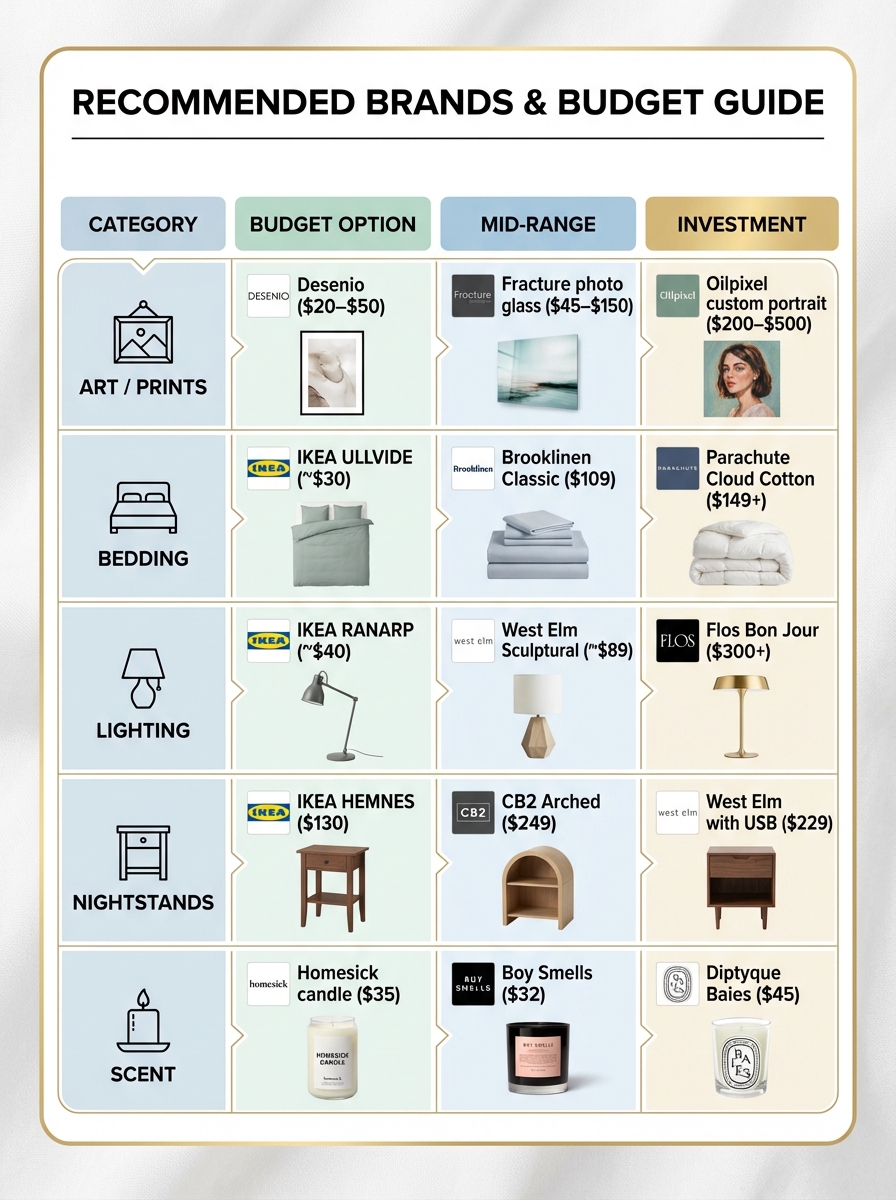
Art / Prints Desenio ($20–$50) Fracture photo glass ($45–$150) Oilpixel custom portrait ($200–$500)
Bedding IKEA ULLVIDE (~$30) Brooklinen Classic ($109) Parachute Cloud Cotton ($149+)
Lighting IKEA RANARP (~$40) West Elm Sculptural (~$89) Flos Bon Jour ($300+)
Nightstands IKEA HEMNES ($130) CB2 Arched ($249) West Elm with USB ($229)
Scent Homesick candle ($35) Boy Smells ($32) Diptyque Baies ($45)
More bedroom and interior design ideas
For the broader design framework, keep these couple bedroom ideas next to the golden rules of interior design, the home styling tips for beginners, and the living room interior design ideas guide when you want the whole home to feel consistent.
If the bedroom still feels flat, study biophilic interior design, wallpaper and textured wall finishes, and blackout curtains with design intent. Those three details solve many couple bedroom decor problems: the room needs texture, better light control, or a calmer connection to nature.
Couple bedroom ideas FAQ
Q: What is the most important element in couple bedroom ideas?
A: Lighting is usually the highest-impact element. A couple bedroom needs more than one overhead fixture: use warm ambient light, two task lights, and one softer accent source. This lets one person read while the other relaxes and makes the room feel calmer at night.
Q: How do we decorate a bedroom when we have completely different tastes?
A: Use a shared neutral base, then give each person a controlled area for preference. The 60/30/10 color rule helps: 60% calm neutral, 30% supporting color, and 10% accent. It keeps the room coherent while still letting both people see themselves in the space.
Q: How much should a couple spend on bedroom decor ideas?
A: A focused refresh can work around $400 to $600 if you spend on bedding, lighting, one art piece, and a few useful accessories. Avoid spreading the budget across too many small objects. Three good choices usually improve the room more than fifteen decorative fillers.
Q: Where should couple artwork be placed in a bedroom?
A: Above the bed is usually the strongest spot because it anchors the room as soon as you walk in. Size the artwork to about two-thirds of the headboard width. If you already have a strong headboard, place secondary art opposite the bed or near a reading corner.
Q: What bedroom colors work best for couples in 2026?
A: Warm neutrals still work best for most couples: warm white, linen, soft greige, and muted taupe. Add personality with sage green, dusty blue, terracotta, rust, or deep olive. The goal is calm, not bland, so use color in textiles, art, or one accent wall.
Q: What are good small bedroom ideas for couples?
A: In a small couple bedroom, prioritize storage and clear walkways before decor. Use wall-mounted lights, slimmer nightstands, under-bed storage, and one large art piece instead of many small frames. Keep the palette simple so the room feels intentional rather than crowded.
Q: How do you make a couple bedroom feel romantic without looking cheesy?
A: Use low warm light, tactile bedding, scent, meaningful art, and less visible clutter. Romance in bedroom decor usually comes from atmosphere and comfort, not obvious heart motifs. Choose materials that invite rest: linen, wood, soft wool, ceramic, warm metal, and gentle fragrance.
Final take on couple bedroom ideas
The best couple bedroom ideas do not try to freeze the room in one perfect style. They make the space easier to share: better light, better sleep, calmer surfaces, and a few personal objects that actually mean something.
Start with lighting. Add one piece of art that means something. Sort out bedding and nightstands. Then edit slowly, because a married couple bedroom should change as the two people living in it change too.
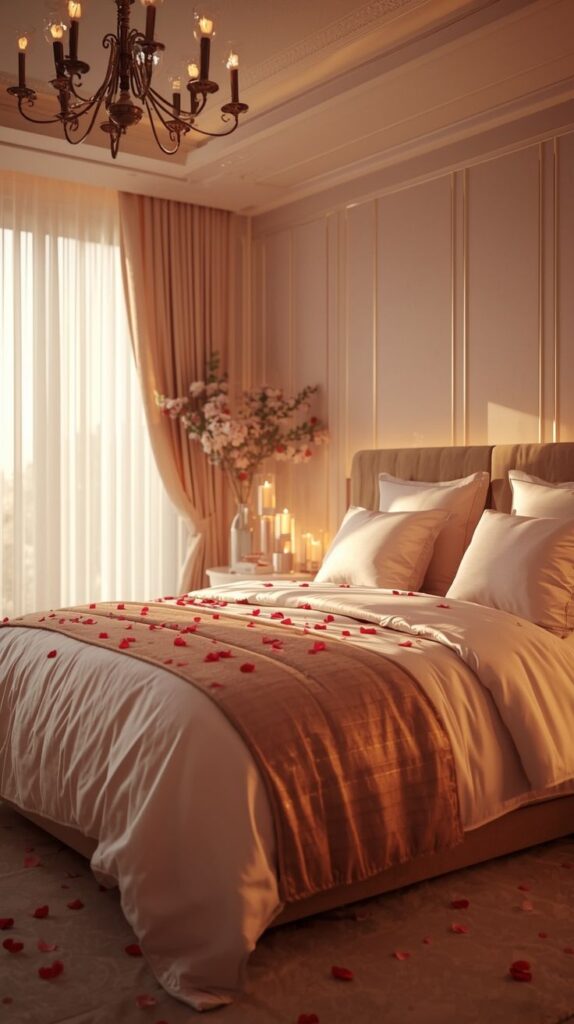
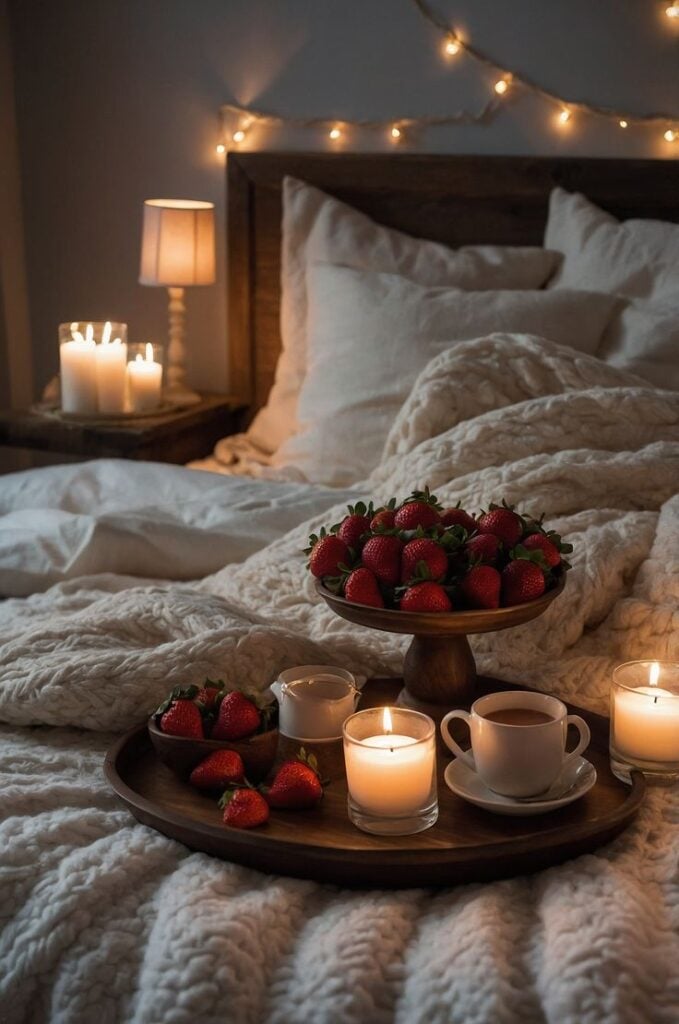
If you want to add a romantic, elevated touch to your sleeping space, consider exploring some beautiful cozy bed canopy ideas that can turn any standard frame into a comfortable sanctuary.
The couples whose bedrooms feel like sanctuaries didn’t get there by buying everything at once. They bought the right things, one at a time, and stopped when it felt like them.
- 291shares
- Facebook0
- Pinterest291
- Twitter0
- Reddit0