There’s a reason Bugatti sketches flood design school portfolios and Pinterest boards alike. These aren’t just cars — they’re rolling sculptures that cost more than most houses and move faster than private jets.
Drawing a Bugatti forces you to wrestle with everything that makes automotive design fascinating: dramatic proportions, complex curves, and surfaces that play with light in ways that feel almost liquid. Whether you’re sketching the art deco elegance of a 1936 Type 57 Atlantic or the aggressive stance of the new 1,800-horsepower Tourbillon, you’re studying 115 years of design evolution in a single silhouette.
I’ve put together this guide covering five iconic Bugatti models — each from a different era, each with its own drawing challenges. You’ll learn why the EB110 is perfect for beginners (those angular lines are forgiving), why the Chiron’s curves demand patience, and how to tackle the Tourbillon before anyone else has tutorials for it.
- A Brief History of Bugatti's Design DNA
- Essential Supplies for Bugatti Drawing
- The Foundation: Mastering Hypercar Proportions
- Drawing Bugatti's Signature Design Elements
- Model 1 — Type 57 SC Atlantic (Difficulty: 8/10)
- Model 2 — EB110 (Difficulty: 6/10) ⭐ Best for Beginners
- Model 3 — Veyron 16.4 (Difficulty: 7/10)
- Model 4 — Chiron (Difficulty: 7/10)
- Model 5 — Tourbillon (Difficulty: 9/10) ⭐ Newest Model
- Rendering Realistic Reflections on Hypercars
- Common Mistakes and How to Fix Them
- FAQ — Bugatti Drawing Questions Answered
- Now It's Your Turn
By the end, you’ll understand not just how to draw these hypercars, but why they look the way they do. That’s the difference between copying shapes and actually seeing like a designer.
Grab your pencils. We’re starting with some history.
A Brief History of Bugatti’s Design DNA
The Ettore Bugatti Era (1909-1947)
Ettore Bugatti wasn’t just an engineer — he was an artist’s son who treated machinery like sculpture. Born in Milan in 1881, he opened his Molsheim factory in 1909 with a radical idea: cars should be beautiful and fast.
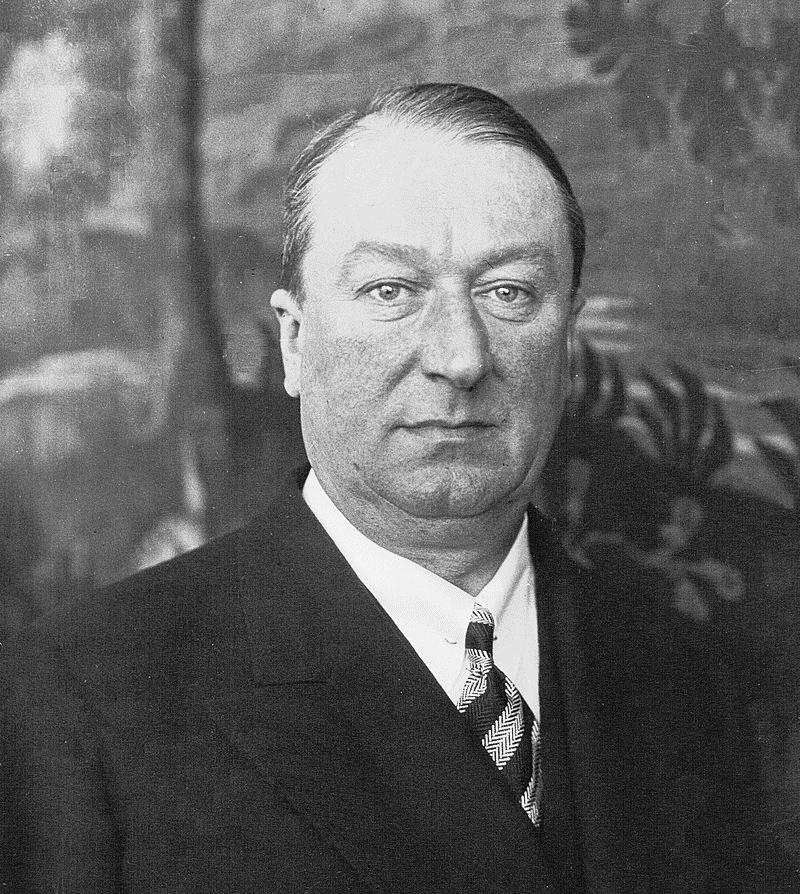
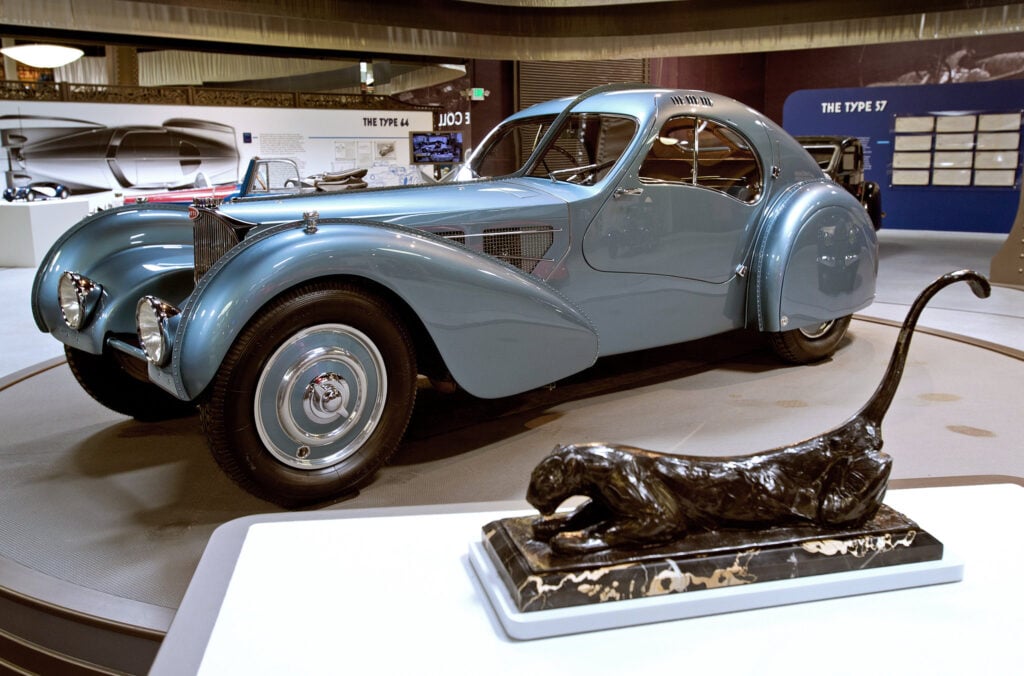
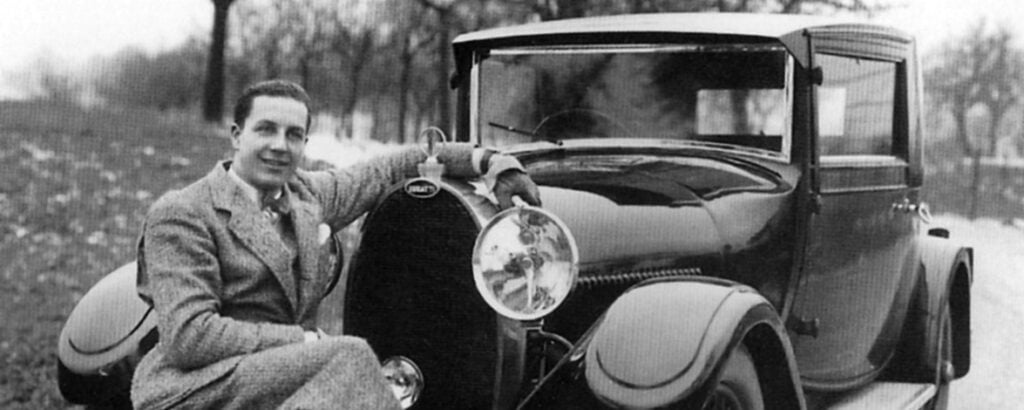
His Type 35 became the most successful racing car in history, racking up over 1,000 victories. But it was his son Jean who created the brand’s crown jewel — the Type 57 SC Atlantic. With its flowing fenders and riveted dorsal seam, only four were ever built. One sold for over $30 million at auction.
Jean’s death in 1939 while testing a race car marked the beginning of the end. The original Bugatti factory closed in 1963.
The Modern Revival (1987-Present)
Italian entrepreneur Romano Artioli resurrected the name in 1987, launching the EB110 — a carbon-fiber supercar that felt decades ahead of its time. Financial troubles killed that venture by 1995.
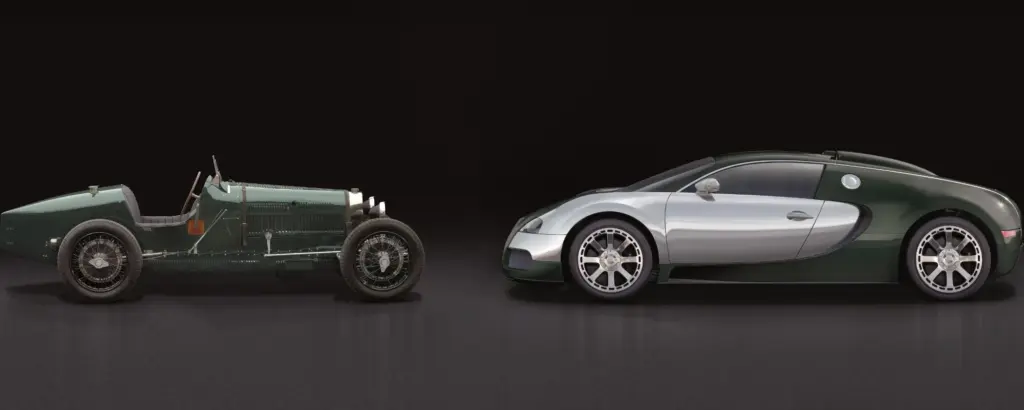
Then Volkswagen stepped in. Under Ferdinand Piëch’s leadership, the German automaker acquired Bugatti in 1998 with an audacious goal: build a 1,000-horsepower car that could hit 400 km/h and drive to brunch on Sunday. The Veyron delivered in 2005. The Chiron followed in 2016. And in 2024, the Tourbillon arrived with 1,800 hybrid horsepower.
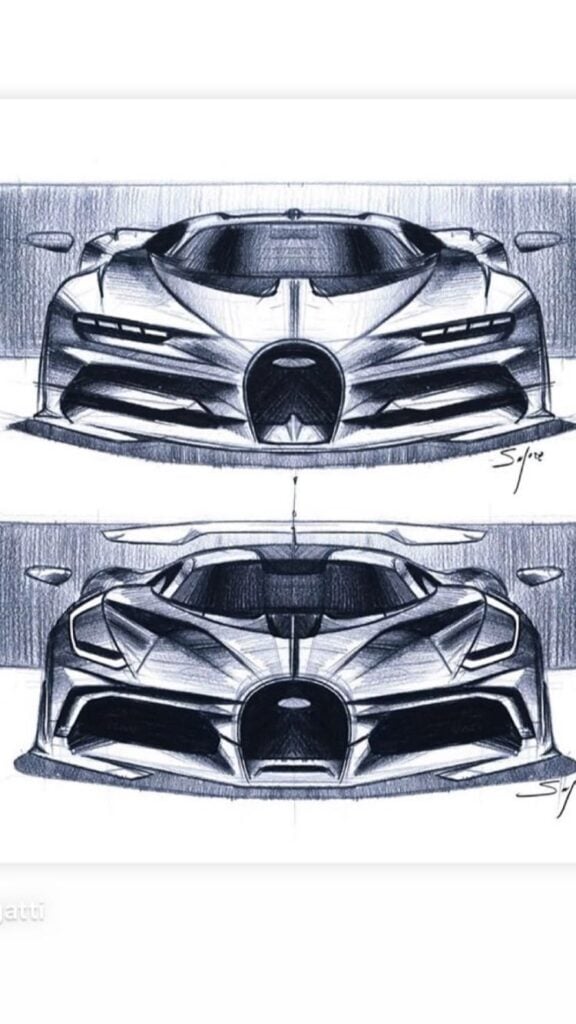


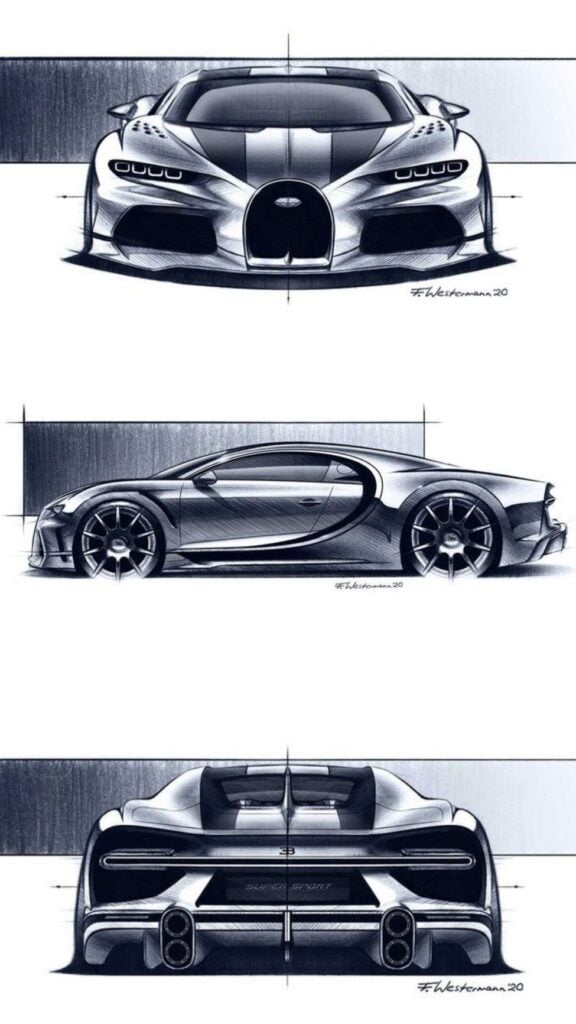
5 Design Elements That Make a Bugatti
Every Bugatti shares a visual DNA. Learn these, and you’ll recognize (and draw) any model:
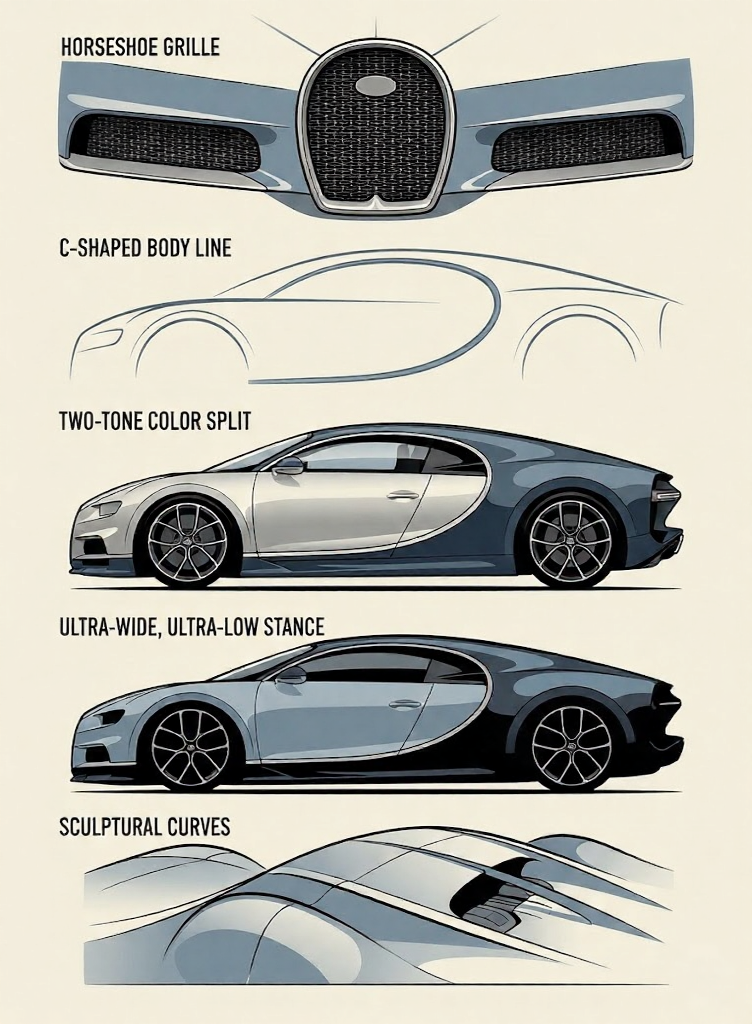
- Horseshoe Grille — the signature since 1910
- C-shaped Body Line — flows from front fender through the door
- Two-tone Color Split — typically following the C-line
- Ultra-wide, Ultra-low Stance — aggressive proportions
- Sculptural Curves — no flat panels, everything flows
These five elements are your cheat sheet. Nail them, and your drawing will read as “Bugatti” instantly.
Essential Supplies for Bugatti Drawing
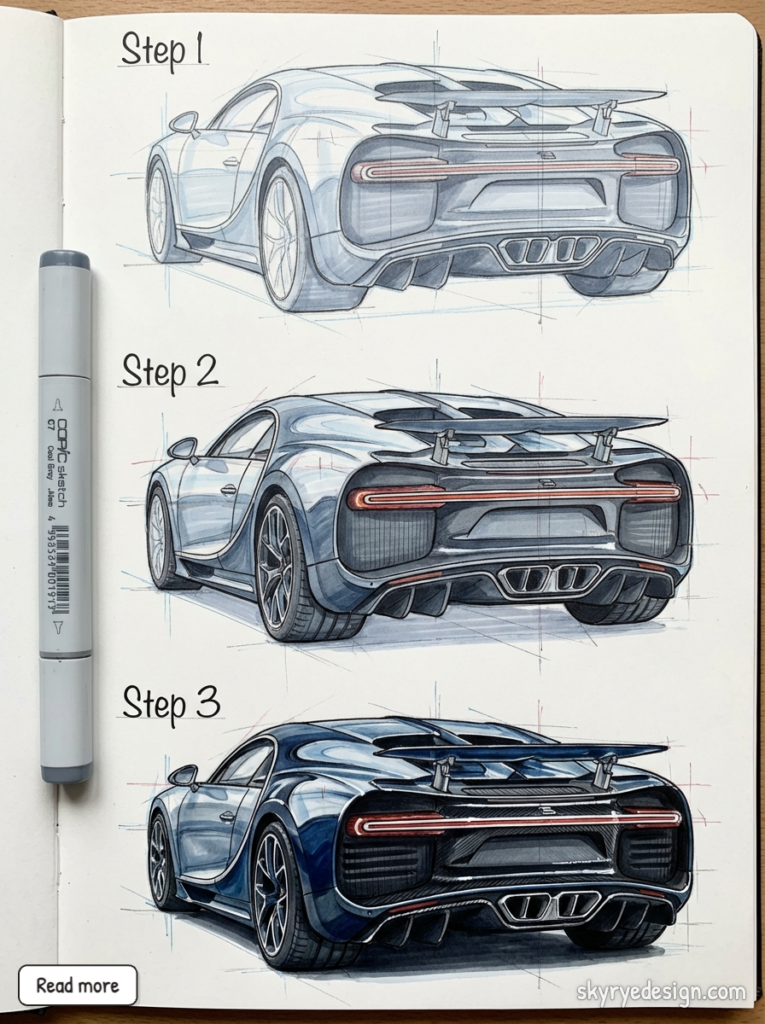
You don’t need expensive gear to start. But the right tools make rendering those glossy curves and metallic reflections much easier.
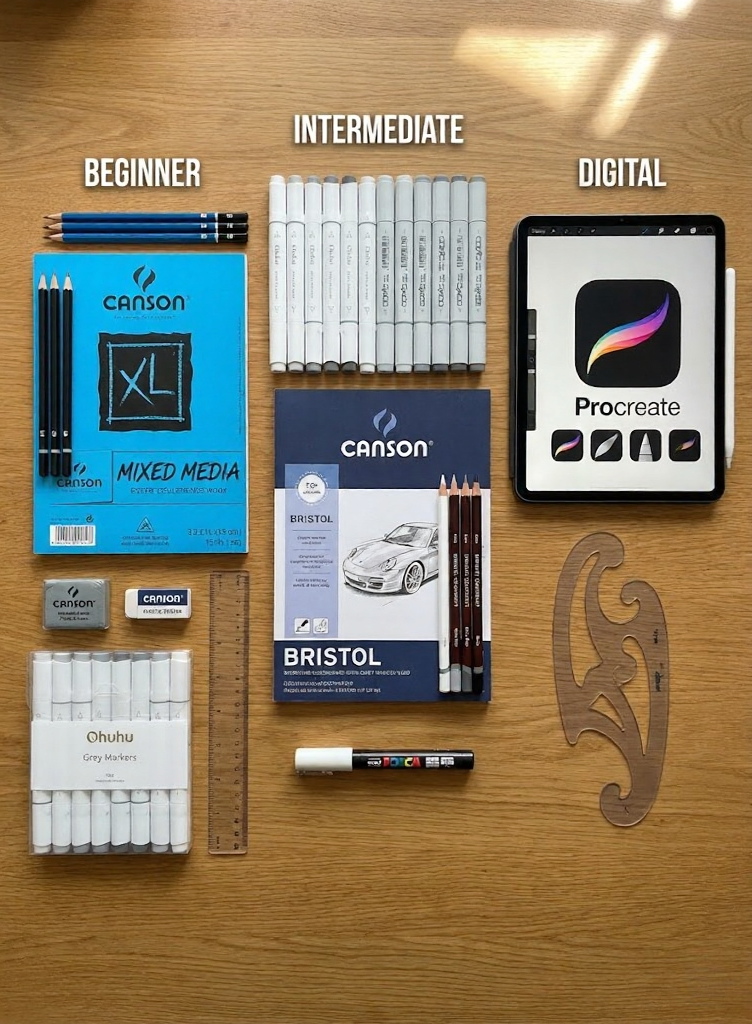
For Beginners (Under $50)
Keep it simple. A basic kit gets you surprisingly far:
- Pencils: HB, 2B, and 4B graphite set (~$8)
- Paper: Canson XL Mixed Media pad — handles light marker work (~$12)
- Erasers: Kneaded eraser for lifting highlights, plastic eraser for clean edges
- Ruler: 30cm transparent ruler for the grid method
- Optional: Ohuhu 24-piece grey marker set (~$20) — great value for practice
For Intermediate Artists ($50-150)
Once you’re comfortable with proportions, upgrade to tools that make rendering smoother:
- Markers: Ohuhu Honolulu or Copic Sketch in cool greys (CG020, CG030, CG050, CG070, plus Black)
- Paper: Canson Bristol 250gsm or Canson Illustration Manga — both blend beautifully
- Colored Pencils: Derwent Coloursoft in White, Dove Grey, and Black for fine details
- Highlights: Posca PC-3M white paint marker — the secret weapon for chrome reflections
- Optional: French curves for smooth body lines
Digital Alternative
Prefer screens over paper? Totally valid.
- Setup: iPad + Apple Pencil + Procreate (~$12 app)
- Brushes: 6B Pencil for sketching, Studio Pen for line work, Soft Airbrush for rendering
- Advantage: Layers let you experiment without commitment — perfect for testing color schemes
I’d recommend starting traditional to build your eye, then moving digital once proportions feel natural. But honestly? Use whatever keeps you drawing.
The Foundation: Mastering Hypercar Proportions
Here’s the uncomfortable truth: most failed car drawings aren’t ruined by bad shading or sloppy details. They’re ruined in the first five minutes — when the proportions go wrong.
Bugattis are especially unforgiving. These hypercars have extreme silhouettes: roofs barely higher than your waist, bodies wider than most SUVs, and wheelbases that look stretched in Photoshop. Your eye isn’t used to these ratios, so your hand will lie to you.
The fix? Stop guessing. Use a grid.
The Grid Method Step-by-Step
This technique removes guesswork and makes accurate sketching almost foolproof:
- Choose your reference photo — 3/4 front angle works best for beginners
- Match aspect ratios — resize the photo to fit your paper dimensions
- Add a grid overlay — 2cm x 2cm squares work well for A4 paper (use Photoshop, Procreate, or free online tools)
- Recreate the grid lightly on your paper — only draw the squares you’ll actually use
- Transfer one square at a time — focus on where lines cross grid intersections
- Start with the wheels — they’re your anchor points; typically spaced 3 wheel-widths apart
- Build outward — wheels to body to roof, always checking against your grid
Bugatti-Specific Proportion Rules
Beyond the grid, keep these ratios in mind:
- Wheel position: Front wheel center sits at roughly 1/4 of total car length
- Roof height: Hypercars run 1.1-1.2 meters tall — absurdly low compared to normal cars
- Body width: Bugattis often exceed 2 meters wide — emphasize that stance
- The 2:3 rule: The cabin takes up roughly 2 parts; the hood and rear combined take 3 parts
- Mirror check: Flip your sketch in a mirror (or phone camera). Errors you missed will scream at you.
I’ve found that spending an extra 30 minutes on the sketch saves hours of frustration later. If proportions are wrong at this stage, no amount of fancy rendering will save the drawing. Get this right, and everything else becomes easier.
Drawing Bugatti’s Signature Design Elements
Now we get to the details that separate a generic supercar sketch from something unmistakably Bugatti. Master these four elements, and your drawings will have that instant brand recognition — even before you add color.
The Horseshoe Grille (The Most Important Detail)
This is Bugatti’s logo in physical form. Get it wrong, and the whole car feels off.
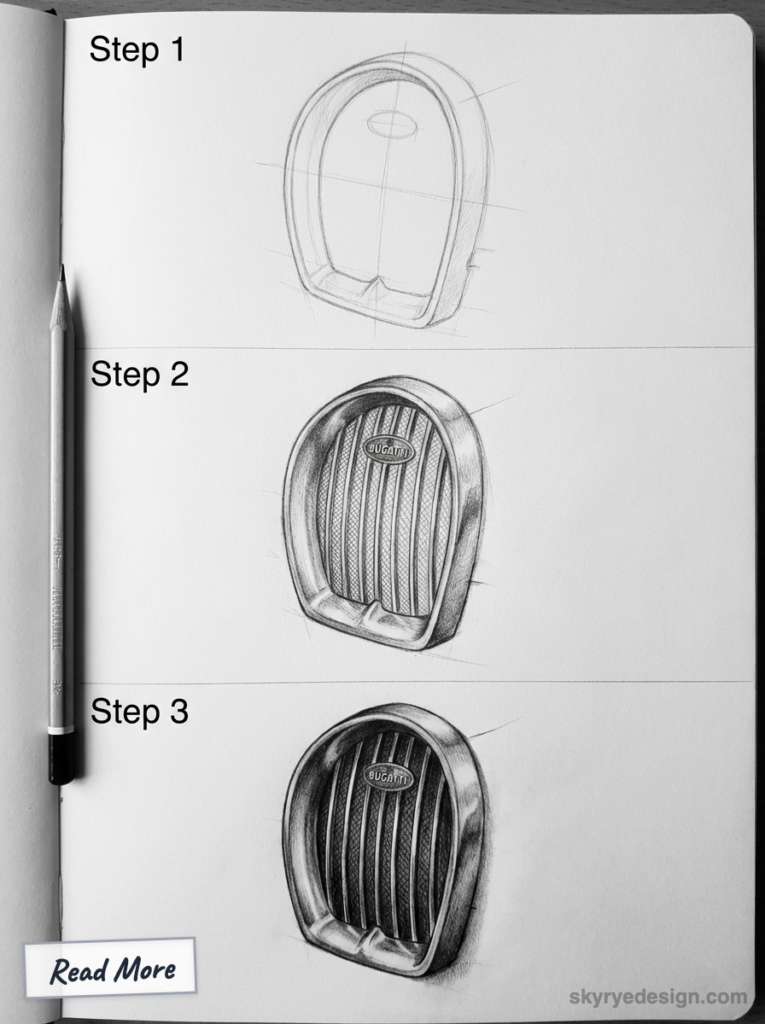
The grille has been the brand’s signature since the Type 13 in 1910. But here’s what trips people up: it’s not actually a horseshoe. It’s closer to an upside-down U with gently curved sides — more oval than circular.
How to construct it:
- Draw a vertical centerline first
- Sketch the outer curves from top to bottom on both sides — keep them symmetrical
- The height should be roughly 1.5x the width
- Add the mesh pattern last (fine horizontal slats work best)
On the Veyron and Chiron, the grille sits upright and prominent. On the new Tourbillon, it’s more recessed, blending into the front fascia. Adjust accordingly.
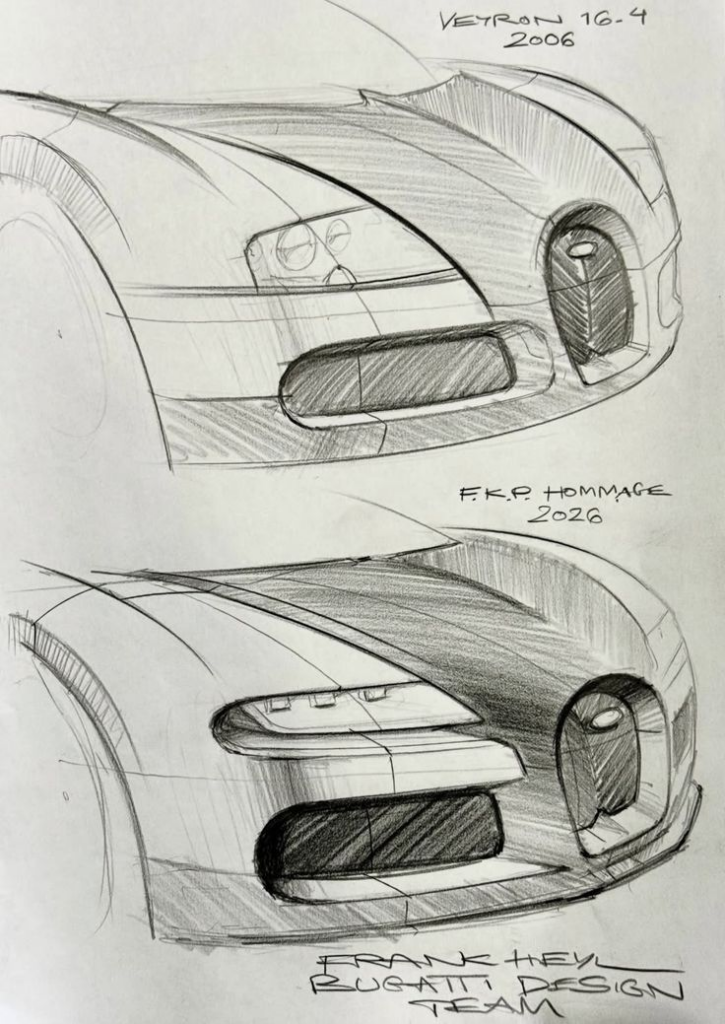
Common mistake: Drawing it too narrow or too perfectly round. Real horseshoe grilles have subtle asymmetry and presence.
The C-Shaped Body Line
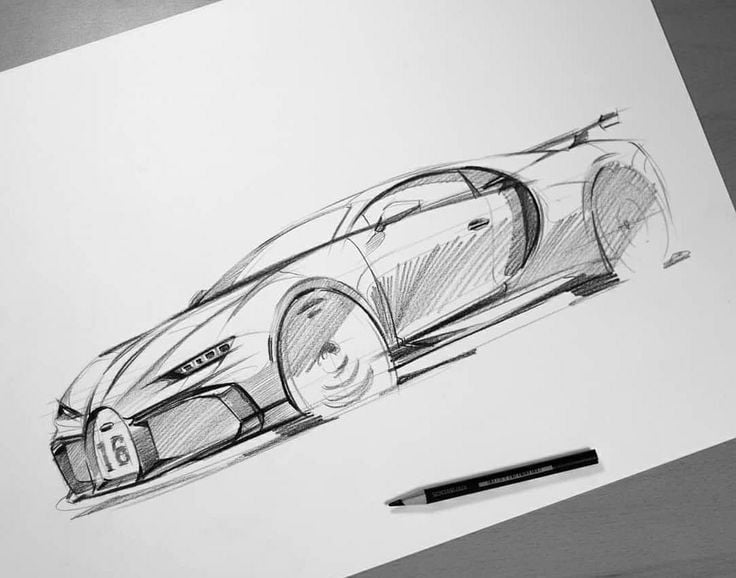
This signature curve flows from the front fender, sweeps through the door, and trails toward the rear. It’s what gives Bugattis that unmistakable side profile.
On the Veyron and Chiron, the C-line is bold — it literally divides the two-tone color sections. On the Tourbillon, it’s more integrated into the door shape, subtler but still there.
Drawing tip: Use a French curve or commit to a single confident stroke. This line should feel continuous and flowing, never segmented or hesitant.
Wheels and Rims (The Make-or-Break Detail)
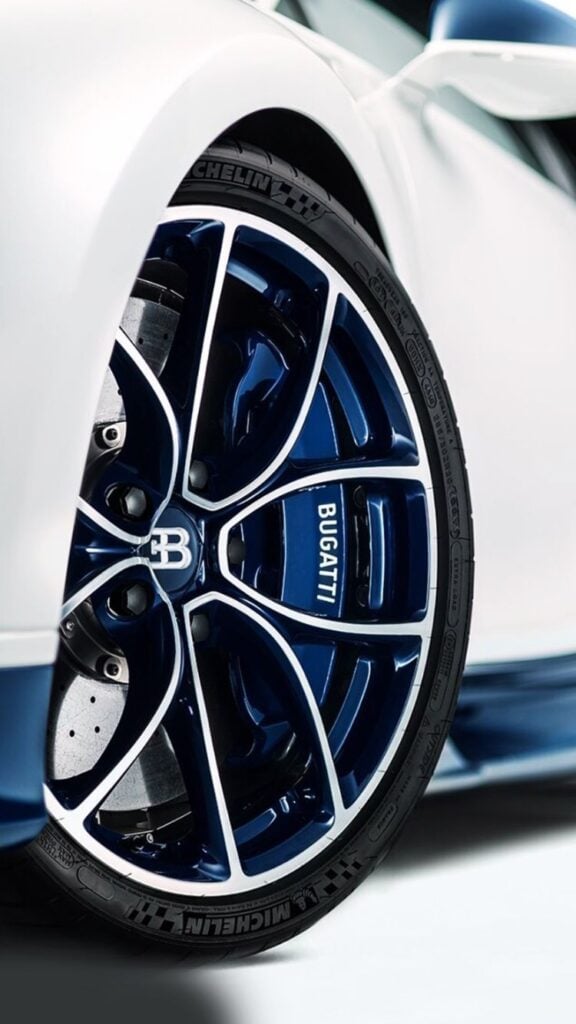
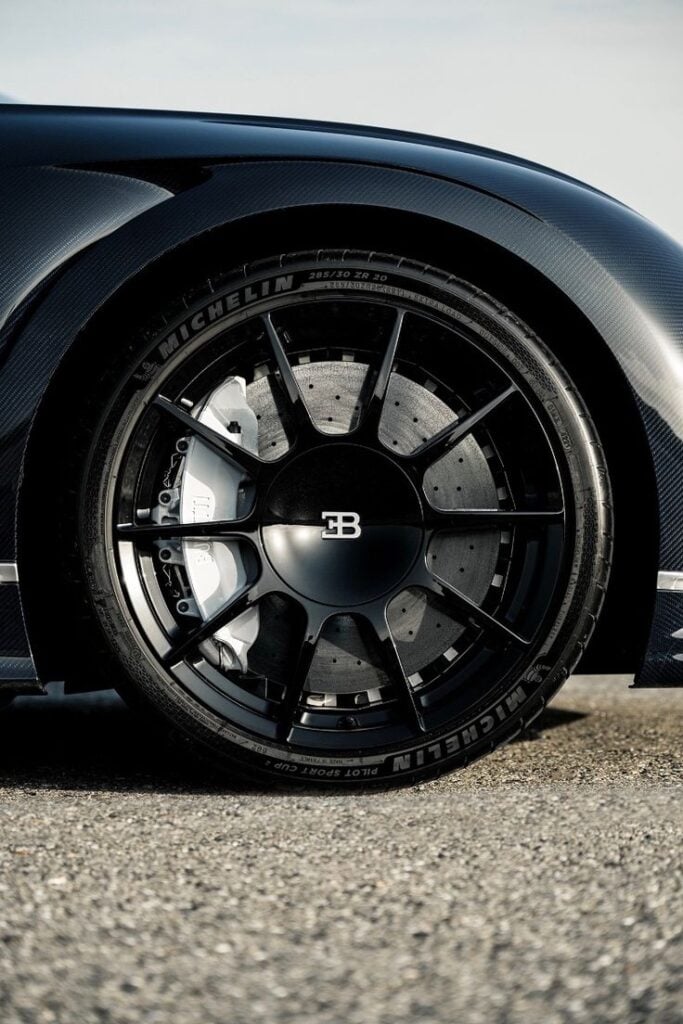
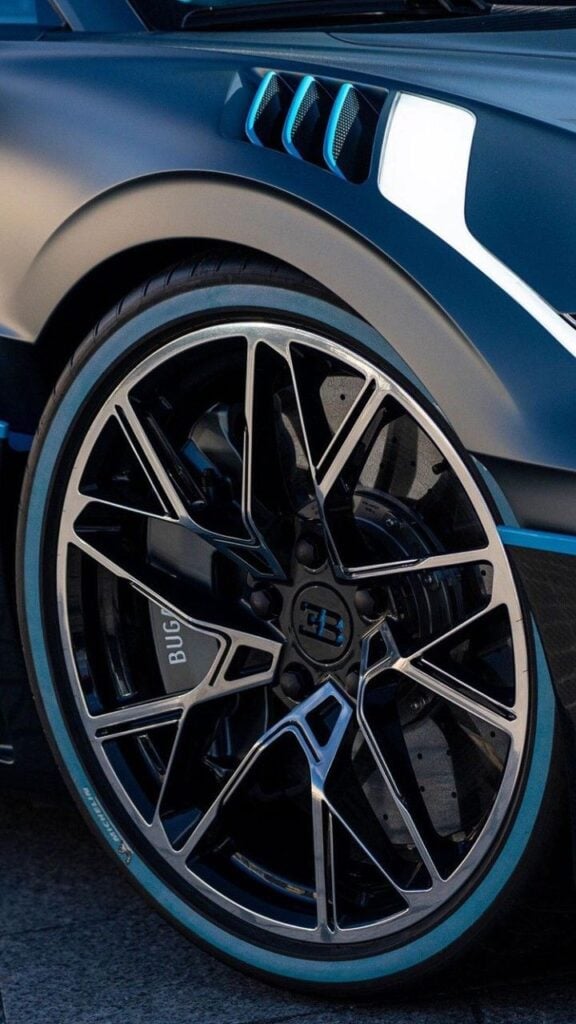
Bugatti wheels are always intricate — multi-spoke designs that look like they belong on a jet turbine. Rushing them ruins an otherwise solid drawing.
Key points:
- Start with the ellipse — wheels at an angle are ovals, not circles. Mark top, bottom, left, right, then connect smoothly.
- Spoke direction: Every spoke points toward the center hub, even if you can’t see the hub itself.
- Color order: Black areas first (tire, deep shadows), then mid-greys, then highlights last.
Two-Tone Color Division
Bugattis are famous for contrasting body sections — usually split along the C-line.
When coloring, finish one section completely before starting the next. Leave a hair-thin sliver of paper between sections for a clean visual break. It sounds fussy, but the separation reads as precision rather than sloppiness.
Model 1 — Type 57 SC Atlantic (Difficulty: 8/10)
If Bugatti ever made a car that belonged in the Louvre, this is it.
Why Draw the Atlantic?
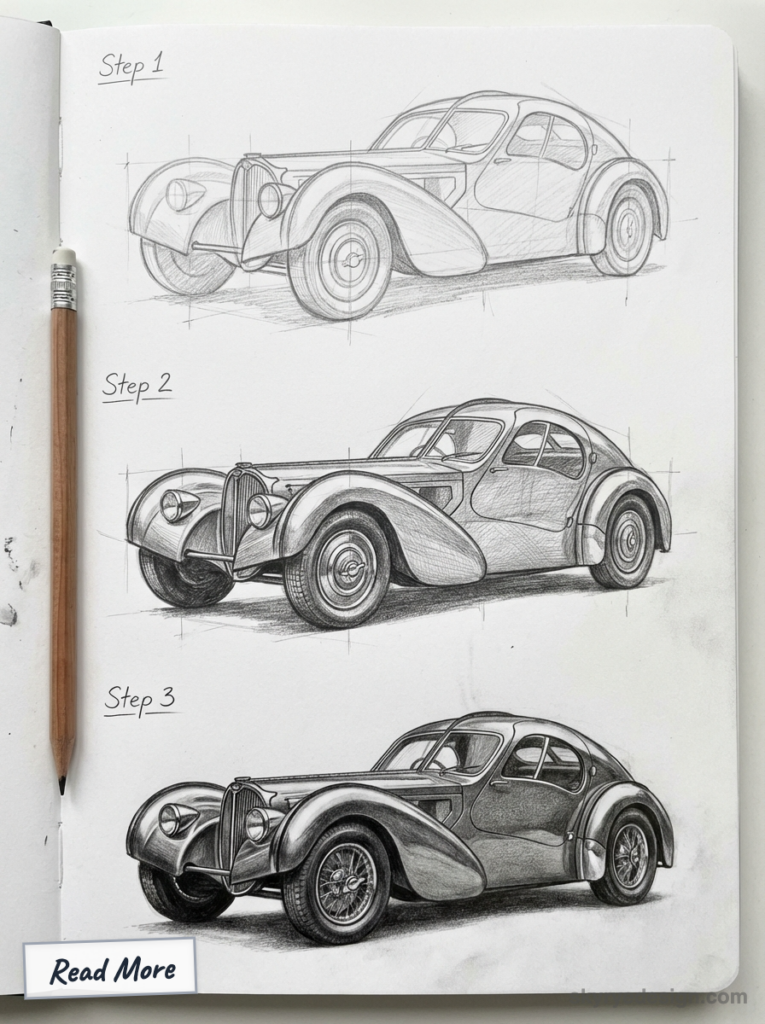
Jean Bugatti designed the Type 57 SC Atlantic in the mid-1930s, and it still looks like nothing else on earth. The flowing teardrop fenders, the dramatic dorsal seam riveted down the center — it’s art deco on wheels.
Only four were ever built. One sold at auction for over $30 million. You’ll probably never see one in person, but drawing it teaches you something no modern Bugatti can: how to handle complex organic curves without a single flat surface to anchor you.
Unique Drawing Challenges
The Atlantic doesn’t play nice with beginners:
- The dorsal seam: A raised spine runs from hood to tail, studded with visible rivets. It’s the car’s defining feature — and easy to get wrong.
- Teardrop fenders: These bulge dramatically from the body. They require smooth, confident strokes with no hesitation.
- Wire wheels: Dozens of thin spokes radiating from the hub. Don’t try to draw every single one.
- Unusual proportions: Low cabin, extremely long hood — different ratios than modern hypercars.
Step-by-Step Tips
- Draw the dorsal seam first — treat it as the car’s spine. Everything else relates to it.
- Let the fenders bulge outward from the seam — exaggerate the curves slightly if needed.
- Embrace high contrast — the Atlantic looks stunning in stark black and white, like a 1930s photograph.
This one takes patience. But when it clicks, you’ll have drawn automotive history.
Model 2 — EB110 (Difficulty: 6/10) ⭐ Best for Beginners
If you’ve never drawn a Bugatti before, start here.
Why Draw the EB110?
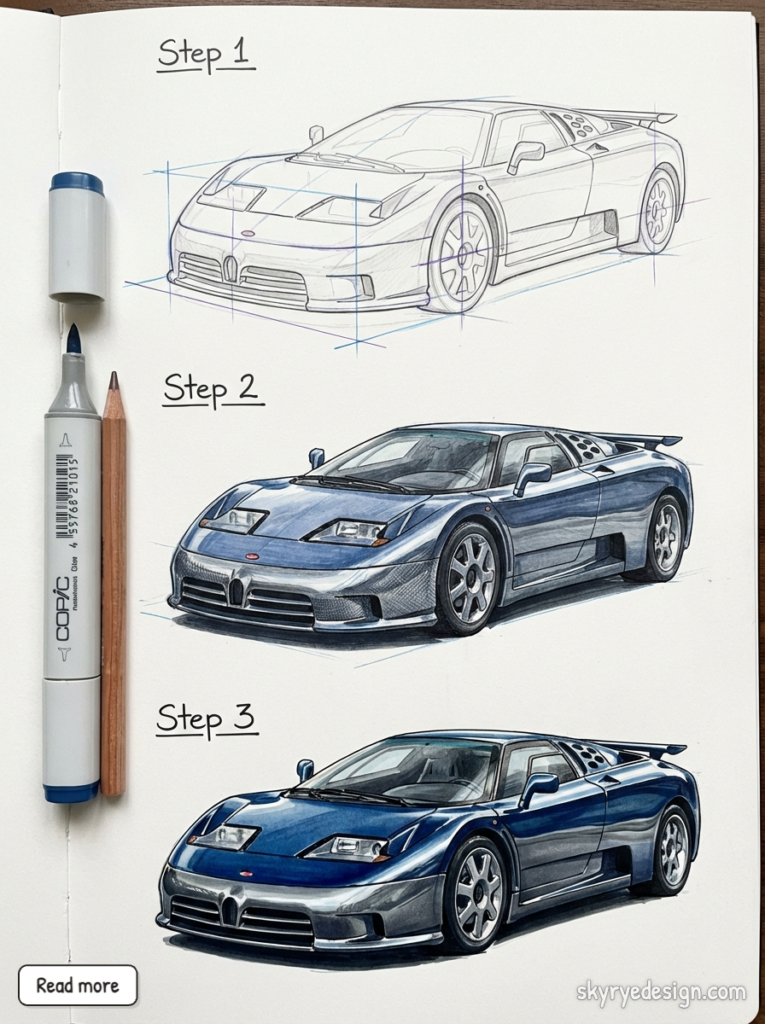
The EB110 marked Bugatti’s resurrection after three decades of silence. Italian entrepreneur Romano Artioli unveiled it on September 15, 1991 — exactly 110 years after Ettore Bugatti’s birth. Hence the name.
It was revolutionary for its time: quad-turbocharged V12, all-wheel drive, and the first production car with a carbon fiber monocoque chassis. Michael Schumacher bought one. So did other F1 drivers who recognized the engineering.
But here’s why artists love it: the EB110 is angular. Where the Veyron and Chiron flow, the EB110 cuts. Straight lines, defined edges, clear surfaces. For beginners still building confidence with proportions, those angles are forgiving in a way that curves aren’t.
Why It’s Easier to Draw
- Angular design: More straight lines than curves — easier to sketch accurately
- Clear surfaces: Fewer complex reflections to render
- Symmetrical front face: Almost perfectly balanced, which simplifies the 3/4 view
- Classic supercar proportions: Wide and low, but not as extreme as modern hypercars
Step-by-Step Tips
- Use the 3/4 front view — it shows off the horseshoe grille and those iconic scissor doors
- Block shapes first — think rectangles and wedges. The EB110’s body breaks down into simple geometry.
- Headlights are easy — round covers behind glass, nothing too intricate.
- Color recommendation: The EB110 looks incredible in Bugatti Blue — a soft, almost powder blue that photographs beautifully
Only 139 were ever made. Drawing one puts you in rare company.
Model 3 — Veyron 16.4 (Difficulty: 7/10)
This is the car that made Bugatti a household name again.
Why Draw the Veyron?
When the Veyron launched in 2005, it shattered every record that mattered. First production car with over 1,000 horsepower. First to crack 400 km/h. Price tag: €1.4 million. Ferdinand Piëch wanted a car that could hit top speed in the morning and drive to the opera that night — and somehow, Bugatti delivered.
The numbers are absurd: 8.0-liter quad-turbo W16 engine, 1,001 hp, 407 km/h top speed. The Super Sport variant pushed that to 431 km/h in 2010, setting a Guinness World Record. Between 2005 and 2015, Bugatti built 450 Veyrons across countless special editions.
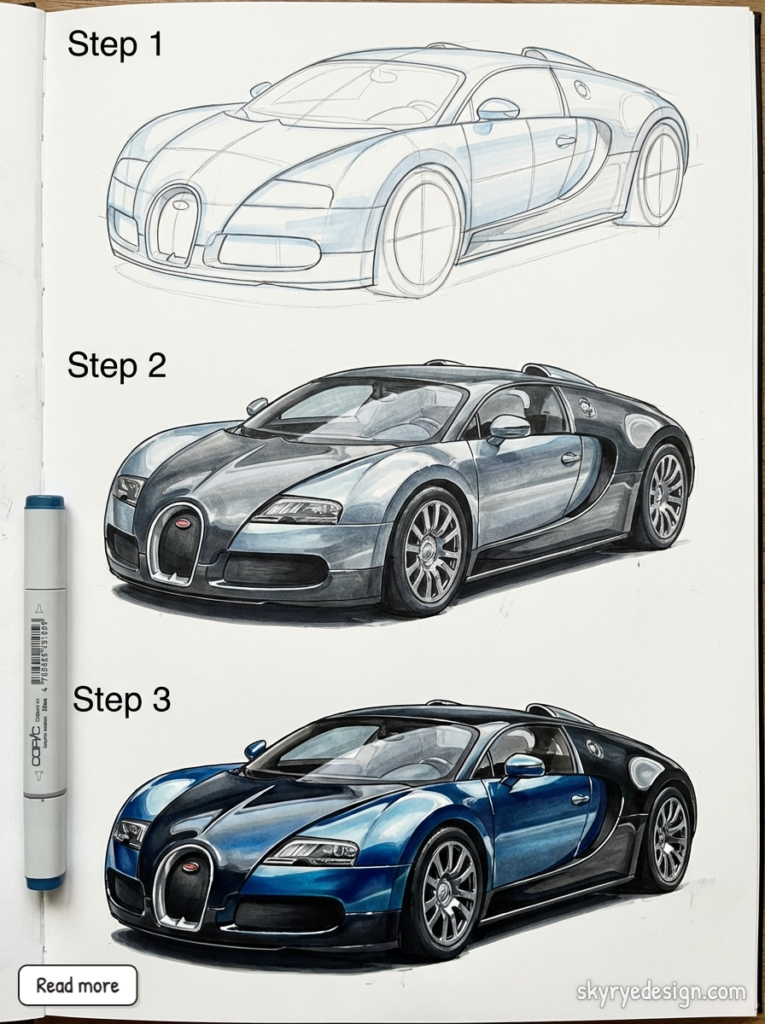
For artists, the Veyron is where modern Bugatti design language solidified. The dramatic C-line, the prominent horseshoe grille, the two-tone color splits — it’s all here, waiting to be drawn.
Unique Drawing Challenges
- The C-line: Very pronounced on the Veyron — it divides the entire body visually
- Complex front fascia: Grille, intakes, and splitter blend into one busy area
- Aerodynamic vents: Air channels run throughout the body — easy to overlook
- The tail: Retractable spoiler and quad exhaust require careful attention
Step-by-Step Tips
- Wheels and body first — the Veyron’s wheel arches are massive and define the stance
- Draw the C-line early — it’s your roadmap for the two-tone color division
- Commit to two-tone — the Veyron almost always appears in contrasting colors
Pro tip: The Grand Sport Vitesse (convertible version) makes great practice — no complex windshield or roofline to worry about.
Famous Color Schemes Worth Drawing
- Sang Noir: Black on black with tan leather interior
- Bleu Centenaire: All-blue 100th anniversary edition
- L’Or Blanc: White porcelain-inspired collaboration with Königliche Porzellan-Manufaktur
Pick a spec that excites you. You’ll draw better when you’re invested.
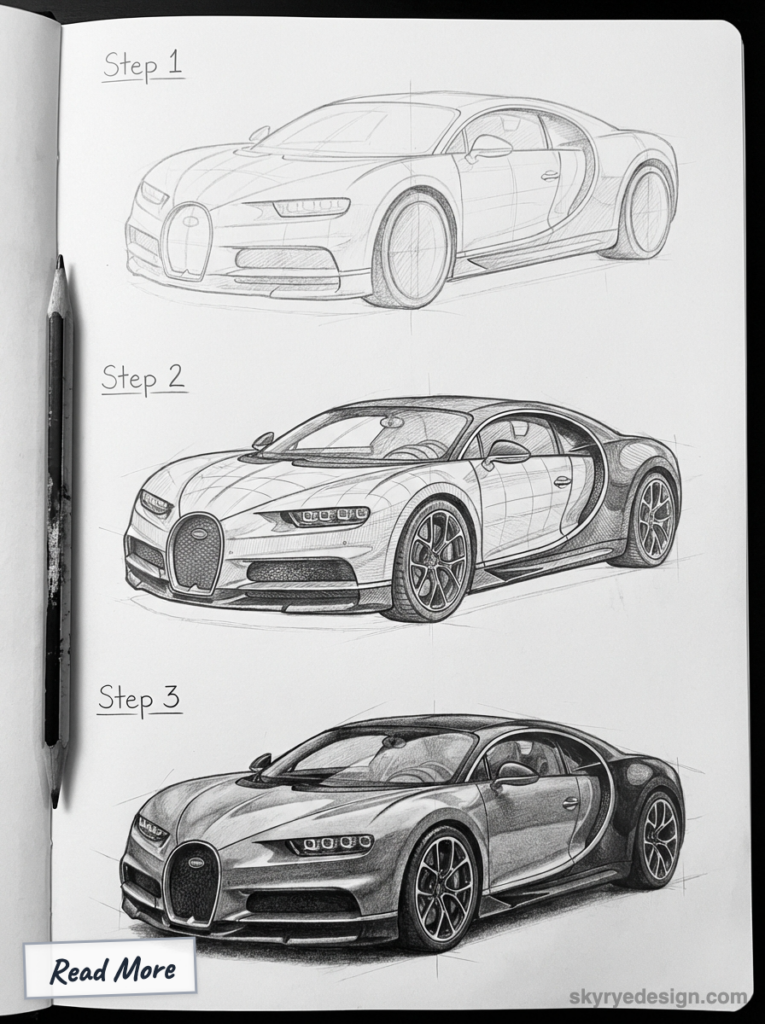
Model 4 — Chiron (Difficulty: 7/10)
The Veyron rewrote the rules. The Chiron refined them.
Why Draw the Chiron?
Named after Louis Chiron — the legendary Monégasque driver who won more races for Bugatti than anyone — this 2016 successor pushed everything further. The W16 engine jumped to 1,500 hp. Top speed hit 420 km/h (electronically limited because no tire could handle more). Base price: €2.4 million.
Then came the Super Sport 300+. In 2019, a modified Chiron clocked 304.77 mph at Volkswagen’s Ehra-Lessien test track — the first production car to break 300 mph. That record still stands.
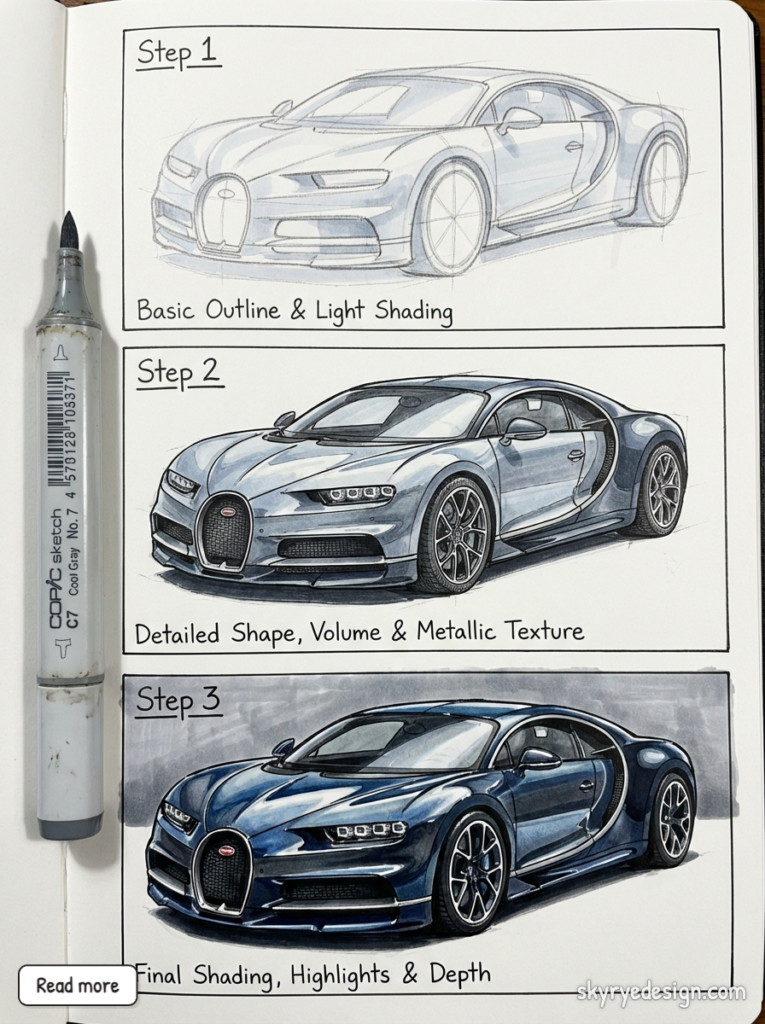
Bugatti built 500 Chirons, and for artists, it’s become the definitive modern hypercar to draw. The lines are more organic than the Veyron, the surfaces more sculpted, the presence even more aggressive.
How It Differs from the Veyron
- Softer, flowing lines: Less angular, more organic curves throughout
- Redesigned C-line: Now integrated into the massive side air intake
- New light signature: Thin LED strips replace traditional headlights
- Lower, wider stance: Even more dramatic proportions
Step-by-Step Tips
- Start with the silhouette — the Chiron sits noticeably lower than the Veyron
- The side intake defines everything — that giant scoop is the car’s visual anchor
- Grille is more recessed — it blends into the fascia rather than standing proud
- Watch your curves — the Chiron’s body panels wrap light in complex ways. Study your reference closely.
Special Editions Worth Drawing
- Divo: Track-focused, sharper aero (difficulty: 8/10)
- La Voiture Noire: One-off $18.68 million tribute to the Type 57 (difficulty: 9/10)
- Centodieci: Angular throwback to the EB110 (difficulty: 8/10)
The Chiron is the modern Bugatti most people picture. Drawing it well means you’ve arrived.
Model 5 — Tourbillon (Difficulty: 9/10) ⭐ Newest Model
This is your chance to draw a Bugatti before the tutorials catch up.
Why Draw the Tourbillon?
When Bugatti revealed the Tourbillon in June 2024, it stunned everyone. Gone was the quad-turbo W16. In its place: a naturally aspirated 8.3-liter V16 developed with Cosworth, paired with three electric motors for a combined 1,800 hp. The engine screams to 9,000 rpm — a sound no turbocharged Bugatti ever made.
The name comes from watchmaking. A tourbillon is a precision mechanism that counteracts gravity in mechanical timepieces. Fitting, since Swiss horologists built the Tourbillon’s instrument cluster from 600+ components, including titanium, sapphire, and ruby.
Only 250 will be made. Price: €3.8 million. All sold before production even started.
Very few drawing tutorials exist for this car yet. Nail it now, and your work stands out.
What Makes It Unique to Draw
- New design language: More aggressive and aerodynamic than the Chiron
- Butterfly doors: Dihedral doors integrate into the roofline — subtle cut lines
- Evolved grille: The horseshoe is more recessed, almost sculpted into the fascia
- Clean surfaces: Fewer vents and details, but more complex surfacing underneath
- Long Venturi tunnels: Underbody aero means less visual clutter up top
Step-by-Step Tips
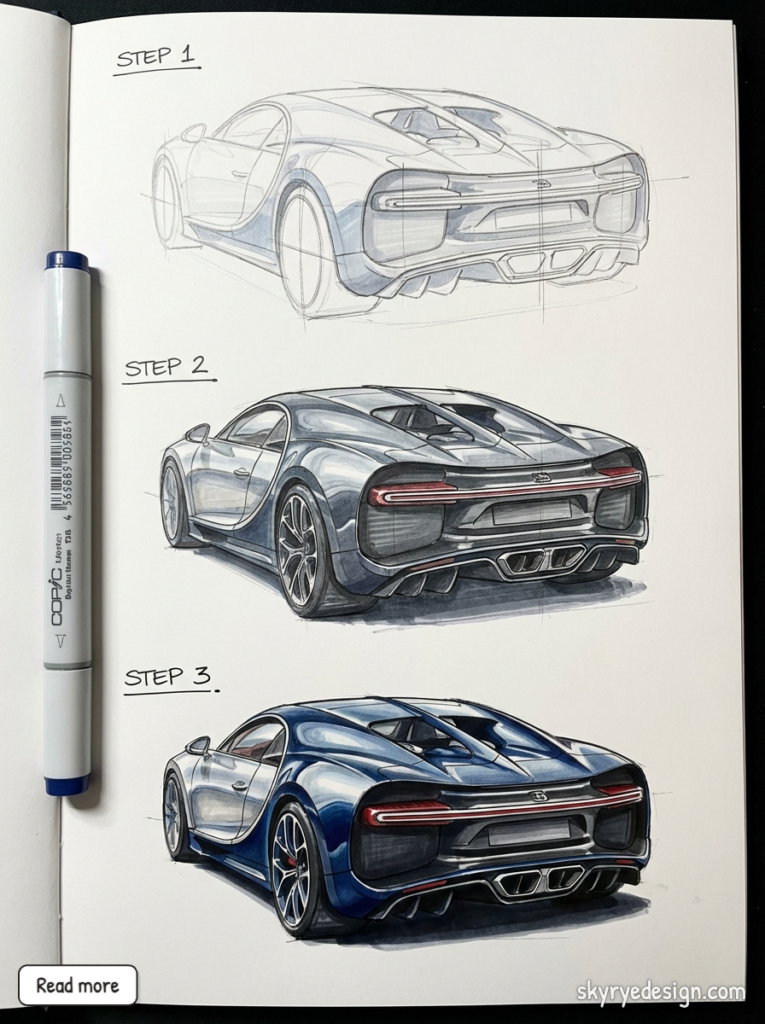
- Roofline flows smoothly — from A-pillar straight into the rear deck, almost seamless
- Front fascia is integrated — headlights, grille, and aero blend as one shape
- The rear is dramatic — wide light bar, sculpted diffuser, quad exhaust tips
Color Suggestions
- Nocturne Black to Doré Gold: The launch car’s stunning gradient
- Atlantic Blue: Heritage callback to the Type 57
- Exposed carbon fiber: Highlights the engineering
Draw the Tourbillon now. In two years, everyone else will finally have tutorials.
Rendering Realistic Reflections on Hypercars
This is where good drawings become great ones.
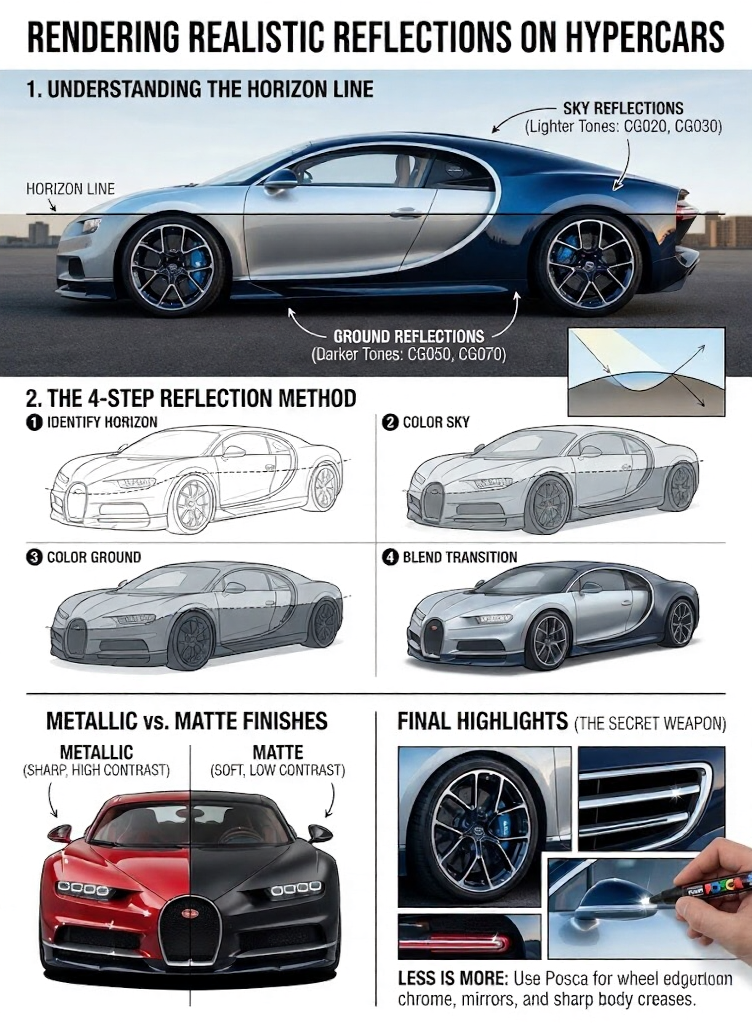
A Bugatti without reflections looks like a toy. Add them correctly, and suddenly the car has weight, presence, and that liquid-metal quality that makes people stop scrolling. The technique isn’t complicated — but it does require understanding how light actually behaves on curved surfaces.
Understanding the Horizon Line
Every car photograph has an invisible horizon line running across its body. This line divides two worlds:
- Above the horizon: Reflections of the sky — lighter tones, often white, pale blue, or soft grey
- Below the horizon: Reflections of the ground and surroundings — darker tones, sometimes picking up colors from nearby objects
On flat panels, this line runs straight. On Bugatti’s sculpted curves, it bends and flows with the body. Look at any professional car photo and you’ll see it — usually sitting around door handle height, sometimes higher on the hood, lower on the fenders.
Once you see it, you can’t unsee it. And once you draw it, your cars will never look flat again.
The 4-Step Reflection Method
Here’s the process I use for every car rendering:
- Identify the horizon line on your reference photo — trace it mentally across the whole body
- Color sky reflections first — use your lightest greys (CG020, CG030) for everything above the line
- Color ground reflections — use darker greys (CG050, CG070) below the line
- Blend the transition — where sky meets ground, use intermediate tones to soften the edge
That’s it. Four steps that transform flat shapes into three-dimensional metal.
Metallic vs. Matte Finishes
Not all Bugattis shine the same way.
Metallic paint:
- Sharp, mirror-like reflections with hard edges
- High contrast — very bright highlights next to very dark shadows
- Add small specular highlights with your white Posca marker
Matte paint:
- Soft, diffused reflections with gradual transitions
- Lower contrast — no harsh bright spots
- Skip the Posca highlights; matte surfaces don’t pop the same way
The matte black Chiron editions are popular drawing subjects, but they require a completely different approach than a glossy Veyron.
Final Highlights (The Secret Weapon)
Your white Posca PC-3M paint marker is the finishing move.
Add bright specular highlights to:
- Wheel rim edges
- Chrome grille slats
- Door mirror housings
- Sharp body creases where light catches
The rule: Less is more. Five perfectly placed highlights beat fifty scattered ones. Each highlight should follow your established light source direction — random dots look like mistakes.
I’ve watched artists spend hours on a sketch, then rush the reflections in the last ten minutes. Don’t do that. This stage is where the magic happens. Give it the time it deserves.
Common Mistakes and How to Fix Them
Even experienced artists fall into these traps. Here’s how to catch them early
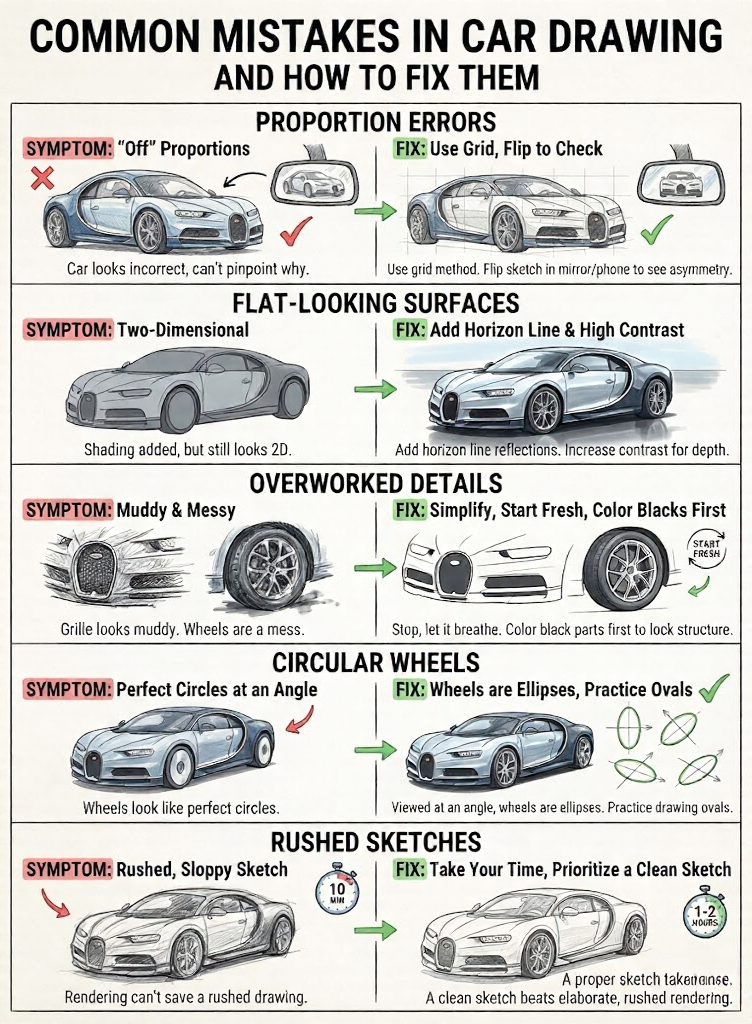
Proportion Errors
Symptom: The car looks “off” but you can’t pinpoint why.
Fix: Use the grid method until proportions become instinctive. Quick check: flip your sketch in a mirror or phone camera — asymmetry becomes instantly obvious.
Flat-Looking Surfaces
Symptom: You’ve added shading, but the car still looks two-dimensional.
Fix: Add horizon line reflections. Increase the contrast between light and dark areas. If you’re unsure, go darker in the shadows.
Overworked Details
Symptom: The grille looks muddy. The wheels are a mess.
Fix: Stop. Let it breathe. Sometimes starting that area fresh with a lighter touch works better than layering more on top. Prevention: always color black parts first to lock in structure.
Circular Wheels
Symptom: Your wheels look like perfect circles.
Fix: Wheels viewed at any angle are ellipses, not circles. Practice drawing ovals at different tilts before tackling another car.
Rushed Sketches
Symptom: The rendering can’t save the drawing.
Fix: Accept that a proper sketch takes 1-2 hours. A clean sketch with simple rendering always beats a sloppy sketch with elaborate shading.
FAQ — Bugatti Drawing Questions Answered
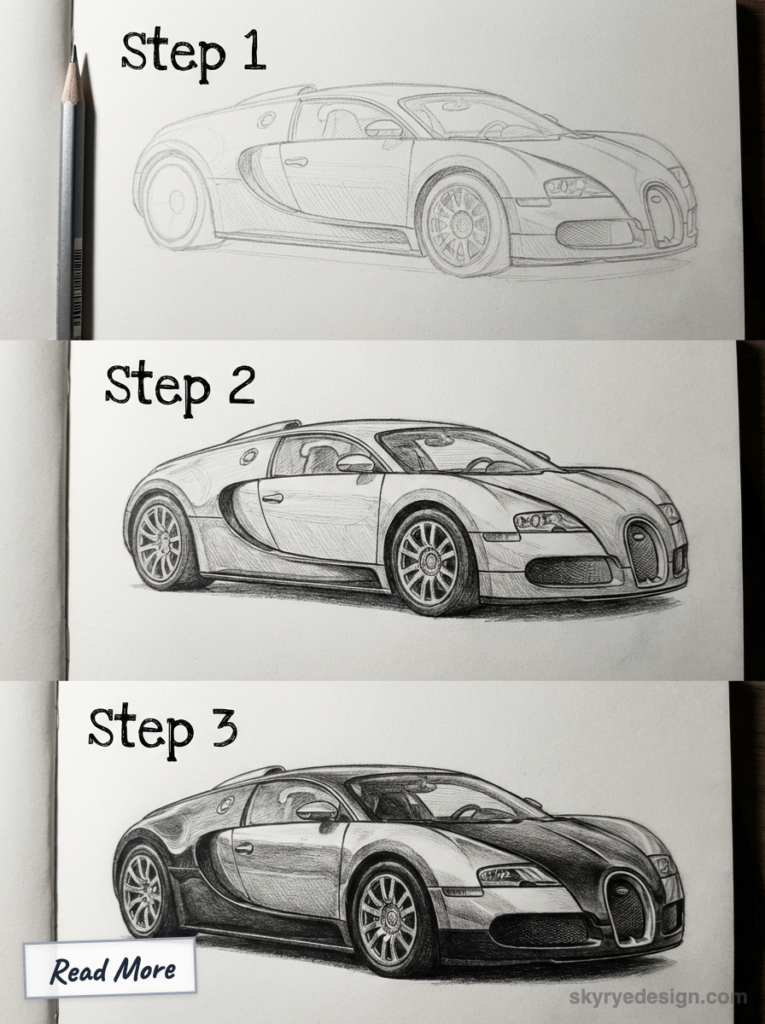
What’s the easiest Bugatti to draw for beginners?
The EB110. Its angular design breaks down into simple geometric shapes — rectangles, wedges, straight lines. The curves on the Veyron and Chiron are far less forgiving. Start with the EB110’s 3/4 front view and build confidence before tackling the curvier models.
How long does it take to draw a realistic Bugatti?
Plan for 4-8 hours total. The pencil sketch alone takes 1-2 hours if you’re using the grid method properly. Coloring and rendering with markers adds another 2-4 hours. Rushing any stage shows in the final result — give yourself permission to slow down.
What markers work best for Bugatti drawings?
You need a solid range of cool greys. Ohuhu Honolulu markers (CG020, CG030, CG050, CG070, plus Black) offer excellent quality for $20-40. Copic Sketch markers are industry standard but cost 3-4x more. Both work beautifully on Canson Bristol or marker-specific paper.
How do I draw chrome and metallic surfaces?
High contrast is everything. Place your brightest highlights directly next to your darkest shadows with minimal transition between them. Finish with a white Posca paint marker for specular highlights on edges and creases. Metallic surfaces are about extremes — don’t be timid.
Can I skip the grid method?
You can, but your proportions will probably suffer. Hypercars have extreme ratios that your eye isn’t calibrated for. The grid method isn’t cheating — professional automotive illustrators use similar techniques. Use it until accurate proportions become instinctive.
What’s the best angle to draw a Bugatti from?
The 3/4 front view. It shows the horseshoe grille, headlights, side profile, and wheel design in one frame — maximum impact with full design language visible. Save straight-on front or side views for after you’ve mastered perspective.
Now It’s Your Turn
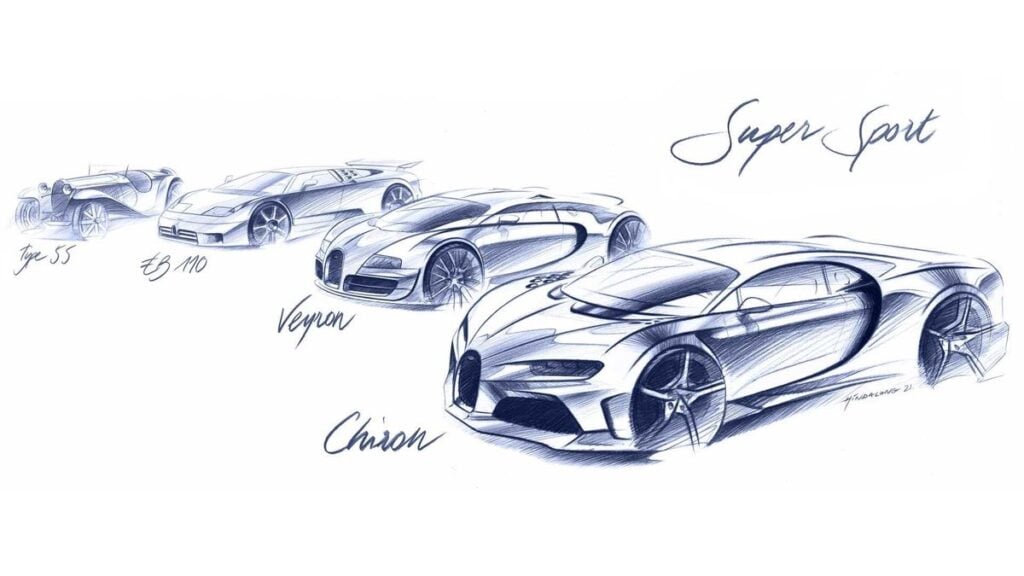
Drawing a Bugatti isn’t just about technical skill — it’s about understanding what makes these machines extraordinary. From Ettore’s original vision in 1909 to the 1,800-horsepower Tourbillon, every model carries a design DNA worth studying.
Your next steps:
- Pick one model (the EB110 if you’re new to this)
- Find a high-resolution reference photo
- Set up your grid and spend real time on the sketch
- Apply the horizon line method for reflections
- Share your work — and keep going
The artists drawing Bugattis professionally today didn’t start with perfect proportions or flawless reflections. They started with messy sketches, learned from mistakes, and kept showing up. Your first Bugatti won’t be your best. But it’ll be the one that gets you started.
Grab your pencils. Draw something fast.
After the Bugatti proportions, switch to how to draw a Lamborghini to practice a sharper wedge body, lower cabin, and more aggressive side-intake shapes.
- 1.2Kshares
- Facebook0
- Pinterest1.2K
- Twitter0
- Reddit0